
If you have ever stood in a bakery or typed out a recipe and second-guessed yourself between wheaten vs wheat, you are not alone. These two words look and sound closely related, yet using one where the other belongs can make your writing confusing, inaccurate, or even grammatically wrong. Whether you are a home baker writing a recipe post, a food blogger crafting a nutrition guide, a student working on an essay, or simply someone who loves language, knowing the distinction between wheaten vs wheat matters more than most people realize.
In this complete guide, you will learn exactly what each word means, when to use it, which mistakes to avoid, and how context shapes the right choice every single time. By the end, the wheaten vs wheat question will never trip you up again.
Define Wheaten
The word wheaten is an adjective. That single grammatical fact explains everything about how it works.
Derived from Old English hwǣten, wheaten is formed by combining the base word “wheat” with the suffix -en, which in English signals “made of” or “relating to.” You see this same pattern in everyday words like wooden (made of wood), golden (made of gold), and silken (made of silk). Wheaten follows that exact same logic: it means “of, relating to, or made from wheat.”
According to Merriam-Webster, wheaten means “of, relating to, or made of wheat.” Collins English Dictionary adds a second sense: wheaten also describes a pale yellow or beige color, like the warm golden hue of ripe wheat stalks in a late-summer field.
In modern English, wheaten carries three distinct uses:
- Culinary and baking: Wheaten describes food products made from wheat flour. A wheaten loaf, wheaten crackers, wheaten porridge, wheaten flour — in every case, the word is a modifier telling you what the food is made from.
- Color description: Interior designers, fashion writers, and animal breeders use wheaten to describe that pale, warm, golden-beige shade. A wheaten coat, wheaten fur, wheaten walls — all refer to this specific color.
- Breed descriptor: The Soft Coated Wheaten Terrier is a dog breed whose name directly references the color of its coat. You will also see wheaten used in livestock contexts to describe animals with that particular coloring.
Because wheaten is purely an adjective, it always needs a noun to modify. It cannot stand alone. You would never say “I bought some wheaten.” You say “I bought some wheaten bread” or “she wore a wheaten wool coat.”
The difference in the wheaten vs wheat comparison starts right here: one is a describing word, the other is a thing.
Define Wheat
Wheat is a noun. It refers to a specific cereal grain belonging to the genus Triticum, one of the most widely cultivated crops in the world and a cornerstone of human nutrition for thousands of years.
Wheat is grown across every major continent and forms the foundation of staple foods including bread, pasta, noodles, pastries, couscous, and breakfast cereals. The grain contains starchy endosperm, bran layers, and a germ, all of which contribute to its nutritional profile.
There are several major varieties of wheat, each suited to different uses:
| Wheat Variety | Common Use | Key Characteristic |
| Hard Red Winter Wheat | Bread flour | High protein, strong gluten |
| Soft White Wheat | Pastry and cake flour | Low protein, tender crumb |
| Durum Wheat | Pasta and semolina | Very hard, high gluten |
| Spelt | Specialty baking | Ancient grain, nutty flavor |
| Hard Red Spring Wheat | Artisan bread | Very high protein content |
| Emmer (Farro) | Salads, soups | Ancient grain, chewy texture |
Nutritionally, wheat is a good source of complex carbohydrates, dietary fiber (especially in whole grain forms), protein, B vitamins, iron, and zinc. It is one of the three most important food crops globally, alongside rice and maize.
As a noun, wheat stands confidently on its own. You can buy wheat, grow wheat, grind wheat, store wheat, or study wheat. It does not need another word beside it to make sense.
In the wheaten vs wheat comparison, wheat is the substance itself, while wheaten is the adjective that describes something made from that substance.
Read This: Rug Vs Rag, How Are These Different? When To Use Them?
How To Properly Use The Words In A Sentence
Understanding grammar rules is one thing. Seeing them applied in real sentences is where the learning sticks. Here is how to put both words to work correctly every time.
How To Use Wheaten In A Sentence
Because wheaten is an adjective, it always precedes and modifies a noun. Think of it as a tag you attach to something to tell your reader what it is made from or what color it is.
Correct patterns for using wheaten:
- Wheaten + food noun (wheaten bread, wheaten biscuits, wheaten flour, wheaten porridge)
- Wheaten + color noun (wheaten hue, wheaten shade, wheaten tone)
- Wheaten + animal/coat noun (wheaten terrier, wheaten fur, wheaten fleece)
Example sentences:
- The café serves its signature soup with a thick slice of freshly baked wheaten bread.
- She painted the bedroom walls in a warm wheaten shade that matched the oak flooring perfectly.
- The puppy’s soft, wheaten coat gleamed in the afternoon sunlight.
- His grandmother’s wheaten scones were the highlight of every Sunday visit.
- The nutritionist recommended switching to wheaten crackers for a higher fiber snack option.
Notice in every example that wheaten sits directly before a noun. It is doing the job of telling you about that noun. That is its only function. Whenever you write or say wheaten, ask yourself: “What noun am I describing?” If you cannot answer that question, you are using the word incorrectly.
How To Use Wheat In A Sentence
Because wheat is a noun, it behaves like any other countable or uncountable noun in English. It can be a subject, an object, or part of a compound noun. It stands alone.
Correct patterns for using wheat:
- Subject of a sentence (Wheat is grown across six continents.)
- Object of a verb (Farmers harvest wheat in late summer.)
- Part of a compound noun (wheat flour, wheat germ, wheat field, wheat bread)
- After a quantity or determiner (a bushel of wheat, some wheat, the wheat)
Example sentences:
- The farmer planted wheat across forty acres of fertile land.
- Wheat is one of the most important staple crops in human history.
- She ground fresh wheat into flour using a stone mill.
- The recipe calls for two cups of wheat flour and one cup of oat flour.
- Rising temperatures are affecting wheat yields in parts of South Asia.
- Scientists are developing drought-resistant strains of wheat to combat food insecurity.
Notice that wheat works completely on its own. It does not need a partner noun. You can start a sentence with wheat, end a sentence with wheat, or place it anywhere in between.
More Examples Of Wheaten & Wheat Used In Sentences
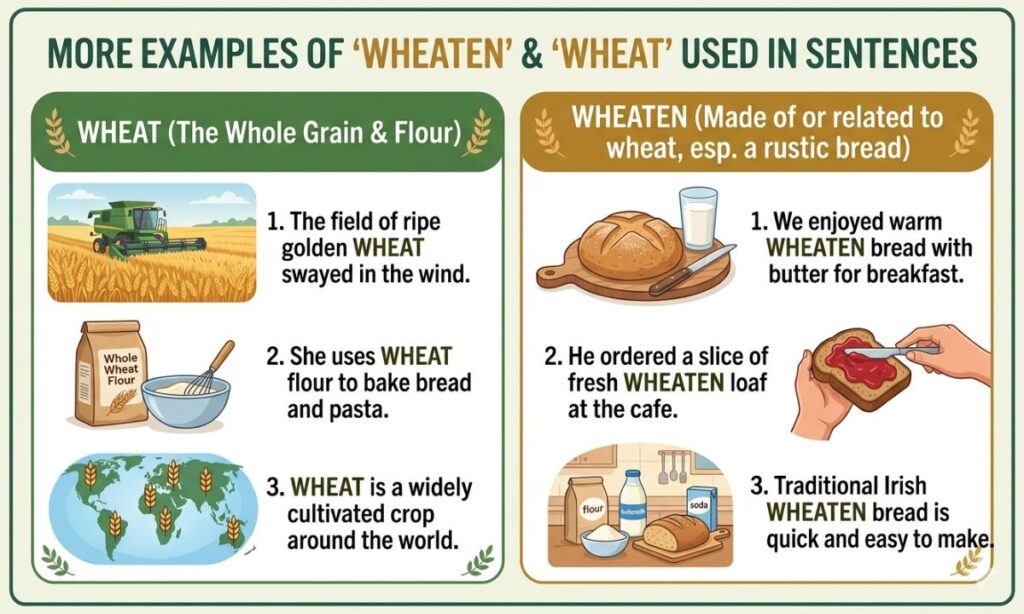
Building familiarity with both words means reading them in many different contexts. The more you encounter wheaten vs wheat used correctly, the more natural the right choice becomes.
Examples Of Using Wheaten In A Sentence:
- The bakery’s wheaten loaf sold out every morning before ten o’clock.
- Her kitchen walls were painted in a soft wheaten tone that felt warm and inviting.
- Traditional Irish wheaten bread is made with wholemeal flour, buttermilk, and bicarbonate of soda.
- The farmer sold wheaten hay to neighboring sheep farms throughout the dry season.
- She layered smoked salmon over a toasted slice of wheaten bread for a simple, satisfying lunch.
- The dog breeder explained that the wheaten coat of the terrier requires regular grooming to stay tangle-free.
- Researchers studied the mineral content of a wheaten wholemeal diet over a 30-day period.
- He chose a wheaten linen fabric for the summer suit because it worked well with his complexion.
- The children enjoyed wheaten porridge with honey and sliced banana every morning before school.
- A wheaten straw hat sat on the hook by the farmhouse door.
Examples Of Using Wheat In A Sentence:
- Global wheat production has increased significantly over the past five decades.
- The mill grinds wheat into several grades of flour, from coarse wholemeal to fine white.
- Wheat contains gluten, which gives bread dough its elasticity and chew.
- The export of wheat from Ukraine plays a major role in global food security.
- She avoids wheat entirely because of a diagnosed gluten intolerance.
- Hard red winter wheat is commonly used in the production of bread flour.
- The children learned about the history of wheat cultivation on their school field trip.
- Wheat grows best in temperate climates with moderate rainfall and well-drained soil.
- Durum wheat is the variety most commonly used to make traditional Italian pasta.
- He studied the different species of wheat as part of his agricultural science degree.
Common Mistakes To Avoid
When writers confuse wheaten vs wheat, the errors tend to fall into two predictable categories. Knowing them in advance will help you sidestep both.
Mistake #1: Using “Wheaten” As A Synonym For “Wheat”
This is the most frequent error in the wheaten vs wheat debate. Because wheaten so clearly comes from the word wheat, many people assume the two words can be swapped freely. They cannot.
Why it is wrong: Wheaten is an adjective and wheat is a noun. They belong to completely different grammatical categories. You cannot substitute a describing word for the thing it describes.
| Incorrect | Correct |
| I need to buy some wheaten from the store. | I need to buy some wheat from the store. |
| The recipe calls for two cups of wheaten. | The recipe calls for two cups of wheat. |
| The wheaten harvest was poor this year. | The wheat harvest was poor this year. |
| She is allergic to wheaten. | She is allergic to wheat. |
The fix is simple: if you need to name the grain itself as a standalone noun, always use wheat. Wheaten cannot function without a noun beside it.
Mistake #2: Using “Wheat” When Referring To A Specific Variety Of Wheaten
The opposite error also happens. Some writers reach for the noun wheat when they actually want to describe a product made from wheat. This usually occurs when writers are trying to be concise and drop the adjective in favor of the noun.
Why it is wrong: Wheat bread and wheaten bread are not the same phrase, though they are closely related. Wheat bread is a common compound noun describing bread made from wheat, particularly popular in American English. Wheaten bread is a more specific term used especially in Irish and British English contexts, often referring to wholemeal soda bread. Using wheat in place of wheaten loses that specific meaning and can cause regional misunderstanding.
Examples:
| Intended Meaning | Incorrect Version | Correct Version |
| Bread described as wheat-based | “wheat bread” (acceptable in US) | “wheaten bread” (more precise, Irish/British use) |
| Describing a pale golden color | “wheat color coat” | “wheaten coat” |
| A terrier breed | “wheat terrier” | “wheaten terrier” |
Tips To Avoid Making These Mistakes
Follow these practical checks every time you write either word:
- Test for replaceability: Can you replace the word with another adjective like “golden” or “oaten”? If yes, you likely want wheaten. Can you replace it with a noun like “corn” or “rice”? If yes, you likely want wheat.
- Check for a following noun: If wheaten is the last word in your phrase or sentence and nothing follows it, you have used it incorrectly as a noun. Change it to wheat.
- Ask “what or which?”: If the question is “what grain is this?” use wheat. If the question is “which kind of bread/color/coat?” use wheaten.
- Read it aloud: “I need wheaten” sounds incomplete to most native English ears. “I need wheat” sounds natural. Trust that instinct.
Context Matters
The right choice in the wheaten vs wheat comparison does not depend only on grammar. Context shapes which word fits best in ways that go beyond rules alone.
Culinary Context
In culinary writing, both words appear regularly but serve different purposes. Wheat appears when you are discussing the grain as an ingredient category: “This recipe uses wheat flour.” Wheaten appears when you are describing a finished food product or its character: “These are wheaten crackers with a nutty flavor.”
In Irish and Northern Irish cooking traditions, wheaten carries extra cultural weight. Wheaten bread is a staple, a comfort food, and a regional identity marker. In that culinary context, using wheat bread instead of wheaten bread would read as either incorrect or culturally uninformed. The two phrases are not simply interchangeable.
Culinary LSI terms often paired with these words include: wholemeal flour, whole grain, bran, germ, gluten, soda bread, buttermilk, fiber content, complex carbohydrates, and cereal grain.
Nutritional Context
In nutritional writing, wheat appears most often because nutritionists discuss the grain itself, its macronutrients, its fiber content, and its gluten protein. Phrases like “wheat consumption,” “wheat allergy,” “wheat bran,” and “whole grain wheat” are standard.
Wheaten appears in nutritional contexts mainly when describing specific food formats: “a wheaten diet,” “wheaten porridge,” or “wheaten bread as part of a high-fiber meal plan.”
One key nutritional distinction worth noting: wholemeal wheaten products generally retain more fiber, vitamins, and minerals than refined wheat products because they include the bran and germ layers of the grain.
Cultural Context
The wheaten vs wheat distinction takes on a cultural dimension in Irish, Northern Irish, Scottish, and some British English contexts. In Northern Ireland especially, wheaten is a word tied to identity, tradition, and home baking. Saying “wheaten bread” in Belfast signals cultural fluency in a way that “wheat bread” does not.
Outside these regions, wheaten is less commonly used in everyday speech. American English writers, for example, tend to say “whole wheat bread” rather than “wheaten bread,” though both refer to similar products. Understanding this cultural layer helps you choose the right word for your specific audience.
Geographic Context
Geography directly influences which term readers expect to encounter:
| Region | Preferred Term | Common Phrase |
| Northern Ireland | Wheaten | Wheaten bread, wheaten loaf |
| Republic of Ireland | Wheaten / Brown soda bread | Wheaten bread, brown bread |
| United Kingdom | Wheaten (less common) | Wheaten flour, wheaten biscuits |
| United States | Wheat | Whole wheat bread, wheat flour |
| Australia/Canada | Wheat | Wheat bread, wheat grain |
| International (academic) | Wheat | Wheat cultivation, wheat production |
If you are writing for a global audience, wheat is the safer and more universally understood choice for naming the grain. Wheaten is better reserved for descriptive use or for audiences familiar with Irish and British English traditions.
Exceptions To The Rules: Wheaten Bread vs Wheat Bread
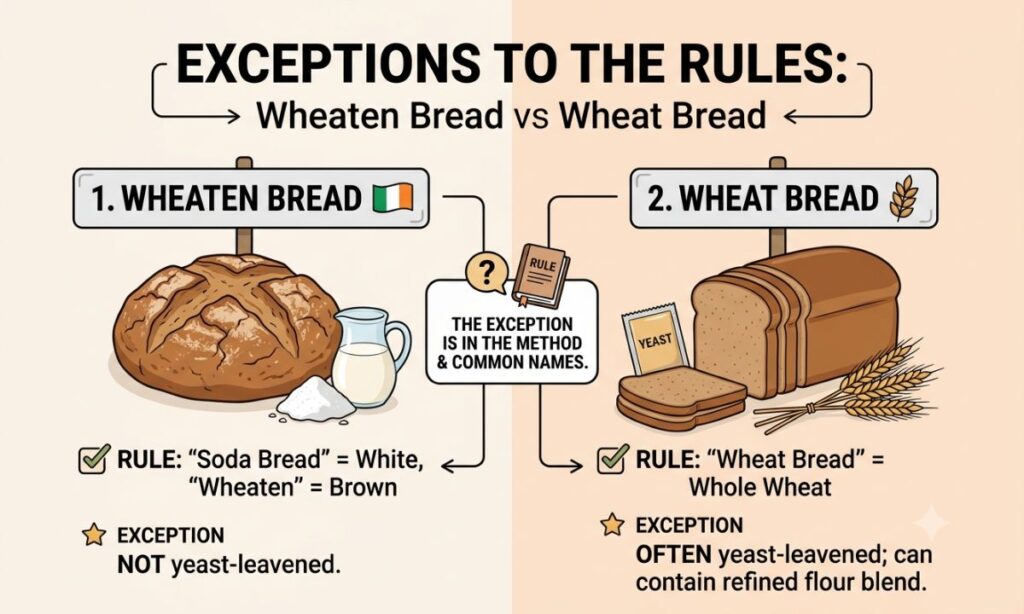
Grammar rules are a foundation, not a cage. Just as with most English words, wheaten and wheat have real-world exceptions shaped by regional habits, technical terminology, and commercial branding.
1. Regional Differences
The clearest exception to standard usage rules involves wheaten bread vs wheat bread. In Northern Ireland, wheaten bread is the accepted name for brown soda bread made primarily from wholemeal flour. The word wheaten here is not simply an adjective modifying bread; it has become a proper food name with its own cultural and culinary identity.
As Merriam-Webster and CNN food writers both note, wheaten bread in Northern Ireland is a specific product: typically baked in a loaf tin, slightly sweet, dense, made with wholemeal flour, buttermilk, and bicarbonate of soda, and served sliced with butter. Calling it “wheat bread” in that context would feel like calling a croissant a “roll.”
In the United States, wheat bread refers broadly to any bread made with wheat flour, and “whole wheat bread” is the standard phrase for the heartier, fiber-rich version. Neither of these is the same product as Northern Irish wheaten bread, even though all three share wheat as their base grain.
2. Technical Terminology
In agricultural science, animal nutrition, and food science literature, wheaten appears in very specific technical phrases:
- Wheaten hay: Hay made from wheat straw and grain residue, commonly fed to livestock
- Wheaten bran diet: A controlled diet used in animal studies examining fiber intake and digestive health
- Wheaten wholemeal: A specific milling grade describing whole grain wheat flour
These technical uses follow the adjective rule correctly, but they can appear unusual to general readers unfamiliar with the fields. In these contexts, wheaten is correct, precise, and preferred over more casual alternatives.
3. Brand Names
Some food brands have incorporated wheaten into their product names as a proper noun or brand identifier. In these cases, the word functions less as a pure adjective and more as a trademarked identifier. Examples include packaged wheaten bread mixes, wheaten biscuit lines, and wheaten cracker brands sold across Ireland, the United Kingdom, and parts of Australia.
When brand names are involved, follow the brand’s own capitalization and usage conventions rather than strict grammatical rules.
Read This: Bachelor vs Batchelor: When to Opt for One Term Over Another
Practice Exercises
The fastest way to lock in the wheaten vs wheat distinction is through active practice. Work through the exercises below to test your understanding.
Exercise 1: Fill In The Blank
Choose either wheaten or wheat to complete each sentence correctly.
- The farmer grew ________ on the south field every other year. (Answer: wheat)
- She spread butter generously on a slice of warm ________ bread. (Answer: wheaten)
- Nutritionists recommend whole grain ________ as part of a balanced diet. (Answer: wheat)
- The interior designer suggested a ________ tone for the living room walls to create warmth. (Answer: wheaten)
- Hard red ________ is preferred by professional bread bakers for its high protein content. (Answer: wheat)
- His grandmother made the best ________ scones in the entire county. (Answer: wheaten)
- The export of ________ contributes billions of dollars to the global economy each year. (Answer: wheat)
- She paired the homemade soup with a thick slice of ________ bread and salted butter. (Answer: wheaten)
- Durum ________ is used almost exclusively for making dried pasta. (Answer: wheat)
- The ________ terrier’s coat was long, soft, and carefully groomed. (Answer: wheaten)
Exercise 2: Sentence Completion
Rewrite each incorrect sentence so that it uses wheaten or wheat properly.
Incorrect: The health store sells organic wheaten in 5-kilogram bags. Corrected: The health store sells organic wheat in 5-kilogram bags.
Incorrect: She is allergic to wheaten, so she avoids all baked goods. Corrected: She is allergic to wheat, so she avoids all baked goods.
Incorrect: The recipe recommends wheat flour for a more rustic loaf with extra fiber. Corrected: The recipe recommends wheaten flour for a more rustic loaf with extra fiber.
Incorrect: The farmer stored his wheat harvest in silos until spring. Corrected: (Already correct, no change needed.)
Incorrect: She served wheaten with butter and jam at the tea table. Corrected: She served wheaten bread with butter and jam at the tea table.
Conclusion
The wheaten vs wheat question comes down to one fundamental principle: wheaten describes, wheat names. Wheat is the cereal grain, the crop, the ingredient that feeds billions of people around the world. Wheaten is the adjective that tells you something is made from that grain, colored like that grain, or related to it in some descriptive way.
Using wheaten and wheat correctly shows precision, cultural awareness, and strong writing skills. It matters in recipe writing, food journalism, agricultural science, nutritional content, and everyday communication about food and language.
Remember: whenever you write wheaten, follow it with a noun. Whenever you need to name the grain on its own, use wheat. Keep that single rule in mind, and the wheaten vs wheat debate will never slow you down again.
The next time you sit down to write about bread, baking, grain production, or the pale golden color of a summer field, you will know exactly which word belongs on the page.
Have questions about other commonly confused word pairs? The grammar of food writing is full of nuances worth exploring, and getting the details right is always worth the effort.