
Have you ever typed “batchelor” and then paused, wondering if the word looks right? You are not alone. The confusion between bachelor vs batchelor is one of the most searched spelling queries in the English language. People come across both versions online, in old books, and even in academic contexts, which creates genuine uncertainty.
Here is the short answer: bachelor vs batchelor is not really a competition between two equal words. One is the standard, widely accepted spelling used in everyday English. The other is either a common misspelling, an archaic historical variant, or a proper surname. Understanding which is which can make a real difference in your writing, especially when it comes to resumes, academic papers, and professional emails.
This comprehensive guide breaks down everything you need to know about bachelor vs batchelor, including their definitions, correct usage, common mistakes, real-world examples, and helpful exercises. By the time you finish reading, you will never second-guess yourself again.
Quick Comparison: Bachelor vs Batchelor at a Glance
| Feature | Bachelor | Batchelor |
| Correct Modern Spelling | Yes | No (unless a proper noun) |
| Refers to Unmarried Man | Yes | No |
| Refers to Academic Degree | Yes | No |
| Used as a Surname | Occasionally | Yes |
| Found in Modern Dictionaries | Yes | No |
| Historical/Archaic Use | Limited | Yes |
Define Bachelor
The word bachelor is a standard English noun with several widely recognized meanings. It traces its roots back to Middle English “bacheler,” which entered the language through Anglo-Norman French and ultimately comes from the Medieval Latin word baccalārius. The earliest known recorded use in written English dates back to 1297 in Robert of Gloucester’s Chronicle.
In its most common modern sense, a bachelor refers to a man who has never been married or who is not currently in a committed relationship. This usage is so well established that phrases like “eligible bachelor,” “confirmed bachelor,” and “bachelor lifestyle” have become part of everyday vocabulary.
Beyond marital status, bachelor also carries an important academic meaning. It refers to the first and lowest undergraduate degree awarded by a college or university. This is why we say “Bachelor of Arts,” “Bachelor of Science,” or simply “bachelor’s degree.” The academic meaning developed during the Middle Ages when senior university students supervised younger ones and were called “bachelors” as a rank below full masters.
There is also a lesser-known zoological use: a bachelor can refer to a young male animal, such as a fur seal or elephant, that has not yet claimed territory or mated. This usage, while uncommon, does appear in scientific writing.
Key meanings of bachelor:
- An unmarried man who has never been wed
- A person who has earned an undergraduate academic degree
- Historically, a young knight who followed another knight’s standard
- In zoology, a young male animal without a mate or territory
Define Batchelor
Batchelor is a word that causes a surprising amount of confusion, precisely because it looks so close to “bachelor” at first glance. The extra letter “t” after the “a” is what separates the two spellings, and that single letter changes everything in a modern context.
In contemporary standard English, batchelor is not a recognized word. You will not find it in Merriam-Webster, Oxford English Dictionary, or any other authoritative modern dictionary as a common noun. When someone writes “batchelor” in place of “bachelor,” it is considered a spelling mistake.
However, batchelor does have two legitimate contexts where it appears correctly:
1. As a Surname: Batchelor is a real English surname. People with the last name Batchelor exist, and in that context, the spelling is entirely correct. For example, “Mr. Batchelor attended the conference” is grammatically and orthographically correct.
2. As a Historical or Archaic Variant: In older English texts, particularly from the medieval period, spelling was not standardized the way it is today. Variations like “batchelor,” “bacheler,” and “bachelier” all appear in historical documents. However, these are archaic forms that have no place in modern writing.
So when you see bachelor vs batchelor framed as a choice, the clearest way to understand it is this: “bachelor” is the correct word, and “batchelor” is either a misspelling or a proper surname.
Read This: Dysregulated vs Disregulated: How Are These Words Connected?
How To Properly Use Bachelor vs Batchelor
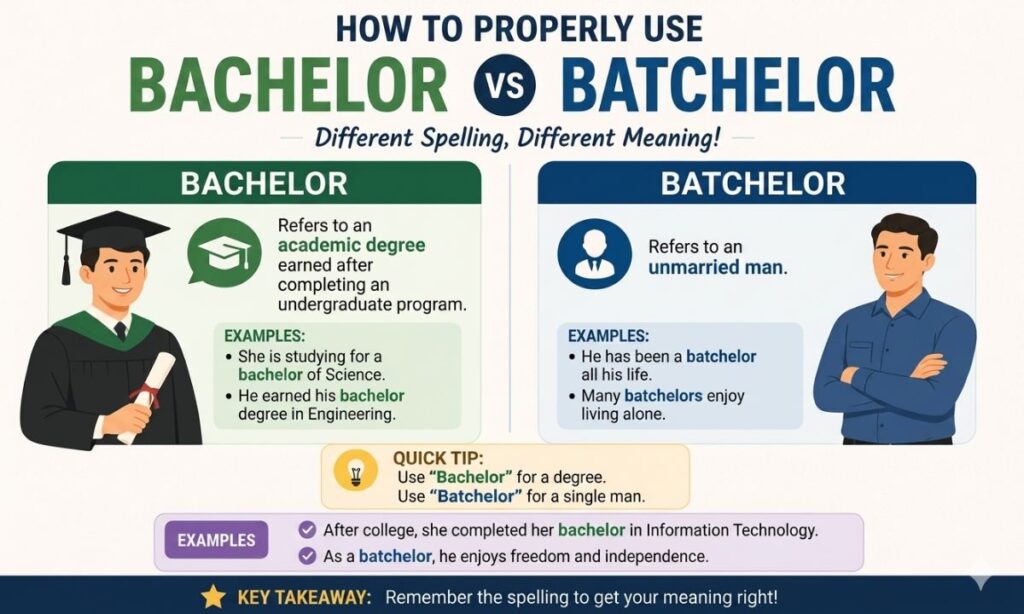
Using bachelor vs batchelor correctly comes down to three simple principles:
Principle 1: Always use “bachelor” as a common noun. Whether you are referring to an unmarried man or an academic degree, “bachelor” is the only correct spelling. There are no exceptions to this rule in modern English.
Principle 2: Use “Batchelor” only as a proper noun. If you are writing about a person whose last name is Batchelor, capitalize it and use that spelling. This is a proper name, not a common word.
Principle 3: Avoid “batchelor” in all other contexts. Using “batchelor” in professional, academic, or casual writing marks you as someone who has made a spelling error. Spell-checkers will flag it, editors will correct it, and readers may question your attention to detail.
Here is a quick reference guide for proper usage:
| Situation | Correct Usage |
| Referring to an unmarried man | He is a bachelor. |
| Referring to an academic degree | She earned her bachelor’s degree. |
| Writing someone’s surname | Dr. Batchelor gave the lecture. |
| Referring to a historical text | Medieval manuscripts used “batchelor.” |
| Any other general writing | Always use bachelor. |
More Examples Of Bachelor & Batchelor Used In Sentences
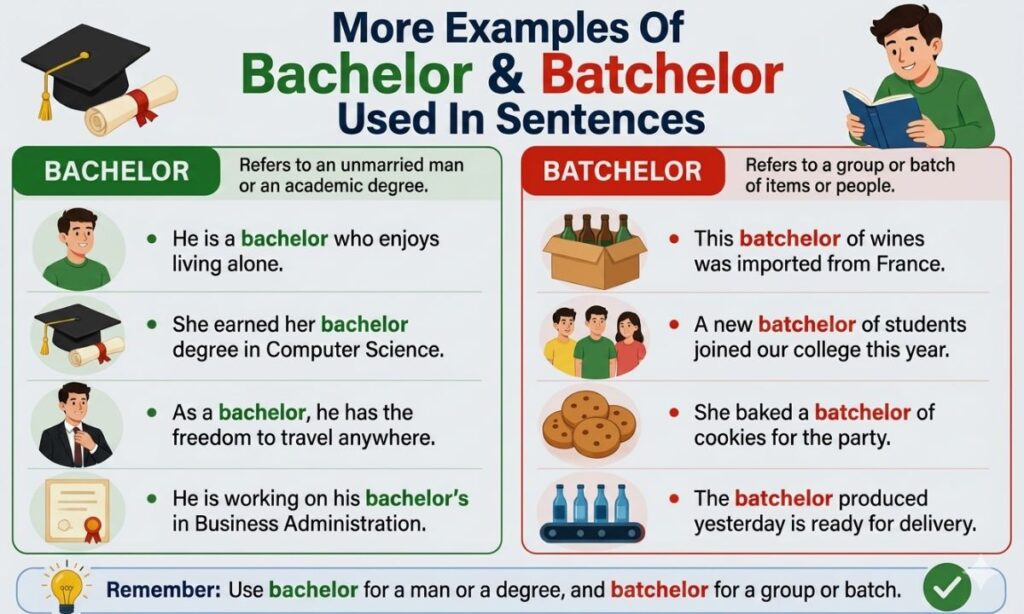
Seeing bachelor vs batchelor used in real sentences is one of the most effective ways to lock in the correct usage. Below are practical, everyday examples to reinforce your understanding.
Examples Of Using Bachelor In A Sentence
The word bachelor appears naturally in many different contexts. Here are clear examples across those different uses:
Referring to Marital Status:
- James has lived alone for years and is a happy bachelor who enjoys his independence.
- After his long relationship ended, he returned to the bachelor lifestyle without regret.
- The TV show features an eligible bachelor looking for his perfect match.
- My neighbor is a confirmed bachelor who travels the world freely.
- She introduced him to her friends as the most charming bachelor at the party.
Referring to an Academic Degree:
- She completed her bachelor of science degree in three years instead of four.
- He applied for the job right after finishing his bachelor’s in computer engineering.
- A bachelor of arts in English literature prepared her well for her writing career.
- Most entry-level positions in this firm require at least a bachelor’s degree.
- After earning his bachelor’s, he immediately enrolled in a master’s program.
Zoological Context:
- The young bachelor seal had not yet established a territory on the rocky shore.
- A group of bachelor elephants roamed the plains separately from the main herd.
Examples Of Using Batchelor In A Sentence
Because batchelor functions correctly only as a proper noun (a surname), all correct example sentences treat it as a name:
- Professor Batchelor presented her research at the annual linguistics symposium.
- The Batchelor family has owned that farm for four generations.
- Mr. Batchelor signed the contract on behalf of the company.
- We were pleased to welcome Dr. Batchelor to the panel this afternoon.
- Angela Batchelor was elected as the new chairperson of the committee.
Notice that in all of the above sentences, “Batchelor” is capitalized because it functions as a proper name. If someone writes “he is a batchelor” with a lowercase “b,” that is simply incorrect English.
Common Mistakes To Avoid
When working through bachelor vs batchelor in your writing, certain errors come up again and again. Being aware of these pitfalls helps you avoid them consistently.
Using “Batchelor” Instead Of “Bachelor”
This is by far the most frequent mistake people make. The misspelling “batchelor” likely occurs because writers hear the word and insert a “t” after the “a,” perhaps influenced by the word “batch” or simply by habit. The result looks plausible at a glance, which is exactly why it slips through so easily.
Wrong: He finally received his batchelor’s degree in business administration. Right: He finally received his bachelor’s degree in business administration.
Wrong: Tom is a confirmed batchelor who never plans to marry. Right: Tom is a confirmed bachelor who never plans to marry.
A simple way to remember the correct spelling: think of the word “Bach,” as in Johann Sebastian Bach, then add “elor.” The word has no “t” after the “a.”
Using “Bachelor” To Refer To A Degree Without Proper Context
Another common mistake is using “bachelor” loosely when referring to a specific degree type. While “bachelor” on its own is technically understood, academic and professional writing calls for more precision.
Less Clear: She has a bachelor. Better: She has a bachelor’s degree in marketing. Most Formal: She holds a Bachelor of Science in Marketing from Stanford University.
This distinction matters especially in resumes, cover letters, and academic documents. Specifying “bachelor of arts,” “bachelor of science,” or “bachelor of education” gives your writing authority and clarity.
Confusing “Bachelor” With “Bachelorette”
These two words look and sound similar but carry distinct, gender-specific meanings that are not interchangeable.
- Bachelor traditionally refers to an unmarried man.
- Bachelorette traditionally refers to an unmarried woman.
Using them interchangeably is a grammatical error that can also come across as culturally imprecise.
Wrong: The bachelorette party welcomed all the unmarried men at the venue. Right: The bachelor party welcomed the groom’s closest friends.
In modern usage, some style guides and media outlets use “bachelor” in a more gender-neutral sense, but in formal writing, maintaining the traditional distinction is advisable.
Context Matters
Understanding bachelor vs batchelor fully means recognizing that context shapes everything. The same word can mean different things depending on where and how you use it. This is especially important for writers, students, and professionals.
Examples Of Different Contexts
Social and Relationship Context: In casual or social settings, “bachelor” most often refers to an unmarried man. Phrases like “bachelor party,” “bachelor lifestyle,” and “eligible bachelor” all belong to this domain. Here, the word carries no academic meaning whatsoever.
Example: “The entire office was excited when they heard about the bachelor party happening Friday night.”
Academic and Professional Context: In educational and career settings, “bachelor” refers to an undergraduate degree. This context requires precision: “bachelor’s degree,” “bachelor of arts,” or “bachelor of science” are the preferred forms.
Example: “Her bachelor of science degree qualified her for the entry-level research position.”
Historical and Archival Context: In academic research involving medieval or early modern texts, a scholar might encounter the spelling “batchelor” as an archaic variant. In this context, it is appropriate to reference the historical spelling, but only within quotations or clear historical discussion.
Example: “The medieval document referred to the young knight as a ‘batchelor,’ reflecting the spelling conventions of the era.”
Proper Noun Context: When “Batchelor” is someone’s surname, it must be spelled that way exactly. Getting a person’s name wrong is disrespectful and unprofessional.
Example: “The award was presented to Dr. Sarah Batchelor for her contributions to public health.”
Exceptions To The Rules
While bachelor vs batchelor has a clear answer in most situations, there are a few legitimate exceptions worth knowing.
1. Regional Differences
English spelling became standardized largely through the efforts of lexicographers like Samuel Johnson (British English, 1755) and Noah Webster (American English, 1828). Before standardization, regional spelling variants were common. In some historical regional texts from Britain and Ireland, “batchelor” appears alongside “bachelor.” Today, however, both British and American English agree on “bachelor” as the sole correct spelling for the common noun. Neither British English nor American English accepts “batchelor” as a standard alternative in modern writing.
2. Names And Titles
As mentioned throughout this article, “Batchelor” is a legitimate English surname. It also appears in historical titles and institutional names. For example, certain historic guilds, buildings, and estates may carry the “Batchelor” spelling as part of their official proper name. In those cases, you must use the spelling as it appears in the official record, regardless of the standard word spelling.
Example: “The Batchelor Street community center has served the neighborhood for over a century.” (If that is the official registered name.)
3. Historical Usage
Medieval English manuscripts, court records, and literary works sometimes use “batchelor” or other variant spellings. When quoting directly from historical sources, you should reproduce the original spelling faithfully within quotation marks. This is standard practice in historical research and literary scholarship. However, your own analytical prose surrounding such a quotation should use the modern “bachelor.”
Example: A historian might write: The chronicle refers to “a young batchelor of noble birth,” illustrating how spelling conventions differed before standardization.
Practice Exercises
The best way to master bachelor vs batchelor is through direct practice. These exercises will sharpen your understanding and build confident, accurate spelling habits.
Exercise 1: Fill In The Blank
Choose the correct word (bachelor or Batchelor) to complete each sentence:
- My brother is a ___________ who has lived alone in his apartment for six years.
- After four years of study, she finally earned her ___________ of arts degree.
- The committee was chaired by Professor ___________, who specializes in medieval literature.
- The TV show “The ___________” features a single man looking for love.
- He received his ___________ in engineering from a university in Texas.
- Mrs. ___________ brought her entire family to the company picnic.
- He has been a ___________ for so long that his friends have stopped trying to set him up.
- A ___________ degree is usually the first academic milestone for university students.
Answer Key:
- bachelor, 2. bachelor, 3. Batchelor, 4. Bachelor, 5. bachelor, 6. Batchelor, 7. bachelor, 8. bachelor
Exercise 2: Sentence Correction
Identify and correct the errors in the following sentences:
- “He is a confirmed batchelor who enjoys the freedom of single life.” Corrected: He is a confirmed bachelor who enjoys the freedom of single life.
- “She earned her batchelor of science degree last spring.” Corrected: She earned her bachelor of science degree last spring.
- “The groom’s friends organized an epic batchelor party.” Corrected: The groom’s friends organized an epic bachelor party.
- “Dr. Bachelor reviewed the case files and submitted her report.” (Here, “Bachelor” is someone’s surname.) Corrected: Dr. Batchelor reviewed the case files and submitted her report.
- “He introduced himself as a batchelor looking to settle down.” Corrected: He introduced himself as a bachelor looking to settle down.