
If you have ever been typing a sentence and paused at the word “greatly,” wondering if it looks right or if it should be spelled “grately,” you are absolutely not alone. The confusion between grately vs greatly trips up students, bloggers, professionals, and even experienced writers every single day. Both words sound nearly identical when spoken aloud, which is precisely what makes this spelling mistake so easy to miss.
But here is what you need to know right away: only one of these spellings is a real, recognized English word. The question of grately vs greatly has a definitive answer, and knowing that answer will immediately make your writing sharper, more credible, and more professional.
In this article, you will learn the exact definitions of both words, how to use them correctly in sentences, what mistakes to watch out for, and how context shapes the way you write. By the time you finish reading, the grately vs greatly debate will be completely settled in your mind, and you will never mix them up again.
Quick Answer: Grately vs Greatly
| Feature | Grately | Greatly |
| Is it a real English word? | No | Yes |
| Part of speech | N/A | Adverb |
| Meaning | No recognized meaning | To a large or significant extent |
| Accepted in dictionaries? | No | Yes (Merriam-Webster, Oxford, Collins) |
| Used in formal writing? | Never | Always preferred |
| Common mistake type | Spelling/typographical error | Correct usage |
| Root word | N/A | Great + ly |
Define Grately
“Grately” is not a word recognized in standard English. You will not find it in Merriam-Webster, the Oxford English Dictionary, Collins Dictionary, or any other authoritative language reference. It is, in every sense, a misspelling of the word “greatly.”
So where does “grately” come from? It shows up because of a few overlapping reasons. First, when people speak quickly, the word “greatly” can sound almost exactly like “grately.” Second, writers sometimes confuse the spelling with similar-sounding words like “grateful” or “gratefully,” which do begin with “grat.” Third, fast typing and over-reliance on autocorrect allow the error to slip through unnoticed.
Some sources attempt to define “grately” as an adverb meaning “in a great manner,” but this usage has no legitimate standing in any recognized grammar guide. The grately vs greatly question, when it comes to “grately” specifically, ends here: it is a spelling error, not an alternate form.
If “grately” appears in your writing, it should be replaced with “greatly” every single time. Using it in professional emails, academic papers, or published content signals to readers that the writer was not careful enough to proofread, which can quietly chip away at your credibility.
Define Greatly
“Greatly” is a legitimate English adverb with a long history. According to the Oxford English Dictionary, the earliest known use of “greatly” dates back to before the year 1200, placing it firmly in the Middle English period. It derives from the root adjective “great” combined with the standard adverbial suffix “-ly.”
The Collins English Dictionary defines “greatly” as meaning “in or to a great degree; much.” Merriam-Webster defines it as “to a great extent or degree: very much.” In informal terms, it is the adverbial equivalent of saying something is “a lot” or “very much,” but with a more formal and polished tone.
When you use “greatly” in a sentence, you are emphasizing the intensity, magnitude, or significance of an action or quality. This is exactly what makes it so useful in professional writing, academic work, business communication, and formal correspondence.
In the grately vs greatly comparison, “greatly” is the word that belongs in every context where the other one would be tempting to use.
Read This: Ally vs Allie: The Main Differences And When To Use Them
How To Properly Use The Words In A Sentence
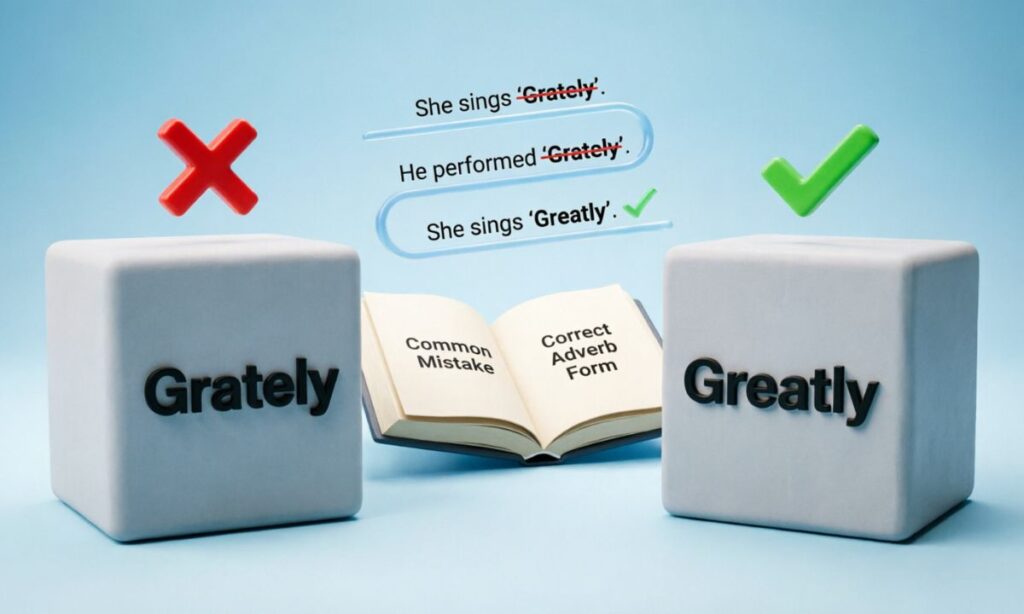
Understanding the grately vs greatly difference in theory is one thing. Putting it into practice in real sentences is where the skill becomes automatic. This section will show you exactly how each word behaves in actual writing so you can build the right habit permanently.
How To Use “Grately” In A Sentence
Because “grately” is not a recognized English word, there is technically no correct way to use it in a sentence. Any sentence that contains “grately” should be revised immediately by replacing it with “greatly.”
That said, it is worth seeing what “grately” looks like in sentences so you can recognize the error when you encounter it:
- “I am grately thankful for your support.” (incorrect)
- “Her performance was grately improved this season.” (incorrect)
- “The company’s revenue has grately increased.” (incorrect)
All three of these sentences feel natural when read quickly, which is exactly why the grately vs greatly confusion persists. The word slots in convincingly, but it is still a spelling mistake. Anyone reviewing these sentences for grammar or professionalism would flag every instance immediately.
The takeaway: there is no situation in which “grately” is the correct choice. If you find it in your writing, it is always a mistake to be corrected.
How To Use “Greatly” In A Sentence
“Greatly” functions as an adverb. That means it modifies verbs, adjectives, or other adverbs to describe the degree or intensity of something. It typically appears directly before or after the verb it is modifying.
Here is a simple rule that helps: if you can replace “greatly” with “very much” or “significantly” and the sentence still makes sense, you are using it correctly.
Correct sentence structures for “greatly”:
- Before a verb: “I greatly appreciate your effort.”
- After a verb: “His health has improved greatly over the past year.”
- Before a past participle: “Your help would be greatly appreciated.”
- Before an adjective: “She was greatly relieved when the test results came back.”
The grately vs greatly distinction becomes crystal clear the moment you practice placing “greatly” in real sentences. It flows naturally, adds emphasis without sounding forced, and fits every context from casual emails to formal reports.
Grately vs Greatly Meaning
The grately vs greatly meaning comparison is simple, but it is worth spelling out clearly because the nuance matters for writing accurately.
Grately has no meaning. It is a non-word. It carries no definition, no grammatical function, and no communicative value. Its only role in writing is as an error.
Greatly carries substantial meaning. It signals that something is happening to a large or significant degree. It adds weight and emphasis to whatever it modifies. When you write that someone “greatly improved” or that results “greatly exceeded expectations,” you are communicating intensity that words like “slightly,” “somewhat,” or “a little” cannot match.
Here is a quick meaning comparison to lock in the grately vs greatly distinction:
| Intended Meaning | Incorrect Version | Correct Version |
| Very much appreciate | “I grately appreciate it.” | “I greatly appreciate it.” |
| Improved a lot | “Performance grately improved.” | “Performance greatly improved.” |
| Significantly impacted | “The change grately impacted us.” | “The change greatly impacted us.” |
| Deeply admired | “She was grately admired.” | “She was greatly admired.” |
| Heavily reduced | “Costs were grately reduced.” | “Costs were greatly reduced.” |
Every time you see “grately” in that table, the grately vs greatly verdict is the same: it is wrong, and “greatly” belongs in its place.
More Examples Of Grately and Greatly Used In Sentences
Seeing more examples is one of the fastest ways to train your brain to choose correctly between grately vs greatly. The more you see how each word looks in context, the more automatic the right choice becomes.
Examples Of Using Grately In A Sentence
These sentences all contain an error. Each one uses “grately” where “greatly” should appear. Study them carefully so you can spot the mistake in your own writing:
- “The manager was grately impressed by the team’s quarterly results.”
- “Our relationship was grately strengthened after working through those challenges together.”
- “The new software has grately reduced the time we spend on data entry.”
- “His reputation was grately damaged by the public controversy.”
- “The teacher was grately encouraged by her students’ progress this semester.”
- “Sales figures were grately affected by the unexpected supply chain disruption.”
- “She was grately relieved when the project was finally approved.”
- “The researcher’s findings were grately influenced by earlier studies in the field.”
- “Customer satisfaction scores were grately improved after the new training program.”
- “The community was grately impacted by the construction of the new hospital.”
Every one of those sentences reads almost naturally, which is the danger of the grately vs greatly mistake. Your eye slides right over it. But the word is wrong in every single case, and a careful reader or grammar tool will catch it immediately.
Examples Of Using Greatly In A Sentence
These sentences are all correct. They demonstrate the proper placement and usage of “greatly” across a range of topics and tones:
- “I greatly appreciate your patience and understanding throughout this process.”
- “The team’s morale greatly improved after the new manager joined in January.”
- “Her early mentorship greatly shaped the direction of his entire career.”
- “The new policy is expected to greatly reduce processing times across all departments.”
- “We were greatly encouraged by the positive feedback from our initial product launch.”
- “His contributions to the project were greatly valued by every member of the team.”
- “The organization’s reach was greatly expanded after the partnership was announced.”
- “Sales greatly exceeded our projections for the third quarter of this year.”
- “The community has greatly benefited from the new after-school programs.”
- “She was greatly admired by her colleagues for her calm leadership under pressure.”
Notice how “greatly” in each of these sentences adds a clear sense of degree and intensity. This is the hallmark of correct grately vs greatly usage: the word makes the sentence more powerful and more precise.
Common Mistakes To Avoid
Understanding grately vs greatly also means understanding the patterns that lead to the mistake in the first place. Once you know what causes the error, you can stop it before it starts.
Mistakes To Avoid
Here are the most common errors writers make when dealing with grately vs greatly:
1. Phonetic spelling Many writers spell words based on how they sound rather than how they are spelled. Because “greatly” is sometimes pronounced in a way that de-emphasizes the “t” sound, some people hear “grately” and write exactly that. This is how spelling mistakes spread.
2. Confusion with “grateful” and “gratefully” The words “grateful” and “gratefully” both begin with “grat,” which is close to how some people spell “grately.” The brain autocompletes based on familiar patterns and produces “grately” instead of “greatly.”
3. Fast typing without proofreading In quick messages, emails, and social media posts, people type faster than their conscious brain can check spelling. The grately vs greatly error happens most often in these low-attention writing environments.
4. Trusting autocorrect blindly Autocorrect catches many spelling errors, but it does not catch all of them, especially when the misspelled word resembles another real word. Some systems may not flag “grately” at all.
5. Using “grately” in formal writing This is the highest-risk version of the error. Writing “grately” in a business proposal, academic essay, or published article creates a negative impression that is hard to undo.
How To Avoid These Mistakes
These practical strategies will help you eliminate the grately vs greatly confusion permanently:
- Think of the root word. “Greatly” comes from the adjective “great.” Adding “-ly” to “great” gives you “greatly,” not “grately.” This one mental step fixes the problem instantly.
- Use the substitution test. Before you write “greatly,” try replacing it with “very much” or “significantly.” If the sentence still makes sense, you have confirmed that “greatly” is the right word.
- Proofread with fresh eyes. After writing, step away for a few minutes before rereading. A rested eye catches errors that a rushed eye misses.
- Use grammar-checking software. Tools like Grammarly or Microsoft Editor will catch spelling mistakes that autocorrect misses. Run your work through one before finalizing it.
- Read your writing aloud. When you hear your sentences spoken, errors like grately vs greatly stand out more clearly than they do on a silent screen.
Context Matters
While the grately vs greatly rule is straightforward, context shapes how and where you use “greatly” to best effect. The word carries a formal tone, which means it is not equally ideal in every type of writing.
Examples Of Different Contexts
Formal and Professional Writing “Greatly” shines brightest in formal contexts. It signals seriousness, professionalism, and precision. Business emails, cover letters, academic papers, and reports all benefit from its use.
Examples:
- “We would greatly appreciate a response at your earliest convenience.”
- “The results greatly exceeded the benchmarks established at the start of the fiscal year.”
- “Your expertise has greatly contributed to the success of this initiative.”
Casual Writing In casual texts, social media posts, or everyday conversation, “greatly” can feel slightly stiff or formal. In these contexts, you might prefer “a lot,” “very much,” or “really” instead. However, “greatly” is never incorrect even in casual writing. It is simply a stylistic choice.
Academic Writing In research papers and academic writing, “greatly” is a strong choice for describing the magnitude of findings, changes, or influences. It adds authority without crossing into hyperbole.
Creative and Literary Writing Authors use “greatly” to add weight and dignity to descriptions. A character can be “greatly troubled,” an event can “greatly alter” the course of a story, or a discovery can be “greatly underestimated.” The word elevates the prose without overpowering it.
Exceptions To The Rules
Most grammar rules in English have exceptions. The grately vs greatly situation, however, is unusually clear-cut. Still, there are some edge cases worth understanding.
When “Grately” Might Be Used
There is really only one situation where “grately” might appear intentionally: deliberate creative, humorous, or informal writing where the author is either quoting an error, discussing the mistake itself, or using it as a stylistic device for a specific effect. For example, a blog post discussing grately vs greatly might include the word in quotation marks to illustrate the error.
In archaic English texts, unusual spellings of modern words do sometimes appear. However, “grately” does not show up in historical texts as a legitimate variant of “greatly.” Its appearance online is almost entirely the result of modern spelling errors rather than any historical usage.
The bottom line: in virtually every real-world context, “grately” is a mistake and nothing else.
When “Greatly” Might Not Be Used
There are stylistic situations where “greatly” is technically correct but not the best choice:
When it sounds redundant: Pairing “greatly” with a word that already implies intensity can feel repetitive. For example, “greatly enormous” stacks emphasis unnecessarily. In these cases, drop one of the intensifiers.
In very casual or conversational writing: If you are writing a text message to a friend, “greatly” might sound stiff or overly formal. Opting for “a lot” or “so much” feels more natural in those environments.
When repetition weakens the writing: Using “greatly” multiple times in the same paragraph can make your writing feel flat. Vary your intensifiers with synonyms like “considerably,” “significantly,” “enormously,” “immensely,” or “substantially” to keep the prose dynamic.
Practice Exercises
The best way to lock in the grately vs greatly difference is through practice. Work through these exercises to test your understanding and build lasting confidence.
Exercise 1: Fill In The Blank
Fill each blank with either “grately” or “greatly” and then identify which one is correct:
- “She was ______ surprised by the positive reception her speech received.”
- “The investor’s decision was ______ influenced by the quarterly earnings report.”
- “We ______ value the trust that our clients place in our team every day.”
- “His recovery was ______ aided by the support of his family and friends.”
- “The new safety guidelines ______ reduced the number of workplace incidents.”
- “Her confidence has ______ improved since she started the public speaking course.”
- “The charity event ______ exceeded our fundraising goals this year.”
- “Customer complaints were ______ reduced after the new help desk was implemented.”
Answers: In every case, the correct answer is “greatly.” “Grately” is never correct.
Exercise 2: Identify The Correct Word
Read each sentence below. Decide whether the underlined word is correct or incorrect. If it is incorrect, write the correct version:
- “I am grately indebted to everyone who contributed to this research.” → Incorrect. Replace with greatly.
- “The company has greatly expanded its operations across three new markets.” → Correct.
- “His advice grately influenced the direction of my career.” → Incorrect. Replace with greatly.
- “We were greatly relieved when the storm passed without major damage.” → Correct.
- “The partnership grately strengthened both organizations’ positions in the industry.” → Incorrect. Replace with greatly.
- “Her writing style has greatly matured over the past two years.” → Correct.
- “The scientific discovery grately changed our understanding of the human genome.” → Incorrect. Replace with greatly.
- “Their dedication to quality is greatly appreciated by all of our clients.” → Correct.
Read This: Manuel Vs Manual: When To Use Each One In Writing?
Frequently Asked Questions About Grately vs Greatly
Is “grately” ever correct in any form of English?
No. “Grately” is not correct in any recognized form of standard English. It is always a spelling error.
Why do so many people write “grately” instead of “greatly”?
The words sound nearly identical when spoken quickly, and people confuse the spelling with similar words like “grateful” or “gratefully.”
What does “greatly” mean?
“Greatly” is an adverb meaning to a large or significant degree, often used to intensify verbs or past participles. It is synonymous with “very much” or “significantly.”
Where does “greatly” come from?
It derives from the Old English adjective “great” combined with the adverbial suffix “-ly,” with earliest documented use dating back to before the year 1200.
Can I use “greatly” in informal writing?
Yes, though it carries a formal tone. In casual writing, you may prefer “a lot” or “very much” for a warmer, more conversational feel.
What are some synonyms for “greatly”?
Common alternatives include considerably, significantly, enormously, immensely, substantially, remarkably, vastly, and profoundly.
Does autocorrect catch the “grately” error?
Not always. Some autocorrect systems miss the error, which is why manual proofreading remains essential.
Can “greatly” come after a verb?
Yes. “Greatly” can appear both before and after the verb it modifies. “I greatly appreciate your help” and “I appreciate your help greatly” are both grammatically correct.
Conclusion
The grately vs greatly debate has a clear and permanent answer: “greatly” is the correct English word, and “grately” is always a spelling mistake. Every time you are tempted to write “grately,” the solution is to stop, remember that “greatly” comes from “great” plus “-ly,” and make the correction.
This matters more than it might seem. In professional communication, even one misspelled word can shift how readers perceive your competence and attention to detail. A single instance of “grately” in a cover letter, business proposal, or published article can quietly undermine your authority in ways that are completely avoidable.
The grately vs greatly rule is one of the easiest grammar fixes in the English language once you know it. There are no exceptions, no regional variations, and no gray areas. “Greatly” belongs in your writing. “Grately” does not.
Use “greatly” to show magnitude, intensity, and significance. Use it before and after verbs. Use it in formal writing, academic essays, professional emails, and polished content. And every time you catch yourself about to type “grately,” let the correct form take its place instead.
Good writing is built on small, consistent choices. Choosing “greatly” over “grately” every single time is one of those choices, and now you have every reason to get it right. The next time the grately vs greatly question comes up in your writing, the answer will come to you instantly.