

Have you ever called something a rug when you actually meant a rag, or the other way around? You are not alone. The words rug vs rag confuse millions of English speakers every single year, and it is easy to understand why. Both words are short, both relate to fabric, and both differ by just one vowel sound. Yet their meanings, functions, and correct usage are completely different from each other.
Whether you are redecorating your living room, cleaning your kitchen, or simply trying to improve your English vocabulary, knowing the exact difference between rug vs rag will save you from embarrassing mix-ups. In this guide, you will find everything you need: the origin of each word, how people use them in everyday life, a clear breakdown of meanings, pronunciation tips, comparison tables, and real sentence examples. By the time you finish reading, rug vs rag will never confuse you again.
Quick Answer: Rug Vs Rag at a Glance
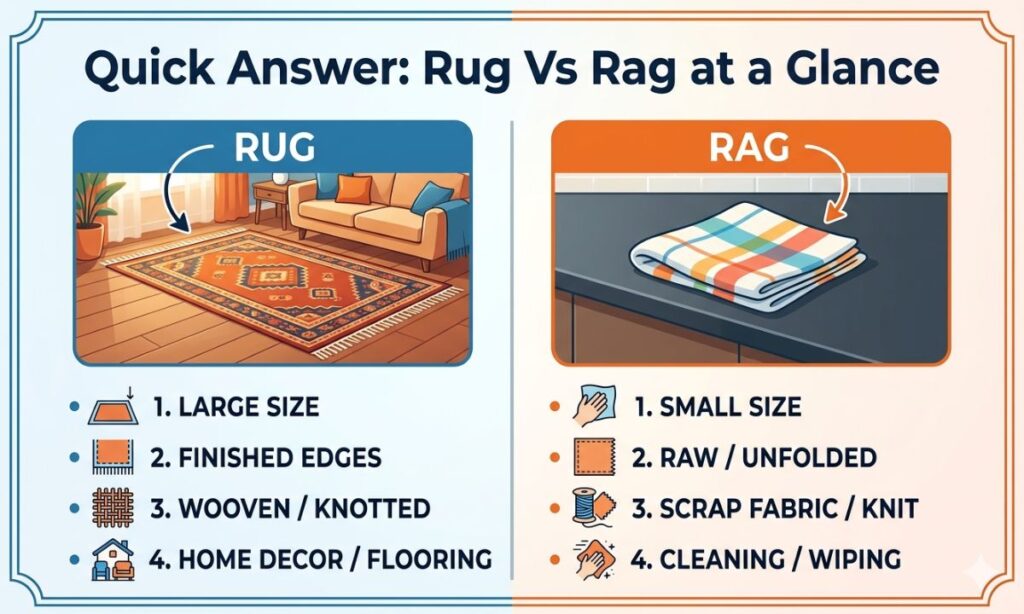
Before diving into the full details, here is the simplest way to separate rug vs rag in your mind:
| Feature | Rug | Rag |
| Primary Use | Floor covering, decoration | Cleaning, wiping, crafts |
| Material | Thick woven fabric, wool, synthetic | Old cloth, torn fabric, worn material |
| Appearance | Decorative, patterned, stylish | Plain, worn, often stained |
| Location | On the floor of a room | In a cleaning bucket or toolbox |
| Value | Can be expensive or budget-friendly | Usually worthless or repurposed |
| Example | A Persian rug in the living room | A rag used to wipe engine oil |
This table alone tells the story of rug vs rag clearly. One adds beauty to your home. The other helps you clean it.
Read This: Kinesthesiology vs Kinesiology: Meaning And Differences Explained Clearly
Origin Of The Phrase
The story of rug vs rag goes back several centuries, and tracing their linguistic roots actually helps explain why the two words are so easily confused even today.
Where Did the Word “Rug” Come From?
The word “rug” has Scandinavian origins. Linguists trace it back to the Old Norse word “rǫgg,” which referred to a tuft of wool or long shaggy hair. The Norwegian dialect word “rugga” meant a coarse coverlet, and the Swedish word “rugg” described coarse or shaggy hair. English speakers began using the term “rug” around the mid-15th century to describe coarse, rough fabric. By the early 19th century, the meaning had shifted clearly toward what we know today: a thick piece of woven fabric used as a floor covering.
It is worth noting that Merriam-Webster traces the Middle English form of the word back to a similar Scandinavian root, describing it as a piece of thick heavy fabric used as a floor covering or a lap robe. The word “rug” also picked up a secondary, informal meaning over time: a hairpiece or toupee worn by men to cover baldness.
Where Did the Word “Rag” Come From?
The word “rag” has a similarly ancient history. According to etymological records, “rag” entered English in the early 14th century, most likely borrowed from a Scandinavian source. The Old Norse “rögg” (shaggy tuft) and Old Danish “rag” are considered probable ancestors. Some linguists also suggest it may have developed as a back-formation from the older English word “ragged.”
The Proto-Germanic root “rawwa” and the Proto-Indo-European root “reue” both carry the meaning of tearing, smashing, or ripping apart. This origin makes perfect sense because a rag is, by definition, a torn or worn piece of cloth that has been ripped away from its original form.
How the Two Words Diverged
Interestingly, both “rug” and “rag” trace back to related Scandinavian concepts around rough, shaggy fabric. That shared ancestry is part of why people still mix them up in rug vs rag debates today. Over centuries, though, the two words took separate paths. The rug became a valued household item, a symbol of warmth, comfort, and artistic expression. The rag became the humble workhorse of the home, something you reach for when there is a mess to clean.
By the 19th century, the distinction in rug vs rag was firmly established in the English language.
How People Use Them
Understanding how people actually use rug vs rag in daily life is the fastest way to lock in the difference permanently.
How People Use a Rug
A rug is used primarily as a decorative and functional floor covering. Here is how you will encounter rugs in everyday settings:
In the home: Rugs are placed in living rooms, bedrooms, hallways, dining rooms, and entryways. They add warmth, reduce noise, and protect the floor underneath.
In interior design: Interior designers use rugs as anchor pieces for furniture arrangements. A well-chosen rug can tie together the color scheme and style of an entire room.
In outdoor spaces: Outdoor rugs made from weather-resistant materials are popular on patios and decks.
As travel accessories: In some cultures and historical contexts, rugs were used as lap robes or travel blankets.
As hairpieces: In informal English, a toupee or hairpiece worn by a man is sometimes called a rug.
As a craft item: Rug hooking and rug weaving are popular crafts where people create their own decorative floor pieces.
The most common question people have about rug vs rag in a home context is whether a small mat by the door counts as a rug. Yes, it does. Any woven or fabric floor covering placed for decoration or comfort falls under the rug category.
How People Use a Rag
A rag plays a completely different role in daily life. Here is where you will find rags being used:
In cleaning: Rags are the go-to tool for wiping down surfaces, mopping up spills, dusting shelves, and polishing furniture.
In automotive work: Mechanics keep rags in their toolboxes to wipe grease, clean engine parts, and dry hands after working on vehicles.
In painting and DIY projects: Painters use rags to wipe excess paint, clean brushes, and smooth surfaces before applying coatings.
In crafts: Strips of rags are used in quilting, braided mat making, and various upcycling projects.
Informally for newspapers: In British English, a low-quality newspaper is sometimes called a “rag” as a dismissive or insulting term.
In music history: The word “rag” also refers to ragtime music, a rhythmic style popular in the late 19th and early 20th centuries. This meaning is unrelated to the cleaning cloth definition but shows how flexible English vocabulary can be.
When thinking about rug vs rag, remember this rule: if you would put it on your floor as a permanent feature, it is a rug. If you would grab it to clean something up, it is a rag.
More About Rugs
Since rugs are more complex and varied than rags, they deserve a closer look. The world of rugs is surprisingly rich, with many types, materials, and uses worth knowing.
Types of Rugs
The rug world is enormous. Here are the most common types you will encounter when searching for rug vs rag differences in home decor:
Area Rug: The most common type. Placed in the center of a room to define a seating or dining space. Available in almost every size, color, and pattern.
Persian Rug: Handwoven rugs originating from Iran, known for intricate patterns and high craftsmanship. These can cost thousands of dollars and are considered art.
Shag Rug: Features long, soft pile fibers that create a fluffy, plush surface underfoot. Popular in bedrooms.
Flatweave Rug: Has no pile, making it thin, lightweight, and easy to clean. Common in high-traffic areas.
Braided Rug: Made by braiding strips of fabric together in circular or oval patterns. Traditional American style.
Runner Rug: Long and narrow, used in hallways and corridors.
Outdoor Rug: Made from synthetic materials designed to withstand weather, moisture, and dirt.
Rag Rug: This is where rug vs rag gets interesting. A rag rug is a floor covering made by weaving, braiding, or hooking strips of old fabric together. It literally transforms rags into a rug. In the United Kingdom, rag rugs were especially popular during World War II when materials were scarce and people repurposed everything they had.
What Rugs Are Made Of
Rugs are crafted from a wide variety of materials, including:
- Wool: Durable, soft, and naturally stain-resistant. The most traditional rug material.
- Cotton: Affordable, washable, and lightweight.
- Silk: Luxurious and incredibly detailed, usually reserved for high-end decorative rugs.
- Synthetic fibers: Nylon, polypropylene, and polyester rugs are affordable and easy to maintain.
- Jute and sisal: Natural plant fibers used for rustic or eco-friendly rugs.
- Animal skin: Sheepskin and cowhide rugs add texture and warmth to a space.
Caring for Rugs
Proper maintenance keeps a rug looking great for years:
- Vacuum regularly to remove surface dirt and dust.
- Rotate the rug every six months to ensure even wear.
- Use a rug pad underneath to prevent slipping and protect floors.
- Deep clean annually using professional services or appropriate home methods.
- Address spills immediately by blotting, not rubbing.
This is a clear case where rug vs rag knowledge matters practically. You would clean a rug with care and professional products. You would use a rag to do the cleaning.
Rug or Rag Meaning
Now that you understand their history and uses, here is a crisp, clear breakdown of the core meanings that define rug vs rag.
What Does “Rug” Mean?
A rug is a thick piece of woven or tufted fabric used to cover part of a floor. It is smaller than a carpet (which covers the entire room) and is usually moved or replaced without any permanent installation. Rugs are used for decoration, warmth, noise reduction, and floor protection.
Secondary meanings of “rug”:
- Informal term for a man’s hairpiece or toupee
- In some technical contexts, a lap robe or travel blanket
What Does “Rag” Mean?
A rag is a torn, worn, or otherwise used piece of cloth that has little or no decorative value. It is typically repurposed from old clothing, towels, or other fabric items and used for cleaning, wiping, or polishing.
Secondary meanings of “rag”:
- A low-quality or sensationalist newspaper (British informal)
- A piece of ragtime music
- In plural form, “rags” can refer to worn-out, tattered clothing
The Core Difference in Rug vs Rag Meaning
| Word | Core Meaning | Secondary Meaning |
| Rug | Decorative floor covering | Hairpiece, lap robe |
| Rag | Old cloth for cleaning | Bad newspaper, rags as poor clothing |
The clearest way to remember rug vs rag is through purpose. A rug serves your floor and your eyes. A rag serves your hands and your messes.
Can a Rag Become a Rug?
Yes, and this is one of the most fascinating overlaps in the rug vs rag debate. As mentioned earlier, a rag rug is a legitimate type of floor covering made entirely from repurposed fabric strips. Historically, families with limited resources would collect old clothes and fabric scraps, cut them into strips, and weave or braid them into functional floor mats. This tradition was common in both Europe and North America and is still practiced today as a sustainable craft.
So while a rag and a rug are distinctly different things in modern usage, the two words have a creative intersection in the form of the rag rug, a humble object that manages to be both at once.
Rag vs Rug Pronunciation
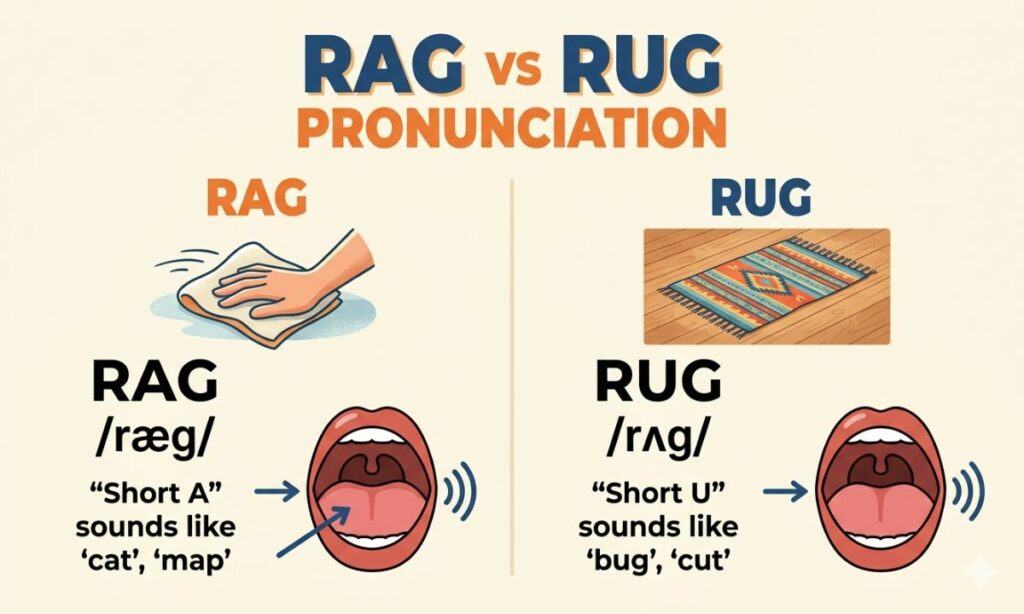
Pronunciation is one of the biggest reasons rug vs rag causes confusion, especially among people learning English as a second language. The two words look almost identical and sound very similar, but they are not the same.
How to Pronounce “Rug”
Phonetic spelling: /rʌɡ/
The vowel sound in “rug” is the “uh” sound, the same sound you hear in words like “cup,” “mud,” “fun,” and “sun.” Open your mouth slightly, relax your jaw, and make the short “uh” sound before adding the hard “g” at the end.
Syllables: 1 Sounds like: “ruhg” Rhymes with: bug, mug, jug, tug, shrug, drug, snug, plug
How to Pronounce “Rag”
Phonetic spelling: /ræɡ/
The vowel sound in “rag” is the short “a” sound, the same vowel you hear in “cat,” “bat,” “trap,” “had,” and “sat.” Your mouth should open slightly wider than for “rug,” and the sound sits more at the front of your mouth.
Syllables: 1 Sounds like: “rag” Rhymes with: bag, tag, flag, wag, drag, nag, lag, snag
Rug vs Rag Pronunciation Comparison
| Feature | Rug | Rag |
| Phonetic | /rʌɡ/ | /ræɡ/ |
| Vowel Sound | Short “uh” (like “cup”) | Short “a” (like “cat”) |
| Mouth Position | Relaxed, mid-open | Wider, front of mouth |
| Rhymes With | Bug, mug, tug | Bag, tag, wag |
Tips for Getting the Pronunciation Right
The key to distinguishing rug vs rag in pronunciation lies entirely in the vowel sound. Practice these pairs out loud:
- Bug / Bag (same pattern as Rug / Rag)
- Cup / Cap
- Fun / Fan
- Run / Ran
If you can hear and feel the difference between “bug” and “bag,” you already know how to pronounce rug vs rag correctly. The vowel shift is subtle but distinct, and with a little practice, it becomes automatic.
Rug vs Rag in British vs American English
Both British and American English pronounce these words in essentially the same way. The IPA symbols /rʌɡ/ and /ræɡ/ apply across dialects. However, regional accents may slightly soften or shift the vowel sounds, particularly in areas of the United States where the “cot-caught merger” or certain Southern vowel shifts occur. The distinction remains consistent enough that mispronunciation is rarely a serious communication barrier, but getting it right does improve clarity and confidence in speech.
Examples In A Sentence
Seeing rug vs rag used correctly in sentences is the best way to make the distinction stick in your memory. Here are detailed, natural examples across different contexts.
Sentences Using “Rug”
- She placed a hand-knotted Persian rug in the center of the dining room, and it instantly transformed the entire space.
- The children tracked mud across the white rug, and it took two hours to clean.
- He rolled up the rug before the movers arrived so it would not get damaged during the furniture relocation.
- The designer recommended a round rug to soften the hard angles of the modern living room.
- That colorful rug was woven by artisans in Morocco and took over three months to complete.
- A thick rug by the bed means cold feet are no longer a problem on winter mornings.
- He laughed when his friend called the toupee a “rug,” but the nickname stuck.
- The rug in the hallway serves as both a welcome mat and a colorful design statement.
- Every hotel room had a soft rug beside each bed, making the stay feel more like home.
- After years of heavy foot traffic, the rug began to show signs of wear along its center.
Sentences Using “Rag”
- He grabbed a rag from the cabinet under the sink and wiped down the kitchen counter.
- The mechanic had a greasy rag tucked into his back pocket throughout the entire repair job.
- She cut an old T-shirt into strips to use as cleaning rags instead of buying disposable wipes.
- After painting the fence, he used a damp rag to remove the drips from the wooden trim.
- The dog dragged a rag from the laundry pile into the living room as if it were a toy.
- His clothes were so worn that people described them as little more than rags.
- That local paper is nothing but a rag, printing gossip instead of real journalism.
- Keep a clean rag nearby when you are polishing furniture to buff away excess product.
- The artist used a cotton rag dipped in solvent to blend the oil paint across the canvas.
- She twisted the rag tightly before squeezing out the dirty water into the bucket.
Sentences Where the Difference Matters
These examples show how mixing up rug vs rag can create humorous or confusing results:
Wrong: “Please grab a rug from the bathroom and wipe up that spill.” Right: “Please grab a rag from the bathroom and wipe up that spill.”
Wrong: “They spread a rag across the living room floor under the coffee table.” Right: “They spread a rug across the living room floor under the coffee table.”
Wrong: “She kept a beautiful rug in her back pocket for cleaning the car.” Right: “She kept a useful rag in her back pocket for cleaning the car.”
These examples make it clear why rug vs rag is worth learning carefully. One wrong word changes the entire picture in the reader’s mind.
Common Mistakes People Make with Rug vs Rag
Even experienced English speakers sometimes slip up. Here are the most frequent errors people make when dealing with rug vs rag:
Mistake 1: Using “rug” when referring to a cleaning cloth. “Hand me that rug to wipe the counter.” The correct word is “rag.”
Mistake 2: Calling a floor mat a “rag.” “We bought a new rag for the living room.” The correct word is “rug.”
Mistake 3: Mispronouncing due to a vowel swap. Saying “rag” when you mean “rug” or vice versa in conversation, especially when speaking quickly.
Mistake 4: Assuming they are interchangeable. Some learners think rug vs rag is a minor stylistic choice. They are not interchangeable. The words describe entirely different objects.
Mistake 5: Forgetting the rag rug connection. Not knowing that rags can be crafted into rugs leads to confusion when this compound noun appears in reading or conversation.
Helpful Memory Tricks for Rug vs Rag
Struggling to remember which is which in rug vs rag? Try these:
Rug rhymes with “hug.” A rug makes your floor feel hugged and cozy.
Rag rhymes with “nag.” A rag is for nagging away at dirt and grime.
Think of the U in rug as “under your feet.” A rug goes under you on the floor.
Think of the A in rag as “absorb.” A rag absorbs spills, dirt, and mess.
These small mental associations make rug vs rag far easier to recall in the moment.
Frequently Asked Questions About Rug Vs Rag
Q: Can a rug and a rag be the same thing? A: Not typically. A rug is a floor covering, while a rag is a cleaning cloth, but a “rag rug” is a floor covering made from old fabric strips.
Q: Is “rug” or “rag” more commonly used in English? A: Both are common, but “rug” appears more frequently in home decor and interior design contexts.
Q: Why do people confuse rug vs rag? A: They differ by only one vowel, sound similar, and both involve fabric, which makes them easy to mix up in fast conversation.
Q: Can I use an old rug as a rag? A: Yes, old worn rugs can be cut up and repurposed as cleaning rags.
Q: Is calling a newspaper a “rag” offensive? A: It is informal and dismissive, often intended as an insult to suggest low quality.
Q: What is the plural of rug and rag? A: The plural of rug is “rugs.” The plural of rag is “rags.”
Q: Are rugs always more expensive than rags? A: No. While luxury rugs can cost thousands of dollars, budget cotton rugs are affordable. Rags are usually free since they are made from old clothes.
Q: How do I know which word to use in conversation? A: Ask yourself: is this item on the floor for style or comfort? It is a rug. Is it in your hand for cleaning? It is a rag.
Read This: Flatform vs Platform: Key Differences and Proper Usage Explained Clearly
Conclusion
The rug vs rag debate is one of the most relatable small confusions in the English language. Two short words, one vowel apart, yet worlds away in meaning. A rug transforms your living space, adding warmth, color, and texture to your floors. A rag handles the dirty work, quietly soaking up spills and scrubbing away messes without any glory.
Once you understand the origin of each word, the purpose each item serves, and the small but important difference in how they sound, rug vs rag becomes one of those distinctions you will never forget. Think of the rug as the star of your home decor and the rag as the unsung hero of your cleaning routine. Both deserve respect, both have centuries of history behind them, and both prove that even the simplest words carry a remarkable amount of meaning.
Whether you are shopping for a new area rug, grabbing a rag to clean your car, or explaining rug vs rag to someone learning English, you now have everything you need to use these words correctly, confidently, and every single time.