
Have you ever typed a word and second-guessed yourself halfway through? If you have ever paused between writing “emersion” and “immersion,” you are certainly not alone. These two words sit side by side in the English language, separated by just one letter, yet they travel in completely opposite directions. Understanding emersion vs. immersion is one of those small vocabulary upgrades that instantly sharpens your writing and prevents embarrassing slip-ups.
Whether you are a student writing an essay, a teacher designing a language program, a professional crafting a report, or simply someone who loves getting words right, this guide has everything you need. From clear definitions and pronunciation tips to psychology, kitchen tools, synonyms, and real sentence examples, this complete breakdown of emersion vs. immersion leaves zero room for confusion.
By the end of this article, you will know exactly when to use each word, why they mean what they mean, and how to remember the difference every single time.
Definitions Of Emersion And Immersion
Before exploring the broader differences, it helps to lock down exactly what each word means on its own. Many people assume emersion vs. immersion is just a spelling variation. In reality, these two words describe actions that point in completely opposite directions.
Definition Of Emersion
Emersion is a noun. It refers to the act of rising out of something, coming into view, or emerging from a hidden or submerged state. When something that was beneath the surface, out of sight, or concealed becomes visible again, that process is called emersion.
The word is commonly found in scientific fields. In astronomy, emersion describes the reappearance of a celestial body, such as a star or planet, after it has been hidden behind another object during an eclipse or occultation. In biology and ecology, emersion refers to the process by which aquatic organisms or plants rise out of the water, for example during low tide.
In everyday informal language, emersion can describe anything that surfaces after being hidden, such as the sun breaking out from behind thick cloud cover or a submarine returning to the surface after a deep dive.
Key characteristics of emersion include:
- It describes movement from a hidden or submerged state to an exposed or visible one
- It is primarily a scientific or technical term
- It signals a transition, not a prolonged state
- It is a relatively rare word compared to immersion
- It is the opposite of immersion in nearly every context
Definition Of Immersion
Immersion is also a noun. It refers to the state of being completely submerged in a liquid, or the act of plunging something into a liquid. Beyond the physical meaning, immersion has a powerful figurative sense: being totally absorbed, deeply engaged, or fully involved in an activity, culture, language, or experience.
Immersion is a far more commonly used word than emersion. You will encounter it in education, psychology, technology, religion, and everyday speech.
Key characteristics of immersion include:
- It describes going into or being surrounded by something
- It can be physical (submerging in water) or figurative (being absorbed in a task)
- It often implies total, complete, or deep involvement
- It is widely used across many fields and everyday conversation
- It is the opposite of emersion
A quick side-by-side definition summary:
| Term | Core Meaning | Direction | Frequency |
| Emersion | Rising out or coming into view | Outward / upward | Rare, mostly technical |
| Immersion | Submerging or being deeply absorbed | Inward / downward | Common, used everywhere |
Read This: All-Time Favorite or All Times Favorite: Which is Correct?
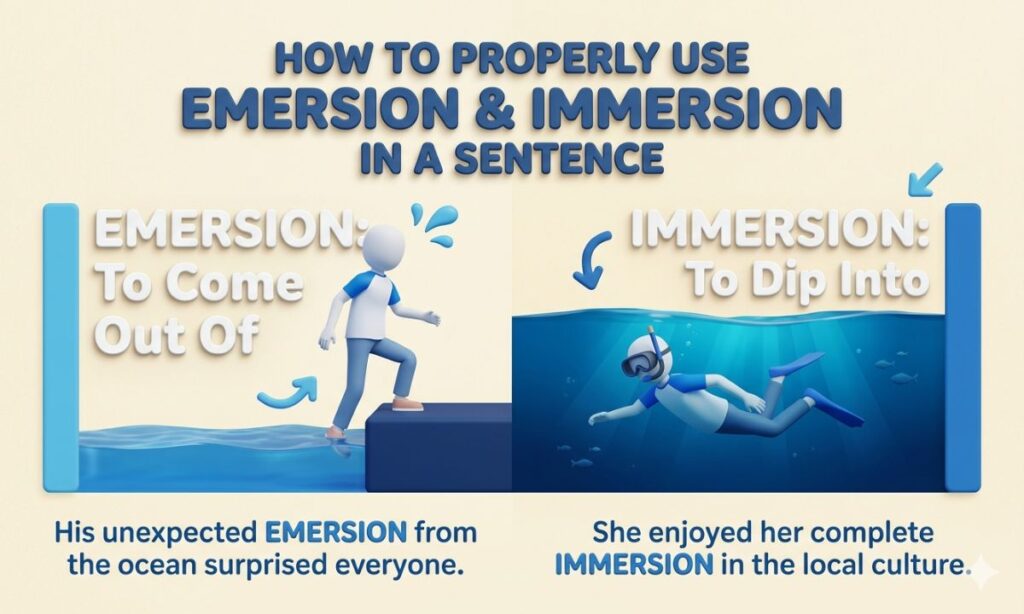
How To Properly Use Emersion And Immersion In A Sentence
Knowing the definition is only half the battle. Knowing how to place each word naturally in a sentence is what separates confident writers from hesitant ones. Let us walk through both words with practical usage guidance.
How To Use The Word Emersion
Use emersion when you want to describe something coming out of a submerged, hidden, or obscured state. It works best in scientific writing, nature descriptions, and formal contexts where you are specifically describing a process of emergence or reappearance.
Tips for using emersion correctly:
- Pair it with subjects that are rising, surfacing, or reappearing
- Use it in scientific, academic, or nature-writing contexts
- Avoid using it as a synonym for “emergence” in casual writing, as it may confuse readers
- Do not use it to describe kitchen tools, language programs, or psychological states
Correct usage examples:
- “The emersion of Jupiter from behind the moon was a breathtaking sight through the telescope.”
- “Scientists recorded the emersion of the coral reef organisms as the tide receded.”
- “The emersion of the sun after three days of clouds lifted everyone’s spirits.”
- “Astronomers planned to observe the emersion of the star from behind Saturn’s rings.”
Common mistake to avoid: Do not write “emersion program” when you mean a language learning program. The correct phrase is always “immersion program.”
How To Use The Word Immersion
Use immersion whenever you want to describe complete involvement in something, whether physical submersion in liquid or deep mental and emotional engagement. This word is versatile, flexible, and fits naturally in hundreds of everyday contexts.
Tips for using immersion correctly:
- Use it for language learning programs, cultural experiences, and educational methods
- Apply it to describe deep focus, flow states, and total absorption in a task
- Use it for physical contexts involving liquids, such as baptism or cooking
- Use it in technology contexts such as virtual reality and gaming
- Always choose immersion, not emersion, when describing a blender
Correct usage examples:
- “Her immersion in Spanish culture helped her become fluent within six months.”
- “The immersion of the vegetables in boiling water speeds up the cooking process.”
- “Total immersion in a new language is one of the fastest ways to achieve fluency.”
- “The VR headset created a full immersion experience that left players breathless.”
- “His immersion in the novel was so complete that he missed three phone calls.”
Emersion Vs Immersion Meaning
At the heart of emersion vs. immersion meaning is a single idea: direction. These two words are essentially antonyms. One means going in; the other means coming out.
When something experiences immersion, it is entering, sinking, being surrounded, or becoming fully absorbed. Think of a diver plunging beneath the surface, a student wrapped up in a new culture, or a chef submerging food in a pot of oil.
When something experiences emersion, it is exiting, rising, resurfacing, or becoming visible again. Think of that same diver breaking through the surface, a star reappearing from behind a planet, or a plant breaking out of the soil after a long winter.
A helpful memory trick:
- Immersion starts with “Im” which sounds like “In.” Something is going IN.
- Emersion starts with “Em” which sounds like “Exit.” Something is coming OUT.
This simple trick works every time and makes emersion vs. immersion meaning crystal clear in any context, from a science paper to a daily conversation.
It is also worth noting that immersion is used both literally and figuratively, while emersion tends to stay closer to its literal, physical meaning in most modern usage. That is why you hear “language immersion” and “cultural immersion” constantly, but “language emersion” is essentially never used.
Immersion Vs Emersion Psychology
In the field of psychology, the contrast between immersion vs. emersion takes on a fascinating and nuanced meaning. These two concepts are used to describe different phases of engagement, reflection, and identity development.
Immersion in psychology refers to a state of deep, total mental and emotional focus. When a person is immersed in an activity, their attention is completely consumed by it. This aligns closely with what psychologist Mihaly Csikszentmihalyi called the “flow state,” where a person is so absorbed in a task that time seems to disappear. Immersion in this context is active, engaged, and present-focused.
Emersion in psychology refers to the reflective phase that follows deep engagement. After a period of immersion, a person surfaces and begins to process, evaluate, and make meaning out of what they experienced. Emersion is therefore more analytical, retrospective, and detached.
In racial identity development theory, emersion also carries specific meaning. Psychologists William Cross and others have described an emersion stage as the period during which a person who has been deeply immersed in exploring their racial or cultural identity begins to emerge and synthesize that identity with a broader worldview.
Key psychological contrasts:
| Aspect | Immersion (Psychology) | Emersion (Psychology) |
| Mental state | Active, engaged, present | Reflective, analytical, retrospective |
| Time orientation | Present-focused | Past-focused |
| Level of engagement | Total absorption | Detached observation |
| Learning style | Experiential and hands-on | Evaluative and interpretive |
| Emotional tone | Excitement, curiosity, focus | Clarity, insight, resolution |
For educators and therapists, understanding both stages matters. A student can be deeply immersed in a project and then need space for emersion to consolidate what they have learned. Both phases work together to create genuine, lasting understanding.
Emersion Vs Immersion Blender
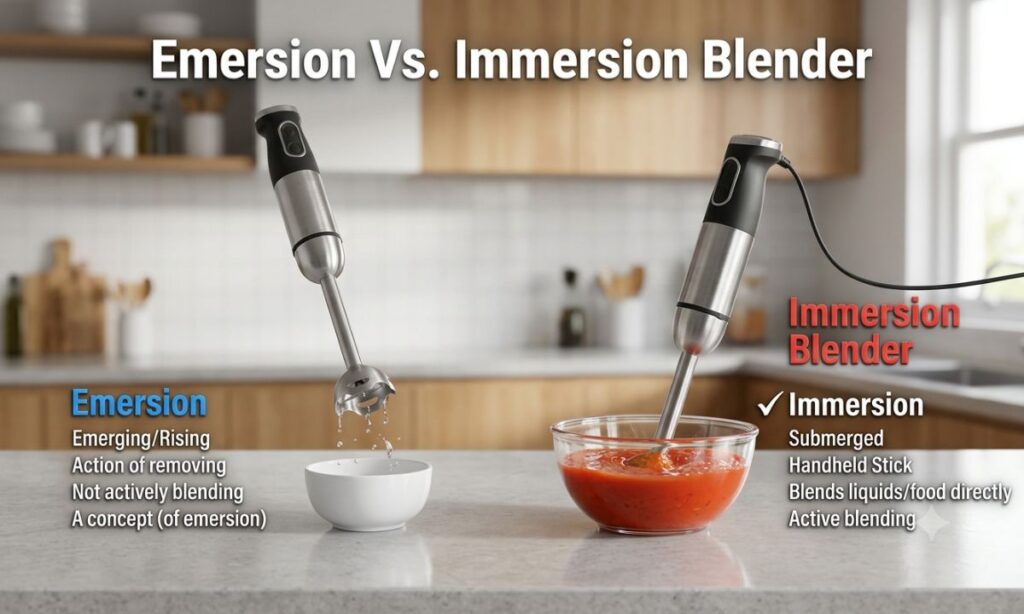
One of the most common places people encounter the word immersion in daily life is the kitchen. The immersion blender is a popular cooking tool, and it is worth clarifying once and for all why it is called that.
An immersion blender is a handheld, electric kitchen device with rotating blades at one end. You use it by plunging the blade end directly into a pot of soup, sauce, smoothie, or any liquid food and blending it right there in the container. The blade is literally immersed in the food. That is where the name comes from.
There is no such thing as an “emersion blender.” This is one of the most frequent spelling errors people make when searching for kitchen tools online. The appliance is always called an immersion blender because the blending mechanism goes into the food, not out of it.
Why the name “immersion blender” makes perfect sense:
- The blades are submerged (immersed) in the liquid
- The tool enters the food to do its work
- The name describes the physical action of plunging in
- It follows the core meaning of immersion: going into something
Other common kitchen and household uses of the word immersion include the immersion heater, which is a device submerged in water to heat it, and immersion cooling in technology, where electronic components are submerged in a special liquid to keep them cool.
Remember: in any kitchen context, the answer in the emersion vs. immersion blender debate is always immersion. Every single time.
Emersion Vs Immersion Synonym
Understanding emersion vs. immersion synonyms helps expand your vocabulary and gives you more flexibility when writing or speaking. Here is a breakdown of words that carry similar meanings to each term.
Synonyms for Emersion:
- Emergence
- Surfacing
- Reappearance
- Rising
- Ascent
- Resurgence
- Coming out
Synonyms for Immersion:
- Submersion
- Absorption
- Engrossment
- Involvement
- Saturation
- Inundation
- Plunge
- Dipping
- Concentration
An important note: while “submersion” and “immersion” are close in meaning when describing physical liquids, there is a subtle difference. Submersion typically implies being fully under a liquid, often unintentionally or completely. Immersion can be partial or total, and it carries the additional figurative sense of deep engagement that submersion does not usually have.
When writing about language learning, culture, or education, your best synonym for immersion is “total involvement” or “deep engagement.” When writing about water or liquids, “submersion” works as a close synonym for the physical sense of immersion.
For emersion, your most reliable synonym in almost every context is simply “emergence.” It is more familiar to most readers and carries the same core meaning of coming out or rising from a submerged or hidden state.
Emersion Vs Immersion: Four Exciting Differences
Now that the definitions and individual contexts are clear, let us look at four specific and fascinating differences between emersion vs. immersion that go well beyond the basic meaning.
Opposite Meanings
The most fundamental difference between emersion vs. immersion is that they are antonyms. They describe actions that move in completely opposite directions. Immersion means going in, sinking, submerging, or becoming absorbed. Emersion means coming out, rising, surfacing, or reappearing.
This is not a subtle difference in nuance. It is a full directional reversal. If you use one when you mean the other, your sentence will say the exact opposite of what you intend. A diver experiencing immersion is going under the water. A diver experiencing emersion is coming back up. These are as different as north and south.
In astronomy, this opposite relationship is especially precise. When a star disappears behind a planet, that is immersion. When the same star reappears on the other side, that is emersion. Scientists use both terms in the same sentence when describing an occultation event, and they mean completely different moments in time.
History And Etymology
Both words share Latin roots, but their prefixes tell the whole story of their difference.
Immersion comes from the Latin word immersio, which itself comes from in (meaning “into”) plus mergere (meaning “to plunge” or “to dip”). Immersion has been used in English since at least the early 1600s. Early uses appear in religious contexts, particularly baptism by full submersion in water. Over time, the word expanded to include figurative meanings of deep engagement.
Emersion comes from the Latin emersio, which comes from ex (meaning “out of”) plus the same root mergere. The prefix shift from “in” to “ex” is the entire key to the difference. Emersion also entered English in the 1600s, primarily through scientific and astronomical writing.
So the etymological difference between emersion vs. immersion is exactly one Latin prefix: “in” (into) versus “ex” (out of). Everything else, including their opposite meanings, flows directly from that single root difference.
Syllables And Pronunciation
Both words have four syllables and share a very similar sound, which is a big part of why people confuse them.
Immersion: ih-MER-zhun (4 syllables) Emersion: ih-MER-zhun (4 syllables)
Wait, they sound almost identical? Yes. The only difference in pronunciation is the very first sound. Immersion begins with a short “ih” sound followed immediately by “m.” Emersion also begins with an “ih” sound but has a tiny hint of the “e” at the front.
In practice, many speakers pronounce them so similarly that the words are nearly indistinguishable in casual speech. This is exactly why emersion vs. immersion confusion is so widespread. The difference in writing is just one letter: an “i” versus an “e” at the start. When you are speaking quickly, that difference almost disappears entirely.
A practical tip: when you hear one of these words in conversation and the speaker does not give you enough context to know which one they mean, ask a clarifying question or watch for contextual clues.
Root Verb
Both emersion and immersion come from the same root verb: the Latin mergere, meaning to plunge, dip, or submerge. In modern English, we still have this root in words like:
- Merge (to blend or combine, often used in traffic or business)
- Submerge (to go below a surface)
- Emerge (to come out or come into view)
- Immerge (an older, rare verb meaning to plunge into)
The root verb difference in emersion vs. immersion comes from the associated modern English verbs:
- The verb form of immersion is immerse: “She decided to immerse herself in the culture.”
- The verb form of emersion is emerge: “The submarine began to emerge from the depths.”
Notice that we do not say “emerse” in modern English. “Emerge” has taken over that role completely. This is one reason emersion sounds unusual to many ears even when used correctly. Its parent verb, emerge, is far more familiar, while immerse is the active verb people reach for when they want to describe the action of deep engagement.
List Of Examples Of Emersion And Immersion Use In Sentences
The best way to lock in your understanding of emersion vs. immersion is to see both words used naturally across a wide range of topics and tones. Here are thirty carefully crafted example sentences divided evenly between the two words.
Emersion Example Sentences:
- The emersion of the moon from behind Earth’s shadow during the lunar eclipse drew a collective gasp from the crowd gathered on the hillside.
- Marine biologists studied the emersion behavior of sea stars during periods of extreme low tide.
- The emersion of the volcanic island from the ocean floor was a geological event that scientists had predicted for decades.
- In the telescope’s lens, the emersion of the distant star from behind Jupiter took less than four seconds but lasted a lifetime in memory.
- The emersion of the submarine was carefully timed to avoid detection by radar systems.
- After months of fog, the emersion of the mountain peaks in clear morning light felt like a miracle.
- The emersion of the whale from the deep water created a dramatic wave that rocked the small research vessel.
- Scientists use the term emersion to describe the reappearance of celestial objects following an occultation.
- The emersion of buried ruins after the flood receded gave archaeologists access to an untouched historical site.
- The poem described the emersion of spring flowers after a long, harsh winter as a kind of resurrection.
- During the experiment, the emersion of the dye-coated bead from the water column was recorded at precisely 14.7 seconds.
- The gradual emersion of truth in the courtroom drama kept the audience riveted until the final scene.
- Ecological researchers documented the emersion of certain amphibian species as seasonal temperatures rose.
- The emersion of the iceberg above the waterline represented only a fraction of its total mass.
- As the tide fell, the emersion of the rock pools revealed a thriving underwater world to the curious children.
Immersion Example Sentences:
- Her two-year immersion in Japanese culture transformed not just her language skills but her entire worldview.
- The immersion of the steel rod in the acid solution was part of a controlled chemistry experiment conducted under strict safety protocols.
- Language immersion programs have consistently shown better results than traditional classroom-based language instruction.
- The immersion blender made it easy to puree the hot tomato soup without moving it to a separate container.
- Total immersion in a creative project often produces the most original and powerful results.
- The baptism ceremony involved full immersion in the river, a practice dating back centuries in their faith tradition.
- Virtual reality gaming has advanced to the point where immersion in digital worlds feels nearly indistinguishable from real experience.
- His immersion in the startup culture of Silicon Valley reshaped his approach to problem-solving and risk-taking.
- The immersion heater in the water tank kept the household supplied with warm water throughout the cold winter months.
- Cultural immersion during a gap year abroad builds empathy, adaptability, and global awareness in young people.
- The professor believed that deep immersion in primary source material was the only true path to historical understanding.
- Her immersion in grief after the loss was profound, but she slowly began to surface as the months passed.
- The documentary filmmaker sought complete immersion in the subject community, living with them for an entire year.
- Full immersion in a second language before the age of ten significantly increases the likelihood of native-level fluency.
- The spa offered a signature immersion therapy experience involving herbal baths, essential oils, and guided meditation.
Frequently Asked Questions About Emersion Vs Immersion
What is the main difference between emersion and immersion?
Emersion means coming out or rising from something, while immersion means going into or being fully absorbed in something. They are antonyms.
Is “emersion” a real word?
Yes, emersion is a valid English word, though it is used far less frequently than immersion and appears mainly in scientific contexts.
Can I say “emersion blender”?
No. The correct term is always “immersion blender” because the blade is submerged into the food during use.
Which is more commonly used, emersion or immersion?
Immersion is far more commonly used across education, psychology, technology, religion, and everyday language. Emersion is mostly found in scientific and technical writing.
What does immersion mean in language learning?
In language learning, immersion refers to a teaching method where students are surrounded by and constantly practice the target language in real or simulated situations.
What does emersion mean in astronomy?
In astronomy, emersion is the reappearance of a celestial body after it has been hidden behind another object during an eclipse or occultation.
Are emersion and immersion synonyms?
No. Emersion and immersion are antonyms, not synonyms. They describe opposite directions of movement or engagement.
How do I remember the difference between emersion and immersion?
Remember: Immersion starts with “I” for “In.” Emersion starts with “E” for “Exit.” One thing goes in, the other comes out.
Read This: Is There Any vs Are There Any: Use Correctly
Conclusion
The debate around emersion vs. immersion might seem like a small vocabulary question, but getting it right reflects genuine care and precision in your use of the English language. These two words are not interchangeable. They are not spelling variations of the same idea. They are true opposites rooted in Latin prefixes that have meant exactly what they mean today for over four hundred years.
Immersion pulls you in: into water, into culture, into language, into a story, into a moment so captivating you lose track of time. Emersion brings you back out: rising to the surface, reappearing after being hidden, stepping back to reflect and see clearly again.
Both processes are valuable. In education, you need immersion to learn and emersion to integrate. In astronomy, you need both moments to describe a complete occultation event. In life, you need both the depth of full involvement and the clarity of stepping back.
Now that you know the full picture of emersion vs. immersion, including their definitions, etymology, psychological applications, kitchen connections, synonyms, and sentence examples, you will never mix them up again. Use immersion when something is going in. Use emersion when something is coming out. It really is that simple, and that powerful.