
If you have ever paused mid-sentence wondering whether to write quantify or qualify, you are in very good company. These two words look similar, sound similar, and both appear frequently in academic writing, business reports, and everyday professional communication. Yet they serve completely different purposes. A strong grasp of quantify vs qualify can instantly sharpen your writing, boost your credibility, and eliminate confusion for your readers.
This guide walks you through everything you need to know about quantify vs qualify: clear definitions, real-world examples, proper usage in sentences, common mistakes, synonyms, contextual applications, exceptions, and hands-on practice exercises. By the time you finish reading, you will never mix these two words up again.
Introduction to Quantify vs Qualify
Language precision matters more than most people realize. In science, business, research, and even everyday conversation, choosing the wrong word can change your entire message. The confusion around quantify vs qualify is extremely common because both words share a similar spelling structure and both appear in professional settings.
Here is the core truth you need to remember: quantify is about numbers and measurement, while qualify is about context, description, or meeting conditions. One deals with data. The other deals with meaning.
When a researcher says, “We need to quantify the results,” they mean assigning numerical values to the findings. When a candidate says, “I qualify for this role,” they mean they meet the required conditions. These are two entirely different ideas, and mixing them up weakens your communication significantly.
Understanding the distinction between quantify vs qualify is essential whether you are writing an academic paper, drafting a business report, preparing a job application, or simply trying to express an idea with precision and clarity.
Define Quantify
Quantify is a verb that means to express or measure something in numerical terms. When you quantify something, you assign it a count, a percentage, a rate, a value, or any measurable unit. The word comes from the Latin root quantus, meaning “how much.”
In plain terms, if you can count it, measure it, or express it as a number, you are quantifying it.
Key characteristics of quantify:
- It involves numbers, data, statistics, or measurable values
- It is commonly used in scientific research, data analysis, and financial reporting
- It provides objective, comparable information
- It answers the question “how much?” or “how many?”
Quick definition: To quantify means to measure or express something as a quantity using numbers or data.
Quantify is the foundation of fields like mathematics, economics, medicine, and engineering. Researchers quantify variables. Businesses quantify revenue. Scientists quantify chemical concentrations. Marketers quantify campaign performance. In each case, the goal is the same: to attach a measurable value to something so it can be analyzed and compared.
Define Qualifying
Qualifying is the present participle of the verb qualify, which has several related but distinct meanings. You can qualify for something (meet eligibility requirements), qualify a statement (add context or limitations), or qualify a word in grammar (modify or describe another word).
The word comes from the Latin qualificare, meaning “to attribute a quality to.”
Key characteristics of qualify and qualifying:
- It involves descriptions, conditions, characteristics, or contextual details
- It is commonly used in grammar, law, job applications, academic writing, and everyday communication
- It answers the question “in what way?” or “under what conditions?”
- It adds nuance, depth, or limitations to a statement
Quick definition: Qualifying means describing, limiting, or adding context to a statement, claim, or concept. It can also mean meeting the conditions or requirements needed for eligibility.
When a writer says, “She qualified her statement by noting that the data was from a small sample,” they are using qualifying in its descriptive, contextual sense. When someone says, “He qualified for the final round of competition,” they are using qualify in its eligibility sense. Both usages share the idea of conditions and qualities rather than numbers.
Read This: Village vs Subdivision: Unraveling Commonly Confused Terms
Quantify vs Qualify Meaning
At the heart of the quantify vs qualify debate is one simple question: are you dealing with numbers or with descriptions?
The table below breaks down the core meaning difference clearly:
| Feature | Quantify | Qualify |
| Core function | Measure using numbers or data | Describe, limit, or meet conditions |
| Root word | Quantity (how much) | Quality (what kind) |
| Answer to | “How much?” or “How many?” | “In what way?” or “Under what conditions?” |
| Used in | Science, statistics, finance, research | Grammar, law, writing, eligibility |
| Example | “Sales increased by 30%” | “Sales increased, though only in the domestic market” |
| Type of information | Objective, numerical | Descriptive, contextual, or conditional |
| Measurement tool | Numbers, percentages, units | Words, descriptions, criteria |
The easiest memory trick to distinguish quantify vs qualify is this:
Quantify comes from quantity and always involves a number. Qualify comes from quality and always involves a description or condition.
Once that connection clicks, the quantify vs qualify meaning becomes clear and intuitive every time you write.
How To Properly Use Quantify and Qualifying Words In A Sentence
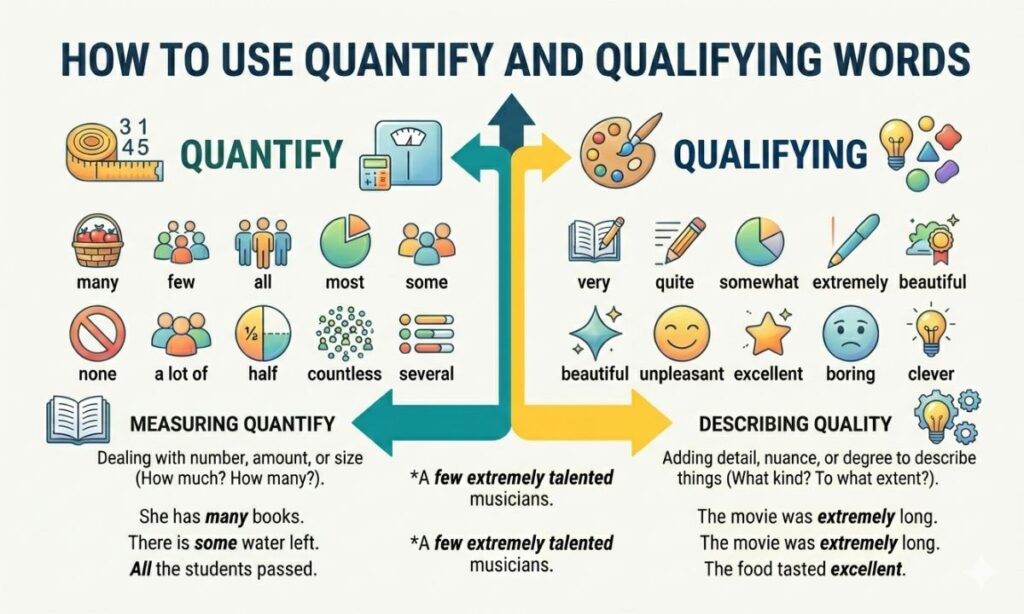
Knowing the definition of a word is only half the battle. Using it correctly in a sentence is where most errors happen. Below are detailed guidance notes on how to use both words with precision and confidence.
How To Use “Quantify” In A Sentence
When you use quantify in a sentence, you should always be attaching a number, a measurable unit, or a data value to something. The sentence should answer the question “how much?” or “how many?”
Tips for using quantify correctly:
- Be specific. Use actual numbers rather than vague terms like “a lot” or “many.”
- Pair it with measurement words like percentage, units, rate, count, or value.
- Use it when the purpose is data analysis, comparison, or objective reporting.
- Avoid using it for emotions, abstract qualities, or subjective experiences.
Sentence structure examples:
- “The study aimed to quantify the effects of sleep deprivation on memory retention.”
- “Analysts struggled to quantify the economic impact of the new regulation.”
- “The marketing team was asked to quantify the return on investment for the campaign.”
- “It is difficult to quantify the exact number of species affected by deforestation.”
- “The lab technician used sensors to quantify the concentration of carbon dioxide in the air.”
In each case, the sentence involves assigning or seeking a numerical measurement. That is the defining signal that quantify is the right word.
How To Use “Qualifying” In A Sentence
When you use qualifying in a sentence, you are adding context, conditions, descriptions, or limits to a statement. The word should signal that additional information is being provided to make a claim more accurate or complete.
Tips for using qualifying correctly:
- Use it when you want to soften, limit, or add nuance to a claim.
- Use it when describing someone meeting conditions or eligibility criteria.
- In grammar, use it to describe words that modify or describe other words.
- Avoid using it when you actually mean assigning a number or measurement.
Sentence structure examples:
- “She made a qualifying statement to clarify that her opinion applied only to small businesses.”
- “Only candidates with five years of experience will be considered for the qualifying round.”
- “The professor added several qualifying remarks to ensure the research findings were not overgeneralized.”
- “Adjectives are qualifying words because they describe and modify nouns.”
- “He passed the qualifying exam and moved on to the next stage of the hiring process.”
In grammar, qualifying words include adjectives and adverbs that restrict, describe, or limit the meaning of the words they modify. This grammatical usage is a key reason quantify vs qualify appears in so many writing and language guides.
More Examples Of Quantify and Qualifying Used In Sentences

Examples Of Using Quantify In A Sentence
Here is a rich set of examples showing quantify used correctly across different contexts:
- “Researchers are trying to quantify the long-term health benefits of a Mediterranean diet.”
- “The finance team was tasked with quantifying the losses incurred during the first quarter.”
- “It is nearly impossible to quantify the value of emotional support during a crisis.”
- “To quantify customer satisfaction, the company used a Net Promoter Score system.”
- “Scientists have begun to quantify the rate of glacial retreat using satellite imagery.”
- “The project manager needed to quantify the hours spent on each task for the budget report.”
- “The team managed to quantify a 40% reduction in production costs after automation.”
- “Economists are working to quantify the impact of inflation on household spending.”
- “Using surveys, researchers quantified the percentage of adults who exercise regularly.”
- “The software helps businesses quantify their carbon footprint in metric tons.”
Examples Of Using Qualifying In A Sentence
Here is a comprehensive set of examples showing qualifying used correctly:
- “She added a qualifying remark, noting that the results were from a pilot study only.”
- “All athletes must pass a qualifying round before advancing to the national championship.”
- “His qualifying statement made clear that his review was based on limited data.”
- “The word ‘very’ is a qualifying adverb that modifies the adjective ‘tall.'”
- “Only those qualifying under the income threshold will receive the benefit.”
- “The lawyer used several qualifying phrases to avoid making absolute claims.”
- “In English grammar, adjectives serve as qualifying words that describe nouns.”
- “The committee set strict qualifying criteria before selecting candidates for the award.”
- “He made a qualifying observation before presenting the final recommendation.”
- “Sales leads go through a qualifying process to determine their likelihood of converting.”
Common Mistakes To Avoid
Using “Quantify” When You Mean “Qualify”
One of the most common errors writers make in the quantify vs qualify debate is using quantify when they actually mean to describe, limit, or add context to something.
Incorrect: “She tried to quantify her disappointment as being mostly related to the lack of communication.”
Correct: “She tried to qualify her disappointment by noting it was mostly related to the lack of communication.”
Here, the speaker is not assigning a number to disappointment. She is explaining the nature and context of it. That is a qualifying action, not a quantifying one.
Using “Qualify” When You Mean “Quantify”
The reverse mistake is just as common. Writers sometimes use qualify when they should be expressing a measurable value.
Incorrect: “The report helped the team qualify the exact percentage of customer churn.”
Correct: “The report helped the team quantify the exact percentage of customer churn.”
A percentage is a number. Any time you are working with a number, rate, amount, or count, quantify is the correct word.
Tips For Avoiding These Mistakes
Follow these practical guidelines to keep your use of quantify vs qualify accurate every time:
- Ask yourself a simple question. Am I measuring something? Use quantify. Am I describing or adding context? Use qualify.
- Look for numbers. If there is a number, percentage, count, or rate involved, quantify is almost always correct.
- Think about the root word. Quantify comes from quantity. Qualify comes from quality. This root connection is the best mental shortcut.
- Read the sentence aloud. If the sentence sounds like a measurement statement, use quantify. If it sounds like a description or condition, use qualify.
- Rewrite the sentence. Before finalizing, rewrite using the opposite word and see if the meaning changes. If it does, you have chosen correctly. If it still makes sense, reconsider your choice.
Quantify vs Qualify Synonym
Understanding synonyms for both words can further strengthen your grasp of quantify vs qualify and help you vary your language naturally.
| Word | Common Synonyms |
| Quantify | Measure, calculate, assess numerically, count, enumerate, evaluate statistically, compute |
| Qualify | Describe, characterize, limit, modify, specify, condition, restrict, contextualize, clarify |
When you see any of these synonyms in a sentence, they can help you determine whether the original sentence was intended to be a quantify context or a qualify context.
Context Matters
One of the most important lessons in the quantify vs qualify discussion is that context determines everything. The same subject can be both quantified and qualified, but for different purposes.
Quantify in Context
Quantify is most at home in the following contexts:
- Scientific research: Measuring variables, expressing experimental results in numbers
- Business and finance: Reporting revenue, tracking metrics, analyzing data
- Healthcare and medicine: Measuring dosages, blood counts, recovery rates
- Technology: Tracking performance metrics, speed, uptime, error rates
- Environmental science: Measuring pollution levels, carbon emissions, biodiversity counts
In all of these contexts, the goal of quantify is to produce data that is objective and comparable. Without quantification, analysis becomes vague and unreliable.
Qualifying in Context
Qualifying is most at home in these contexts:
- Academic writing: Adding nuance, limitations, and conditions to research findings
- Legal writing: Restricting the scope of claims or statements
- Grammar: Adjectives and adverbs that describe or modify other words
- Job applications and hiring: Meeting the eligibility criteria for a position
- Marketing and sales: Determining whether a prospect meets the criteria to be a strong lead
- Debate and argumentation: Adding conditions to strengthen or protect an argument
Qualifying adds depth to communication. It prevents overgeneralizations and makes statements more accurate by acknowledging conditions, exceptions, and limitations.
Examples
The following side-by-side examples show how quantify vs qualify work differently even when discussing the same topic:
Topic: Employee Performance
- Quantify: “The employee completed 47 tasks in the reporting period, a 15% increase over the previous quarter.”
- Qualify: “The employee performed well, particularly in client-facing roles where communication skills were most valued.”
Topic: Marketing Campaign
- Quantify: “The campaign generated 2,400 new leads and achieved a 3.8% conversion rate.”
- Qualify: “The campaign was successful, though its impact was stronger among younger demographic segments.”
Topic: Environmental Impact
- Quantify: “Industrial runoff contributed to a 22% increase in water toxicity levels downstream.”
- Qualify: “Industrial runoff significantly worsened water quality, especially near agricultural zones.”
Each pair shows how the same subject can be expressed either through numbers (quantify) or through descriptive, contextual language (qualify).
Exceptions To The Rules
Like most rules in the English language, the guidelines around quantify vs qualify come with a few notable exceptions worth understanding.
Exceptions For Quantify
1. Quantifying abstract concepts
In some academic and philosophical discussions, writers attempt to quantify abstract or subjective concepts. For example, happiness research attempts to quantify wellbeing using scales and indexes. Cognitive science attempts to quantify attention spans through reaction time measurements.
In these cases, quantify is used even when the subject seems inherently non-numerical. The key is that researchers are using structured measurement tools to assign proxy values to complex concepts.
Example: “Psychologists have developed tools to quantify subjective wellbeing using self-reported happiness scales.”
2. Approximate quantification
Quantify does not always require an exact number. In some contexts, even approximations count as quantification if they fall within a defined range.
Example: “We can only loosely quantify the ancient population of the city, estimating it somewhere between 50,000 and 200,000 inhabitants.”
Exceptions For Qualifying
1. Qualifying in competitive contexts
In sports and competitions, qualifying refers to passing a threshold to advance. Here, the word paradoxically involves meeting a measurable standard, such as a specific time, score, or rank.
Example: “She ran the 100 meters in 10.8 seconds, qualifying her for the regional finals.”
In this case, qualifying is linked to a numerical threshold, which creates an overlap with quantify territory. The distinction is that qualifying here refers to the act of meeting a condition (the threshold), not to measuring the number itself.
2. Qualifying statements in science
When scientists qualify their findings, they are not abandoning measurement. Instead, they are adding important contextual boundaries to quantified data.
Example: “The data shows a 12% increase in stress markers, though the researchers were careful to qualify the findings by noting the small sample size of 30 participants.”
Here, both words are present in the same sentence and both are correct. The 12% increase is quantified. The note about sample size qualifies the claim.
Examples
| Situation | Word Used | Why It Works |
| Expressing a happiness index score | Quantify | Assigns a numerical proxy to an abstract concept |
| Approximating ancient population range | Quantify | Uses numeric range as measurement |
| Passing a timed sports threshold | Qualify | Meets a condition, even if that condition is a number |
| Adding a limitation note to a statistic | Qualify | Describes the condition or scope of the data |
Practice Exercises
Now that you have a thorough understanding of quantify vs qualify, it is time to test your knowledge. These exercises will help cement the difference and give you the confidence to use both words correctly in your own writing.
Exercise 1: Quantify Or Qualify?
Read each sentence and decide whether the missing word should be quantify or qualify. Answers are provided at the end.
- “The study attempted to ________ the number of microplastics found in drinking water samples.”
- “She added a ________ remark to clarify that her recommendation applied to small firms only.”
- “Investors need to ________ the potential return before committing capital.”
- “Only applicants who ________ based on the income criteria will be considered.”
- “The team used sensor data to ________ the average temperature fluctuation over six months.”
Answers: 1. quantify | 2. qualifying | 3. quantify | 4. qualify | 5. quantify
Exercise 2: Rewrite The Sentence
Each of the following sentences contains an error in the use of quantify or qualify. Rewrite each sentence with the correct word.
- “We need to qualify the exact percentage of returning customers.”
- “The coach tried to quantify his concerns by noting that the team lacked communication.”
- “The scientist quantified her findings by noting they were based on preliminary data only.”
- “Only those who quantify under the requirements will be shortlisted.”
Corrected versions:
- “We need to quantify the exact percentage of returning customers.”
- “The coach tried to qualify his concerns by noting that the team lacked communication.”
- “The scientist qualified her findings by noting they were based on preliminary data only.”
- “Only those who qualify under the requirements will be shortlisted.”
Exercise 3: Fill In The Blank
Complete each sentence by choosing the correct form of either quantify or qualify.
- “The HR department developed a ________ process to screen candidates before interviews.” (qualifying / quantifying)
- “Economists are struggling to ________ the full cost of the supply chain disruption.” (qualify / quantify)
- “The adjective ‘brilliant’ serves as a ________ word that describes the noun ‘student.'” (quantifying / qualifying)
- “Before drawing conclusions, the analyst added several ________ statements to the report.” (quantifying / qualifying)
- “Environmental agencies worked to ________ carbon emissions from industrial plants.” (qualify / quantify)
Answers: 1. qualifying | 2. quantify | 3. qualifying | 4. qualifying | 5. quantify
Read This: Skiid or Skied: Which Spelling Is Correct and When to Use It?
Conclusion
The quantify vs qualify distinction comes down to one clear principle: numbers vs descriptions. When you assign a measurable value to something, you quantify it. When you add context, conditions, or characteristics, you qualify it. These two words serve entirely different functions in language, and using them correctly signals clarity, intelligence, and precision in your writing.
Remember the root word trick: quantify comes from quantity and always involves a number. Qualify comes from quality and always involves a description or condition. That simple connection makes the quantify vs qualify choice easy every time.
Strong writers know when to measure and when to explain. Mastering quantify vs qualify is a small but powerful step toward clearer, more authoritative communication in every context, whether academic, professional, or everyday. Practice the exercises, study the examples, and you will use both words with total confidence going forward.