
If you have ever typed the word and stopped to wonder whether it should be skiid or skied, you are not alone. This is one of those small spelling questions that trips up native speakers, English learners, bloggers, students, and even professional writers. The answer is straightforward once you understand the grammar rule behind it, but the confusion is real and surprisingly common. People writing about winter vacations, ski resorts, sports stories, or travel journals often pause at this exact moment and second-guess themselves.
In this complete guide, you will get a fast answer, understand the grammar rule behind it, explore the origin and pronunciation of the word, look at real-life examples, and learn why one spelling has never existed in any English dictionary. Whether you are writing a school essay, a social media caption, or a professional travel article, this guide will eliminate all doubt. The question of skiid or skied will never slow you down again.
Skiid or Skied – Quick Answer
Skied is the correct spelling. Skiid is not a real English word.
Here is the one-line rule you need:
The past tense of the verb ski is skied. You simply add -ed to the base verb. No letter doubling. No extra vowel. Just ski + ed = skied.
Every major English dictionary confirms this, including Oxford, Cambridge, Merriam-Webster, Collins, and Dictionary.com. None of them list “skiid” as a valid form. If your spell-checker underlines “skiid” in red, that is exactly why.
| Question | Answer |
| Correct past tense of ski | Skied |
| Is skiid a real word? | No |
| Used in British English? | Yes, skied |
| Used in American English? | Yes, skied |
| Past participle of ski | Skied |
| Present participle | Skiing |
So whenever the debate of skiid or skied crosses your mind, remember: only one of those is real English.
Skiid
Let us talk about “skiid” directly so there is absolutely no confusion. Skiid does not exist in the English language. It is not found in any dictionary, grammar guide, or style manual. It is not an accepted regional spelling in British English, American English, Australian English, or Canadian English. It has no history of standard usage in any published text or academic writing.
So why does it appear at all? People write “skiid” because they hear the long “ee” sound in the word and assume that doubling the vowel is necessary, similar to how some other words work. This is a natural instinct, but it leads to a spelling error in this case.
There is also confusion caused by the way some verbs double their final consonant before adding a suffix. Words like “run” become “running,” “sit” becomes “sitting,” and “stop” becomes “stopped.” Learners sometimes apply this pattern broadly, but the doubling rule in English applies to consonants in specific conditions, not to vowels.
In summary, skiid is:
- Not a word in any English dictionary
- Not accepted in formal or informal writing
- Not a regional spelling variant
- A common typing mistake or grammar misunderstanding
- Always flagged as an error by spell-check software
If you have written “skiid” before, no need to feel embarrassed. It is a very common confusion, and now you know the correct form is always skied.
Skied
Skied is the correct, standard, universally accepted past tense and past participle of the verb “ski.” It is used the same way in every English-speaking country in the world. Oxford defines it clearly: skied is what you say or write when referring to the act of skiing in the past.
Here is how “skied” fits into the complete conjugation of the verb ski:
| Verb Form | Example |
| Base form (infinitive) | ski |
| Present simple (third person) | skis |
| Past simple | skied |
| Past participle | skied |
| Present participle | skiing |
Notice something interesting: the present participle is “skiing,” which does retain a double-i appearance. That is because when you add “-ing” to a verb ending in a silent or single vowel, the vowel from the base word combines with the suffix. So “ski” + “ing” gives you “skiing” with two separate i letters, one from the root and one from the suffix. However, in the past tense, that same logic does not apply. You simply attach “-ed” to form “skied.”
Skied is used correctly in sentences like:
- She skied down the slope without hesitating.
- We skied in Austria last February.
- He has skied competitively for over a decade.
- They skied through a blizzard and still finished the race.
- I had never skied before my trip to Switzerland.
All of these are grammatically correct, natural, and widely accepted in any English writing context.
Read This: Catagory Vs Category: The Correct Spelling You Must Know
Skiid or Skied Meaning
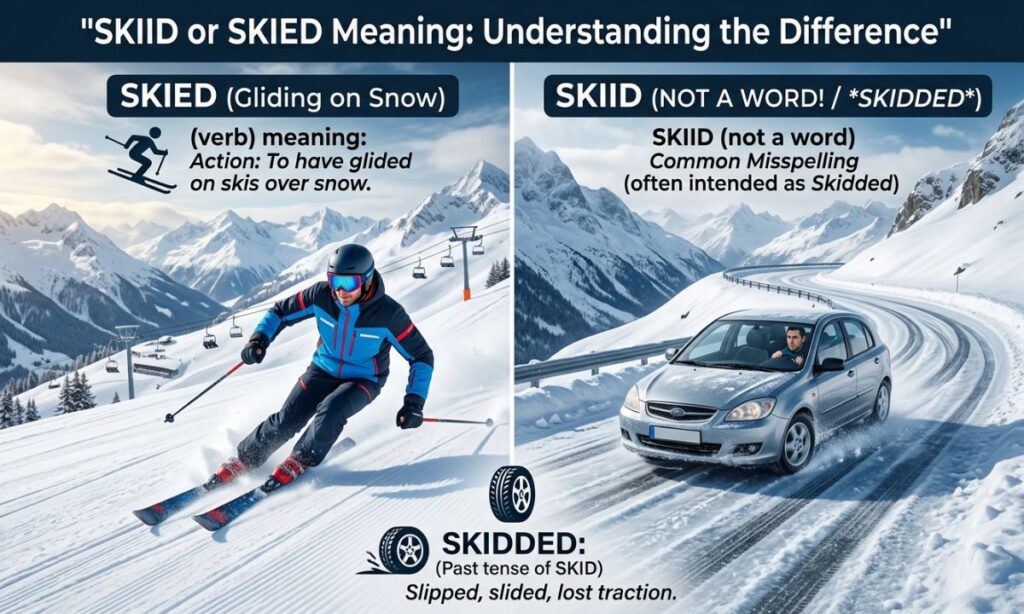
When people search for skiid or skied meaning, they are typically asking two things at once. First, they want to confirm the correct spelling. Second, they want to understand what the word actually means.
Skied carries a clear, direct meaning:
To have performed the action of skiing in the past. Skiing refers to gliding over snow on narrow boards called skis, typically for sport, recreation, or transportation.
In sentence form, “skied” is used to describe a completed action. It works both as a simple past tense verb and as a past participle:
As simple past tense: “I skied for the first time when I was ten years old.”
As past participle with “have”: “She has skied in more than fifteen countries.”
As past participle with “had” (past perfect): “They had skied the entire trail before the storm arrived.”
So when the question of skiid or skied meaning comes up, the answer is simple: only “skied” carries meaning because only “skied” is a real word. “Skiid” means nothing in English because it is not recognized as part of the language.
Skiid or Skied Slang
The word skied does appear occasionally in informal and slang usage, though this is separate from its standard grammatical meaning.
In some informal American dialects and urban slang, “skied” has been used loosely to mean being under the influence of a substance, particularly cocaine. This usage appears in informal speech and some online communities and is tied to the idea of being elevated or flying high, similar to how skiing might feel. It is worth noting this usage is informal, regionally specific, and not part of standard English vocabulary.
In the skiing and snowboarding community itself, slang like “I skied some insane pow today” or “we skied fresh lines all morning” is completely standard and simply refers to the sport.
From a grammar standpoint, the slang conversation of skiid or skied has the same answer: if you are using either word informally, the correct form remains “skied.” Writing “skiid” in slang contexts does not make it correct simply because the context is casual.
Key takeaway: Whether formal or informal, slang or academic, the correct spelling is always skied.
Skiid or Skied Slang Reddit
On Reddit, particularly in communities like r/grammar, r/EnglishLearning, r/skiing, and r/learnEnglish, the question of skiid or skied comes up regularly. Users searching for quick spelling confirmation often find discussions where the community is unanimous: “skiid” is wrong, “skied” is correct.
Some Reddit threads touch on the slang uses of “skied” as well, particularly in subreddits that discuss street culture, music lyrics, or informal language. In those discussions, the word “skied” may appear in a non-sporting context, but again, the spelling remains the same.
Reddit grammar communities generally explain the rule this way: English verbs that end in a vowel followed by “-i” form their past tense by replacing the final vowel with “-ied” or simply adding “-ed.” There is no English rule that doubles a vowel in the past tense, so “skiid” never makes grammatical sense.
Common responses seen in Reddit discussions about skiid or skied:
- “Skied is 100% correct. Skiid is never used.”
- “Think of it like ‘die’ becomes ‘died,’ not ‘diied.'”
- “Your spellchecker is right. Skied is the word you want.”
- “Skiid looks weird because it is. Stick with skied.”
Skiid or Skied Pronunciation
Pronunciation is actually one of the reasons people get confused about skiid or skied in the first place. Let us break it down clearly.
Skied is pronounced: /skaɪd/
That is one syllable. It rhymes with:
- Tried
- Cried
- Dried
- Fried
- Died
- Tied
The vowel sound is a long “eye” sound, not a long “ee” sound. This is important because some people hear “skied” and think it sounds like “skee-d,” which makes them want to write “skiid” to reflect that double-vowel sound. However, the standard pronunciation is /skaɪd/, like “sky” + “d.”
Collins English Dictionary confirms the pronunciation as /skaɪd/ when referring to the past tense of ski (the sport). Interestingly, Collins also notes that “skied” can be pronounced /skiːd/ when it refers to the past tense of “sky” (used in cricket to describe hitting a ball high). These are two different words with two different pronunciations.
For the purposes of winter sports, travel writing, and everyday conversation about skiing, the pronunciation is always /skaɪd/.
Summary:
| Word | IPA Pronunciation | Rhymes With |
| Skied (past tense of ski) | /skaɪd/ | Tried, dried, cried |
| Skiing (present participle) | /ˈskiːɪŋ/ | Being, seeing |
The Origin of Ski and Skied
Understanding where the word “ski” comes from helps explain why its past tense looks the way it does.
Ski entered the English language in the mid-18th century, borrowed from Norwegian. The Norwegian word “ski” itself came from Old Norse skíð, which meant “a billet of wood” or “a snowshoe.” The Old Norse term was used to describe a long strip of wood used for gliding over snow, which is essentially what a ski still is today.
When English adopted “ski” as a verb, it treated it as a regular English verb and applied the standard conjugation rules. That means adding “-ed” to form the past tense, which gives us “skied.”
The word was integrated into English verbal structure quickly. Historical written records show “skied” appearing in travel accounts from as early as the 1890s. By the early 20th century, skiing had become popular in Europe and North America, and “skied” was firmly established as the correct past tense.
Because “ski” was borrowed from a foreign language and adapted to English rules, there was never a phase where “skiid” competed with “skied.” The word went straight into the English verbal system with the standard “-ed” ending, and that is how it has remained ever since.
The Old Norse origin also explains why the word ends in “-i” rather than a consonant. Old Norse had many words ending in vowel sounds, and when those words entered English, they kept their endings but followed English grammar from that point forward.
British English vs American English Spelling
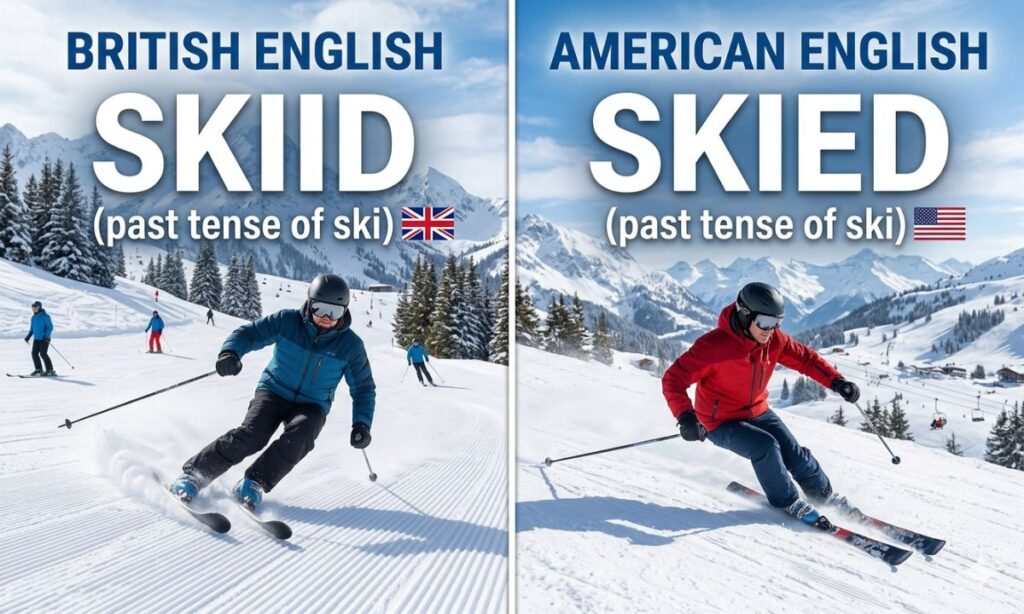
One of the most frequent concerns people have when asking about skiid or skied is whether the spelling differs between British and American English. This is a fair question because many words do differ, such as “colour” vs “color,” “travelling” vs “traveling,” or “analyse” vs “analyze.”
However, skied is spelled identically in British English and American English. There is no regional variation here. Every major dictionary on both sides of the Atlantic agrees:
| Dictionary | Entry | Verdict |
| Oxford English Dictionary (UK) | skied | Correct |
| Cambridge Dictionary (UK) | skied | Correct |
| Merriam-Webster (US) | skied | Correct |
| Dictionary.com (US) | skied | Correct |
| Collins English Dictionary (UK/US) | skied | Correct |
Whether you are writing for a British audience or an American one, whether you are a student in London or a travel blogger in New York, the answer is the same: skied is the only correct form.
The absence of regional variation here is actually reassuring. With skiid or skied, you never have to worry about your audience’s location. Skied works everywhere.
Which Spelling Should You Use?
This might be the simplest section of the entire article.
Always use skied. Never use skiid.
There is no situation, context, audience, or writing style in which “skiid” would be the appropriate choice. It is not accepted in:
- Academic writing
- Journalism and news articles
- Social media posts
- Travel blogs
- Sports writing
- Text messages
- Formal letters
- Fiction writing
- Any other form of English communication
Skied is appropriate everywhere. It is the correct form in all tenses, all styles, and all audiences.
If you are ever uncertain, here is a quick memory trick: think of similar verbs that end in vowel sounds:
- Die becomes died (not diied)
- Tie becomes tied (not tiied)
- Lie becomes lied (not liied)
- Ski becomes skied (not skiid)
The pattern is consistent. English simply adds “-ed” without doubling the vowel. Once you see this pattern, the question of skiid or skied becomes obvious every time.
Common Mistakes with Skiied or Skied
Beyond the main confusion of skiid or skied, there is another misspelling that appears occasionally: skiied. This is also incorrect, though it has a slightly different logic behind it.
Some writers know that the present participle is “skiing” and assume that if the present form has a double-i, then maybe the past tense should too. This leads to “skiied,” which is wrong for the same reason “skiid” is wrong: English does not double the vowel i in past tense formation.
Here is a breakdown of the most common mistakes:
| Incorrect Form | Why People Write It | Correct Form |
| Skiid | Doubling vowel like “running” | Skied |
| Skiied | Assuming past tense mirrors “skiing” | Skied |
| Ski’d | Using apostrophe for contraction | Skied |
| Skid | Confusing with a different word | Skied |
Other grammar mistakes to avoid with “skied”:
- Confusing “skied” with “skid” — “Skid” is a completely different word meaning to slide uncontrollably. A car skids on ice; a person skied down a mountain.
- Using “skied” incorrectly in present tense — Do not write “She skied to work every day” to describe a current habit. Use “She skis to work every day” for present habits.
- Forgetting the past participle usage — Many writers forget that “skied” works with helping verbs: “I have skied,” “she had skied,” “they have never skied.”
- Writing “went skiing” when “skied” works fine — Both are grammatically correct, but “skied” is often more concise.
Skied in Everyday Examples
Seeing skied in real sentences helps lock in the correct usage. Here are varied examples across different writing styles:
Casual Conversation
- “Have you ever skied before? It is honestly the best feeling.”
- “We skied all morning and had hot chocolate by the fire in the afternoon.”
- “He skied so fast down that hill I thought he was going to fly off the edge.”
Travel Writing
- “We arrived in Innsbruck on a Wednesday and skied the famous Nordkette trails by Thursday morning.”
- “She had skied in the Dolomites twice before, but this trip felt entirely different.”
- “The entire family skied together for the first time during their holiday in Canada.”
Sports and News Writing
- “The Olympic contender skied a clean run in the second heat and moved into first place.”
- “He skied under extreme weather conditions and still posted the fastest time of the day.”
- “The athlete skied her way into history, becoming the youngest champion in the event’s history.”
Academic Writing
- “Participants skied a designated course three times to establish a performance baseline.”
- “Subjects who skied regularly reported lower rates of stress and higher physical fitness scores.”
Social Media Style
- “Just skied my first black diamond and survived. Barely.”
- “We skied fresh powder this morning and it was absolutely unreal.”
All of these examples use skied correctly. Notice how naturally it fits every context. That is the advantage of using the right word: it never draws attention to itself.
Skiid or Skied – Google Trends and Usage Data
When you look at actual usage data for skiid or skied, the numbers make the answer even clearer.
Google Trends shows that searches for “skied” consistently and dramatically outperform searches for “skiid” across all time periods and all geographic regions. The word “skied” appears in billions of web pages, news articles, books, and academic publications. The word “skiid” appears almost exclusively in discussions about whether it is correct (the answer always being no).
Google’s own autocorrect and spellcheck systems automatically flag “skiid” as a spelling error and suggest “skied” as the correction. This is consistent across Google Docs, Gmail, Google Search, and all other Google products.
In the Google Books Ngram Viewer, which tracks word frequency in published books over time, “skied” shows consistent usage going back to the late 1800s. The word “skiid” does not register any meaningful usage in published books at any point in history.
Whenever anyone searches for skiid or skied online, the results consistently point to the same answer. Search engines themselves have learned which is right.
Key usage insights:
- “Skied” appears in every major English corpus and database
- “Skiid” does not appear in any published dictionary or grammar reference
- Spell-check software universally corrects “skiid” to “skied”
- Google Search autocomplete suggests “skied” and does not recognize “skiid” as a valid query
- Content using “skied” ranks in Google; content using “skiid” is often penalized for spelling errors
This data reinforces what grammar tells us: in the debate of skiid or skied, skied is the only option that exists in real, standard, published English.
Comparison Table: Skied or Skiied
Here is a full comparison table to serve as a quick reference for the most common spelling confusions around this word:
| Feature | Skied | Skiid | Skiied |
| Real English word? | Yes | No | No |
| Found in dictionaries? | Yes | No | No |
| Past tense of ski? | Yes | No | No |
| Past participle of ski? | Yes | No | No |
| Accepted in formal writing? | Yes | No | No |
| Accepted in informal writing? | Yes | No | No |
| British English usage? | Yes | No | No |
| American English usage? | Yes | No | No |
| Spell-check approved? | Yes | No | No |
| Correct in academic writing? | Yes | No | No |
| Grammar rule it follows | Regular verb + ed | Does not exist | Does not exist |
The table makes it visually clear. In any column you look at, only skied qualifies. The debate of skiid or skied has a clean, consistent, one-sided answer.
Read This: Implicit vs Complicit: Clear Differences Explained With Practical Examples
Conclusion
The question of skiid or skied has one clear, permanent answer: skied is correct, and skiid is not a word. This holds true across every variety of English, every writing style, every audience, and every context you can imagine.
The confusion around skiid or skied exists because English spelling rules can feel inconsistent, and the double-i in “skiing” naturally makes some writers wonder if “skiid” might work too. But it does not. English forms the past tense of “ski” by simply adding “-ed,” following the same clean pattern as “die → died” and “tie → tied.”
Whether you are writing a travel blog about the Alps, a sports article about an Olympic athlete, a school assignment, or a casual post about your weekend on the slopes, the word you want is always skied. It is the only form recognized by dictionaries, accepted by grammar guides, approved by spell-checkers, and used by English speakers worldwide.
Now that you know the rule, the answer to skiid or skied will come to you instantly every time. And the answer is always the same: skied, without exception. Bookmark this page, share it with a friend who is also wondering about skiid or skied, and never second-guess this spelling again.