

If you have ever tried to describe where you live and felt unsure whether to call it a village or a subdivision, you are not alone. The village vs subdivision debate confuses many people, whether they are writing a real estate listing, filling out a school form, or simply telling a friend about their neighborhood. These two terms look similar on the surface because both describe places where people live. However, they carry very different meanings, histories, and lifestyle implications.
Understanding the village vs subdivision difference is not just a grammar exercise. It shapes how others picture your community, affects legal and municipal records, and even influences how you feel about where you call home. In this article, we break down both terms with clear definitions, real-world examples, common mistakes, and useful exercises so you can use each word with total confidence.
Quick Answer: Village vs Subdivision at a Glance
| Feature | Village | Subdivision |
| Origin | Grows naturally over time | Planned and built by a developer |
| Location | Rural or semi-rural areas | Urban or suburban areas |
| Population | Small, usually a few hundred to a few thousand | Varies, often denser |
| Governance | Local council, mayor, or barangay | Homeowners Association (HOA) or private management |
| Infrastructure | Organic, may be less structured | Modern, uniform, pre-designed |
| Community feel | Close-knit, traditional | Structured, neighbor-friendly |
| Land ownership | Communal or government-managed | Private lots owned by residents |
| Philippines usage | Small barangay community | Gated community or housing project |
Define Village
A village is a small, naturally formed community typically located in a rural or semi-rural area. It grows organically over time, meaning people settle there gradually without a single master plan guiding its layout. Villages are one of the oldest forms of human settlement in history. They often develop around shared resources like farmland, a river, a marketplace, or a place of worship.
In a village, residents usually know each other personally. Life moves at a slower pace. The population is small, generally ranging from a few hundred to a few thousand people. A village may have its own local government, such as a municipal council or, in the Philippines, a barangay captain. Residents share strong cultural traditions, celebrate local festivals, and often rely on one another for daily needs.
Key characteristics of a village include:
- Located in rural or semi-rural surroundings
- Small population with a close-knit community feel
- Governed by a local council, mayor, or barangay official
- Developed naturally without a single developer or master plan
- Strong cultural identity, traditions, and shared history
- May include a central gathering space like a town square or church courtyard
- Residents often engage in farming, fishing, or traditional crafts
The word village comes from the Old French term “village,” which itself came from the Latin “villa,” meaning a country house or estate. Over centuries, it evolved to describe any small rural settlement. Today it is used globally, though its legal definition varies by country and region.
Define Subdivision
A subdivision is a planned residential development where a larger parcel of land is divided into individual lots, each intended for a home or group of homes. Unlike a village, a subdivision does not grow naturally. A real estate developer purchases raw land, installs infrastructure such as roads, water lines, drainage, and electricity, then sells individual lots to homeowners or builds houses directly for sale.
Subdivisions are typically found in urban or suburban areas. They are designed with a clear layout from the beginning, often following a grid pattern or a carefully mapped street system. Modern subdivisions usually include shared amenities such as parks, playgrounds, covered parking, clubhouses, and sometimes swimming pools or basketball courts.
Key characteristics of a subdivision include:
- Planned and built by a private developer
- Located in urban or suburban areas
- Organized layout with uniform streets, lot sizes, and architectural styles
- Managed by a Homeowners Association (HOA) that enforces community rules
- Modern infrastructure built in before residents move in
- May be gated or open to the public
- Residents own individual lots with clear title deeds
- Often has a formal name chosen by the developer
The word subdivision comes from the verb “subdivide,” which means to divide something that has already been divided into even smaller parts. In real estate language, it refers specifically to the act of breaking a large piece of land into smaller residential plots.
Read This: Skiid or Skied: Which Spelling Is Correct and When to Use It?
Village vs Subdivision Example
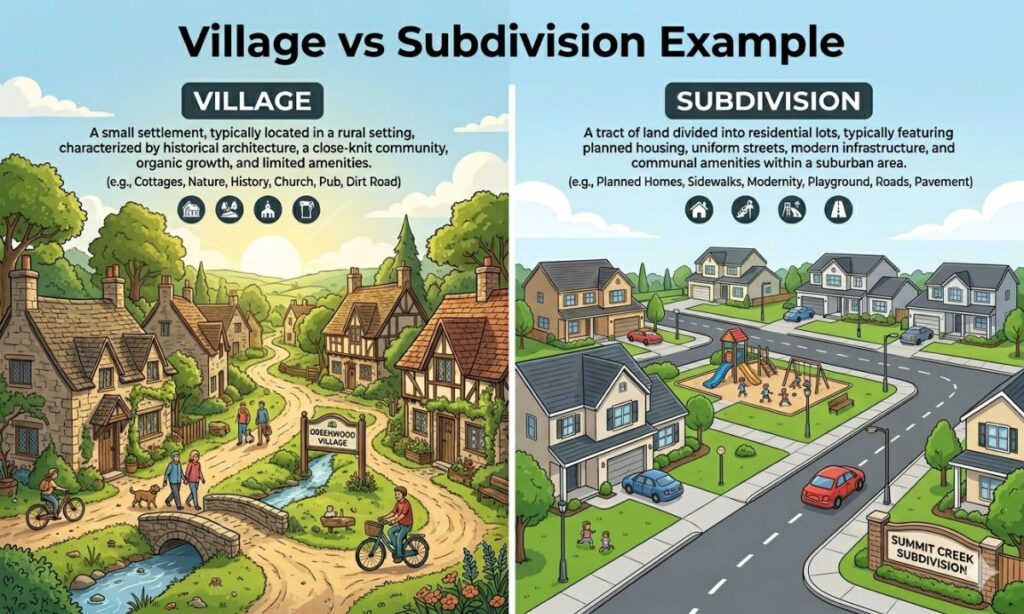
Understanding village vs subdivision is easier when you look at real-life scenarios side by side.
Example 1: The Rural Setting
Imagine a small community nestled beside rice paddies on the outskirts of a province. The community has existed for over a hundred years. Families have farmed the same land for generations. There is a small chapel at the center, a public market open every Saturday, and children play freely in unpaved streets. The community elects its own local leaders every three years. This is a village. It was never built by a developer. It simply grew as families settled, built homes, and created a shared life.
Example 2: The Urban Development
Now picture a gated complex just outside a major city. A real estate company purchased 10 hectares of previously empty land five years ago. They installed concrete roads, a drainage system, and underground power lines. They built 200 identical two-story houses arranged in neat rows, each with its own lot title. Residents pay monthly dues to an HOA that maintains the clubhouse, guards the entrance, and enforces rules about parking and home renovations. This is a subdivision.
Both places have houses. Both places have people. But they are fundamentally different in how they came to be, how they are managed, and what kind of life they support. The village vs subdivision difference becomes clear the moment you examine the origin and governance of each community.
Village vs Subdivision in the Philippines
The village vs subdivision topic has a uniquely Filipino dimension that is worth exploring in depth. In the Philippines, both terms are widely used in everyday conversation, but they carry specific local meanings that differ slightly from Western definitions.
In the Philippine context, the word village is commonly used to describe an upscale gated community, often in Metro Manila or other major cities. Well-known examples include Forbes Park, Dasmariñas Village, Urdaneta Village, and San Lorenzo Village in Makati. These are exclusive residential enclaves with high-end homes, tight security, and premium amenities. Filipino use of the word village, especially when referring to gated enclaves, has very little to do with the traditional, rural meaning of the word. It has taken on a prestige connotation.
The word subdivision in the Philippines typically refers to a planned housing project developed by a real estate company such as Ayala Land, DMCI Homes, Filinvest, or Vista Land. These range from affordable housing developments to mid-range and high-end residential communities. A Philippine subdivision may be gated or open, and it is governed by an HOA called a Homeowners Association.
Here is how village vs subdivision works in the Philippine context:
| Aspect | Village (Philippines) | Subdivision (Philippines) |
| Common usage | Upscale or exclusive gated community | General planned housing development |
| Examples | Forbes Park, Dasmariñas Village | BF Homes, Filinvest, Vista Residences |
| Price range | High to ultra-high end | Affordable to high end |
| Security | Usually very high, with multiple security layers | Varies by developer and tier |
| Governance | Homeowners Association | Homeowners Association |
| Developer | Private, exclusive | Real estate companies |
It is worth noting that the Philippines’ Housing and Land Use Regulatory Board (HLURB), now the Human Settlements Adjudication Commission, regulates subdivision developments under the Subdivision and Condominium Buyers Protective Decree (P.D. 957). Under Philippine law, “subdivision” has a formal legal definition tied to real estate development and buyer protections. The informal use of “village” for upscale gated communities has no equivalent legal standing but is widely understood in casual and real estate conversations.
How To Properly Use The Words In A Sentence
Choosing between village vs subdivision in your writing or speech depends on what kind of community you are describing. Here are practical rules to help you use each word correctly.
How To Use “Village” In A Sentence
Use the word village when describing a small, traditionally formed community in a rural or semi-rural location. It should convey the idea of natural growth, cultural identity, community bonds, and local governance.
Think about these questions before using village:
- Did the community grow naturally over time, without a master developer?
- Is it located in a rural, agricultural, or historically significant area?
- Does it have its own local government or community leadership?
- Do residents share strong cultural or traditional ties?
If the answers are yes, village is the right word.
Correct sentence examples:
- “My grandmother grew up in a small village surrounded by rice fields and fishponds.”
- “The village council met every week to discuss water supply and road repair.”
- “Tourists visit the village every December for its famous lantern festival.”
- “After the typhoon, the village mayor organized relief operations for displaced families.”
- “The old stone church at the center of the village has stood for three hundred years.”
How To Use “Subdivision” In A Sentence
Use the word subdivision when describing a planned housing development that was designed and built by a developer. It should convey the idea of modern infrastructure, lot-based ownership, structured rules, and an organized community layout.
Think about these questions before using subdivision:
- Was the community planned and built by a real estate developer?
- Is it located in an urban or suburban area?
- Does an HOA manage the community and enforce rules?
- Are homes built on individually titled lots following a preset design?
If the answers are yes, subdivision is the right word.
Correct sentence examples:
- “They just moved into a new subdivision near the highway with a park and a basketball court.”
- “The subdivision HOA sent a notice reminding residents about the new parking rules.”
- “Our subdivision was built five years ago and already has over three hundred homes.”
- “The developer offered three house models when they opened the subdivision for sale.”
- “Every home in the subdivision has a small front garden and a covered carport.”
More Examples Of Village and Subdivision Used In Sentences
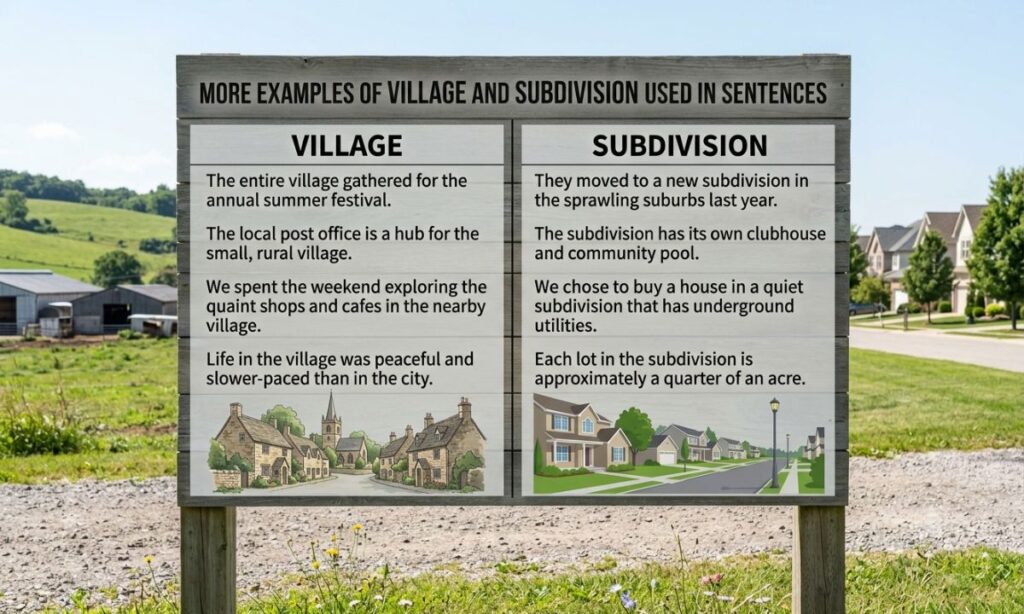
Examples Of Using Village In A Sentence
- The fishing village woke up before dawn as boats prepared to head out to sea.
- She returned to her village after ten years working abroad and was welcomed with a community feast.
- The village elder called a meeting to discuss the proposed construction of a new school.
- Children in the village walk long distances every day to reach the nearest secondary school.
- Archaeologists discovered pottery fragments in the ruins of an ancient village near the river.
- The village market sold fresh vegetables, dried fish, and handwoven baskets every Sunday.
- A new health center was built at the edge of the village to serve families in the surrounding area.
- The mountain village is accessible only by a narrow road that becomes muddy during the rainy season.
- Residents of the coastal village prepare for storms by reinforcing their wooden homes each year.
- Village life taught her the value of patience, cooperation, and respect for the older generation.
Examples Of Using Subdivision In A Sentence
- The new subdivision near the industrial park attracted hundreds of young families within its first year.
- Before purchasing a lot, she read all the subdivision rules and HOA fee schedules carefully.
- The subdivision developer promised to build a clubhouse and swimming pool by end of year.
- Residents organized a neighborhood watch program within their subdivision to improve security.
- The subdivision entrance features a guardhouse with security cameras and a visitor logbook.
- A new commercial strip was built just outside the subdivision to serve its growing population.
- The road inside the subdivision is well-paved and wide enough for two vehicles to pass at once.
- Many families in Metro Manila prefer living in a gated subdivision for its safety and sense of order.
- The architect submitted the house plans to the subdivision HOA for approval before construction began.
- The subdivision was developed in three phases, with the final phase opening just last year.
Common Mistakes To Avoid
The village vs subdivision mix-up is one of the most common errors in everyday writing and conversation, especially in the Philippines and other parts of Asia. Here are the most frequent mistakes and how to steer clear of them.
Mistake 1: Using “Village” To Describe A Subdivision
Many people call a gated housing development a “village” simply because it sounds more prestigious or elegant. While this usage is common in Filipino informal speech, it can create confusion in formal writing, legal documents, and real estate listings.
Why it is a mistake: A village implies natural growth, rural character, local governance, and cultural identity. A planned housing development with an HOA, uniform homes, and a developer-assigned name does not fit that definition. Calling it a village may mislead buyers, tenants, or government officials who rely on precise language.
Incorrect: “We live in a charming village that was built by Ayala Land three years ago.” Correct: “We live in a well-maintained subdivision developed by Ayala Land three years ago.”
Mistake 2: Using “Subdivision” To Describe A Village
On the other hand, some writers use the word subdivision when they are actually referring to a traditional community that has existed organically for generations. This usually happens when someone is unfamiliar with the village’s history or is trying to be technically precise.
Why it is a mistake: Calling a historically rooted community a subdivision strips it of its cultural and civic identity. A village with its own government, traditions, and history is not simply a “subdivision” of land. It is a living, breathing community.
Incorrect: “The farming subdivision on the hillside has been there for over two hundred years.” Correct: “The farming village on the hillside has been there for over two hundred years.”
Tips To Avoid Making These Mistakes
Follow these simple rules every time you are unsure about village vs subdivision:
- Ask about origin. Did the community grow naturally, or was it built by a developer? Natural growth points to a village. Developer-built points to a subdivision.
- Check the governance. A community with a mayor, council, or barangay captain is likely a village. A community governed by an HOA is likely a subdivision.
- Look at the location. Rural settings favor village. Urban or suburban settings favor subdivision.
- Consider formal documents. If land titles, government permits, or developer brochures use a specific term, follow that usage in formal writing.
- Think about infrastructure. Pre-planned roads, uniform houses, and modern facilities suggest a subdivision. Organic roads, varied home styles, and community centers suggest a village.
Village vs Subdivision Reddit
The village vs subdivision debate shows up regularly on Reddit, particularly on communities focused on real estate, linguistics, and Filipino culture. Across various threads, people share surprisingly passionate opinions about which word fits which community.
On forums like r/Philippines, r/realestate, and r/grammar, a common point of discussion is how Filipino usage of the word “village” differs from its global meaning. Many Reddit users from the Philippines explain that when they say “village,” they almost always mean an upscale gated community, not a rural farming community. Meanwhile, users from the United States and the United Kingdom often express surprise at this usage because for them, a village is unmistakably rural and small.
Another popular Reddit discussion around village vs subdivision involves the emotional and aspirational weight of each word. Many users note that real estate developers and homebuyers in the Philippines prefer the word “village” because it sounds elevated and exclusive. In contrast, “subdivision” is seen as more neutral or even less prestigious, even though technically both terms describe planned housing developments.
From a linguistic standpoint, Reddit users who study language often point out that word meanings shift based on regional and cultural context. The village vs subdivision case is a perfect example of how English adapts to local realities around the world. What matters most is whether your audience understands what you mean and whether your usage is appropriate for the context.
The key takeaway from online discussions is this: both words are widely used, both are understood in their respective contexts, but mixing them up in formal writing can cause real confusion. Whether you are posting on Reddit or writing a legal document, choosing the right term matters.
Context Matters
No guide to village vs subdivision would be complete without a serious discussion of context. Language is never used in a vacuum. The right word depends on who you are talking to, where you are, and what you are trying to communicate.
Location
Location is the single strongest factor in choosing between village vs subdivision. A community in a rural province surrounded by farmland and governed by a barangay is almost certainly a village. A gated complex near a city center with numbered lots and an HOA is almost certainly a subdivision. When location is clear, the right word usually follows naturally.
In countries like the UK, the word village is deeply tied to rural England, with images of stone cottages, country pubs, and rolling meadows. In the United States, “village” may even refer to a legal municipality, which is a small incorporated town. In the Philippines, as discussed, the word village has taken on a distinctly urban and upscale meaning. Location not only tells you which word to use but also tells you how your audience will interpret it.
Lifestyle
The lifestyle associated with each term is another major context clue. Village life tends to be slower, more communal, more dependent on shared resources, and more tied to cultural traditions. People in a village often know their neighbors’ names, histories, and daily routines.
Subdivision life, on the other hand, tends to be more structured and private. Residents follow HOA rules, maintain their homes to a certain standard, and live in an organized environment designed for modern convenience. The community feel exists but is often more formal. Neighbors may be friendly but interactions tend to be less deeply rooted than in a traditional village.
When writing about lifestyle, matching the right word to the right kind of community strengthens your credibility and clarity.
Personal Preferences
Sometimes the choice between village vs subdivision reflects a personal or emotional preference rather than a strict definition. Some people love the idea of living in a “village” because it evokes warmth, simplicity, and belonging. Some prefer a “subdivision” because it suggests safety, order, and modern comfort.
Neither preference is wrong. What matters is that when you put the word on paper or use it in conversation, it accurately reflects the community you are describing. Personal preferences are valid, but accuracy serves everyone better in the long run.
Exceptions To The Rules
As with most language rules, the village vs subdivision distinction has exceptions. Real-world communities do not always fit neatly into categories.
Historical Villages
Some communities began as traditional villages centuries ago but have since grown into something much larger. They may now have paved roads, modern homes, and commercial establishments, yet they are still officially called villages. In these cases, the historical designation sticks even when the community no longer looks rural. Respect the established name and governance structure when writing about such places.
Planned Villages
Some developers deliberately design residential communities to feel like traditional villages. They use architectural styles inspired by rural aesthetics, include a central plaza, and name streets after old Filipino or European towns. These are sometimes marketed as “planned villages.” Even though they were built by developers, they blur the line between village and subdivision. In these cases, using whichever term the developer officially uses is the safest approach.
Unincorporated Subdivisions
Some subdivisions exist outside the legal boundaries of any town or city. They are governed by county or provincial authorities rather than a formal municipal government. These unincorporated subdivisions may share some features with villages, such as informal community leadership or a more rural feel, but they are still legally classified as subdivisions. The key difference is that they lack the formal municipal government that defines an incorporated village.
Regional Differences
The village vs subdivision distinction is not universally understood the same way. In Australia, a “subdivision” can also refer to a planned retirement community or shopping district. In parts of Canada, “village” is a formal legal designation for a municipality of a certain size. In India, “village” is a central term in rural administration, tied to the panchayat system of local governance. Always consider the regional context of your audience before choosing your word.
Practice Exercises
Now that you understand the village vs subdivision difference, test your knowledge with these exercises. They will help you apply what you have learned in real-world scenarios.
Exercise 1: Fill In The Blank
Choose either “village” or “subdivision” to correctly complete each sentence.
- The __________ was developed by a real estate company and opened to buyers last March. (subdivision)
- Every summer, the entire __________ gathers at the town plaza to celebrate the patron saint’s feast day. (village)
- The HOA of the __________ announced new rules about parking along internal roads. (subdivision)
- She grew up in a small coastal __________ where her family had fished for four generations. (village)
- The developer built three hundred homes in the __________ near the new expressway. (subdivision)
- The __________ barangay captain organized a cleanup drive along the river last weekend. (village)
- Buyers were required to submit their house plans to the __________ association before starting construction. (subdivision)
- The ancient __________ on the mountainside has been inhabited for over five hundred years. (village)
Exercise 2: Identify The Correct Word
Read each description and decide whether it is describing a village or a subdivision.
- “A community of 250 families who have lived beside the same lake for generations, governed by an elected captain and known for their hand-painted pottery.” Answer: Village
- “A 15-hectare property near a major city, divided into 400 lots, with uniform house models, a clubhouse, a covered court, and a monthly association fee of PHP 500.” Answer: Subdivision
- “A small hillside community accessible by a winding road, with a public elementary school, a chapel, and a weekly market where farmers sell fresh produce.” Answer: Village
- “A gated residential development built five years ago by a major real estate company, with security cameras at the entrance and a dedicated property management team.” Answer: Subdivision
- “A community that has been part of the same barangay for 200 years, with a traditional festival held every January and multi-generational families living side by side.” Answer: Village
Read This: Catagory Vs Category: The Correct Spelling You Must Know
Frequently Asked Questions About Village vs Subdivision
Is a village bigger than a subdivision?
Not necessarily. A village is defined by its organic growth and rural character, not its size. A subdivision is defined by its planned development structure.
Can a subdivision become a village?
In rare cases, a large subdivision may eventually incorporate as a municipality or village, but this requires a formal legal process.
Is a gated community a village or a subdivision?
A gated community is typically a subdivision. In the Philippines, it is often informally called a village, especially if it is upscale.
Which is better to live in, a village or a subdivision?
Neither is universally better. It depends on your lifestyle, budget, and personal preferences.
Are village and subdivision the same in the Philippines?
No. In the Philippines, “village” usually refers to an upscale gated community, while “subdivision” covers a broader range of planned housing developments.
Does a village have an HOA?
Traditional villages are governed by elected councils or barangay officials, not HOAs. Subdivisions are typically governed by HOAs.
Conclusion
The village vs subdivision debate is more than a simple vocabulary question. It touches on how communities are formed, how they are governed, and what kind of life they support. A village grows naturally, carries deep cultural roots, and is governed by its own people. A subdivision is carefully designed, built by developers, and managed by associations with formal rules. Knowing the village vs subdivision difference helps you communicate more accurately, whether you are writing a real estate listing, filling out a government form, or simply describing where you live.
In the Philippines, both terms carry additional layers of meaning shaped by local culture and real estate traditions. Understanding these nuances makes you a more confident and credible communicator. Use village when you mean a naturally formed community with history and local governance. Use subdivision when you mean a planned housing development built on divided lots. Get this distinction right, and you will never confuse your reader or your audience again.
Whether you prefer the quiet warmth of a village or the modern convenience of a subdivision, both offer something valuable: a place to belong.