


If you have ever typed a word and then second-guessed yourself, you know how frustrating English can be. The debate between nonresponsive vs unresponsive is one of those situations that trips up writers, healthcare professionals, and students every single day. Both words look nearly identical. Both describe a lack of reaction. Yet using the wrong one at the wrong time can make your writing feel off, unclear, or even unprofessional.
This guide breaks down the nonresponsive vs unresponsive difference in plain, simple terms. Whether you are writing a medical report, sending a professional email, or just trying to improve your vocabulary, you will walk away knowing exactly which word fits where and why it matters.
Quick Answer: Nonresponsive vs Unresponsive Explained Fast
Here is the short version before we go deeper.
Unresponsive is the more common, natural word. It means not reacting to something, whether that is a person ignoring you, a patient not waking up, or an app that has frozen on your screen.
Nonresponsive is the more formal, context-specific word. It means not providing the expected or required response, and it appears most often in medical documentation, legal settings, research papers, and formal business writing.
Key Takeaway
Both nonresponsive vs unresponsive describe a failure to respond. The difference lies in tone, formality, and the expectation behind the lack of response. When in doubt, use unresponsive. It fits almost every situation naturally.
Side-by-Side Comparison: Nonresponsive vs Unresponsive Meaning
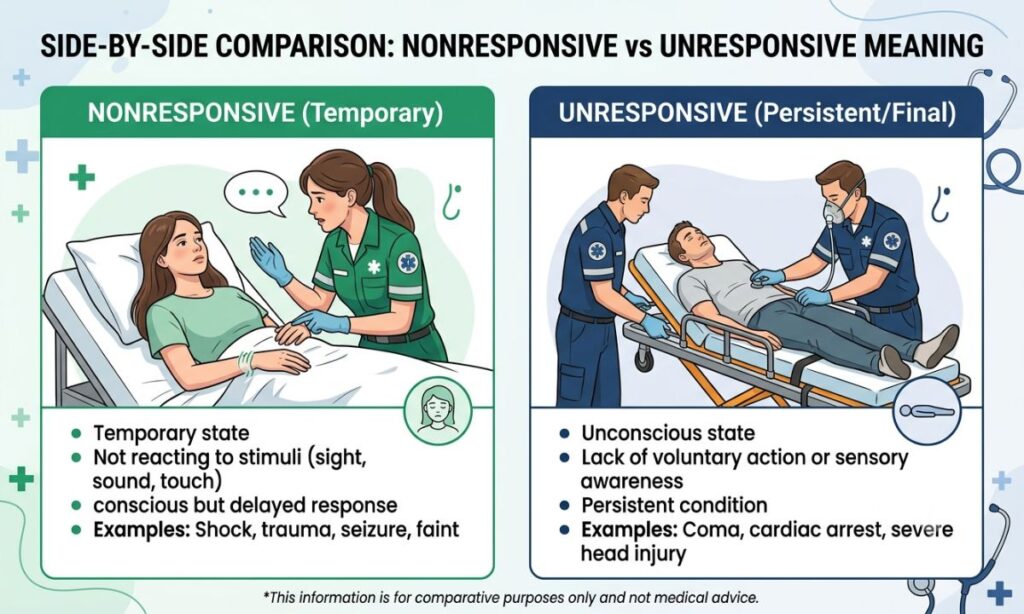
Before diving into detailed explanations, here is a quick visual breakdown of nonresponsive vs unresponsive to give you the clearest picture.
| Feature | Unresponsive | Nonresponsive |
| Tone | Casual and formal | Formal and clinical |
| Everyday Use | Very common | Less common |
| Medical Use | Standard emergency language | Used in research and documentation |
| Tech Use | Widely used | Occasionally used |
| Emotional Use | Yes (e.g., emotionally unresponsive) | Rarely used |
| Legal/Business Use | Acceptable | Preferred in formal reports |
| Urgency Implied | Often high | Context-dependent |
| Prefix Origin | “un” (Latin, reversing) | “non” (Latin, negating) |
As this table shows, while nonresponsive vs unresponsive overlap significantly, the contexts where each feels most natural are different. This distinction becomes critical in professional and medical writing.
Read This: Quantify vs Qualify: Key Differences You Must Understand Today
What Does “Unresponsive” Mean?
Core Meaning
The word unresponsive comes from the prefix “un,” meaning “not,” combined with “responsive.” Together they form: the state of not being responsive. It is a broad, flexible adjective that applies to people, systems, emotions, and physical conditions equally.
According to the Cambridge Dictionary, unresponsive means “not reacting in a quick or positive way to something” or “not reacting or moving at all because of illness or unconsciousness.” That second definition is what makes this word so powerful in medical and emergency contexts.
Common Uses of “Unresponsive”
Human Behavior
When someone fails to reply to messages, shows no emotional reaction, or seems completely shut off from conversation, unresponsive describes that behavior naturally.
Examples:
- “She was completely unresponsive to his attempts at conversation.”
- “Despite several follow-up emails, the client remained unresponsive.”
- “He sat in the corner, unresponsive and distant.”
This use captures both emotional and communicative absence. It feels natural, direct, and widely understood, which is why unresponsive dominates everyday English over nonresponsive.
Medical Context
In emergency medicine and clinical care, unresponsive is the go-to term for a patient who shows no reaction to stimuli. This includes verbal commands, physical touch, and pain response. When paramedics or emergency responders say someone is unresponsive, it communicates immediate danger.
Examples:
- “The patient was found unresponsive at the scene.”
- “She was unresponsive upon arrival at the emergency room.”
- “The victim was unresponsive when police arrived.”
The Merriam-Webster dictionary confirms this exact usage: “not reacting or able to react in a normal way when touched, spoken to, etc.” This is the clinical shorthand that emergency teams rely on worldwide.
Technology
In the world of software, apps, and devices, unresponsive describes a system that has stopped reacting to user input. This is by far the most commonly understood tech usage.
Examples:
- “The app became unresponsive after the update.”
- “My screen is completely unresponsive to touch.”
- “The website went unresponsive during peak traffic.”
Why “Unresponsive” Dominates Everyday English
The prefix “un” is one of the most natural negation prefixes in the English language. Words like unhappy, unfair, and unusual all follow the same pattern. This familiarity makes unresponsive feel instinctive, easy to say, and immediately understood across all age groups and audiences. It also carries an emotional weight that nonresponsive simply does not have, which is why it fits personal, emotional, and urgent scenarios so well.
What Does “Nonresponsive” Mean?
Core Meaning
The word nonresponsive uses the prefix “non,” which is derived from Latin and means simply “not.” It is a neutral negation that does not carry emotional urgency. It describes something or someone that has not provided the response that was expected, required, or measured.
The Cambridge Dictionary defines non-responsive as “not working or reacting to changes, instructions, etc.” and “not answering.” This definition already hints at its more structured, rule-based context.
Where “Nonresponsive” Is Commonly Used
Medical Documentation
In formal clinical language, a patient may be described as nonresponsive to treatment or nonresponsive to medication. This is different from being unconscious. Here, nonresponsive specifically means the expected medical outcome did not occur, even though the patient may still be awake and conscious.
Examples:
- “The tumor was nonresponsive to the chemotherapy protocol.”
- “The patient remained nonresponsive to the prescribed antibiotic course.”
- “Nonresponsive cases were referred to a specialist.”
This is a critical nonresponsive vs unresponsive medical distinction. A patient can be fully awake but still nonresponsive to treatment. That situation would never correctly use the word unresponsive, since unresponsive implies a total loss of physical reaction.
Research and Studies
Academic and scientific writing frequently uses nonresponsive when describing subjects, groups, or variables that did not produce the expected outcome within a study.
Examples:
- “Nonresponsive participants were excluded from the final data set.”
- “The control group was largely nonresponsive to the stimulus.”
- “Researchers identified three nonresponsive cases in the trial.”
Business and Surveys
In formal business communication and market research, nonresponsive describes individuals, companies, or survey participants who did not reply within a defined window or did not provide a usable answer.
Examples:
- “Nonresponsive candidates were removed from the shortlist.”
- “The survey noted a 22% nonresponsive rate.”
- “Clients deemed nonresponsive after 14 days were flagged for follow-up.”
Subtle Difference in Tone
One of the clearest ways to understand nonresponsive vs unresponsive is through tone. Unresponsive feels personal. It is the word you would say out loud in an emergency, a conversation, or a text message. Nonresponsive feels clinical. It is the word you would write in a report, a study, or a legal brief. That tonal gap is the most reliable guide for choosing between them.
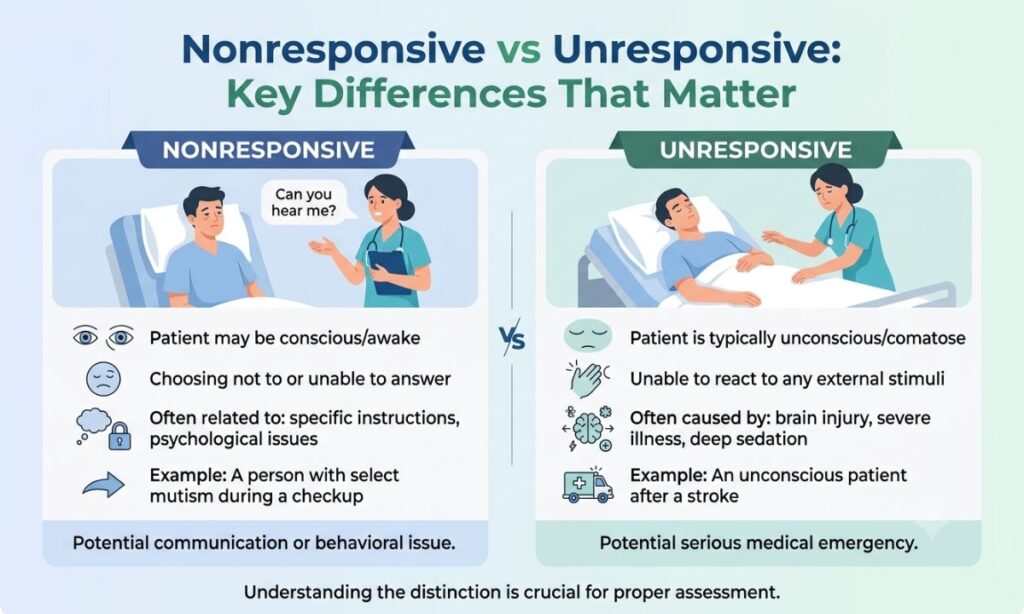
Nonresponsive vs Unresponsive: Key Differences That Matter
Tone and Natural Usage
Unresponsive reads as natural, direct, and conversational. It suits spoken English, informal writing, medical emergencies, and everyday communication with equal ease.
Nonresponsive reads as technical, structured, and report-like. It is more comfortable in written formal documents than in everyday speech.
Context-Based Difference
| Context | Better Choice |
| Emergency medical situation | Unresponsive |
| Treatment outcome in a study | Nonresponsive |
| App or software issue | Unresponsive |
| Survey non-reply tracking | Nonresponsive |
| Personal emotional behavior | Unresponsive |
| Legal or formal report | Nonresponsive |
| Casual conversation | Unresponsive |
| Clinical documentation | Either, based on meaning |
Practical Rule
Think of it this way: if you are describing a real-time lack of reaction that feels urgent or personal, use unresponsive. If you are documenting an absence of the expected outcome in a measured or formal setting, use nonresponsive. This practical rule resolves almost every nonresponsive vs unresponsive dilemma instantly.
Nonresponsive vs Unresponsive in Different Contexts
Medical Context (Critical Distinction)
This is where the nonresponsive vs unresponsive difference matters most. Getting it wrong in clinical writing can create genuine miscommunication.
Common Usage
Unresponsive in a medical emergency means the patient is not reacting to any external stimuli at all. They do not respond to their name being called, to touch, or to pain. It typically signals unconsciousness and is used in triage, emergency response, and urgent clinical notes.
Nonresponsive in medical documentation means the patient or condition did not react to a specific treatment, therapy, or intervention. The patient may be fully conscious and alert.
Example Comparison
| Sentence | Meaning |
| “The patient is unresponsive.” | Unconscious, not reacting at all, emergency situation |
| “The patient is nonresponsive to the treatment.” | Treatment is not working, but the patient may be awake |
Why This Matters
Mixing these terms in medical notes can cause serious misunderstandings. A nurse reading “nonresponsive patient” might not trigger the same alarm as reading “unresponsive patient.” Precision in healthcare language is not just about grammar. It is about patient safety.
Technology and Devices
Both nonresponsive vs unresponsive appear in tech writing, but one is clearly more common.
In technology, unresponsive dominates. When an operating system shows an error like “Application Not Responding,” the everyday language version is always “the app is unresponsive.” This is because technology failure feels immediate, urgent, and personal, which matches unresponsive perfectly.
Why?
The word unresponsive communicates that a system has completely stopped reacting, which mirrors its medical usage. The urgency is the same, even if lives are not at risk.
Nonresponsive occasionally appears in formal software documentation or IT reports, such as “the module remained nonresponsive to the command input,” but it is much less common in everyday tech language.
Communication and Everyday Writing
For emails, messages, and everyday writing, unresponsive is almost always the better choice. Saying “she has been nonresponsive to our emails” is grammatically correct, but it sounds slightly stiff and robotic compared to “she has been unresponsive to our emails.” Both nonresponsive vs unresponsive work here, but one simply sounds more human.
Are Nonresponsive and Unresponsive Interchangeable?
This is the most common question people have about nonresponsive vs unresponsive, and the honest answer is: sometimes yes, sometimes no.
When They Can Be Interchanged
In many general contexts, both words carry the same meaning and either can be used without creating confusion.
- “The audience was nonresponsive/unresponsive to the presenter.”
- “The user interface is nonresponsive/unresponsive.”
- “He has been nonresponsive/unresponsive to our calls.”
In these cases, the nonresponsive vs unresponsive swap works because neither specific nuance is critically important to the meaning.
When They Should NOT Be Swapped
There are situations where swapping nonresponsive vs unresponsive changes the meaning entirely or creates clinical confusion.
- “The patient is unresponsive” should never be replaced with “nonresponsive” in an emergency, as it may dilute the urgency.
- “The tumor is nonresponsive to radiation” should not be replaced with “unresponsive,” as “unresponsive” implies physical incapacity, not treatment failure.
- In legal depositions, a “nonresponsive answer” has a specific formal meaning: the answer did not address the question asked. Using “unresponsive” here could create confusion.
Example
Imagine a doctor’s note that reads: “Patient is unresponsive.” That means an emergency. Now imagine it reads: “Patient is nonresponsive to opioid analgesics.” That means the medication is not working. These are two completely different clinical statements. This is why the nonresponsive vs unresponsive distinction is not just a grammar exercise but a matter of real-world precision.
Nonresponsive vs Unresponsive vs Responsive
To fully understand where nonresponsive vs unresponsive sit on the spectrum, it helps to compare both against their positive counterpart.
Quick Comparison Table
| Word | Meaning | Tone | Best Context |
| Responsive | Reacting quickly and appropriately | Positive | All contexts |
| Unresponsive | Not reacting at all | Urgent, personal | Everyday, medical emergencies, tech |
| Nonresponsive | Not providing the expected response | Formal, clinical | Research, reports, documentation |
Insight
“Responsive” is the shared opposite of both nonresponsive and unresponsive. When you add a negating prefix, you choose between “un” for immediate, observable failure to react, and “non” for formal, measured absence of expected response. That is the heart of the nonresponsive vs unresponsive comparison.
Common Mistakes and How to Avoid Them
Mistake: Using “Nonresponsive” in Casual Writing
Many writers reach for nonresponsive when they want to sound professional. But in casual or emotional writing, it actually makes sentences feel cold and robotic.
Wrong: “My friend has been nonresponsive to my messages for a week.” Right: “My friend has been unresponsive to my messages for a week.”
Mistake: Ignoring Context
The biggest error in the nonresponsive vs unresponsive debate is treating both words as perfectly identical at all times. As shown throughout this guide, there are specific contexts, especially medical ones, where the distinction is critical.
Quick Fix Checklist
Before choosing between nonresponsive vs unresponsive, ask yourself:
- Is this an emergency or urgent situation? Use unresponsive.
- Am I writing a formal report, study, or legal document? Consider nonresponsive.
- Is this about a treatment or outcome that did not work? Use nonresponsive.
- Is this about a person, app, or system that stopped reacting entirely? Use unresponsive.
- Am I writing casually or conversationally? Use unresponsive.
Pronunciation and Spelling Guide
Getting the spelling and pronunciation right is the first step to using these words confidently.
Unresponsive Spelling: U-N-R-E-S-P-O-N-S-I-V-E Pronunciation: un-rih-SPON-siv Part of speech: Adjective
Nonresponsive Spelling: N-O-N-R-E-S-P-O-N-S-I-V-E Pronunciation: non-rih-SPON-siv Part of speech: Adjective
Note: Some style guides write it as “non-responsive” with a hyphen. Both forms are acceptable. The hyphenated version appears more in British English, while the single word appears more in American English usage.
Tip
Both words share the same root: “responsive.” If you can spell “responsive,” you can spell either word simply by adding your chosen prefix at the start.
Memory Tricks to Choose the Right Word
Easy Associations
| If you think of… | Use… |
| An ambulance and a patient who cannot wake up | Unresponsive |
| A research paper with stats and outcomes | Nonresponsive |
| Your phone screen freezing | Unresponsive |
| A clinical trial where a drug did not work | Nonresponsive |
| A friend ignoring your texts | Unresponsive |
| A survey with no replies logged | Nonresponsive |
Quick Rule
Think of “un” as urgent and personal. Think of “non” as neutral and numerical. That mental shortcut resolves nearly every nonresponsive vs unresponsive choice in seconds.
Real-World Examples That Make It Clear
Example 1: Medical Emergency
“When the paramedics arrived, the man was completely unresponsive. He did not react to verbal commands, light, or physical touch. He was rushed immediately to the intensive care unit.”
Here, unresponsive is the only correct choice. The situation is urgent. The person is physically not reacting. This is not a documentation context but a real-time emergency.
2: Business Communication
“After three follow-up emails and two phone calls over the course of two weeks, the vendor remained nonresponsive. The procurement team flagged the case as unresolved and moved to an alternative supplier.”
Here, nonresponsive fits the formal business document tone. The vendor has not met the expected response requirement within a structured process.
3: Research Context
“Of the 400 participants enrolled in the clinical trial, 47 were classified as nonresponsive to the primary intervention. These cases were excluded from the efficacy analysis and reported separately in the supplemental data.”
In this research context, nonresponsive is the only appropriate choice. The subjects did not react to the treatment as expected, but they were not unconscious or incapacitated.
Case Study: Tech Support Scenario
Situation
A customer service representative is writing an incident report after a user complained that their tablet stopped working.
Issue
Original sentence written: “The device was nonresponsive to all user inputs during the reported period.”
Improved Version
“The device was unresponsive to all user inputs during the reported period.”
Result
The revised version feels more natural, direct, and in line with standard tech language. While both nonresponsive vs unresponsive are technically correct here, unresponsive is the clearer, more widely understood choice for most readers. The report becomes easier to read without losing any precision.
Is “Nonresponsive” a Correct Word?
Yes, absolutely. Nonresponsive is a valid, correctly formed English word. Some people assume it sounds awkward or incorrect because unresponsive is so much more common in daily life. But in formal writing, clinical language, legal contexts, and research documentation, nonresponsive is not just acceptable, it is often the preferred choice.
The nonresponsive vs unresponsive debate is not really about one being right and the other being wrong. Both are correct. The real question is always about which one fits the context better.
Key Insight
Correctness and appropriateness are two different things. Both words are correct. But only one may be appropriate for a given situation. That is the entire lesson of nonresponsive vs unresponsive in a single sentence.
Reference: Cambridge Dictionary Definitions
For readers who want authoritative backing, here are the Cambridge Dictionary definitions for both terms.
Unresponsive (Cambridge Advanced Learner’s Dictionary): “Not reacting in a quick or positive way to something” or “not reacting or moving at all because of illness or unconsciousness.”
Non-responsive (Cambridge Advanced Learner’s Dictionary): “Not working or reacting to changes, instructions, etc.” or “not answering a question” or, in medical use, referring to a condition that does not improve with treatment.
These definitions confirm everything covered in this guide. Unresponsive is broader and more urgent. Non-responsive is more structured and context-specific. Together, they represent two sides of the same concept, shaped by context, tone, and expectation.
Read This: Village vs Subdivision: Unraveling Commonly Confused Terms
Conclusion
The nonresponsive vs unresponsive comparison is one of those fine-grained language distinctions that genuinely matters in certain fields and barely matters in others. For everyday writing, go with unresponsive every single time. It is natural, widely understood, and works across all situations.
For formal reports, clinical studies, legal documents, and research papers, nonresponsive is often the better fit. It signals a measured, expected response that did not occur, rather than a total physical or emotional shutdown.
The next time you face the nonresponsive vs unresponsive choice, remember the golden rule: if it feels urgent and personal, use unresponsive. If it belongs in a report or clinical note about an outcome, reach for nonresponsive. Both words are correct. Your job is simply to pick the right one for the right moment.