
Have you ever received great news and replied with “glad to hear that,” only to feel like your response sounded flat and robotic? You are not alone. Most people repeat the same phrase over and over until it loses all meaning. Whether you are writing a professional email to a client or texting a close friend who just shared exciting news, the words you choose say a lot about how much you care.
The truth is, 10 better ways to say “glad to hear that” exist that can make your responses feel warmer, more genuine, and perfectly matched to the moment. Learning these alternatives gives you the right words for every situation, whether you need something polished for a business setting or relaxed for a casual conversation.
This guide breaks down all 10 phrases with clear examples, tone notes, and tips on when to use each one. By the end, you will never scramble for the right response again when someone shares positive news with you.
Why You Need Different Ways To Respond
When you repeat “glad to hear that” in every email, text, or meeting, people start to notice. Your words begin to feel copy-pasted rather than thoughtful. Using the same phrase repeatedly signals that you are not fully present in the conversation.
Here is why learning 10 better ways to say “glad to hear that” matters in real life:
- It shows emotional intelligence. Matching your response to the size and nature of the news proves you are listening and truly engaged.
- It builds stronger relationships. A more specific, warm reply makes the other person feel genuinely valued rather than processed.
- It raises your professional image. In workplace communication, varied and well-chosen language signals maturity, confidence, and communication skill.
- It prevents awkward repetition. When you respond to multiple updates in one email thread, using the same phrase three times in a row looks careless.
- It reflects authentic happiness. Your friend getting engaged deserves more enthusiasm than a routine work update. Different responses for different news makes your reactions feel real.
Think of it this way: the English language gives you a full vocabulary to work with. Using only one phrase is like cooking every meal with a single spice. Once you learn 10 better ways to say “glad to hear that,” you will reach for the right expression naturally without overthinking it.
Read This: Inhouse or In-House or In House? Which is Correct?
Professional Ways To Say “Glad To Hear That”
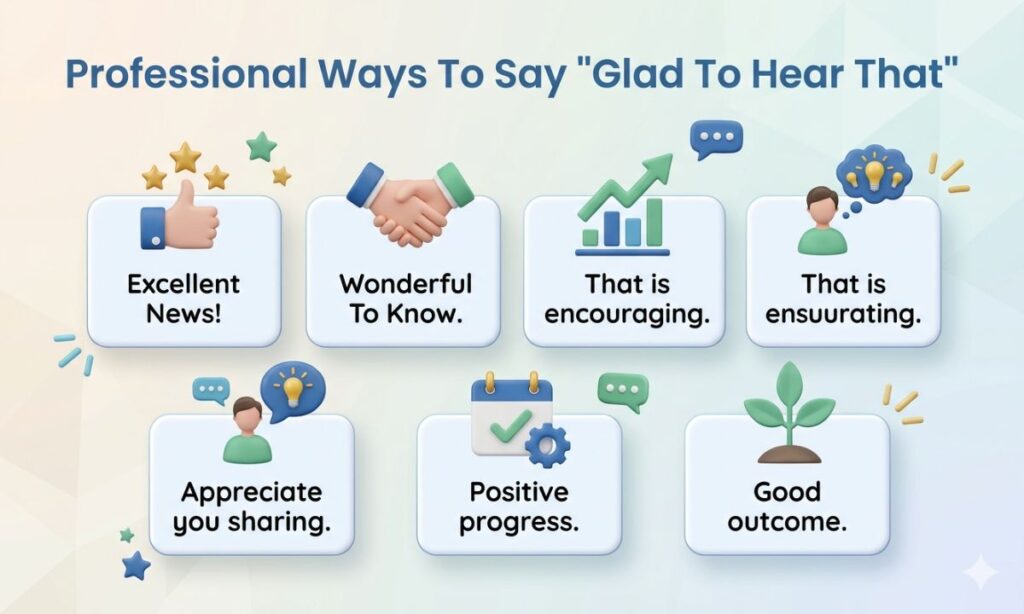
Work settings call for language that is polished, respectful, and appropriate for the relationship. These professional alternatives to “glad to hear that” work well in emails, meetings, reports, and formal conversations with colleagues, managers, and clients. Each one shows positivity while maintaining the right level of formality.
That’s Excellent News
Tone: Formal, enthusiastic, professional
Best for: Workplace achievements, project approvals, client wins
“That’s excellent news” is one of the strongest 10 better ways to say “glad to hear that” in a professional context. The word “excellent” adds a layer of genuine admiration that “glad” simply cannot match. It signals that the news is not just fine but truly noteworthy and deserving of recognition.
This phrase works especially well when something you were hoping for comes through, such as a budget approval, a signed contract, or a positive client review. It sounds confident and engaged without crossing into casual territory.
Examples:
| Situation | How to Use It |
| Client approves a proposal | “That’s excellent news. Thank you for moving forward with our proposal.” |
| Project passes quality review | “That’s excellent news. The team has worked really hard on this one.” |
| A colleague gets promoted | “That’s excellent news. You have earned it with all your contributions.” |
| A problem gets resolved | “That’s excellent news. I appreciate you handling it so quickly.” |
Pro tip: Follow “That’s excellent news” with a brief explanation of why the news matters to you. This one extra sentence transforms a polite reply into a genuinely warm one.
Thank You for the Update
Tone: Professional, appreciative, neutral
Best for: Business emails, status reports, follow-up conversations
Among the 10 better ways to say “glad to hear that,” this phrase stands out because it does two things at once. It acknowledges the good news and shows gratitude to the person who took the time to share it. That combination is powerful in professional communication.
When someone keeps you informed about a project, a meeting outcome, or a situation you have been tracking, responding with “thank you for the update” shows you value their effort to communicate. It keeps information flowing and encourages people to stay in touch with you.
Examples:
- “Thank you for the update. Please continue to keep me informed as things progress.”
- “Thank you for the update on the client situation. I will adjust the timeline accordingly.”
- “Thank you for the update regarding the delivery. That puts us in a better position for launch.”
- “Thank you for the update. I knew the team would pull through on this.”
This phrase is one of the 10 better ways to say “glad to hear that” that can be used even when the news is neutral rather than purely positive. It still conveys appreciation and professionalism without committing to a specific emotional response.
Thank You for Telling Me
Tone: Warm, sincere, professional
Best for: Personal updates shared in work settings, sensitive news, one-on-one conversations
This alternative feels slightly more personal than “thank you for the update.” It acknowledges not just the information but the act of choosing to share it with you. When someone decides to bring you into a situation or loop you in on something meaningful, that trust deserves recognition.
“Thank you for telling me” appears in our 10 better ways to say “glad to hear that” list because it works beautifully when news has a more personal dimension, even in professional settings. Think of situations where a colleague shares health news, a personal milestone, or something they did not have to tell you but chose to anyway.
Examples:
- “Thank you for telling me about the change in direction. I will plan accordingly.”
- “Thank you for telling me. It means a lot that you kept me in the loop.”
- “Thank you for telling me. We could not have achieved this without the whole team’s effort.”
- “Thank you for telling me about the new development. I look forward to seeing where it leads.”
When you include a brief follow-up thought after this phrase, your response feels complete and thoughtful rather than brief and dismissive. It is one of the 10 better ways to say “glad to hear that” that naturally invites further conversation.
Delighted to Hear That
Tone: Formal, emotionally expressive, polished
Best for: Major announcements, significant achievements, formal correspondence
If “glad” is the baseline, “delighted” is several levels above it. This word carries genuine warmth and a sense of personal joy that makes your response sound sincere rather than routine. Among the 10 better ways to say “glad to hear that,” this one stands out in formal writing and high-stakes professional settings.
Use “delighted to hear that” when the news is truly significant, not for every small update. A contract win, a promotion, a long-awaited approval, or a resolution to a serious problem all deserve this level of expression. Saving it for moments that merit it also preserves its impact.
Examples:
| Situation | How to Use It |
| A major business deal closes | “I am delighted to hear that the partnership has been finalized.” |
| A colleague recovers from illness | “I am delighted to hear that you are feeling much better now.” |
| A client gives glowing feedback | “I am delighted to hear that the project exceeded your expectations.” |
| A long-term goal is achieved | “I am delighted to hear that the campaign reached its targets ahead of schedule.” |
This is one of the 10 better ways to say “glad to hear that” that elevates the tone of an entire email or conversation. It signals emotional intelligence and genuine engagement in a way that casual alternatives cannot replicate.
That’s a Pleasure to Hear
Tone: Warm, formal, gracious
Best for: Client communications, positive feedback responses, news that personally satisfies you
“That’s a pleasure to hear” sits at the intersection of professionalism and warmth. It conveys personal satisfaction in a refined way, making it ideal for client-facing communication and situations where you want to sound both pleased and poised.
This phrase is especially effective when someone confirms that your work or service has made a positive difference. It acknowledges their feedback with gratitude while also expressing genuine joy about the outcome. As one of the 10 better ways to say “glad to hear that,” it adds a touch of elegance that elevates the conversation.
Examples:
- “That’s a pleasure to hear. We put a lot of thought into that presentation.”
- “That’s a pleasure to hear. Client satisfaction is always our top priority.”
- “That’s a pleasure to hear. We hope to continue building on this success together.”
- “That’s a pleasure to hear. Please do not hesitate to reach out if anything else comes up.”
When to avoid it: Skip this phrase in purely casual settings or when responding to very personal news like a family announcement. It sounds best in professional or semi-formal contexts where warmth and polish both matter.
Casual Ways To Say “Glad To Hear That”
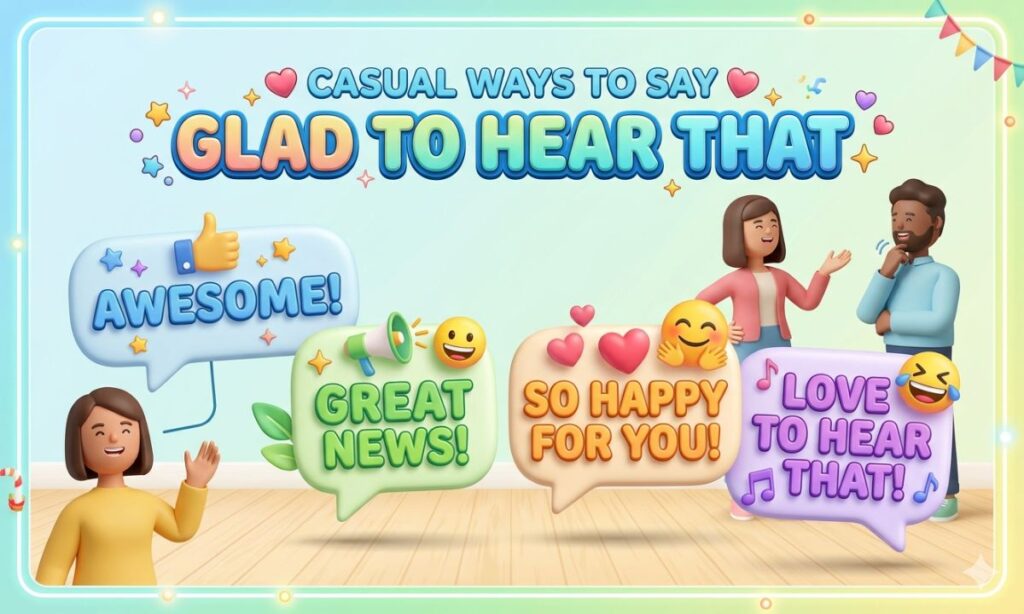
Not every conversation needs formal language. When you are catching up with a friend, texting a family member, or chatting with a coworker you know well, a relaxed response feels far more natural and genuine. These casual alternatives from our list of 10 better ways to say “glad to hear that” strike the perfect balance between warmth and ease.
I’m Happy to Hear It
Tone: Friendly, genuine, versatile
Best for: Personal updates, friend conversations, semi-casual workplace chats
“I’m happy to hear it” is one of the most natural and flexible options in the 10 better ways to say “glad to hear that” collection. It sounds real and warm without trying too hard. The phrase fits in a wide range of situations, from a friend telling you they passed an exam to a coworker sharing that a stressful situation has been resolved.
The slight shift from “glad” to “happy” makes the phrase feel slightly more personal and emotionally sincere. It tells the other person that their news genuinely affected your mood in a positive way.
Examples:
- “I’m happy to hear it! I knew you would do well in that interview.”
- “I’m happy to hear it. That must be such a relief after all the waiting.”
- “I’m happy to hear it. Let’s celebrate when I see you next week.”
- “I’m happy to hear it. Give everyone my congratulations.”
Among the 10 better ways to say “glad to hear that,” this one works particularly well when you add a small personal touch after the phrase. A single sentence of follow-up turns a simple acknowledgment into a genuine moment of connection.
That’s Good to Hear
Tone: Relaxed, warm, everyday
Best for: Casual updates, everyday conversations, mild positive news
Simple, clean, and honest. “That’s good to hear” belongs on any list of 10 better ways to say “glad to hear that” because of how effortlessly it fits into everyday conversation. It does not overstate your reaction but still communicates that the news is welcome and appreciated.
Use this one when someone shares good but not extraordinary news, like telling you that their commute was better than expected, that a minor issue got fixed, or that they are feeling okay after being under the weather. It matches the scale of the news without sounding over the top.
Examples:
- “That’s good to hear. I was a bit worried after what you told me last week.”
- “That’s good to hear. Sounds like things are finally turning around.”
- “That’s good to hear! Let me know if anything changes.”
- “That’s good to hear. I’m glad it worked out the way you hoped.”
One smart tip: pair “that’s good to hear” with a question to keep the conversation going. Responding with “That’s good to hear! How did the rest of the day go?” shows you are genuinely interested, not just checking off a response.
Fantastic News
Tone: Enthusiastic, energetic, celebratory
Best for: Big wins, surprise announcements, exciting achievements
When good news is genuinely thrilling, say so. “Fantastic news” is one of the most expressive options in the 10 better ways to say “glad to hear that” lineup. It channels real excitement and makes the other person feel that their announcement landed with the weight it deserves.
Save this one for moments that genuinely call for celebration: a promotion, an engagement, a major life milestone, or a big win after a long struggle. Using it for routine updates waters down its impact, so treat it as your high-energy option.
Examples:
| Situation | How to Use It |
| Friend announces pregnancy | “Fantastic news! I am so excited for your growing family!” |
| Colleague lands a big client | “Fantastic news! All that hard work finally paid off.” |
| Someone shares they are cancer-free | “Fantastic news. We have all been hoping for this.” |
| A startup gets funded | “Fantastic news! I knew the pitch would impress them.” |
The enthusiasm in “fantastic news” is contagious. As one of the 10 better ways to say “glad to hear that,” it lifts the energy of the entire conversation and makes the other person feel genuinely celebrated rather than simply acknowledged.
That’s Good News
Tone: Warm, relaxed, conversational
Best for: Everyday updates, moderate positive news, follow-up check-ins
“That’s good news” reads as honest and natural. It sits slightly above “that’s good to hear” in terms of emphasis but still keeps a calm and grounded tone. Among the 10 better ways to say “glad to hear that,” this one fits the middle ground between casual and slightly more meaningful.
Use it when someone gives you an update that genuinely matters but does not call for over-the-top excitement. A neighbor telling you the road construction is finally done, a friend confirming their job interview went well, or a family member sharing that test results came back fine all work perfectly with this phrase.
Examples:
- “That’s good news. I know you were worried about how the review would go.”
- “That’s good news! Let me know when you hear back from them.”
- “That’s good news for the whole team. We have been waiting on this.”
- “That’s good news. I am glad things worked out the way you were hoping.”
Adding a personal connection after this phrase makes it far more meaningful. One sentence that shows you remember the context of their news transforms “that’s good news” from a filler response into a genuine expression of care.
I’m Thankful for That
Tone: Warm, deeply appreciative, personal
Best for: News that directly benefits you, acts of kindness, supportive updates
This phrase takes a slightly different angle from the others. While most responses on this list of 10 better ways to say “glad to hear that” express happiness or relief, “I’m thankful for that” expresses gratitude. It says that the news did not just make you happy but genuinely meant something to you on a personal level.
Use this when someone goes out of their way to help you, share information that benefits you, or deliver news that lifts a burden off your shoulders. It is one of the strongest emotional responses in the 10 better ways to say “glad to hear that” collection because it creates a lasting sense of genuine appreciation.
Examples:
- “I’m thankful for that. Knowing you had it covered made a real difference.”
- “I’m thankful for that. I was not sure how things were going to turn out.”
- “I’m thankful for that. Your help through all of this meant more than I can say.”
- “I’m thankful for that. It takes real effort to keep everyone informed, and I appreciate it.”
Among the 10 better ways to say “glad to hear that,” this is the one that often leaves the biggest emotional impression. It shows vulnerability and genuine appreciation, which strengthens trust and deepens any relationship, professional or personal.
How To Pick the Right Response
Knowing all 10 better ways to say “glad to hear that” is only half the job. The other half is knowing which phrase belongs in which situation. Getting this right is what makes your responses feel natural and sincere rather than rehearsed or mismatched.
Here is a practical framework to guide your choice:
Step 1: Consider your relationship with the person.
| Relationship Type | Best Phrases to Use |
| Boss or senior colleague | Delighted to hear that / That’s excellent news |
| Client or business partner | That’s a pleasure to hear / Thank you for the update |
| Colleague or coworker | Thank you for telling me / That’s good news |
| Close friend | Fantastic news / I’m happy to hear it |
| Family member | I’m thankful for that / That’s good to hear |
Step 2: Consider the size of the news.
Small or routine updates need simple, calm responses. Big achievements, milestones, or breakthroughs deserve more expressive reactions. Matching your level of enthusiasm to the significance of the news is the single most important thing you can do to sound genuine.
Step 3: Consider the channel.
- Formal email: Stick to “That’s excellent news,” “Delighted to hear that,” or “Thank you for the update.”
- Work chat or Slack: “That’s good news” or “I’m happy to hear it” both land well.
- Text message: “Fantastic news!” or “That’s good to hear” feel natural and casual.
- In-person conversation: Any phrase works, but tone and expression carry the real meaning.
Step 4: Always add a follow-up sentence.
The single most effective upgrade to any of these 10 better ways to say “glad to hear that” is the sentence that comes after. Even one brief line that references the specific situation shows you were truly listening and not just dropping in a stock phrase.
Making These Phrases Natural
Reading about 10 better ways to say “glad to hear that” is the first step. Feeling comfortable actually using them is the next one. Here is how to make these expressions a natural part of how you communicate.
Practice one phrase at a time. Rather than trying to memorize all 10 at once, pick one phrase and use it intentionally for a few days. Once it feels natural, move to the next one. Repetition builds fluency.
Personalize every response. The phrases in this list of 10 better ways to say “glad to hear that” are starting points, not scripts. Adapt them to your voice. Say “I’m genuinely happy to hear that, especially after everything you went through” instead of just the plain phrase.
Watch the context carefully. A response that works brilliantly in a text message can feel out of place in a formal email. Context awareness is the difference between sounding natural and sounding awkward.
Use names when appropriate. In personal conversations, using someone’s name alongside one of these 10 better ways to say “glad to hear that” creates an immediate feeling of personal connection. “That’s fantastic news, Sarah!” lands differently than just “That’s fantastic news.”
Do not force enthusiasm. If the news is small, a calm and warm response like “That’s good to hear” is far better than a forced “Fantastic news!” that sounds hollow. Authenticity always beats performance.
Here is a quick reference for tone matching:
| News Scale | Ideal Response Tone | Best Phrase |
| Minor update | Calm, warm | That’s good to hear |
| Moderate positive news | Friendly, engaged | That’s good news / I’m happy to hear it |
| Significant achievement | Enthusiastic, genuine | Fantastic news / Delighted to hear that |
| Major milestone | Celebratory, heartfelt | I’m thankful for that / That’s excellent news |
| Professional win | Polished, appreciative | Thank you for the update / That’s a pleasure to hear |
Quick Summary
Here is a fast reference guide to all 10 better ways to say “glad to hear that” covered in this article:
| Phrase | Tone | Best Context |
| That’s Excellent News | Formal, enthusiastic | Workplace achievements, project wins |
| Thank You for the Update | Professional, appreciative | Business emails, status reports |
| Thank You for Telling Me | Warm, sincere | Personal news shared at work |
| Delighted to Hear That | Formal, emotionally expressive | Major announcements, formal emails |
| That’s a Pleasure to Hear | Warm, gracious | Client feedback, service updates |
| I’m Happy to Hear It | Friendly, genuine | Friend or colleague conversations |
| That’s Good to Hear | Relaxed, everyday | Casual updates, mild positive news |
| Fantastic News | Enthusiastic, celebratory | Big wins, exciting achievements |
| That’s Good News | Warm, conversational | Moderate updates, follow-up chats |
| I’m Thankful for That | Deeply appreciative, personal | Acts of kindness, personal support |
All 10 better ways to say “glad to hear that” in this list cover both professional and casual settings. Each one brings something unique: deeper warmth, stronger gratitude, clearer enthusiasm, or more polished professionalism. Together, they give you a complete toolkit for responding to positive news in any situation.
The next time someone shares something positive with you, pause for just a second and choose the phrase that fits the moment. That small pause is what separates a mechanical response from a genuinely human one.
Read This: Less Then or Less Than – Which Is Correct?
Frequently Asked Questions
What does “glad to hear that” mean?
It means you are happy or relieved to receive positive news that someone has shared with you.
Is “glad to hear that” formal or informal?
It sits in a neutral middle ground, but for truly formal settings, phrases like “delighted to hear that” or “that’s excellent news” sound more polished.
Can I use these phrases in professional emails?
Yes. Phrases like “Thank you for the update,” “That’s excellent news,” and “Delighted to hear that” are all fully appropriate for professional emails.
What is a more enthusiastic version of “glad to hear that”?
“Fantastic news” and “Delighted to hear that” both carry significantly more enthusiasm and warmth.
How do I make my response sound more genuine?
Add one personal follow-up sentence after the phrase that references the specific news. This shows you were truly listening.
Is “that’s good news” too casual for work?
Not at all. It works perfectly in semi-formal work conversations, team chats, and follow-up emails with colleagues you know well.
What if I want to express both happiness and gratitude?
“I’m thankful for that” or “Thank you for telling me” both combine positive feelings with genuine appreciation in one phrase.
Can I mix these phrases in one email?
Absolutely. Using two or three different expressions throughout a longer email keeps your tone natural and prevents repetition.
Which phrase works best for responding to health news?
“I’m so happy to hear it” or “That’s a relief to hear” both work well for health updates, as they convey both happiness and relief without sounding overly formal.
How many of the 10 better ways to say “glad to hear that” should I memorize?
Even knowing three or four well-chosen alternatives and using them confidently will dramatically improve your communication. Start small and build from there.
Knowing the 10 better ways to say “glad to hear that” gives you the power to respond with exactly the right words every time. Whether you reach for a polished professional phrase or a warm casual one, these alternatives help you communicate more authentically, build stronger relationships, and leave every conversation feeling genuinely positive.