
Have you ever typed “immersion” and then paused for a second wondering if you actually meant “emersion”? You are not alone. These two words look almost identical on the page, sound nearly the same when spoken, yet they carry completely opposite meanings. Confusing emersion vs immersion is one of the most common mistakes in both everyday writing and academic contexts.
Whether you are a student working on an essay, a teacher explaining language learning methods, a science writer covering astronomy, or simply someone who wants to speak and write English with precision, understanding the difference between emersion and immersion is genuinely useful. This guide breaks everything down clearly, from definitions and etymology to real-life examples and sentence usage, so you never mix up these two words again.
Quick Answer: Emersion vs Immersion in One Simple Explanation
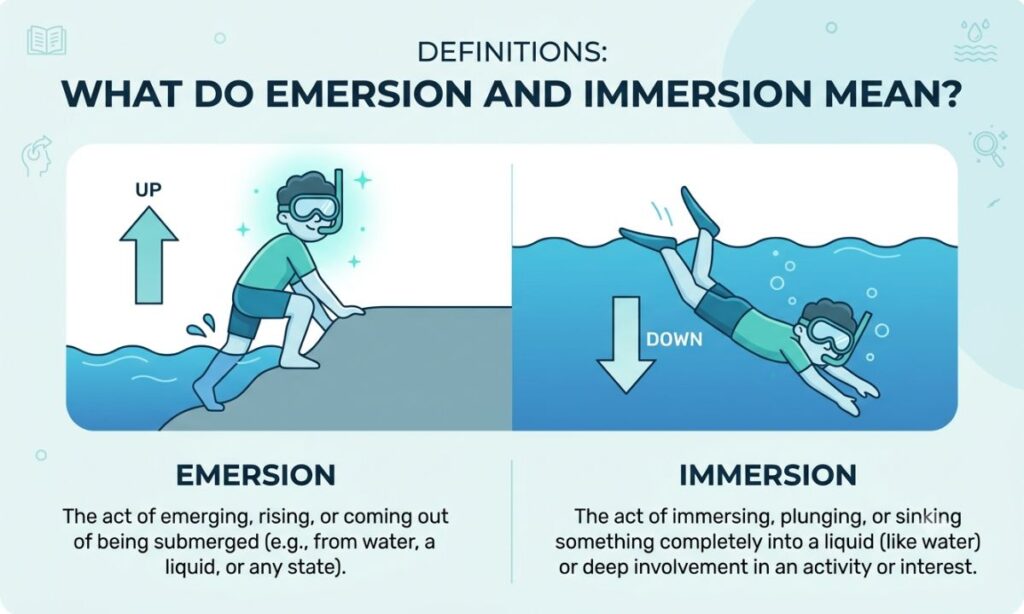
Immersion means going INTO something, either physically by being submerged in a liquid, or figuratively by being deeply absorbed in an activity or experience.
Emersion means coming OUT OF something, specifically rising or emerging from a submerged or hidden state.
That is the entire difference in one sentence: emersion vs immersion is simply a matter of direction. One goes in. The other comes out.
Simple Analogy
Think of a submarine on a mission. When it dives below the ocean surface and disappears into the deep water, that is immersion. When it rises back up, breaks through the waves, and reappears at the surface, that is emersion. Same vessel, same ocean, but completely opposite movements. Every time you think about emersion vs immersion, picture that submarine.
Definitions: What Do Emersion and Immersion Mean?
Before diving into comparisons, it helps to understand each word individually.
What Is Emersion?
Emersion is a noun that refers to the act of emerging or rising out of something, particularly out of a liquid or a concealed state. It describes the process of becoming visible or apparent after having been hidden, submerged, or obscured. In scientific contexts, especially in astronomy and marine biology, emersion is a precise technical term used regularly.
The word appears far less frequently in everyday conversation than its counterpart, which is why many people encounter it and assume it is a typo for immersion.
Example
“After the total lunar eclipse, scientists recorded the exact moment of the moon’s emersion from the Earth’s shadow.”
What Is Immersion?
Immersion is a noun describing the state of being completely submerged in a liquid, or the condition of being deeply and wholly absorbed in an activity, subject, or environment. It is used widely across education, technology, religion, psychology, and everyday language. Emersion vs immersion in everyday usage almost always sees immersion winning, simply because it has so many practical applications.
According to the Cambridge Dictionary, immersion means “the fact of becoming completely involved in something” or “the process of learning a language by being surrounded by people who speak only that language.”
Example
“Her complete immersion in the project meant she barely noticed the hours passing.”
Read This: Nonresponsive vs Unresponsive: What’s the Real Difference?
Emersion vs Immersion: Key Differences at a Glance
| Feature | Emersion | Immersion |
| Core meaning | Coming out of something | Going into something |
| Direction | Outward | Inward |
| Frequency of use | Rare, technical | Very common |
| Common contexts | Astronomy, marine biology, ecology | Education, psychology, religion, technology |
| Latin root | emersio (to bring out or rise) | immersio (to plunge into) |
| Antonym relationship | Opposite of immersion | Opposite of emersion |
| Example sentence | The emersion of the star after the eclipse was recorded. | Her immersion in Spanish culture accelerated her fluency. |
Whenever you analyze emersion vs immersion side by side like this, the contrast becomes crystal clear instantly.
The Core Concept: Direction Matters (In vs Out)
If you only remember one thing about emersion vs immersion, make it this: direction is everything.
Immersion is an inward process. Something enters a substance, environment, or experience. A diver goes into the water. A student enters a language environment. A reader gets absorbed into a novel. All of these describe immersion.
Emersion is an outward process. Something exits a substance, concealed state, or hidden condition. A whale surfaces from the ocean. The sun reappears after a cloud passes. A moon emerges after an eclipse. All of these describe emersion.
The prefixes themselves carry this directional logic, and understanding them makes emersion vs immersion permanently easy to remember.
Visual Explanation
↓ IMMERSION (going in)
════════════════════════════════
[water surface]
════════════════════════════════
↑ EMERSION (coming out)
Whether it is water, a learning environment, a culture, or even a philosophical state, the rule holds every time you compare emersion vs immersion.
Real-Life Examples That Make It Crystal Clear
Abstract definitions only go so far. Seeing emersion and immersion in real contexts is what truly locks in the meaning.
Everyday Examples
Here are situations from daily life where these words apply:
Immersion examples:
- A child learning to swim gets used to full water immersion during lessons.
- The new employee experienced total cultural immersion when transferred to the Tokyo office.
- Virtual reality headsets create digital immersion, making users feel fully present in a simulated world.
- The immersion blender in your kitchen is literally a device you dip into a pot of soup.
Emersion examples:
- The alligator’s slow emersion from the swamp surprised the hikers.
- After years of quiet research, the scientist’s emersion into public debate made headlines.
- The emersion of a colorful butterfly from its cocoon is one of nature’s great spectacles.
Comparing emersion vs immersion through these everyday scenarios shows how naturally the directional logic applies.
Science and Academic Examples
Both words have strong technical applications in academic fields.
In Astronomy: Immersion refers to the disappearance of a celestial body as it passes behind another object or enters a shadow, such as during a solar or lunar eclipse. Emersion refers to the reappearance of that same celestial body once it exits the shadow or comes out from behind the occulting object. This is one of the oldest and most precise uses of emersion vs immersion in science.
In Marine Biology and Ecology: Emersion describes aquatic organisms, such as seaweed, intertidal creatures, or amphibians, rising out of the water or becoming exposed during low tide. Immersion describes those same organisms being covered or submerged during high tide.
In Mathematics: Immersion refers to a differential function in geometry, specifically a smooth mapping between manifolds. This is a highly specialized use that university students encounter in differential geometry.
Example
“During the low tide, researchers studied emersion behavior in barnacles and mussels, noting how the organisms respond when transitioning from immersion to emersion repeatedly throughout the day.”
This single sentence shows exactly how emersion vs immersion operates in a scientific context.
Language Learning Context
Perhaps the most famous application of the word immersion today comes from education.
Immersion Learning
Language immersion is a teaching methodology where students learn a new language not through translation or grammar drills, but by being placed in an environment where that language is the only one spoken. The idea is that being surrounded by a language mimics how children naturally acquire their first language.
Emersion in educational theory refers to what happens after the immersion experience ends. It is the reflective phase when students step back, process what they learned, and integrate the experience into their broader understanding.
Example
“During her semester abroad in France, complete language immersion meant she could only speak French at school, at home with her host family, and at the local shops. Her emersion back into an English-speaking environment months later came with a surprising realization: she now thought in French.”
Understanding emersion vs immersion in this educational frame adds a whole new layer of meaning to both words.
How to Use Emersion and Immersion in Sentences
Knowing definitions is one thing. Using the words correctly in your own writing is another. Here is a practical guide to both.
Using “Emersion” Correctly
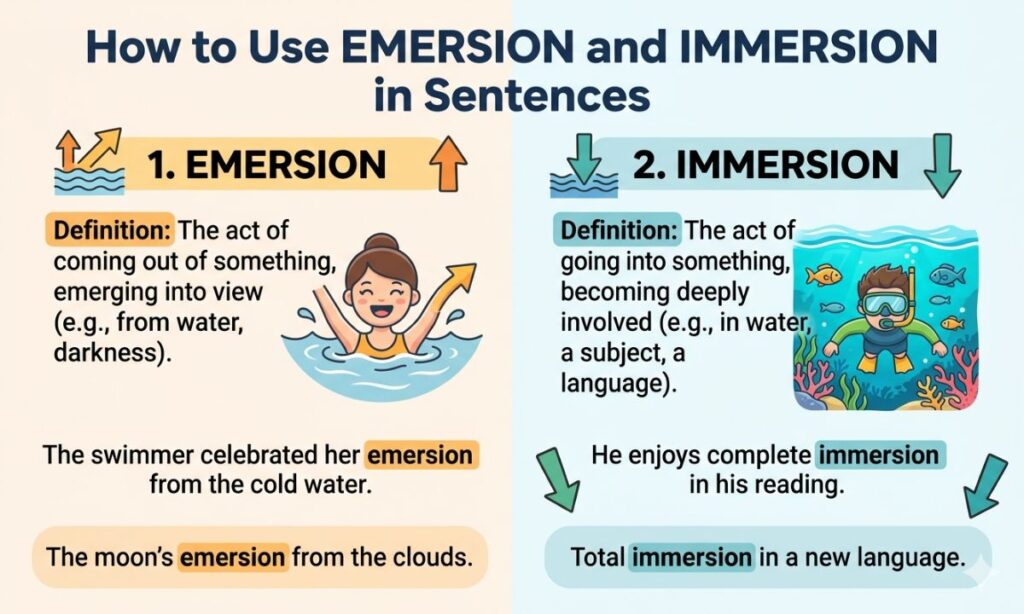
Use emersion when you are describing something or someone that is rising up, coming out of, or becoming visible after being hidden or submerged. The context is usually physical or scientific, though it can occasionally appear in figurative language.
Examples
- “The diver’s emersion from the cold water was greeted with applause from the boat crew.”
- “Astronomers noted the exact time of the planet’s emersion from behind the moon.”
- “After a decade out of the public eye, her emersion into the art world surprised critics.”
- “The emersion of seedlings through the soil in early spring is a reliable sign that warmer days are coming.”
Notice that in each of these sentences, emersion vs immersion is resolved by asking one question: is this thing coming out? If yes, use emersion.
Using “Immersion” Correctly
Use immersion when you are describing something entering a liquid, someone becoming deeply engaged in an activity, or a teaching method where learners are fully surrounded by the subject.
Examples
- “The spa offers a heated mineral bath for total body immersion that lasts forty minutes.”
- “His immersion in classical literature began when he was just twelve years old.”
- “The language immersion program in Quebec requires students to speak only French for the entire semester.”
- “Virtual reality technology is advancing quickly, and full sensory immersion may soon be a reality for home users.”
- “Baptism by immersion is practiced in several Christian denominations as a sign of spiritual rebirth.”
Across all of these examples, emersion vs immersion is decided by the same principle: immersion means going in or being fully absorbed.
Pronunciation and Spelling Differences
Pronunciation
These words are tricky because they sound so similar to the ear.
| Word | Pronunciation | Sounds Like |
| Emersion | /ɪˈmɜːr.ʒən/ | “ih-MER-zhun” |
| Immersion | /ɪˈmɜːr.ʒən/ | “ih-MER-zhun” |
Yes, the standard pronunciation of both words in most dialects of English is virtually identical. This is precisely why the confusion between emersion vs immersion runs so deep. Context and spelling are the only reliable ways to tell them apart in written and spoken language.
Common Mistakes
- Writing “emmersion” (double m at the start) for either word
- Using “immersion” when describing a star reappearing after an eclipse (should be emersion)
- Treating emersion as simply a rare spelling variant of immersion (they are not the same word)
- Writing “emursion” or “immursion” (incorrect vowel in the middle)
Quick Tip
If you are unsure which to use when comparing emersion vs immersion, ask yourself this single question: Is the subject going in or coming out?
Going in = Immersion (think “Im going in”) Coming out = Emersion (think “E for Exit”)
Etymology and Word Origins (Why They Mean Opposites)
Understanding why emersion vs immersion means what it means becomes permanently clear once you trace the Latin roots.
Latin Origins
Both words descend from the Latin verb mergere, which means “to dip,” “to sink,” or “to plunge.” This shared root is why the two words look and sound so similar. They are genuinely related, just representing opposite ends of the same action.
From mergere come two distinct Latin compound verbs:
- Immergere (in + mergere) = “to plunge into”
- Emergere (e/ex + mergere) = “to rise out of”
These compound verbs then gave rise to the Latin nouns immersio and emersio, which entered English and became immersion and emersion.
Prefixes Matter
The entire emersion vs immersion distinction lives inside two tiny prefixes:
“Im” (or “in”) = into, inward, within. This prefix signals movement going inside something. Immersion, import, inject, implant — all involve inward movement.
“E” (or “ex”) = out of, from, away. This prefix signals movement coming from within something outward. Emersion, emerge, exit, exclude, export — all involve outward movement.
Once you understand these two prefixes, you will never need to second-guess emersion vs immersion again.
Common Mistakes and Misconceptions
Why People Confuse These Words
There are several genuine reasons why emersion vs immersion trips people up so consistently:
- Near-identical pronunciation — In spoken English, the two words are almost indistinguishable. Only careful listeners notice the difference in spelling once they see the words written down.
- Rarity of emersion — Most people encounter immersion daily but may go months or years without seeing or hearing emersion. When it does appear, they assume it is a typo.
- Same Latin root — Because both words come from the same ancestor verb mergere, they feel like variations of the same concept rather than opposites.
- “Em” and “Im” look similar — The visual difference between emersion vs immersion is a single letter at the start, making quick proofreading unreliable.
Incorrect vs Correct Usage
| Incorrect | Correct | Why |
| “The star’s immersion after the eclipse was breathtaking.” | “The star’s emersion after the eclipse was breathtaking.” | The star came out, not went in. |
| “Her emersion in the language program helped her become fluent.” | “Her immersion in the language program helped her become fluent.” | She went deeply into the program. |
| “The diver’s immersion from the water surprised the crowd.” | “The diver’s emersion from the water surprised the crowd.” | The diver came out of the water. |
These correction examples show exactly how the emersion vs immersion confusion plays out in real writing.
Related Terms You Should Know
Understanding emersion vs immersion becomes richer when you also know these connected terms:
- Emerge (verb): To come out of or rise from something. The verb form closely related to emersion.
- Immerse (verb): To plunge into or deeply engage with something. The verb form of immersion.
- Submerge: To put something completely under water. Closely related to immersion.
- Surface (verb): To rise to or appear at the surface. Conceptually related to emersion.
- Submersion: The act of going under water or being fully covered. Nearly synonymous with immersion in physical contexts.
- Emergence: The process of becoming visible or prominent. Closely related to emersion.
- Occultation: In astronomy, when one celestial body passes behind another. Immersion precedes the occultation; emersion follows it.
- Total immersion: A teaching method using complete language or environment exposure, or a form of baptism.
- Immersive: An adjective describing experiences that create a deep sense of involvement, such as immersive theater or immersive VR.
When Should You Use Each Word?
Use Immersion when:
- Describing someone being deeply absorbed in a subject, activity, or environment
- Referring to a language learning program where only the target language is spoken
- Talking about submerging an object in a liquid
- Describing baptism practices in religious contexts
- Discussing virtual reality or other technology that creates deep sensory engagement
- Referring to total concentration on a project or creative work
Use Emersion when:
- Describing a celestial body reappearing after an eclipse or occultation
- Writing about an organism or object rising out of water
- Referring to the reflective phase that follows a period of deep engagement
- Describing someone returning to public life after a long period of absence or obscurity
- Using the term in a scientific or academic paper where precision matters
Whenever you face the emersion vs immersion choice, this checklist resolves it within seconds.
Emersion vs Immersion in Language Learning
Language education has popularized the word immersion more than almost any other field. Understanding how emersion and immersion function together in this context gives real insight into how learning works.
What Is Immersion Learning?
Language immersion learning is a pedagogical approach in which students are taught entirely in a target language. There are no translations. There are no grammar tables in the student’s native tongue. The learner is surrounded by the new language in every interaction, classroom activity, and social moment. This is the immersion side of emersion vs immersion in education.
Immersion programs exist at every level, from bilingual kindergartens to full university programs. The Canadian French immersion system is one of the most famous examples in the world. Similar programs operate in Spanish, Mandarin, Welsh, and many other languages globally.
Why It Works
Research consistently shows that language immersion produces faster fluency and stronger retention than traditional grammar-based instruction. The brain naturally acquires patterns, vocabulary, and pronunciation through repeated real-world exposure rather than memorization.
According to research from the Center for Applied Linguistics, students who go through language immersion programs consistently outperform their peers in reading comprehension, grammar, and cultural understanding after three to five years of study.
Case Study
Consider Anna, a high school student from the United States who participates in a semester-long Japanese language immersion program in Kyoto. During her time abroad:
- Her entire school curriculum is delivered in Japanese
- Her host family communicates only in Japanese
- She shops, navigates, and socializes entirely in Japanese
- English is not used at any point during structured program hours
This is full emersion vs immersion in action. She is in a state of deep immersion throughout the program.
When Anna returns home and reflects on her experience, processes her cultural observations, and integrates her new language skills into her American life, that is emersion. Both phases are necessary. Immersion creates the experience. Emersion transforms it into lasting knowledge.
Reference: Cambridge Dictionary Definitions
For those who prefer established dictionary authority when it comes to emersion vs immersion, here are the accepted definitions from trusted sources:
Cambridge Dictionary on Immersion: “The fact of becoming completely involved in something” and “the process of learning a language by being surrounded by people who speak only that language.” Cambridge also notes immersion in its physical sense as the act of putting something completely into a liquid.
Cambridge Dictionary and Merriam-Webster on Emersion: Emersion is defined as “the act of emerging,” specifically “the reappearance of a celestial body after an eclipse” and “emergence especially from water.” Merriam-Webster lists emersion as the antonym of immersion in astronomical contexts, confirming the opposite-direction relationship between these two words.
Vocabulary.com: Lists emersion as the direct antonym of immersion in the astronomy category, defining it as “the reappearance of a celestial body after an eclipse.”
These authoritative definitions confirm everything covered in this guide. Emersion vs immersion is not a matter of preference or dialect. They are two distinct words with clearly defined, opposing meanings, both recognized by every major English dictionary.
Read This: Quantify vs Qualify: Key Differences You Must Understand Today
Frequently Asked Questions
Is emersion a real word?
Yes, emersion is a real and recognized English word. It appears in all major dictionaries, including Cambridge, Merriam-Webster, and Oxford. It is simply less common than immersion.
Are emersion and immersion opposites?
Yes, they are direct antonyms. Emersion means coming out; immersion means going in.
Can emersion be used figuratively?
It can, though it is rare. Immersion is far more commonly used in figurative language.
What is the verb form of emersion?
The related verb is “emerge.” The verb form of immersion is “immerse.”
Do emersion and immersion sound the same?
In most dialects of English, yes. The pronunciation is nearly identical, which is the main reason for confusion.
Which word is more commonly used in everyday writing?
Immersion is far more common. Emersion is primarily found in scientific, technical, and academic writing.
What is emersion vs immersion in astronomy?
In astronomy, immersion is the disappearance of a celestial object behind another body. Emersion is its reappearance afterward.
Is there a spelling variant “emmersion”?
No. “Emmersion” with a double m is a misspelling. The correct spelling is always “emersion.”
Conclusion
The emersion vs immersion question is a perfect example of how two words can look almost identical yet move in completely opposite directions. Immersion takes you in. Emersion brings you out. That single, clear principle is all you really need.
Whether you are writing a science paper about lunar eclipses, describing a language learning program, designing a virtual reality experience, or simply trying to use English precisely in your daily communication, knowing the correct word matters. Immersion builds the experience of being surrounded and absorbed. Emersion marks the return, the surfacing, the emergence into awareness and reflection.
The Latin prefixes tell the whole story: “im” points inward, “e” points outward. The emersion vs immersion distinction was built directly into the words themselves centuries ago, and it has never changed. Now that you know it, you will never confuse them again.
Use immersion when something or someone is going in. Use emersion when something or someone is coming out. Keep that directional rule in mind, and emersion vs immersion will never trip you up in writing or conversation again.