
Have you ever paused mid sentence wondering whether to type inhouse, in-house, or in house? You are not alone. This small punctuation question trips up bloggers, business owners, students, and even seasoned writers every single day. The confusion is understandable because all three versions look almost identical, and they often appear in the same kind of sentence about company work, internal teams, or office tasks.
The good news is that the answer is simple once you understand the grammar rule behind it. In this guide, you will learn exactly which form to use, why the hyphen matters so much, when “in house” without a hyphen actually works, and how to use the correct version confidently in your own writing. By the end, the question of inhouse or in-house or in house will never confuse you again.
This article follows proper English grammar rules, references how major dictionaries treat the term, and gives you plenty of real world examples so you can apply the rule immediately in emails, resumes, blog posts, and business documents. Whether you write for a living or simply want your next email to look polished, understanding inhouse or in-house or in house is a small investment that pays off every time you sit down to write.
Inhouse or In-House or In House? Which is Correct?
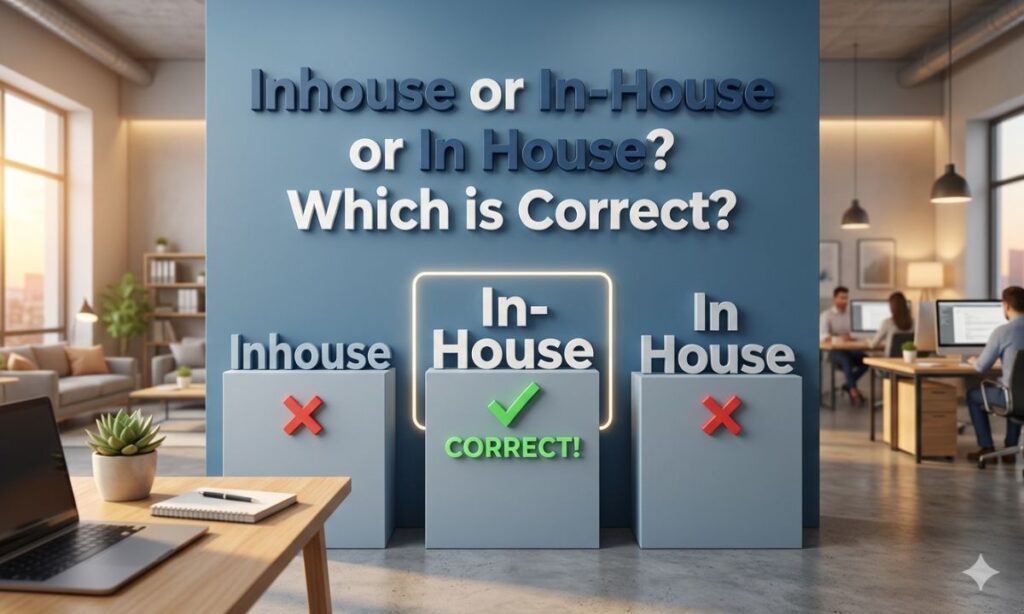
Let’s settle this right away. Among inhouse or in-house or in house, the correct and widely accepted form in professional English is in-house, written with a hyphen.
In-house describes work, services, or tasks that a company handles using its own employees rather than outsourcing them to an outside agency or freelancer. It functions as a compound adjective or a compound adverb, and both functions require the hyphen to connect the two words into a single descriptive unit.
Here is a quick breakdown of all three forms people search for when they type inhouse or in-house or in house into Google:
| Form | Status | When It Appears |
| Inhouse | Incorrect | Sometimes seen in casual writing or branding, but not recognized by any major dictionary |
| In-house | Correct | Standard form used in business writing, journalism, and formal documents |
| In house | Rarely correct | Only acceptable in a literal sense, such as describing a physical location inside a building |
So when someone asks about inhouse or in-house or in house, the safest and most professional answer is always in-house. Major dictionaries including Cambridge and Oxford list only the hyphenated spelling, and neither dictionary recognizes inhouse as a standalone word. This is one of the clearest signs that settles the entire inhouse or in-house or in house debate in favor of the hyphenated version.
Style guides agree on this point too. AP Style, the Chicago Manual of Style, and APA all support hyphenating compound modifiers like in-house when they appear before or after the word they describe. This consistency across different writing standards is one more reason in-house remains the dominant choice whenever the inhouse or in-house or in house question comes up in classrooms, newsrooms, and corporate offices alike.
If you search Google Ngram data, you will notice that in-house appears far more frequently in published books, articles, and professional writing compared to inhouse or in house. That popularity is not random. It reflects decades of accepted grammar usage rather than personal preference, and it reinforces why so many style guides and editors land on the same answer when asked about inhouse or in-house or in house.
Think about it this way. Companies advertise in-house counsel, in-house training, and in-house software development. News articles describe in-house teams handling projects without outside help. Job postings list in-house designer or in-house accountant as common titles. Across nearly every professional context, the hyphenated spelling wins, which is exactly why anyone researching inhouse or in-house or in house should commit this rule to memory.
Grammatical Basis for saying “In-House”
So why exactly does in-house need that small hyphen? The answer comes down to a basic English grammar rule about compound adjectives, and understanding this rule clears up most confusion around inhouse or in-house or in house once and for all.
A compound adjective forms when two or more words join together to describe a single noun. When these words appear before the noun they modify, English grammar requires a hyphen to connect them. This hyphen tells the reader that the words are working as one unit rather than as separate, unrelated words.
In the phrase in-house, the words “in” and “house” combine to create a single descriptive idea, meaning something done internally within an organization. Without the hyphen, a reader’s brain has to work harder to figure out whether you mean a physical house or an internal company function. This is precisely the kind of ambiguity that makes the inhouse or in-house or in house question worth taking seriously.
Here is a simple comparison to show the difference clearly:
- With hyphen: The company hired an in-house designer. (Clear: the designer works for the company internally.)
- Without hyphen: The company hired an in house designer. (Confusing: readers might briefly wonder if this refers to a house.)
This is exactly why hyphenated compound adjectives matter so much in professional writing. The hyphen removes ambiguity and helps readers process meaning instantly, which improves both clarity and readability. Anyone still debating inhouse or in-house or in house in their own writing should picture this exact comparison the next time they hesitate over the spelling.
In-house can also function as an adverb, describing how an action is performed. Even in this role, the hyphen stays in place. For example:
- We handle all our marketing in-house.
- She manages payroll in-house instead of outsourcing it.
In both adjective and adverb roles, the rule never changes. Whether in-house comes before a noun or after a verb, the hyphen is required to maintain its meaning as a single grammatical unit. This consistency is part of what makes the inhouse or in-house or in house rule so easy to remember once it clicks.
This is also why “inhouse,” written as one solid word, is considered incorrect. Combining the two words without any separation removes the visual signal that tells readers these words function together as a compound term. While you might occasionally spot “inhouse” in casual marketing copy or social media captions, it does not follow standard English grammar rules and should be avoided in professional or formal writing, including resumes, contracts, reports, and business emails. Keep this distinction in mind whenever inhouse or in-house or in house comes up again in your writing.
Grammarians often point out that the hyphen in compound modifiers serves a functional purpose rather than a decorative one. It is not there simply because style guides say so. It exists because English readers process words left to right, and without a visual cue connecting “in” and “house,” the brain briefly searches for two separate meanings before settling on the intended one. That tiny delay, multiplied across an entire document, slows down comprehension and weakens the overall flow of your writing. This functional explanation is exactly why grammar experts treat this question as more than a stylistic preference. It is a readability issue with a clear, evidence backed answer.
Read This: Less Then or Less Than – Which Is Correct? (Examples)
Other Correct Ways of Saying: “In House”
While in-house remains the standard hyphenated form for describing internal company work, the phrase “in house” without a hyphen is not always wrong. Context changes everything here, and this nuance is often missing from quick answers to the inhouse or in-house or in house question.
Without a hyphen, “in house” usually functions as a prepositional phrase rather than a compound adjective. In this case, it often refers to a literal location, much like saying “in the house.” For example:
- The keys are in house, so check the kitchen table.
- She left her laptop in house before heading to the meeting.
In these examples, “in house” describes a physical location, not an internal business function. This is a completely different meaning from the hyphenated in-house, which describes internal company operations. Recognizing this difference is the final piece of the inhouse or in-house or in house puzzle that many guides skip over.
There are also several alternative phrases you can use if you want to avoid repeating in-house too often in your writing. These alternatives work well in business communication and help keep your content varied and engaging:
- Handled internally
- Within the company
- Managed by internal staff
- Done by our own team
- Kept within the organization
Using these alternatives can make your writing feel more natural, especially in long documents, reports, or articles where repeating the same term over and over might feel repetitive to readers. Even when you choose one of these alternatives, the underlying answer to inhouse or in-house or in house does not change, since these phrases simply offer variety rather than replacing the grammar rule itself.
Here is a table comparing in-house with its common alternatives:
| Phrase | Meaning | Example Sentence |
| In-house | Done internally within a company | The legal team handles contracts in-house. |
| Handled internally | Same internal meaning, more formal tone | All complaints are handled internally by our staff. |
| Within the company | Emphasizes internal boundary | Training happens within the company, not through outside vendors. |
| By internal teams | Highlights the people doing the work | Reports are written by internal teams every quarter. |
| In house (literal) | Refers to a physical location | The documents are still in house, in the top drawer. |
Why ‘in the house’ is a better version than ‘in house’
If you want to describe a literal location clearly, “in the house” is almost always a stronger and less confusing choice than “in house” without the hyphen. This small adjustment solves a problem that many writers run into while trying to apply the inhouse or in-house or in house rule correctly.
The reason comes down to clarity. “In house” without context can easily be mistaken for an attempt at writing the business term in-house, especially since the two phrases look so similar on the page. Readers might pause, reread the sentence, and try to figure out whether you meant a literal location or an internal company process.
“In the house,” on the other hand, leaves no room for confusion. The article “the” clearly signals that you are talking about an actual physical structure rather than a business concept. Compare these two examples:
- Confusing: She left her phone in house.
- Clear: She left her phone in the house.
The second sentence instantly tells readers you mean a literal house. There is no ambiguity, no need to reread, and no risk of mixing it up with the business meaning of in-house. This is one more reason why settling the inhouse or in-house or in house debate matters beyond simple grammar trivia. It directly affects how clearly your message lands with readers.
This is especially important in professional writing, where clarity should always come first. If you are writing a sentence about a literal location, simply add “the” and avoid any confusion with the hyphenated business term. Save “in house” without an article for very specific contexts where the meaning is already obvious from the surrounding sentence.
In short, when discussing inhouse or in-house or in house, remember that “in the house” works best for literal meanings, while in-house remains the standard for describing internal company functions, services, and teams. This simple distinction is often the missing piece that finally resolves the inhouse or in-house or in house confusion for good.
Examples of using ‘In-house’ in a sentence:
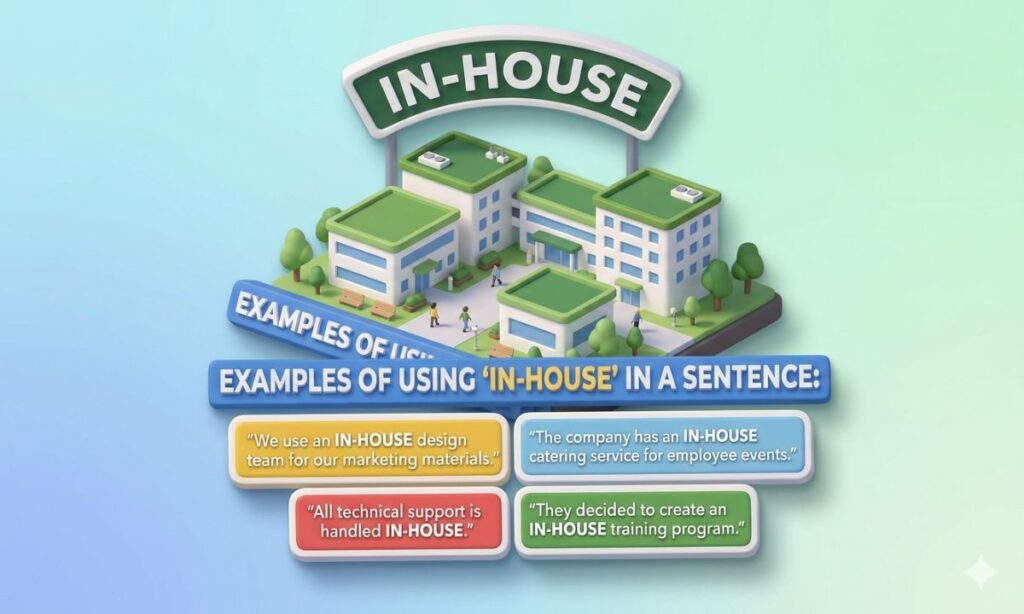
Seeing in-house used correctly across different contexts is one of the easiest ways to fully understand the rule. Below are several examples covering both its adjective and adverb forms, all written to reflect how professionals actually use the term once they have settled the inhouse or in-house or in house question for themselves.
As an adjective (before a noun):
- The company employs an in-house graphic designer for all branding work.
- Our in-house training program helps new employees learn faster.
- The firm relies on its in-house legal team to review every contract.
- Many hotels offer an in-house restaurant for guest convenience.
- The startup built an in-house software platform instead of buying one.
- She works as in-house counsel for a major banking corporation.
- The bakery’s in-house pastry chef creates fresh items every morning.
- Their in-house developers built the entire website from the ground up.
As an adverb (describing an action):
- We handle all customer support in-house rather than outsourcing it.
- The agency decided to manage social media in-house this year.
- All graphic design work is completed in-house to maintain consistent branding.
- Instead of hiring an external auditor, the company reviews finances in-house.
Notice how each sentence places in-house either directly before a noun or right after a verb. In both positions, the hyphen stays exactly where it belongs, connecting the two words into one clear idea. None of these sentences would work correctly using inhouse or in house as a replacement, which is a useful test whenever you are unsure about inhouse or in-house or in house in your own draft.
Using these patterns in your own writing will help you apply the rule naturally, whether you are drafting a resume, writing a business proposal, or simply replying to a work email about internal projects. A helpful trick is to read your sentence aloud and ask whether the phrase describes something happening inside a company. If it does, in-house with a hyphen is almost always correct, settling the inhouse or in-house or in house question on the spot.
A Quick Summary Table for Easy Reference
To make things even easier, here is a simple table you can refer back to anytime you feel unsure about inhouse or in-house or in house.
| Question | Quick Answer |
| Is inhouse correct? | No, it is not recognized by major dictionaries or style guides. |
| Is in-house correct? | Yes, it is the standard and grammatically correct form. |
| Is in house correct? | Only in a literal sense, referring to a physical location. |
| Does in-house need a hyphen before a noun? | Yes, always, since it functions as a compound adjective. |
| Does in-house need a hyphen after a verb? | Yes, since it also functions as a compound adverb. |
| What style guides support hyphenating in-house? | AP Style, Chicago Manual of Style, and APA. |
Common Mistakes to Avoid
Even experienced writers occasionally slip up with this term. Here are a few common mistakes worth watching out for whenever inhouse or in-house or in house appears in your draft:
- Writing “inhouse” as one solid word in formal documents, resumes, or business reports.
- Dropping the hyphen when in-house appears directly before a noun, such as writing “in house team” instead of “in-house team.”
- Confusing the business meaning of in-house with the literal meaning of being physically inside a house.
- Overusing in-house repeatedly in the same paragraph instead of using alternatives like handled internally or within the company.
- Assuming that because some websites or social media posts use “inhouse,” it must be an acceptable spelling.
- Hyphenating the term unnecessarily in cases where “in the house” already communicates the literal meaning more clearly.
Avoiding these small mistakes will instantly improve the clarity and professionalism of your writing, whether you are crafting a blog post, a corporate memo, or a simple email to a colleague. Many of these mistakes happen simply because writers have never seen the inhouse or in-house or in house rule explained clearly, so once you understand the logic behind the hyphen, these errors tend to disappear from your own writing almost immediately.
How to Remember the Rule for Good
If you want a quick mental shortcut for inhouse or in-house or in house, try this simple three step memory trick:
- Check the position. If the phrase sits directly before a noun, such as team, designer, or counsel, use in-house with a hyphen.
- Check the meaning. If you mean an internal company function rather than a physical building, use in-house with a hyphen.
- Check for “the.” If you are describing a literal location and the sentence would naturally include “the,” switch to “in the house” instead of “in house.”
Running through these three checks takes only a few seconds, but it will save you from nearly every mistake people make with inhouse or in-house or in house. Over time, this process becomes automatic, and you will find yourself typing the hyphen correctly without even pausing to think about it.
It also helps to read examples from reputable sources. Newspapers, official company websites, and style guides consistently use in-house with the hyphen in business contexts. Training your eye to notice this pattern in everyday reading reinforces the rule far more effectively than memorizing it in isolation. The next time you read a job listing, a press release, or a company blog post, take a moment to notice how they handle this spelling. You will likely find the hyphenated version every time.
Why Getting This Right Matters
You might wonder why such a tiny hyphen deserves this much attention. The truth is that small grammar details like this one quietly shape how readers perceive your writing. A missing or misplaced hyphen will not usually ruin a sentence’s meaning entirely, but it can make your writing look careless, rushed, or unprofessional, especially in business communication, legal documents, and resumes where precision matters.
Search engines also pay attention to consistent, grammatically correct phrasing. Using the standard spelling of in-house, rather than its incorrect variants, helps your content read more naturally and align with how most readers and search queries expect the term to appear. This matters whether you are a student polishing an essay or a marketer drafting copy for a company website, since both audiences benefit from clear, dependable grammar.
Beyond search visibility, correct grammar simply builds trust. When your writing follows accepted English rules, readers focus on your message instead of getting distracted by spelling or punctuation errors. Whether you are publishing a company blog, drafting a job description, or writing a school assignment, choosing in-house over inhouse or in house shows attention to detail and respect for your audience. People notice these small details more often than we realize, and getting inhouse or in-house or in house right is one of the easiest ways to leave a polished impression.
This is also why professional editors flag inconsistent hyphenation during proofreading. A document that hyphenates in-house correctly in one paragraph and drops the hyphen in another sends a mixed signal about how carefully the writer reviewed their own work. Staying consistent with this spelling throughout an entire piece reflects the same attention to detail that readers associate with trustworthy, well edited content.
Read This: Indulgent vs Sober: Deciding Between Similar Terms
Frequently Asked Questions
Is in-house one word or two?
In-house is technically two words joined by a hyphen, not one solid word and not two separate words without punctuation.
Is “inhouse” a real word?
No, inhouse is not recognized as a standard word by major dictionaries like Cambridge or Oxford.
Can in-house be used as a verb?
No, in-house only functions as an adjective or adverb, never as a verb.
Is in-house hyphenated in British and American English?
Yes, both British and American style guides treat in-house the same way, with a hyphen.
What is the opposite of in-house?
The opposite is outsourced, meaning work given to an external company or freelancer instead of internal staff.
Should I capitalize in-house in titles?
Capitalize both parts, as in In-House, when it appears in a title following standard title case rules.
Is “in house” without a hyphen ever correct?
Yes, but only in a literal sense describing a physical location, not internal company work.
Do AP Style and Chicago Manual of Style agree on this term?
Yes, both style guides support hyphenating in-house as a compound modifier.
Why do people get confused about inhouse or in-house or in house?
The three forms look visually similar, so writers often assume they are interchangeable when only one is grammatically correct.
Does the hyphen rule change in casual writing like texting?
The grammar rule itself does not change, though casual contexts are more forgiving of dropped hyphens than formal writing.
Conclusion
So, after exploring inhouse or in-house or in house from every angle, the answer remains clear and consistent. In-house, written with a hyphen, is the correct and widely accepted form for describing work, services, or teams operating within a company. It functions as both a compound adjective and a compound adverb, and the hyphen is what makes that grammatical role clear to readers.
Inhouse, written as a single word, does not appear in major dictionaries and should be avoided in professional writing. Meanwhile, “in house” without a hyphen only works in its literal sense, referring to a physical location, and even then, “in the house” often communicates that meaning more clearly.
Next time you write a sentence about internal company work or tasks handled without outsourcing, remember the simple rule: use in-house with a hyphen. Keep this guide bookmarked, and you will never have to second guess inhouse or in-house or in house again.