
Have you ever stopped mid-sentence and asked yourself: is it encode vs incode? You typed one, deleted it, typed the other, and still were not sure. You are not alone. This confusion trips up writers, students, developers, and even experienced content creators every single day. The two words look almost identical, sound similar when spoken aloud, and yet only one of them is actually correct in standard English. Understanding the difference between encode vs incode is not just about spelling. It is about communicating clearly, writing with authority, and making sure your content is taken seriously by readers and search engines alike.
Searches for encode vs incode spike every time a new wave of learners enters the tech or writing world, which tells us this is a genuinely persistent confusion worth addressing properly.
In this complete guide, we will settle the encode vs incode debate once and for all. You will learn the proper definitions, see real sentence examples, discover common mistakes to avoid, and work through practice exercises to lock in your understanding. By the time you finish reading, you will never second-guess yourself on encode vs incode again.
Quick Answer: Encode vs Incode at a Glance
The encode vs incode comparison is one of those grammar questions that appears simple but has real consequences for professional writing. Here is a quick reference table before we go deeper:
| Feature | Encode | Incode |
| Status in English | Standard, recognized word | Not a standard English word |
| Dictionary recognized | Yes | Rarely, if at all |
| Common usage | Computing, linguistics, biology | Occasional spelling error or brand name |
| Correct in technical writing | Yes | No |
| Correct in formal writing | Yes | No |
Define Encode
Encode is a verb that means to convert information or data from one format into another so that a computer system, communication network, or another party can read, transmit, or store it properly. The word is built from two parts: the prefix “en,” which means “to put into,” and the root “code,” which refers to a system of signals or symbols. Put them together and you get the literal meaning: to put something into code.
The word encode is widely recognized by every major dictionary, including Merriam-Webster, Oxford, and Cambridge. It appears across multiple fields:
- Computing and programming: Converting text into binary, Base64, UTF-8, or ASCII formats
- Telecommunications: Converting audio or video signals for transmission
- Genetics and biology: When a gene is responsible for producing a specific protein or behavior
- Linguistics: Converting a message into a language or symbolic system
- Cryptography: Transforming plaintext into a structured format (though this differs from encryption)
The encode definition is consistent across all these fields: it describes the act of transformation from one format into another so that another system or party can interpret it correctly. When someone says “the developer used a program to encode the data,” everyone reading that sentence immediately understands what happened. The data was converted into a format suitable for storage or transmission.
Understanding the full encode meaning also means knowing what it does NOT mean. Encoding is not the same as encrypting. Encoding changes the format of data. Encryption changes the format AND hides the content behind a key. A QR code, for example, is an encoded version of a web address. Anyone with a scanner can decode it. That is encoding. A password-protected file, by contrast, uses encryption.
Define Incode
Here is the honest truth about incode: it is not a recognized standard word in the English language. When someone types incode, they are almost always making a spelling mistake. The word simply does not appear in major authoritative dictionaries as a standard verb or noun describing data transformation.
There are two narrow situations where the word “incode” does appear legitimately:
- As a noun in British postal geography: In the United Kingdom, a postcode is divided into two parts. The “outcode” is the first part (before the space), and the incode is the second part (after the space). For example, in the postcode SW1A 1AA, the “SW1A” is the outcode and “1AA” is the incode. This is a highly specific, regional, technical usage that has nothing to do with data or programming.
- As a company or brand name: Several businesses have trademarked or used “Incode” as part of their name. In these cases, it functions as a proper noun, not as a standard English word with a general meaning.
Outside of these two situations, if you encounter incode in a sentence about data, computing, or communication, it is almost certainly a typo for encode. The incode meaning does not extend into programming or digital communication in any officially recognized way.
Read This: Courtesy vs Curtesy: When to Opt for One Term Over Another
How To Properly Use The Words In A Sentence
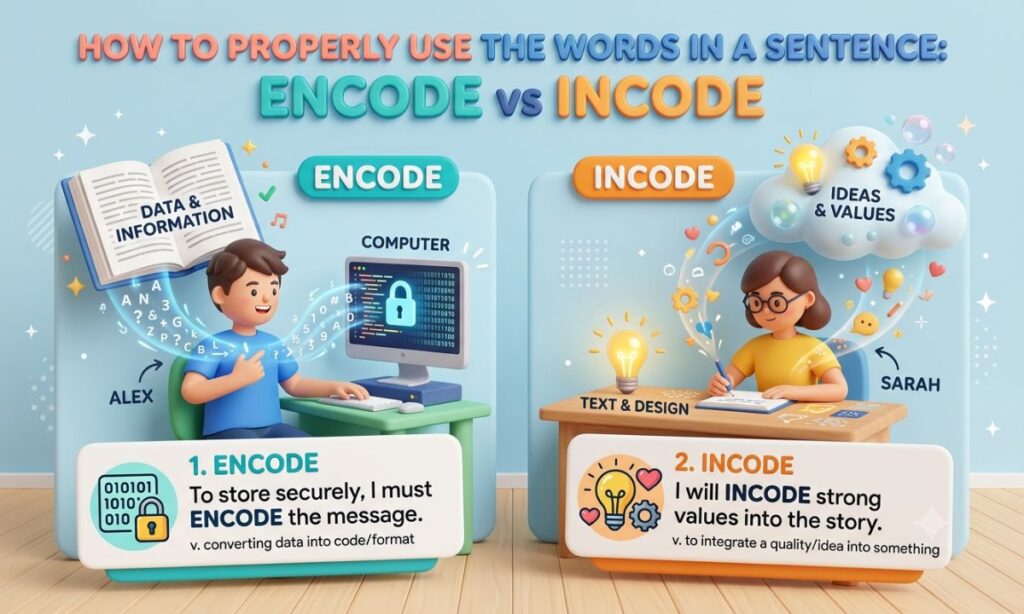
Knowing the definitions is just the beginning. The real skill with encode vs incode comes from knowing how to apply the right word in the right situation. Let us walk through both cases clearly.
How To Use “Encode” In A Sentence
Encode functions as a verb in a sentence. It follows the same grammatical rules as other action verbs. You encode something. A system encodes something. A gene encodes something. The subject performs the action of encoding on an object.
Here are the key patterns for using encode correctly:
Pattern 1: Subject + encode + object The programmer chose to encode the file before uploading it to the server.
Pattern 2: Passive voice (something is encoded) All messages are encoded automatically by the application before being sent.
Pattern 3: With a purpose clause Scientists encode genetic information to study how proteins are produced.
Pattern 4: With a format or method The system uses UTF-8 to encode all text input from users.
When using encode in a sentence, always make sure it refers to a transformation process. If you are talking about converting data, changing formats, or preparing information for transmission, encode is the right choice. The focus keyword comparison of encode vs incode matters most here: whenever your sentence involves data transformation, choose encode every single time.
How To Use “Incode” In A Sentence
Given that incode is not a standard English word, you should avoid it in nearly all writing contexts. The only correct sentence using “incode” as a standard English noun would be in reference to the British postcode system:
Correct (British postcode context): The delivery system automatically validates the incode portion of every UK postcode entered by the user.
Incorrect (data or computing context): ❌ The developer tried to incode the message before sending it. (This should be “encode.”) ❌ You need to incode the data using Base64. (Again, should be “encode.”)
If you are writing about data, computing, digital communication, genetics, or any technical field, do not use incode. There is no correct context for it in those areas. The encode vs incode decision is straightforward: if you are not writing specifically about UK postcodes or referencing a business named Incode, always choose encode.
More Examples Of Encode & Incode Used In Sentences
Seeing words in action is one of the best ways to make definitions stick. Let us look at a range of real-world examples to fully understand encode vs incode.
Examples Of Using Encode In A Sentence
The following sentences demonstrate correct, natural usage of the word encode across different fields and contexts:
- The software development team decided to encode all user credentials using a Base64 scheme before storing them in the database.
- Video streaming platforms encode content in multiple resolutions so that users with slower internet connections can still watch without interruptions.
- Scientists discovered that a single gene can encode the instructions for more than one type of protein, expanding our understanding of genetics.
- When you take a photo with your smartphone, the camera sensor immediately encodes the light data into a JPEG or RAW file format.
- The messaging application was designed to encode every conversation automatically, converting text into a format that could be transmitted across international networks.
- Web developers must encode special characters in URL strings to ensure that browsers interpret them correctly without errors.
- The linguist explained that every spoken language has a unique system to encode meaning through sound, grammar, and vocabulary.
- Before uploading the audio file, the sound engineer used professional software to encode it in the MP3 format.
- The QR code was used to encode the restaurant menu URL so that customers could scan and access the menu instantly.
- Search engines use specific algorithms to encode and index web content so that the most relevant results appear first in searches.
Examples Of Using Incode In A Sentence
As established, incode has limited legitimate usage. Here are the rare cases where it could appear correctly:
- The postal worker noticed the incode on the package was smudged, making it impossible to deliver to the correct address.
- Royal Mail’s system requires a valid incode for every delivery to ensure accurate sorting at the local distribution center.
- The address verification tool flagged the entry because the incode did not match any known postcode in the UK database.
In all other contexts, if you see a sentence using incode to mean the conversion of data, that sentence contains an error. The encode vs incode comparison makes clear that encode is the appropriate term in virtually every non-postcode situation.
Common Mistakes To Avoid
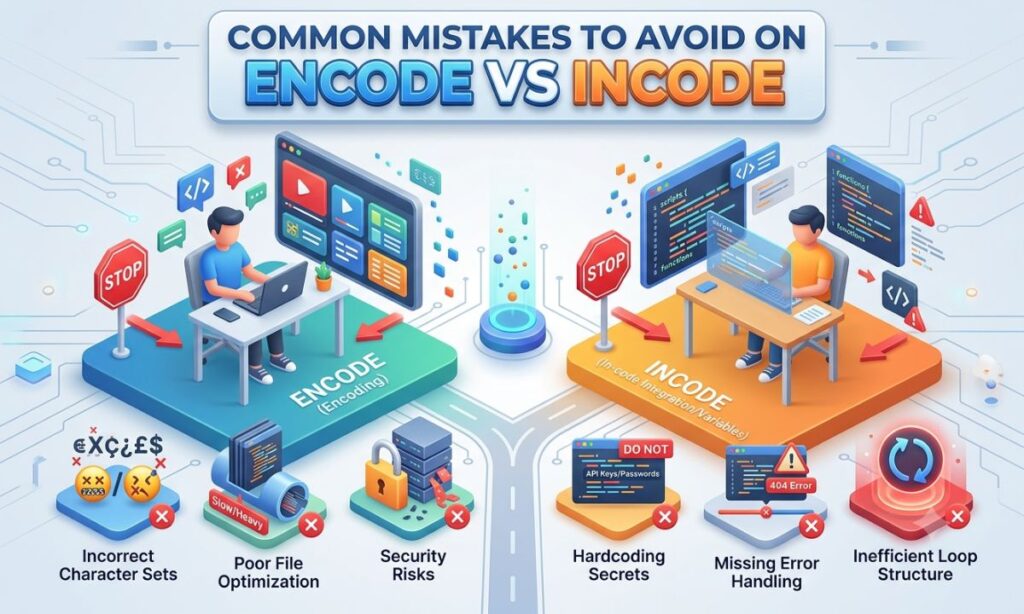
Understanding the encode vs incode difference also means being aware of the traps that cause people to make errors. Here are the most frequent mistakes and how to sidestep them.
Using Incode Instead Of Encode
This is the number one error in the encode vs incode conversation. People type incode when they mean encode for a few simple reasons:
- The words sound nearly identical when spoken quickly
- Autocorrect on some devices does not always catch the mistake
- Writers assume that because both words exist, both must be valid in the same context
The fix is straightforward. Whenever you are writing about data transformation, digital communication, programming, or any technical field, always use encode. Do a quick search-and-replace in your document if needed. The encode vs incode rule here is absolute: encode is the technical standard, and incode is not.
Assuming Encode Means Encrypt
This is a widespread misconception, even among people who know to avoid incode. Encoding and encryption are not the same thing, and conflating them can lead to serious misunderstandings, especially in security contexts.
| Aspect | Encoding | Encryption |
| Purpose | Format conversion for readability or transmission | Data protection from unauthorized access |
| Requires a key? | No | Yes |
| Reversible by anyone? | Yes, with the right tool | No, only with the correct key |
| Example | Base64, UTF-8, ASCII | AES, RSA, SHA |
| Security level | Low (not intended for security) | High |
If you tell a client their data is “encoded,” they may assume it is secure. It is not, unless encryption was also applied. Use the terms precisely to avoid false expectations and potential liability.
Not Understanding The Context
Even with encode, the word can be misused when the writer does not fully understand the field they are writing about. For example:
- Using encode when you mean “compress” (compression reduces file size; encoding changes format)
- Using encode when you mean “translate” (translation changes language; encoding changes format)
- Using encode when you mean “store” (storing saves data; encoding transforms it first)
Context determines the right word. The encode vs incode question is just one part of a broader need for precision in technical and professional writing.
Tips For Avoiding Mistakes
Follow these practical strategies to stay accurate every time:
- Remember the prefix: “En” means “put into.” So encode literally means “put into code.” This mental hook makes the spelling easy to remember.
- Check the context first: Ask yourself whether you are describing a format transformation. If yes, encode is your word.
- Do not confuse encode with encrypt: If you mean to secure data with a key, use “encrypt.” If you mean to change its format, use “encode.”
- Run a spell check AND a grammar check: Basic spell checkers may miss “incode” since it can appear as a valid word in some dictionaries due to its postcode meaning. Always verify manually.
- Read your sentence aloud: If the sentence sounds technically off, revisit your word choice.
Context Matters
One of the most important lessons in the encode vs incode discussion is that the same word can behave differently depending on the context in which it is used. Let us explore this idea more deeply.
Encode
The word encode shifts its specific meaning slightly depending on the field:
- In software development: Encode refers to converting raw data into a format like Base64, UTF-8, or binary so that systems can transmit or store it reliably.
- In telecommunications: Encode means converting analog signals into digital formats for efficient transmission over networks.
- In biology and genetics: A gene “encodes” a protein when it contains the DNA sequence necessary to produce that protein during biosynthesis.
- In linguistics: A speaker encodes a message by choosing the words, grammar, and tone needed to communicate a specific meaning.
- In cybersecurity: Encode is used in the context of preparing data for transmission, often before additional encryption is applied.
Across all of these fields, the core idea remains the same: encode means to convert from one form into another. The context just determines which forms are involved.
Incode
As discussed, incode has only one legitimate standard meaning: the second portion of a UK postcode. In this narrow postal geography context, it refers to the alphanumeric characters that follow the space in a British postcode and that identify the specific delivery point or building.
In any other context, seeing incode should signal a potential error. Writers working in international audiences or technical fields should treat incode as a red flag and verify whether encode was the intended word.
Contextual Examples
The following table shows how context changes the appropriate usage of encode vs incode:
| Context | Correct Word | Example Sentence |
| Web development | Encode | Developers encode special characters in URLs. |
| Video production | Encode | Editors encode footage in H.264 for streaming. |
| Genetics research | Encode | This gene encodes the insulin protein. |
| UK postal system | Incode | The incode was missing from the delivery label. |
| Cryptography | Encode (not incode) | The system encodes data before applying a cipher. |
| Data storage | Encode | Files are encoded in UTF-8 before being saved. |
| Brand or company | Incode (proper noun) | Incode Technologies offers identity verification services. |
Exceptions To The Rules
Language is rarely completely rigid, and the encode vs incode topic is no different. There are a few exceptions worth knowing.
1. Contextual Usage
In creative or experimental writing, authors sometimes invent or adapt words to create a specific effect. A novelist writing a science fiction story might use “incode” as a made-up technical term within their fictional universe. In this purely creative context, the rules of standard English are relaxed. However, even in creative writing, the word should be used intentionally and consistently, not accidentally in place of encode.
2. Regional Differences
As noted, incode has a specific, recognized meaning in British English when referring to postcode geography. This is a genuine regional exception. If you are writing content specifically for a UK audience and discussing postal systems, “incode” is the correct and expected term. For all other audiences and all other topics, the encode vs incode rule holds firm: use encode.
3. Industry-specific Terminology
Some niche industries or proprietary software platforms may define their own internal vocabulary. A company called “Incode” naturally uses that word as its brand name. A software tool might use “incode” as a function name or feature label within its own documentation. In these narrow, industry-specific contexts, the term carries the meaning that the organization assigns to it. Always read the documentation carefully when working within a specific platform or tool.
Practice Exercises
The best way to make the encode vs incode distinction automatic is to practice. Work through the following exercises to test and reinforce your understanding.
Exercise 1: Fill In The Blank
Choose the correct word (encode or incode) to complete each sentence:
- The developer wrote a script to _______ all images uploaded to the website into WebP format.
- The courier could not deliver the package because the _______ on the UK postcode was illegible.
- Scientists are working to understand which genes _______ the proteins responsible for cellular repair.
- Always _______ your URLs properly to avoid broken links when using special characters.
- The _______ portion of the postcode EC1A 1BB is “1BB.”
Answer Key:
- encode
- incode
- encode
- encode
- incode
Exercise 2: Sentence Writing
Write an original sentence for each of the following prompts. Use the correct word from the encode vs incode pair:
- Write a sentence about a programmer preparing data for a server upload. (Hint: use encode)
- Write a sentence about a delivery driver checking a British mailing address. (Hint: use incode)
- Write a sentence about a biologist studying DNA. (Hint: use encode)
- Write a sentence about a video editor preparing a file for YouTube. (Hint: use encode)
Sample Answers:
- The programmer wrote a Python function to encode all uploaded images into Base64 strings before sending them to the cloud server.
- The delivery driver confirmed the incode on the parcel matched the recipient’s registered UK address.
- Biologists discovered that a single strand of DNA can encode the information needed to produce multiple different proteins.
- Before uploading, the video editor used Adobe Premiere to encode the final cut in H.264 at 1080p resolution.
Exercise 3: Multiple Choice
This final exercise on encode vs incode will test whether you can identify the correct word in a variety of real-world writing scenarios. Select the best answer for each question:
1. Which of the following sentences uses the correct word?
a) Please incode the data before transmitting it. b) Please encode the data before transmitting it. c) Both are equally correct. d) Neither is correct.
Answer: b
2. What does “incode” correctly refer to in British English?
a) A method of data encryption b) A type of programming language c) The second part of a UK postcode d) A synonym for encode
Answer: c
3. How is encoding different from encryption?
a) They are identical processes with different names. b) Encoding changes format; encryption secures data with a key. c) Encoding requires a secret key; encryption does not. d) Encoding is only used in biology.
Answer: b
4. Which sentence correctly uses “encode” in a biological context?
a) Scientists incode new proteins every year. b) Genes encode the instructions for building proteins. c) DNA incodes genetic messages. d) Proteins encode genes.
Answer: b
Read This: Manuel Vs Manual: When To Use Each One In Writing?
Frequently Asked Questions
The following FAQ section answers the most common questions people have after studying the encode vs incode topic.
Q: Is “incode” a real word?
Yes, but only as a noun referring to the second part of a UK postcode. It is not a recognized word for data transformation.
Q: Can I use encode and encrypt interchangeably?
No. Encoding changes data format; encryption adds a security key to protect data from unauthorized access.
Q: Which word should I always use in programming contexts?
Always use encode. Incode is not recognized in any programming language or computing standard.
Q: Does “encode” have the same meaning in biology as in computing?
The core idea is the same: a gene “encodes” a protein by carrying the instructions to produce it, just as a system encodes data by converting it into a readable format.
Q: Is “incode” ever acceptable in formal writing?
Only when referring to UK postcode geography or referencing a proper noun such as a company named Incode.
Conclusion
The encode vs incode question has a clear and definitive answer: encode is the correct word in virtually every context involving data, communication, biology, and technology. Writers who research encode vs incode thoroughly never make this mistake again. It is a well-defined, dictionary-recognized verb that carries a consistent meaning across dozens of fields. Incode, on the other hand, is almost always a spelling mistake, with the narrow exception of its use in British postcode geography and as a proper noun for certain brands.
Throughout this guide, you have explored the full encode vs incode picture: the definitions, the correct sentence patterns, the common mistakes, the contextual variations, the legitimate exceptions, and the practice exercises to build confidence. The encode vs incode distinction is one of those language details that, once learned, becomes second nature. You will spot the error instantly in your own writing and in others’.
Use encode when you mean to convert data or information from one format into another. Avoid incode unless you are genuinely writing about UK postal codes or a specific brand. Keep that rule in mind, and the encode vs incode debate will never slow you down again.