
If you have ever typed the word “dowt” phonetically and landed on either dought vs doubt, you are not the first writer to pause and question yourself. These two words look and sound remarkably similar, which makes them one of the sneakiest spelling traps in the English language. Writers at every level, from students to seasoned professionals, have been caught by this confusion.
The good news is that the answer is actually straightforward. Between dought vs doubt, only one belongs in your everyday writing. The other is a relic of a much older era of the English language. This comprehensive guide will walk you through every detail you need: definitions, sentence examples, pronunciation, common mistakes, context rules, and practice exercises, so you can write with total confidence going forward.
Quick Answer: Dought vs Doubt at a Glance
| Feature | Dought | Doubt |
| Status | Archaic / Obsolete | Fully modern and active |
| Part of speech | Archaic verb or noun | Noun and verb |
| Meaning | Old form related to “do/dare” or lump of dough | Uncertainty, hesitation, skepticism |
| Used in modern writing? | Rarely, only in historical or dialect contexts | Yes, widely and frequently |
| Pronunciation | /daʊt/ | /daʊt/ |
| Etymology | Old English / Middle English | Latin “dubitare” |
Define Dought
Dought is an archaic English word with roots stretching back to Middle English and Old English. Historically, the word appeared in two distinct ways. First, it functioned as a past tense variation of the verbs “do” or “dare” in certain dialects, particularly in older manuscripts written before the 16th century. Second, it was linked to the Old English word “dāh,” which referred to a lump of dough or paste used in baking.
Today, dought is considered obsolete in standard modern English. It does not appear in everyday conversation, academic writing, or professional communication. When it surfaces at all, it tends to appear in historical literature, Scottish dialect writing, or very specific linguistic discussions about archaic word forms. For all practical purposes, modern writers should treat dought as a word that belongs firmly in the past.
Key facts about dought:
- It is not recognized in most modern dictionaries as a standard word
- It has no modern synonyms because it carries no recognized contemporary meaning
- People often land on it by spelling “doubt” phonetically, following the pattern of words like “bought,” “thought,” or “fought”
- In some very limited contexts, it appeared as a regional variant of “dough” in parts of the United Kingdom
Understanding dought vs doubt starts with accepting that dought is essentially a museum piece of the English language.
Define Doubt
Doubt is a fully active, widely used word in contemporary English. It functions as both a noun and a verb, and it carries a clear, universally understood meaning: a feeling of uncertainty, hesitation, or lack of confidence about something.
The word traces back to the Latin root “dubitare,” which means to waver or be uncertain. Interestingly, doubt shares its etymological origin with the word “double,” because both trace back to the idea of two possibilities pulling in opposite directions. This history actually explains one of the most confusing things about the word: the silent “b.” Scribes during the Middle English period Latinized the spelling to reflect its etymological roots, which is how the silent “b” crept in and has stayed ever since.
Doubt as a noun:
She had serious doubt about the accuracy of the report.
Doubt as a verb:
I doubt the committee will reach a decision before Friday.
The word doubt plays a central role in critical thinking, academic writing, scientific inquiry, and everyday conversation. It is one of the most versatile words in modern English when it comes to expressing hesitation or skepticism. In every single case where you want to communicate uncertainty in modern writing, dought vs doubt always resolves in favor of doubt.
How To Properly Use The Words In A Sentence
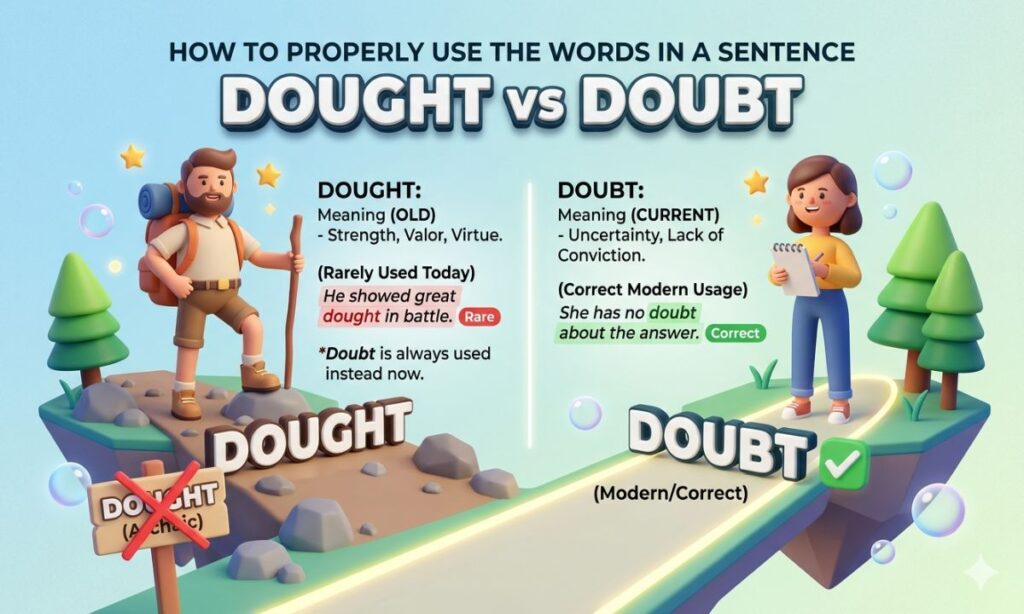
Knowing the definitions of dought vs doubt is only half the battle. Using them correctly in sentences is where the real skill lies.
How To Use “Dought” In A Sentence
Because dought is an archaic or obsolete term, using it in a sentence today requires extreme care and a very specific context. Below are the only legitimate scenarios where dought might appear in a sentence:
As an archaic past tense of “do” or “dare” (historical or literary context):
He dought not speak before the king without permission.
As a reference to a lump of dough in a historical or dialect text:
The old baker shaped the dought carefully before placing it near the fire.
In Scottish dialect writing for authenticity:
She dought not find the courage to cross the frozen river alone.
Important note: If you are writing a recipe, a blog post, a professional email, or any piece of modern content, dought is not the right word. The mixture of flour and water used in baking is spelled dough, which is a completely different word that is often confused with dought.
How To Use “Doubt” In A Sentence
The word doubt belongs in virtually every modern writing situation where you want to express uncertainty or skepticism. Here is how to use it correctly as both a noun and a verb:
Using doubt as a verb:
I doubt the new policy will solve the underlying problem. She doubts whether the project can be completed on schedule. He has always doubted his own ability to lead a team.
Using doubt as a noun:
There is real doubt about whether the evidence is reliable. Her doubt grew stronger as the investigation continued. Without a doubt, this is the most challenging case I have ever worked on.
Using doubt in common expressions:
When in doubt, always choose the simpler word. No doubt, she is the most qualified candidate in the room. I have no doubt that the team will deliver excellent results.
Every time you consider dought vs doubt for a modern sentence, the answer is doubt.
More Examples Of Dought & Doubt Used In Sentences
Examples Of Using Dought In A Sentence
These examples are drawn from historical, archaic, or dialect contexts only:
- The knight dought not raise his sword against his own lord.
- She dought the heavy bread before sunrise in the old village tradition.
- He dought not confess his secret to the elder council.
- The old Scottish tale described how the warrior dought his courage and pressed forward.
- In the medieval text, the villagers dought not challenge the landlord’s authority.
- The scribe wrote that he dought to finish the manuscript before the winter.
Examples Of Using Doubt In A Sentence
These examples reflect natural, modern usage across a variety of contexts:
- I doubt the meeting will end before noon given how many agenda items remain.
- She had no doubt that her years of preparation had paid off completely.
- The scientist expressed serious doubt about the reproducibility of the experiment.
- When in doubt about grammar rules, always consult a reliable style guide.
- His doubt about the project grew stronger after the third failed prototype.
- The jury had reasonable doubt about the reliability of the witness testimony.
- There is absolutely no doubt that regular reading improves writing skills.
- She doubted herself for a moment before stepping forward with confidence.
- The new evidence cast doubt on the entire theory they had built over the years.
- Without doubt, learning the difference between dought vs doubt will improve your writing.
Dought vs Doubt Meaning
When comparing dought vs doubt at the meaning level, the contrast could not be sharper.
Dought meaning today is essentially nonexistent in standard English. Historically, it pointed to:
- An archaic past tense of “do” or “dare” in certain dialects
- A lump of raw, uncooked dough in baking contexts (now considered obsolete)
- A form occasionally used in Scottish dialect to convey “could” or “was able to”
Doubt meaning is rich, current, and well-documented. It refers to:
- A feeling of uncertainty or lack of conviction
- Skepticism about the truth or reliability of something
- Hesitation or reluctance to believe a claim or decision
- A state of mind open to two or more conflicting possibilities
The core takeaway in any dought vs doubt meaning discussion is this: doubt is the living word, and dought is the historical artifact. Choosing between them is not really a choice at all for modern writers.
Dought vs Doubt Pronunciation
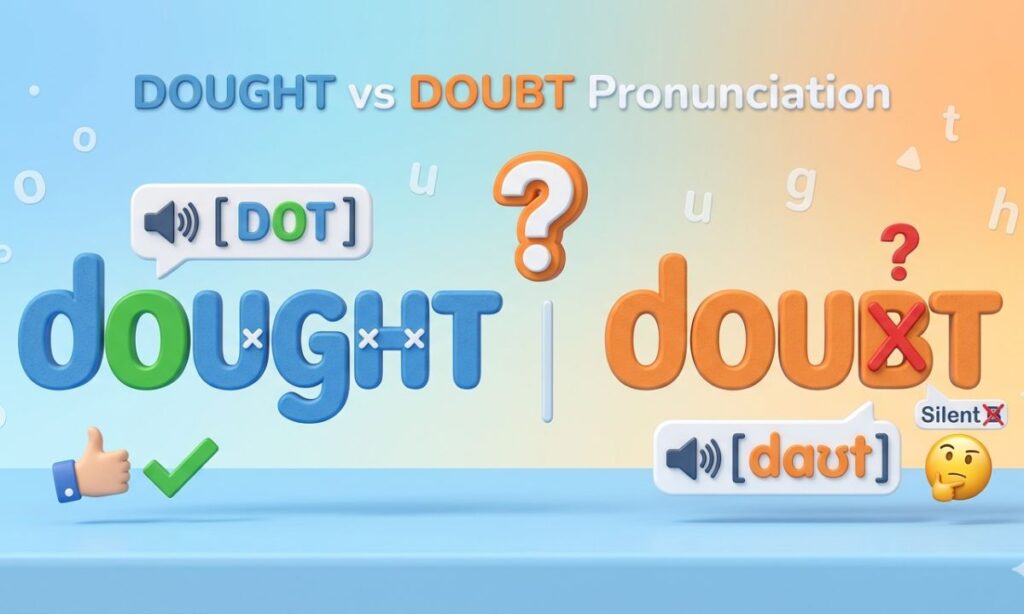
One of the biggest reasons dought vs doubt causes so much confusion is that both words are pronounced identically in modern English.
Both words are pronounced: /daʊt/ (rhymes with “out” and “shout”)
This is the root of the entire spelling problem. When writers hear the word “dowt” in speech, they sometimes reach for a phonetic spelling and write “dought” by analogy with words like:
| Similar Sound | Correct Spelling |
| Bought | B-O-U-G-H-T |
| Thought | T-H-O-U-G-H-T |
| Fought | F-O-U-G-H-T |
| Dought (misspelling of doubt) | Should be D-O-U-B-T |
The pattern seems logical, but it is misleading. The word doubt preserves its silent “b” from its Latin origin, and no amount of phonetic reasoning changes that rule. The correct spelling is always doubt, never dought, in modern English.
A simple memory trick: think of the phrase “Without a doubt.” The “b” is silent but it is always there.
Common Mistakes To Avoid
Understanding dought vs doubt also means knowing the most frequent errors writers make and how to fix them.
Using “Dought” Instead Of “Doubt”
This is by far the most common mistake. Writers hear the word /daʊt/ and spell it phonetically as “dought,” following the pattern of “bought” or “thought.” The result is a spelling error that modern spell-checkers may not always catch.
Incorrect: I dought he will show up for the meeting on time. Correct: I doubt he will show up for the meeting on time.
Incorrect: There is no dought she is the most qualified person for the role. Correct: There is no doubt she is the most qualified person for the role.
Incorrect: She has always doughted her ability to manage large teams. Correct: She has always doubted her ability to manage large teams.
Why this happens: The words “bought,” “thought,” “fought,” and “sought” all follow the “ought” pattern. Writers apply the same logic to the word “dowt” and write “dought.” This feels grammatically familiar but is factually incorrect.
Using “Doubt” Instead Of “Dought”
This is a much rarer mistake, but it does happen in very specific contexts. If a writer is crafting authentic historical fiction set in the medieval period, or deliberately using Scottish dialect for cultural authenticity, replacing the intended archaic “dought” with the modern “doubt” changes the tone and historical accuracy of the text.
Example in historical context:
- Archaic intent: He dought not enter the great hall uninvited.
- Modern replacement: He doubted not entering the great hall uninvited. (Changes the meaning entirely)
In this case, substituting doubt for dought creates a grammatically awkward or semantically different sentence. Writers working in historical genres need to be aware of this distinction.
Confusing The Meanings Of “Dought” And “Doubt”
Another mistake in the dought vs doubt debate is assuming the two words mean the same thing. They do not.
- Dought (in its archaic baking context) refers to a physical substance: a lump of raw dough.
- Doubt refers to an abstract mental state: uncertainty or hesitation.
Swapping one for the other in a sentence produces nonsense:
Incorrect: The baker kneaded his doubt carefully before putting it in the oven. Correct: The baker kneaded his dought carefully before putting it in the oven. (Archaic) Modern correct version: The baker kneaded his dough carefully before putting it in the oven.
The safest rule in any dought vs doubt situation: if you are writing anything in standard modern English, use doubt. If you are describing bread making, use dough. If you are writing historical fiction in dialect, then and only then does dought become a considered option.
Dought vs Doubt Quotes
Famous writers and thinkers have long used doubt as a powerful concept in their work. Here are some well-known expressions featuring the word doubt:
“If in doubt, don’t.” — Benjamin Franklin
“Doubt is the origin of wisdom.” — René Descartes
“To have doubted one’s own first principles is the mark of a civilized man.” — Oliver Wendell Holmes Jr.
“Without doubt, clarity is the greatest gift a writer can give their reader.” — Common writing maxim
Notice that every meaningful quote uses doubt, not dought. That pattern alone tells you everything about which word belongs in serious, thoughtful writing. The dought vs doubt comparison in literary and philosophical traditions consistently lands on one side: doubt is the word that carries weight, history, and meaning in modern discourse.
Context Matters
One of the most important lessons in the dought vs doubt debate is that the correct choice depends entirely on context. While doubt wins in virtually every modern scenario, understanding the contexts where dought technically has a place helps you become a more well-rounded writer.
Examples Of Different Contexts
Here is a breakdown of how context shapes the dought vs doubt decision:
Context 1: Baking
In a baking context, neither dought nor doubt is typically the right word. The correct term is dough.
Incorrect (dought used as dough): Mix the dought until it reaches a smooth consistency. Correct: Mix the dough until it reaches a smooth consistency.
However, if you are writing a piece set in the Middle Ages or using archaic dialect for literary purposes, dought could appear as a historically appropriate variant of “dough”:
Historical/Archaic: The monk shaped the dought into small rounds and set them beside the hearth.
In any modern recipe, food article, or cooking blog, always use dough.
Context 2: Uncertainty
In any context involving uncertainty, hesitation, skepticism, or lack of conviction, doubt is the correct and only modern choice.
Personal context: I doubt this shortcut will save us any real time. Academic context: Researchers expressed doubt about the validity of the sample size. Legal context: The verdict was overturned because of reasonable doubt about the evidence. Professional context: She shared her doubt about the merger during the board meeting.
The dought vs doubt decision in any context involving mental states or uncertainty always resolves in favor of doubt.
Context 3: Scottish Dialect
In Scottish dialect writing or historical Scottish literature, dought has been used as a regional variation meaning “could” or “was able to.” This is one of the very few living (or recently living) contexts where dought appears with legitimate purpose.
Scottish dialect example: She dought not find her way back before the storm broke.
This translates roughly to: “She could not find her way back before the storm broke.”
If you are writing fiction set in Scotland or studying Scottish linguistic heritage, awareness of this usage is valuable. For everyone else, the dought vs doubt answer remains: always use doubt.
Exceptions To The Rules
Grammar always has its exceptions, and the dought vs doubt discussion is no different. Here are the three main exceptions worth knowing:
Exception 1: Regional Differences
In some parts of the United Kingdom, particularly in Scotland and certain areas of Northern England, dought has historically appeared as a regional variant. The spelling reflects local pronunciation patterns rather than standard English orthography. In these regional contexts, using dought is not a mistake but a reflection of cultural and dialectal heritage.
Writers who are documenting, studying, or creatively representing these regional dialects should honor the local form rather than defaulting to standard spelling.
Exception 2: Idiomatic Expressions
In standard modern English, all common idiomatic expressions use doubt, never dought. Phrases like “without a doubt,” “beyond reasonable doubt,” “no doubt about it,” and “when in doubt” are fixed expressions. However, in reconstructed or fictional archaic dialects, a writer might intentionally adapt these expressions with dought for stylistic effect.
This is extremely rare in practice and should only be attempted by writers with a strong command of historical English language patterns.
Exception 3: Technical Terms
In historical linguistics, etymology studies, and academic language research, the word dought may appear as a technical term when discussing the evolution of English vocabulary. In these specialized contexts, using dought is not an error but a deliberate reference to an archaic form for scholarly purposes.
Outside of these narrow technical discussions, the dought vs doubt rule holds firm: doubt is your word.
Practice Exercises
The best way to cement your understanding of dought vs doubt is to practice using them in sentences. Here are two exercises to sharpen your skills.
Exercise 1: Fill In The Blank
Fill in each blank with either dought or doubt. Pay close attention to the context:
- She had no _______ that the research would take longer than expected.
- The medieval scribe wrote that the knight _______ not enter the king’s chamber.
- When in _______, always check your spelling before submitting any written work.
- The old text revealed that the village elder _______ to speak against the council.
- There is little _______ that regular writing practice improves long-term skills.
- Old Scottish texts recorded that the farmer _______ not carry the load alone.
- I _______ the new manager fully understands the complexity of the situation.
- The historian noted that _______ appeared in 14th-century manuscripts as a verb form.
Answer key: 1. doubt, 2. dought, 3. doubt, 4. dought, 5. doubt, 6. dought, 7. doubt, 8. dought
Exercise 2: Choose The Correct Word
Choose the correct word (dought or doubt) to complete each sentence based on the context provided:
1. Modern professional email:
I (dought / doubt) the client will approve the revised proposal without revisions. Answer: doubt
2. Historical fiction set in medieval England:
The young squire (dought / doubt) not challenge the order of the elder knights. Answer: dought
3. Scientific writing:
The team expressed (dought / doubt) about whether the results could be replicated under different conditions. Answer: doubt
4. Scottish dialect story:
Old Hamish (dought / doubt) not cross the icy burn in the darkness of winter. Answer: dought
5. Everyday conversation:
No (dought / doubt) about it, this is the best coffee I have tasted all year. Answer: doubt
6. Legal writing:
The defense argued there was sufficient reasonable (dought / doubt) to acquit the defendant. Answer: doubt
Frequently Asked Questions About Dought vs Doubt
Is “dought” a real word?
Yes, but only in archaic or historical contexts. It is not a recognized modern English word.
Why do people write “dought” instead of “doubt”?
Because both sound identical (/daʊt/) and “dought” follows the spelling pattern of “bought” and “thought.”
Can “dought” and “doubt” be used interchangeably?
No. They have different meanings and belong in entirely different contexts.
What is the silent letter in “doubt”?
The “b” is silent, preserved from the Latin root “dubitare.”
Is “dought” ever correct in modern writing?
Only in very narrow historical, dialect, or linguistic contexts. In all other cases, doubt is correct.
What does “doubt” mean as a noun?
It refers to a feeling of uncertainty or lack of conviction about something.
What does “doubt” mean as a verb?
It means to be uncertain about something or to question its truth or reliability.
Read This: All-Time Favorite or All Times Favorite: Which is Correct?
Conclusion
The dought vs doubt question has a clear and simple answer for modern writers: use doubt. Every time you want to express uncertainty, hesitation, skepticism, or lack of conviction in your writing, doubt is the correct, precise, and universally recognized choice. It is a word with a rich history, a clear meaning, and wide application across every type of writing from casual emails to academic research.
Dought, on the other hand, belongs to a different era of the English language. It is an archaic word that served its purpose in Middle English and Old English texts and in regional Scottish dialects, but it has no place in standard modern communication. Writers who use dought in place of doubt risk confusing readers, damaging their credibility, and making what is essentially a preventable spelling error.
The next time you are writing and you hear that /daʊt/ sound in your head, resist the pattern of “bought” and “thought.” Remember: doubt has a silent “b” for a reason, and that spelling has been with us since Latin scribes shaped the English language centuries ago. Understanding the dought vs doubt distinction is a small step, but it is the kind of small step that separates careful, confident writers from those who let phonetic instinct override grammatical knowledge.
When in doubt, always choose doubt.