
If you have typed “encorporate” into an email, an essay, or a business document and then paused wondering whether it looks right, you are far from alone. The encorporate vs incorporate question is one of the most searched spelling confusions in English, and it trips up students, professionals, and even experienced writers.
The good news is that this guide will clear up the confusion completely. By the end, you will know exactly which word to use, why the other one is wrong, and how to remember the difference forever. We will cover definitions, real examples, grammar rules, comparison tables, and common mistakes, all in simple language anyone can follow.
Let’s settle the encorporate vs incorporate debate once and for all.
The Quick Answer You Need First
Let’s get straight to the point before going into details.
Simple Definition:
Only one of these words is correct in standard English. “Incorporate” is the right spelling, and “encorporate” is a misspelling that does not appear in any major dictionary, including Merriam Webster, Oxford, or Cambridge.
“Incorporate” means to include something as part of a larger whole, or to legally form a business as a corporation.
Example:
Correct: We plan to incorporate your feedback into the next update.
Incorrect: We plan to encorporate your feedback into the next update.
Whenever you face the encorporate vs incorporate choice, always pick incorporate. There is no exception, no regional variation, and no alternate spelling.
What Does “Incorporate” Mean? (Simple Explanation)
The word “incorporate” carries two main meanings, and both are useful in everyday and professional English.
Meaning 1: To Include Something
The first meaning is to add or include something as part of a bigger group, plan, or structure. This is the most common everyday use of the word.
Meaning 2: To Form a Company
The second meaning relates to business and law. To incorporate means to legally register a business as a corporation, giving it its own legal identity separate from its owners.
Think of it this way:
Picture a recipe. When you incorporate an ingredient, you mix it fully into the dish so it becomes part of the whole. The same idea applies whether you are blending flavors in cooking, adding feedback into a report, or forming a company that becomes its own legal “body.”
Incorporate Meaning in Everyday English
Outside of business, “incorporate” appears constantly in casual and formal writing alike.
Common Real-Life Uses:
- A teacher might incorporate new teaching methods into a lesson plan.
- A writer might incorporate research findings into an article.
- A chef might incorporate seasonal vegetables into a menu.
- A designer might incorporate client suggestions into a final layout.
Simple Analogy:
Think of “incorporate” like adding a new piece to a puzzle. The piece does not sit separately; it becomes part of the complete picture. That is exactly what happens when you incorporate an idea, ingredient, or detail into something larger.
Incorporate Meaning in Business (Important Context)
This is where the word “incorporate” becomes especially important, since one wrong letter can completely change the meaning of a legal document.
What Does It Mean to Incorporate a Business?
To incorporate a business means to legally register it as a corporation. Once incorporated, the business becomes its own legal entity, separate from the people who own it.
Key Concepts:
- The business gets its own legal identity, separate from its founders.
- Owners typically gain limited liability protection.
- The company can own property, sign contracts, and be taxed on its own.
- Incorporation usually involves filing documents with a government agency.
What Happens When a Business Is Incorporated?
Once a company completes incorporation, it receives official recognition as a corporation. This often includes a new legal name, a registration number, and formal documents proving its status.
Example Scenario:
Imagine two friends start a small bakery as a simple partnership. After a year, they decide to incorporate the business to protect their personal assets. Once the paperwork is filed and approved, the bakery becomes a legally separate corporation, and the owners are no longer personally responsible for most business debts.
Is “Encorporate” a Real Word?
No. “Encorporate” is not a recognized English word in any standard dictionary. It does not appear in Merriam Webster, Oxford, or Cambridge dictionaries, and it has no accepted meaning of its own.
Whenever someone writes “encorporate,” it is simply a misspelling of “incorporate.” There is no separate definition, no historical usage, and no regional acceptance for this spelling. In every encorporate vs incorporate comparison, encorporate loses because it simply does not exist as a proper word.
Why People Confuse “Encorporate” and “Incorporate”
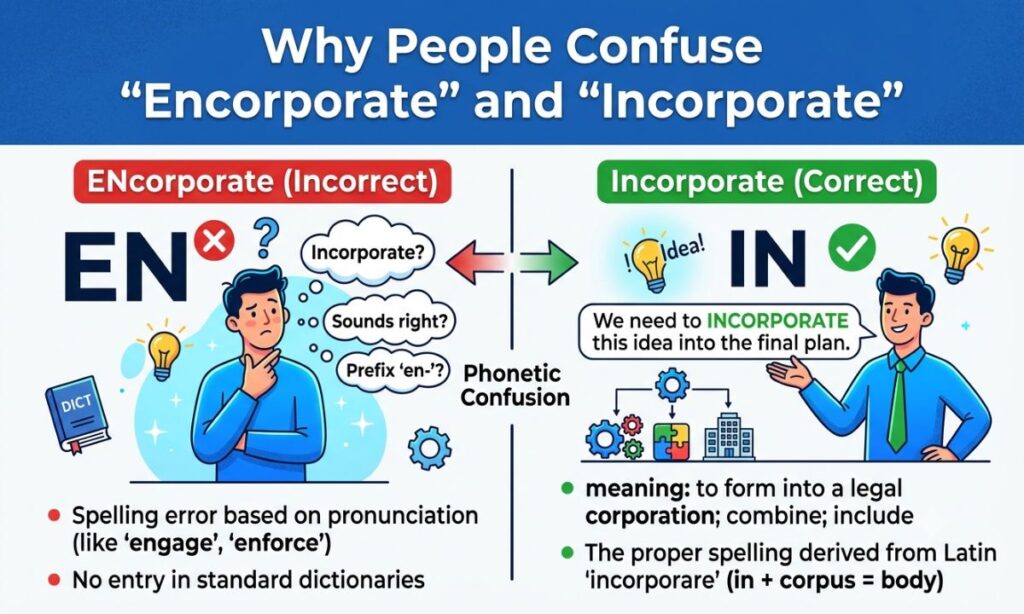
If encorporate is not even a real word, why do so many people type it? The answer comes down to a few simple reasons.
Main Reasons:
- Both words sound almost identical when spoken quickly.
- English has many common words that start with “en,” such as enable, enclose, and enjoy.
- Typing speed and autocorrect habits can reinforce the wrong spelling.
- Visual memory of similar looking words can blur the correct prefix.
Key Insight:
The confusion is purely about spelling, not meaning. People who write “encorporate” almost always mean exactly what “incorporate” means. The intended meaning is correct, but the spelling is not, which is why the encorporate vs incorporate issue is considered a spelling trap rather than a vocabulary problem.
Encorporate vs Incorporate (Clear Comparison)
Here is a simple table that puts the entire encorporate vs incorporate comparison side by side.
| Feature | Incorporate | Encorporate |
| Real word | Yes | No |
| Dictionary listed | Yes (Merriam Webster, Oxford, Cambridge) | No |
| Correct spelling | Yes | No |
| Meaning | To include or form a company | None, it is a misspelling |
| Acceptable in writing | Yes | Never |
| Origin | Latin “incorporare” | No valid origin |
Quick Takeaway:
When deciding between encorporate vs incorporate, remember that only one option is a real, dictionary approved word. Incorporate wins every single time, in every context, in every form of English.
How to Spell “Incorporate” Correctly (And Never Forget It)
Spelling this word correctly is simple once you understand the structure behind it.
Correct Spelling:
I N C O R P O R A T E
Common Mistakes:
- Encorporate (wrong prefix)
- Incoperate (missing a letter)
- Incorprate (missing a letter)
- Encorprate (combines two mistakes)
Memory Trick:
Remember that “incorporate” starts with “in,” just like the words “inside” and “include.” If you can include something, you can incorporate it. Linking these two “in” words together can help you avoid the encorporate vs incorporate trap permanently.
How to Use “Incorporate” in a Sentence
Seeing the word in real sentences makes it much easier to use correctly and confidently.
Everyday Examples:
- She decided to incorporate more vegetables into her diet.
- The teacher will incorporate student feedback into next week’s lesson.
- He tried to incorporate a short workout into his morning routine.
Business Examples:
- The founders chose to incorporate the company in Delaware.
- After incorporating, the business gained limited liability protection.
- Investors often prefer working with companies that are properly incorporated.
Professional Writing:
- This report will incorporate data from three separate departments.
- The new policy incorporates feedback from last year’s employee survey.
- Our team plans to incorporate the client’s suggestions before the final draft.
Verb Forms and Grammar Rules
“Incorporate” is a regular verb, which makes it fairly easy to use across different tenses.
| Form | Word |
| Base form | incorporate |
| Past tense | incorporated |
| Past participle | incorporated |
| Present participle | incorporating |
| Third person singular | incorporates |
Grammar Tip:
Notice that every single form keeps the same “in” prefix. Whether you are writing incorporate, incorporated, incorporating, or incorporates, the spelling pattern never changes to “en.” If you remember this rule, the encorporate vs incorporate confusion becomes much easier to avoid in longer sentences and different tenses.
Incorporate vs Include vs Integrate (Key Differences)
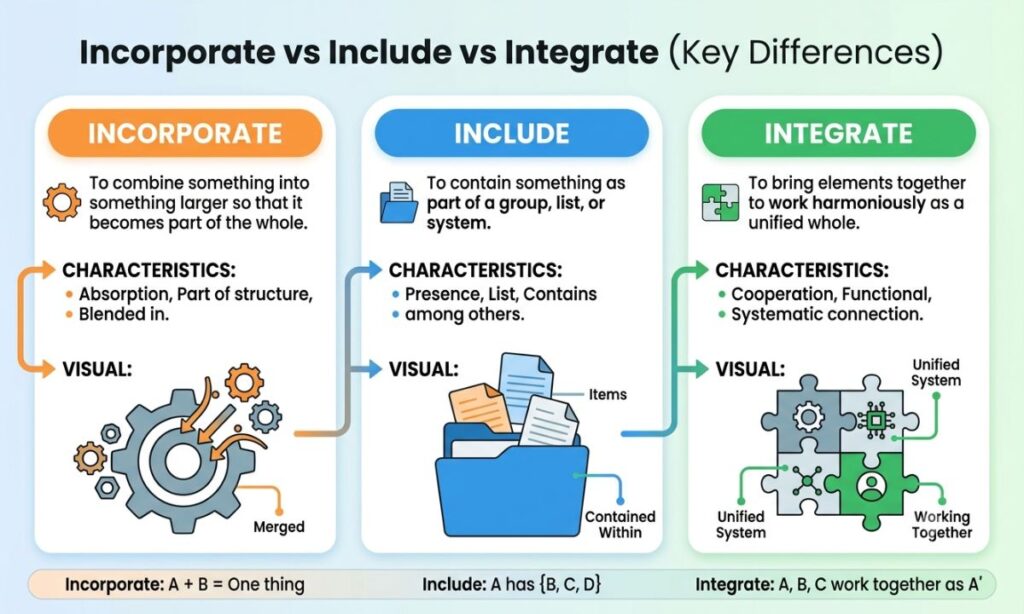
These three words often appear in similar contexts, but they are not interchangeable.
Simple Breakdown:
- Incorporate means to add something so it becomes part of a larger whole.
- Include means to contain something as one part among others, often without full blending.
- Integrate means to combine things so they work together smoothly as a single system.
Comparison Table:
| Word | Core Meaning | Example |
| Incorporate | Add into a structure or form a company | We will incorporate your notes into the plan |
| Include | Contain as part of a list or group | The price includes shipping costs |
| Integrate | Blend so everything functions together | The new software integrates with our existing tools |
Practical Example:
A report can include three sections, incorporate feedback from each department, and ultimately integrate all the data into one unified summary. Each word plays a slightly different role, even though they overlap in meaning.
Synonyms of “Incorporate” (Improve Your Writing)
Using synonyms can make your writing feel more varied and natural, especially in longer documents.
Synonyms:
- Include
- Combine
- Integrate
- Merge
- Embody
- Absorb
- Blend
Example:
Instead of writing “incorporate” three times in one paragraph, you could write: “The new design will combine user feedback, integrate accessibility features, and embody the brand’s updated style guide.” Using varied vocabulary keeps your writing engaging while still conveying the same overall meaning.
Common Mistakes Writers Make
Even confident writers slip up with this word from time to time. Here are the most frequent issues.
Mistake 1: Using “Encorporate”
This is the single biggest mistake. Writers hear the word spoken aloud, assume it starts with “en,” and type it without checking. As covered earlier in this encorporate vs incorporate guide, this spelling is never correct.
2: Confusing with “Include”
Some writers use “incorporate” when a simpler word like “include” would fit better, making sentences feel overly formal or stiff for casual writing.
3: Misusing Business Meaning
In legal or financial writing, some people use “incorporate” loosely when they actually mean something different, such as registering a trademark or opening a business bank account, rather than forming a legal corporation.
Related Spelling Mistakes (Learn Faster)
Once you understand the encorporate vs incorporate pattern, it becomes easier to spot similar spelling traps in English.
Common Errors:
- Inclose vs Enclose
- Insure vs Ensure
- Inquire vs Enquire
- Indorse vs Endorse
Why These Happen:
Most of these errors happen because “in” and “en” prefixes sound nearly identical in fast speech, and both prefixes are extremely common in English. The encorporate vs incorporate issue is really just one example of a much wider pattern involving these two prefixes.
Read This: Nonresponsive vs Unresponsive: What’s the Real Difference?
Quick Practice (Make It Stick)
Practice is one of the fastest ways to lock in correct spelling habits.
Fill in the Blank:
- The company plans to ______ new safety measures next month.
- After being ______, the business gained legal protection.
- Please ______ this feedback into your final draft.
(Answers: incorporate, incorporated, incorporate)
Fix the Sentence:
Wrong: We need to encorporate these changes before Friday.
Correct: We need to incorporate these changes before Friday.
Wrong: The startup was encorporated in California last year.
Correct: The startup was incorporated in California last year.
Key Takeaways (Simple and Clear)
- “Incorporate” is the only correct spelling in standard English.
- “Encorporate” does not exist in any major dictionary and has no meaning of its own.
- “Incorporate” means to include something in a larger whole, or to legally form a corporation.
- The word follows the same spelling pattern across all its forms: incorporate, incorporated, incorporating, incorporates.
- Whenever you face the encorporate vs incorporate choice, the answer is always incorporate, with no exceptions.
Remembering the connection to “include” and “inside” can help you avoid this mistake permanently. The next time the encorporate vs incorporate question comes up in your writing, you will know exactly which spelling to trust.
Reference Cambridge Dictionary Definitions
According to the Cambridge Dictionary, “incorporate” is defined as to include something as part of something larger, and also as to form a legal corporation. These definitions confirm that “incorporate” is the standard, dictionary recognized spelling, while “encorporate” has no listing or definition at all. For anyone still unsure about encorporate vs incorporate, checking a trusted dictionary like Cambridge is the simplest way to confirm that incorporate is, and always has been, the correct choice.