

If you have ever typed a congratulatory note and paused, unsure whether to write “well deserved” or “well-deserved,” you are not alone. This tiny hyphen question trips up native speakers, professional writers, and English learners every single day. The phrase appears in emails, award announcements, performance reviews, social media posts, and everyday compliments. Getting it right matters more than you might think.
So, which is correct: well deserved or well-deserved? The short answer is that both forms are grammatically acceptable, but each one belongs in a specific position within a sentence. Use the wrong form in a professional context and it can quietly undermine your credibility. Use the right one and your writing sounds polished, precise, and authoritative.
This complete, updated guide for 2026 covers the meaning, grammar rules, real-world examples, and everything else you need to master well deserved or well-deserved once and for all.
Well Deserved or Well-Deserved? Which is Correct?
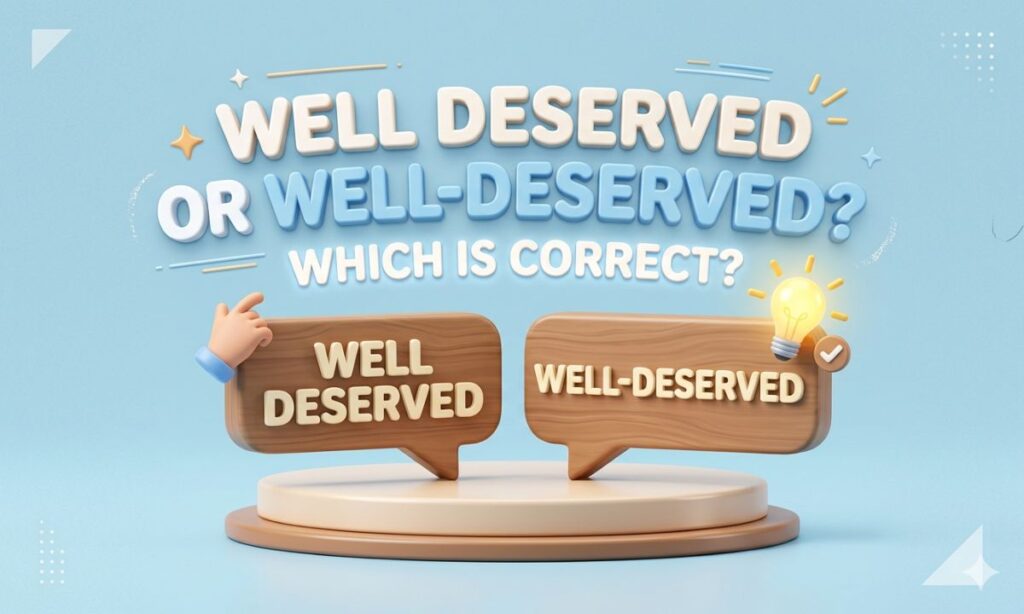
Both well deserved and well-deserved are correct in English. However, the form you choose depends entirely on where the phrase appears in your sentence.
Here is the core rule in plain terms:
- Use well-deserved (with a hyphen) when the phrase comes before a noun and acts as a compound adjective.
- Use well deserved (without a hyphen) when the phrase comes after a linking verb such as “is,” “was,” or “seems.”
This is known as the compound adjective hyphenation rule, and it applies to dozens of similar phrases in English such as “well-known,” “hard-earned,” “long-awaited,” and “much-needed.”
| Position in Sentence | Correct Form | Example |
| Before a noun | well-deserved | She received a well-deserved award. |
| After a linking verb | well deserved | The award was well deserved. |
| Standalone exclamation | well deserved | “Well deserved!” |
| Before a noun (professional) | well-deserved | He got a well-deserved promotion. |
| After “is” or “was” | well deserved | Her recognition is well deserved. |
Understanding this table is the fastest way to stop second-guessing yourself every time you write well deserved or well-deserved.
Why Does the Hyphen Matter?
A hyphen in a compound adjective signals to the reader that two words are working together as a single unit to modify a noun. Without the hyphen, a reader might briefly pause and wonder whether “well” and “deserved” are two separate ideas. The hyphen removes that split-second of uncertainty and keeps your writing clear.
Think of it this way: in “a well-deserved break,” the hyphen shows that “well” is not standing alone. It is not saying the break is “well” in some other sense. It is combining with “deserved” to mean the break was genuinely and fairly earned. That precision is exactly what professional writing demands.
Read This: Seing Vs Seeing: What’s The Correct Spelling To Use?
Well Deserved: Meaning and Usage
Well deserved (without a hyphen) is an adjective phrase that describes something earned through genuine effort, merit, or good behavior. In this form, the phrase follows a linking verb and describes the subject from a distance, rather than sitting directly in front of a noun.
What Does “Well Deserved” Mean?
The phrase “well deserved” means that a reward, recognition, success, or outcome was fully and justifiably earned. It implies fairness, merit, and acknowledgment of genuine effort. When someone says an achievement is well deserved, they are confirming that the result was not accidental or lucky but was a natural consequence of hard work and dedication.
The word “well” functions as an adverb that intensifies “deserved.” It means the thing in question was not just somewhat deserved but thoroughly and rightfully earned.
When to Use “Well Deserved” (No Hyphen)
Use well deserved without a hyphen in the following situations:
- After a linking verb: The noun or subject appears before the phrase, and a verb like “is,” “was,” “seems,” or “has been” connects them.
- As a standalone exclamation: When used alone as a comment or compliment, no hyphen is needed.
- In predicate position: Any time the phrase acts as a predicate adjective describing a subject that has already been named.
Examples of correct usage:
- Her promotion was well deserved.
- The applause was well deserved.
- After all those extra hours, this vacation is well deserved.
- “Congratulations! This recognition is well deserved.”
Notice that in each case above, the noun being described (promotion, applause, vacation, recognition) appears before the phrase. That placement removes the need for a hyphen.
Grammar Note on “Well Deserved”
Some grammar authorities note that even in predicate position, adding the hyphen is not technically wrong. Style guides like APA and MLA sometimes permit “well deserved” without a hyphen in predicate position to avoid over-hyphenation. However, most professional editors prefer to drop the hyphen after a linking verb for clean, modern writing.
Well-Deserved: Meaning and Usage
Well-deserved (with a hyphen) is a compound adjective. It directly modifies a noun that appears immediately after it. This is the form you will see most often in published books, formal reports, award citations, and professional communications.
What Does “Well-Deserved” Mean?
Well-deserved carries the same core meaning as well deserved. It describes something that has been thoroughly earned through effort, skill, patience, or consistent good behavior. The addition of the hyphen does not change the meaning but signals the grammatical relationship between the two words and the noun that follows.
When you write “a well-deserved promotion,” the hyphen tells the reader that “well” and “deserved” are acting together as a single descriptive unit for the word “promotion.”
When to Use “Well-Deserved” (With Hyphen)
Use well-deserved with a hyphen whenever:
- The phrase appears directly before a noun.
- The two words function together as a compound modifier.
- You want to maintain formal, professional, or academic tone.
Examples of correct usage:
- She received a well-deserved recognition.
- They enjoyed a well-deserved vacation after the project ended.
- The team celebrated their well-deserved victory.
- He was finally given a well-deserved raise.
- The scientist received a well-deserved award for her groundbreaking research.
In every example above, the noun (recognition, vacation, victory, raise, award) follows immediately after “well-deserved.” That direct noun relationship is your signal to add the hyphen.
Style Guide Guidance
Major style guides confirm the hyphenated form before a noun:
- AP Style: Hyphenate compound adjectives before a noun. “She received a well-deserved promotion.”
- Chicago Manual of Style: Compound modifiers before nouns take a hyphen.
- Cambridge Dictionary: Lists “well-deserved” as the standard compound adjective form.
- Oxford Dictionary: Confirms “well-deserved” for pre-noun placement.
Well-Deserved in a Sentence
Seeing well deserved or well-deserved used in real sentences is the best way to lock in the rule. Below are varied examples covering different contexts, from casual conversation to formal writing.
Predicate Position (No Hyphen)
These sentences place the phrase after a verb:
- The standing ovation was well deserved after that performance.
- Her reputation as a compassionate leader is well deserved.
- After months of overtime, this rest is truly well deserved.
- Their gold medal seems well deserved given how hard they trained.
- “Congratulations on the win. It was well deserved!”
Attributive Position (With Hyphen)
These sentences place the phrase directly before a noun:
- The athlete took a well-deserved break after the season ended.
- She accepted her well-deserved award with grace and humility.
- The documentary received well-deserved attention from critics worldwide.
- His well-deserved recognition came after fifteen years of service.
- After completing the marathon, he treated himself to a well-deserved meal.
Well Deserved or Well-Deserved Grammar

Understanding the grammar behind well deserved or well-deserved means understanding two core concepts: compound adjectives and predicate adjectives.
Compound Adjectives and Hyphens
A compound adjective is formed when two or more words join together to modify a single noun. When “well” and “deserved” function together this way, they need a hyphen to show they are one unit.
Examples of similar compound adjectives following the same rule:
- Well-known → “a well-known author” (before noun) vs. “the author is well known” (after verb)
- Hard-earned → “a hard-earned victory” vs. “the victory was hard earned”
- Long-awaited → “the long-awaited announcement” vs. “the announcement was long awaited”
- Much-needed → “a much-needed change” vs. “the change was much needed”
The pattern is consistent across all of these. Well deserved or well-deserved follows the same rule that governs the entire category of “adverb + past participle” compound modifiers.
The Role of “Well” as an Adverb
The word “well” is an adverb. It modifies the past participle “deserved.” When an adverb and a past participle combine before a noun, English grammar traditionally calls for a hyphen. However, when that same combination appears after a linking verb (in predicate position), the hyphen is considered optional and is often dropped in modern usage.
This is the complete grammatical explanation for why well deserved or well-deserved can both be correct depending on context.
Quick Grammar Test
Ask yourself these questions before writing the phrase:
- Does “well deserved” come directly before a noun? → Use the hyphen: well-deserved.
- Does it come after a verb like “is,” “was,” or “seems”? → Drop the hyphen: well deserved.
- Are you using it as a standalone comment? → Drop the hyphen: well deserved.
Well Deserved or Well Deserved Examples
The clearest way to master well deserved or well-deserved is through side-by-side comparison. Below are paired examples showing how the same core idea changes form based on sentence position.
| No Hyphen (Predicate) | With Hyphen (Before Noun) |
| The praise was well deserved. | She received well-deserved praise. |
| His rest is well deserved. | He took a well-deserved rest. |
| Their success feels well deserved. | They achieved well-deserved success. |
| This recognition is well deserved. | He was given well-deserved recognition. |
| The break was well deserved. | They enjoyed a well-deserved break. |
| Her victory seems well deserved. | She celebrated her well-deserved victory. |
Each pair expresses the same idea but uses different grammar based on word position. Both are correct within their own context.
Common Mistakes to Avoid
Many writers make these errors when choosing between well deserved or well-deserved:
- Wrong: “She got a well deserved promotion.” (No hyphen before a noun.)
- Right: “She got a well-deserved promotion.”
- Wrong: “The promotion was well-deserved.” (Unnecessary hyphen after a verb.)
- Right: “The promotion was well deserved.”
- Wrong: “Well-deserved!” as a standalone exclamation.
- Right: “Well deserved!” as a standalone exclamation.
Examples of Using “Well Deserved” in a Sentence
Here are 20 original, varied examples showing well deserved (no hyphen) used correctly in the predicate position:
- After years of tireless effort, this honor is well deserved.
- The crowd’s enthusiastic response was well deserved by the performers.
- Your confidence in this achievement is well deserved.
- Given everything she contributed, the recognition was truly well deserved.
- The accolades for her leadership were absolutely well deserved.
- His reputation for fairness and integrity is well deserved.
- “Congratulations to the entire team. The award is well deserved.”
- The applause that followed her speech was well deserved.
- After such a grueling schedule, your time off is well deserved.
- The positive reviews that film received were well deserved.
- His victory in the championship was completely well deserved.
- The company’s growth and recognition are well deserved results of their innovation.
- Everyone agreed that the trophy was well deserved.
- The standing ovation was well deserved after that flawless performance.
- Their success in the global market is well deserved after years of research.
- Her promotion to senior manager is well deserved.
- The community’s gratitude toward the volunteers is well deserved.
- The grade she received on that project was well deserved.
- This year’s vacation will be well deserved after such a demanding work season.
- The coach’s praise of his players was well deserved.
Examples of Using “Well-Deserved” in a Sentence
Here are 20 original examples showing well-deserved (with hyphen) used correctly before a noun:
- She accepted her well-deserved award with quiet dignity.
- The athlete enjoyed a well-deserved rest after the tournament.
- He finally took a well-deserved vacation after finishing the project.
- The team celebrated their well-deserved victory with great enthusiasm.
- The manager gave him a well-deserved compliment during the meeting.
- After months of preparation, they achieved a well-deserved result.
- The scientist received a well-deserved grant for her breakthrough research.
- He earned a well-deserved reputation as one of the best coaches in the league.
- After completing her degree, she treated herself to a well-deserved trip abroad.
- The documentary received well-deserved praise from audiences and critics alike.
- His well-deserved recognition came after fifteen years of dedication.
- The school gave the teacher a well-deserved tribute at the year-end ceremony.
- She landed a well-deserved spot on the national team through consistent performance.
- The charity received well-deserved attention after its community impact was publicized.
- He finally took a well-deserved break from the demanding project.
- Her well-deserved success story inspired many young professionals around her.
- The city awarded the first responders a well-deserved honor at the annual gala.
- After a full decade of hard work, he received a well-deserved raise.
- The play received a well-deserved standing ovation at the end of every show.
- She completed the marathon and celebrated with a well-deserved meal.
Well-Deserved or Well-Deserved Promotion
The phrase “well-deserved promotion” is one of the most common real-world uses of this grammar rule, and it causes significant confusion. Let us break it down clearly.
Which Is Correct: “Well-Deserved Promotion” or “Well Deserved Promotion”?
When “promotion” is the noun being described and it appears directly after the phrase, you must use the hyphen:
Correct: She received a well-deserved promotion after three years of outstanding work.
Incorrect: She received a well deserved promotion after three years of outstanding work.
The noun “promotion” comes directly after “well-deserved,” so the hyphen is required. This is the compound adjective rule in action.
However, if the noun “promotion” appears before the phrase, you drop the hyphen:
Correct: Her promotion was well deserved after three years of outstanding work.
Here, “promotion” appears before the phrase and is linked to it through the verb “was.” No hyphen is needed.
Promotion Examples at a Glance
| Sentence | Correct Form | Rule |
| She received a ___ promotion. | well-deserved | Before noun |
| Her promotion was ___. | well deserved | After verb |
| The ___ promotion surprised no one. | well-deserved | Before noun |
| Everyone agreed the promotion was ___. | well deserved | After verb |
| He celebrated his ___ promotion. | well-deserved | Before noun |
| The promotion felt ___. | well deserved | After linking verb |
Other Common Nouns Used With “Well-Deserved”
The same rule applies when combining well deserved or well-deserved with other common nouns:
- well-deserved break / “the break was well deserved”
- well-deserved award / “the award was well deserved”
- well-deserved raise / “the raise was well deserved”
- well-deserved recognition / “the recognition was well deserved”
- well-deserved vacation / “the vacation was well deserved”
- well-deserved rest / “the rest was well deserved”
- well-deserved success / “the success was well deserved”
The pattern is identical in every case. Position in the sentence determines the form.
British English vs. American English: Any Difference?
One question many writers have is whether well deserved or well-deserved rules differ between British and American English.
The short answer: the core rule is the same in both varieties. Both use the hyphen before a noun and drop it in predicate position. The only minor difference is that British English publications sometimes tend toward fewer hyphens in compound adjectives overall, so you may occasionally see “well deserved promotion” in a British newspaper without the hyphen. However, this is considered a stylistic variation rather than a grammatical preference, and most British grammar guides still recommend the hyphen before a noun.
For international writing, always follow the hyphen rule: well-deserved before a noun, well deserved after a verb.
Synonyms for Well Deserved or Well-Deserved
If you find yourself repeating well deserved or well-deserved too often, consider these synonyms that carry similar meaning:
| Synonym | Example |
| hard-earned | a hard-earned victory |
| merited | The praise was merited. |
| rightfully earned | Her success was rightfully earned. |
| justified | The recognition was justified. |
| warranted | The applause was warranted. |
| fitting | It was a fitting reward. |
| earned | She earned that promotion. |
| due | Credit is due. |
These alternatives let you vary your language while preserving the same meaning as well deserved or well-deserved.
Read This: Manuel Vs Manual: When To Use Each One In Writing?
Frequently Asked Questions
Is “well deserved” one word or two?
It is two words. The hyphenated version “well-deserved” is also technically two words joined by a hyphen, not one single word.
Is it “well-deserved” or “well deserved” in AP Style?
AP Style recommends “well-deserved” with a hyphen when the phrase appears before a noun, and “well deserved” without a hyphen in predicate position.
Can I always use “well-deserved” with a hyphen to be safe?
Using the hyphen before a noun is always correct. However, using it after a verb (in predicate position) is unnecessary and considered slightly over-hyphenated by most modern editors.
Is “well deserved” correct as a standalone exclamation?
Yes. When used alone as a comment or exclamation, drop the hyphen: “Well deserved!”
Which form is more common according to data?
“Well-deserved” with a hyphen has historically been more frequent in published writing, as confirmed by usage data from Google Ngram Viewer going back to the early 1900s.
Does “well deserved” work in formal academic writing?
Yes, both forms are accepted in academic writing. Use “well-deserved” before a noun and “well deserved” after a linking verb regardless of context.
What is the difference between “well-deserved” and “well-earned”?
“Well-deserved” emphasizes the worthiness of the recognition or reward, while “well-earned” emphasizes the effort and hard work that produced it. Both are compound adjectives and follow the same hyphenation rules.
Is “well deserve” (without the -d) ever correct?
Only in present-tense sentences with a subject, such as “They well deserve this honor.” In all other contexts, the past participle form “deserved” is the correct choice.
Should I use “well-deserved” in a performance review?
Yes. “She received a well-deserved promotion” is professional, precise, and correct in workplace writing.
What is a quick trick to remember the rule?
Ask: does the noun come right after the phrase? If yes, add the hyphen. If the noun comes before the phrase and a verb connects them, skip the hyphen.
Conclusion
The debate over well deserved or well-deserved comes down to one simple rule: position in the sentence. When the phrase comes directly before a noun and acts as a compound adjective, you need the hyphen. When it follows a linking verb and describes a subject that has already been named, you drop it. That single principle covers every situation you will encounter.
Both well deserved and well-deserved are grammatically correct. Neither is wrong as long as you use each form in the right place. The hyphenated form is a compound adjective. The open form is a predicate adjective. They describe the same idea but occupy different grammatical positions in a sentence.
Mastering well deserved or well-deserved is more than a grammar exercise. It is a signal to your readers, colleagues, and audience that you pay attention to detail. In professional writing, that attention builds credibility. In everyday communication, it makes your compliments and acknowledgments land with the clarity and confidence they deserve.
Now that you know the rule, use it. Give credit where credit is due and do it with perfect grammar every time.