


If you have ever searched for kinesthesiology vs kinesiology and ended up more confused than when you started, you are not alone. These two words look almost identical, sound nearly the same, and are often thrown around in the same conversations about human movement, physical therapy, and sports science. Yet they carry very different meanings, and using them incorrectly can seriously undermine your credibility in academic, clinical, or professional writing.
This comprehensive guide breaks down the kinesthesiology vs kinesiology debate once and for all. You will learn what each term actually means, where it comes from, how to use it correctly in a sentence, and why getting this right matters in real-world contexts. Whether you are a student, a fitness professional, a healthcare practitioner, or simply someone who values precise language, this article covers everything you need to know.
Define Kinesthesiology
Kinesthesiology is derived from the word kinesthesia, which refers to the body’s ability to sense its own movement, position, and spatial orientation. Add the suffix -ology, meaning the scientific study of something, and you get kinesthesiology: the study of how the body perceives, senses, and responds to its own movement through sensory feedback mechanisms.
More specifically, kinesthesiology focuses on the internal sensory signals that travel between muscles, joints, tendons, and the brain. These signals allow you to know where your arm is even with your eyes closed, maintain balance on an uneven surface, or catch a ball without consciously thinking about every movement involved. This process relies heavily on proprioceptors, which are specialized sensory receptors embedded in muscles and joints that relay positional data to the central nervous system.
In clinical and therapeutic settings, kinesthesiology is used to evaluate balance, coordination, posture, and motor control. Physical therapists, occupational therapists, and neurological rehabilitation specialists often apply the principles of kinesthesiology when helping patients recovering from strokes, spinal cord injuries, or orthopedic surgery. The goal is to retrain the body’s sensory awareness so that movement becomes safe, efficient, and controlled once again.
It is also worth noting that kinesthesiology is sometimes used in alternative and complementary health communities to describe practices involving muscle testing and energy flow assessment. In those contexts, the term carries a slightly different connotation than it does in mainstream clinical science. This is one reason why the debate around kinesthesiology vs kinesiology continues to generate confusion.
Quick Summary of Kinesthesiology:
- Focuses on sensory perception of movement
- Rooted in the concept of kinesthesia (body position awareness)
- Applies to proprioception, motor control, and balance
- Used in physical therapy, neurological rehabilitation, and some alternative health practices
- Less commonly used as a standalone academic department name
Define Kinesiology
Kinesiology comes from the Greek word kinesis, meaning movement, combined with -ology, meaning the study of. At its core, kinesiology is the scientific study of human movement. However, what makes this field remarkable is just how broad and multidisciplinary it truly is.
According to Britannica, kinesiology is the interdisciplinary study of human movement that combines anatomy, physiology, neuroscience, and biomechanics to understand how the body functions and adapts to physical activity, injury, and various physical demands. Unlike kinesthesiology, which focuses specifically on sensory perception, kinesiology encompasses the full mechanical, physiological, psychological, and social dimensions of how humans move.
Universities and colleges around the world have formal kinesiology departments offering undergraduate and graduate degrees. The American Kinesiology Association, established in 1983, helped solidify kinesiology as a recognized academic and professional discipline. Today, the field includes subdisciplines such as:
- Exercise physiology: How the body responds and adapts during physical activity
- Biomechanics: The mechanical forces and physical principles governing movement
- Motor learning and control: The neurological foundations of skill acquisition and movement coordination
- Sports psychology: Mental and emotional factors that influence athletic performance
- Sport and exercise nutrition: How the body processes energy from nutrients during physical activity
- Sports medicine: Prevention, diagnosis, and treatment of sports-related injuries
- Physical education pedagogy: How movement skills are taught in educational settings
- Ergonomics: Designing environments and tools that optimize human movement efficiency
Kinesiologists work across an impressive range of settings, including hospitals, sports performance centers, corporate wellness programs, research institutions, and public health agencies. Their work informs everything from injury rehabilitation to the design of assistive technology for people with mobility limitations.
The kinesthesiology vs kinesiology distinction is especially important here because kinesiology is the term used on university transcripts, professional certifications, scientific journals, and government-recognized career pathways. Kinesthesiology does not hold the same formal academic standing in most institutions worldwide.
Quick Summary of Kinesiology:
- Broad, formally recognized scientific discipline
- Studies mechanics, anatomy, physiology, psychology, and sociology of movement
- Offered as a university degree program globally
- Recognized by professional bodies like the American Kinesiology Association
- Applies to sports science, physical therapy, ergonomics, rehabilitation, and more
Read This: Flatform vs Platform: Key Differences and Proper Usage Explained Clearly
Side-by-Side Comparison: Kinesthesiology vs Kinesiology
| Feature | Kinesthesiology | Kinesiology |
| Core Focus | Sensory perception of movement | Scientific study of human movement broadly |
| Etymology | Kinesthesia + ology | Kinesis + ology |
| Academic Recognition | Limited; not a formal degree in most universities | Widely recognized academic discipline |
| Key Concepts | Proprioception, motor control, body awareness | Biomechanics, exercise physiology, anatomy |
| Professional Use | Physical therapy, neuro rehab, alternative health | Sports science, healthcare, fitness, research |
| Appears in University Catalogs | Rarely | Commonly |
| Associated with Alternative Health | Sometimes | Rarely (though “applied kinesiology” does exist) |
How To Properly Use The Words In A Sentence

Understanding the kinesthesiology vs kinesiology difference in theory is useful, but knowing how to apply each word in real sentences is where that understanding becomes practical. The context you are writing in should guide your choice every time.
How To Use Kinesthesiology In A Sentence
Use kinesthesiology when the sentence is specifically about sensory perception of movement, body awareness, proprioception, or the therapeutic application of movement sensing. It is also appropriate in contexts involving rehabilitation, motor control research, or alternative health practices where this specific term is standard.
Example sentences:
- “The rehabilitation specialist drew on principles of kinesthesiology to help the patient regain balance after her hip replacement.”
- “Research in kinesthesiology has revealed how sensory feedback from joints influences posture correction in real time.”
- “The dance academy incorporated kinesthesiology training into its curriculum to help students develop a deeper awareness of their bodies in motion.”
How To Use Kinesiology In A Sentence
Use kinesiology when the sentence relates to the formal academic discipline, a degree program, a broad scientific study of movement, or any of the major subdisciplines like biomechanics or exercise physiology. This is the go-to term for academic writing, professional credentials, and scientific communication.
Example sentences:
- “She enrolled in a kinesiology degree program with the intention of becoming a certified athletic trainer.”
- “Advances in kinesiology have transformed how coaches design strength and conditioning programs for elite athletes.”
- “The hospital hired a kinesiologist to lead its cardiac rehabilitation program based on evidence from current kinesiology research.”
More Examples Of Kinesthesiology and Kinesiology Used In Sentences
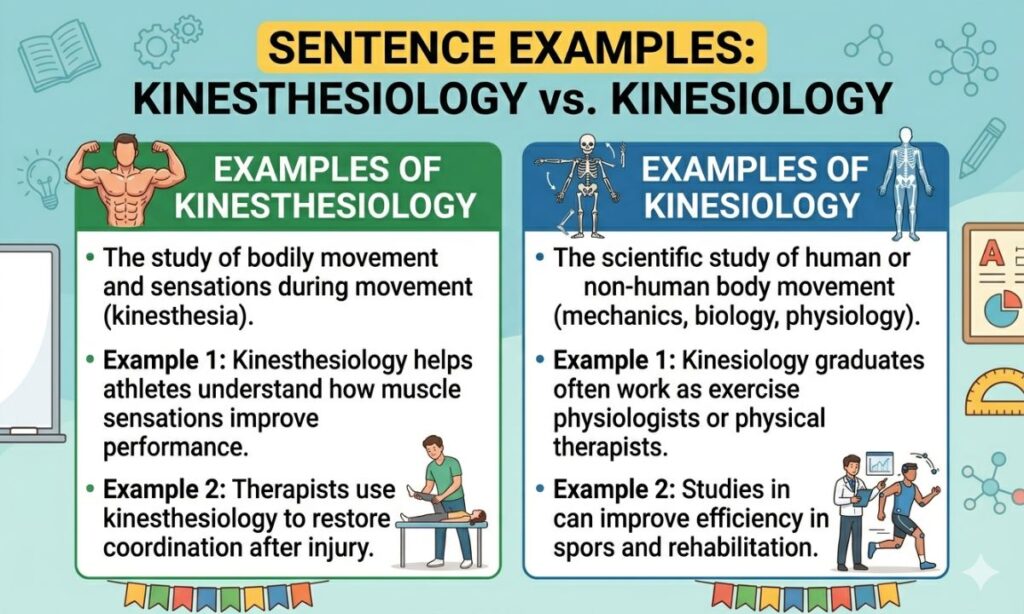
Examples Of Using Kinesthesiology In A Sentence
- The neurologist referenced kinesthesiology when explaining how stroke patients relearn coordinated movement.
- Through kinesthesiology, the physical therapist assessed whether the patient’s proprioceptive awareness had recovered fully.
- Practitioners of applied kinesthesiology use muscle resistance testing to evaluate structural and nutritional imbalances in the body.
- The yoga instructor emphasized kinesthesiology concepts to help students feel the alignment of their spine during each pose.
- Studies in kinesthesiology show that sensory deprivation in the feet significantly impairs balance in older adults.
- The athlete’s recovery plan was guided by kinesthesiology assessments that tracked the return of motor coordination after knee surgery.
- Kinesthesiology training helped the blind gymnast develop exceptional spatial awareness and body control.
Examples Of Using Kinesiology In A Sentence
- The university’s department of kinesiology offers specializations in biomechanics, sport psychology, and exercise physiology.
- A degree in kinesiology opens career paths in physical therapy, athletic training, occupational therapy, and sports coaching.
- The research team from the kinesiology faculty published groundbreaking findings on running economy and fatigue.
- Kinesiology has become one of the fastest-growing fields in health sciences over the past two decades.
- The personal trainer held a master’s degree in kinesiology and used evidence-based programming for every client.
- Concepts drawn from kinesiology are now embedded into ergonomic workplace design to reduce musculoskeletal injuries.
- Many physical therapy programs require prerequisite courses in kinesiology before admission to the clinical track.
Common Mistakes To Avoid
Using Kinesthesiology And Kinesiology Interchangeably
One of the most frequent errors people make in the kinesthesiology vs kinesiology conversation is treating these two terms as synonyms. They are not. While both relate to movement, they refer to fundamentally different scopes of study. Swapping one for the other in academic writing, professional communication, or medical documentation can make the author appear uninformed about the subject matter.
Here are the most common interchangeable misuses to watch for:
- Writing “I studied kinesthesiology at university” when the degree program is officially called kinesiology
- Using “kinesiology” when discussing proprioceptive feedback or sensory movement awareness, where kinesthesiology would be more precise
- Labeling a muscle testing technique as “kinesiology” when it is specifically “applied kinesiology” or draws on kinesthesiological principles
Avoiding Common Mistakes
The best way to avoid errors in the kinesthesiology vs kinesiology discussion is to ask yourself one clarifying question before choosing a term: Am I talking about movement mechanics and the broader scientific discipline, or am I talking about the body’s sensory perception of its own movement?
If the answer is the former, use kinesiology. If the answer is the latter, use kinesthesiology. When in doubt, especially in academic or formal writing, kinesiology is almost always the safer and more universally accepted choice.
Additional tips for avoiding mistakes:
- Always check whether the institution, certification, or journal you are referencing uses a specific term
- In formal academic papers, define your term the first time it appears so readers understand your intended meaning
- Do not rely on spell-check alone since both words pass spell-check even when used incorrectly
- Be especially careful when writing about “applied kinesiology,” which is a clinical muscle testing technique distinct from the broader academic field
Context Matters
One of the most important lessons in the kinesthesiology vs kinesiology discussion is that the right term depends heavily on the context in which it is being used. The same sentence written in a different professional setting might demand a different word entirely.
Examples Of Different Contexts
Academic Context: In a university setting, kinesiology is the correct and expected term. Course catalogs, degree programs, and research publications will almost always use kinesiology. Writing a paper for a kinesiology professor and using kinesthesiology throughout would likely result in a lower grade due to imprecise terminology.
Clinical Rehabilitation Context: In a physical therapy or neurological rehabilitation setting, kinesthesiology becomes relevant when discussing how a patient’s sensory movement awareness is being evaluated or retrained. A therapist assessing proprioceptive deficits following a spinal cord injury would reasonably reference kinesthesiological principles.
Fitness and Sports Context: Most fitness professionals, athletic trainers, and sports coaches operate within the framework of kinesiology. They discuss biomechanics, exercise physiology, and motor learning. Only when addressing body awareness, spatial orientation training, or sensory feedback during athletic performance would kinesthesiology enter the conversation.
Alternative Health Context: Practitioners who use muscle testing, energy work, or holistic movement therapies sometimes use kinesthesiology to describe their approach. This usage is contextually acceptable in those communities even if it differs from mainstream scientific application.
Writing and Publishing Context: If you are writing for a general audience, kinesiology is always the safer choice. It is the recognized, widely understood term. Kinesthesiology should be reserved for specialized discussions where the sensory or proprioceptive angle is genuinely the subject.
Exceptions To The Rules
Identifying Exceptions
Language rarely follows perfectly clean rules, and the kinesthesiology vs kinesiology conversation is no exception. There are a few notable situations where the expected guidelines bend or where the standard rules do not cleanly apply.
Offering Explanations And Examples
Exception 1: Applied Kinesiology Applied kinesiology is a specific clinical diagnostic technique developed by chiropractor George Goodheart in the 1960s. It involves manual muscle strength testing to identify structural, chemical, and emotional imbalances in the body. Despite containing the word kinesiology, applied kinesiology looks and functions very differently from the academic discipline of kinesiology taught in universities. Do not assume that someone practicing applied kinesiology holds a degree in the broader field of kinesiology.
Exception 2: Informal Use of Kinesthesiology in Fitness Communities In some dance studios, yoga communities, and holistic fitness spaces, kinesthesiology is used casually to mean movement awareness or body sensing. Technically, the correct noun in these situations would be kinesthesia, not kinesthesiology. However, the informal usage of kinesthesiology in these settings is common enough that it will not always be considered a serious error in non-academic contexts.
Exception 3: Historical Academic Variations Some older academic institutions and historical texts used kinesthesiology as an alternative name for the broad study of movement, essentially as a synonym for kinesiology. If you are reading older textbooks or research from the early to mid-twentieth century, you may encounter this usage. Modern scholarship has largely standardized around kinesiology.
Exception 4: Regional and Institutional Preferences A small number of universities or certification bodies may use kinesthesiology in their program naming for historical reasons. Always defer to the exact terminology used by the specific institution or credential body you are referencing.
Read This: Sponser or Sponsor: Which Spelling Is Actually Correct?
Practice Exercises
Test your understanding of kinesthesiology vs kinesiology with the following exercises. The answers follow each exercise.
Exercise 1: Fill In The Blank
Fill in the blank with either kinesthesiology or kinesiology based on the context of each sentence.
- The university’s department of __________ offers degrees in exercise science, biomechanics, and sports psychology.
- The therapist used principles of __________ to help the patient regain awareness of his foot position after nerve damage.
- A career in __________ can lead to roles in sports coaching, physical therapy, and occupational health.
- Dancers trained in __________ develop a heightened sense of how their bodies move through space.
- The journal published new findings from __________ researchers on fatigue and running efficiency.
Answers: 1. kinesiology, 2. kinesthesiology, 3. kinesiology, 4. kinesthesiology, 5. kinesiology
Exercise 2: Sentence Completion
Complete each sentence using the most appropriate term from the kinesthesiology vs kinesiology pair, and briefly explain your reasoning.
- “After her shoulder injury, the physiotherapist used __________ assessments to determine whether her proprioceptive function had returned.” Reasoning: The sentence is about proprioceptive function and sensory feedback, which falls under kinesthesiology.
- “He spent four years studying __________ before becoming a certified strength and conditioning specialist.” Reasoning: University degree programs are formally called kinesiology, not kinesthesiology.
- “The workshop explored how __________ principles can be used in mindfulness movement practices to improve body awareness.” Reasoning: Body awareness and sensory movement perception point to kinesthesiology.
Conclusion
Key Takeaways
The kinesthesiology vs kinesiology question is not just about spelling. It reflects a meaningful difference in scope, application, and professional context. Here is a quick summary to carry forward:
- Kinesiology is the broad, formally recognized scientific discipline that studies all aspects of human movement, including biomechanics, physiology, psychology, and anatomy. It is the standard term used in universities, research, and professional healthcare settings.
- Kinesthesiology focuses specifically on sensory perception of movement, proprioception, body awareness, and motor control. It is used in clinical rehabilitation, certain therapeutic practices, and some alternative health communities.
- Using these terms interchangeably is a common mistake that can undermine credibility in academic and professional writing.
- Context is everything. Always consider your audience, purpose, and setting before choosing between kinesthesiology vs kinesiology.
- When in doubt, kinesiology is the safer, more universally accepted term in formal writing.
The kinesthesiology vs kinesiology distinction may seem minor on the surface, but precision in language is the hallmark of expert communication. Whether you are writing a research paper, preparing a client assessment, or simply trying to get your vocabulary right, understanding this difference will serve you well in every conversation about human movement science.
FAQs
Is kinesthesiology the same as kinesiology?
No. Kinesthesiology focuses on sensory movement perception and proprioception, while kinesiology is the broader scientific study of all aspects of human movement, including biomechanics, physiology, and anatomy.
What does a kinesthesiologist do?
A kinesthesiologist evaluates and works to improve how the body senses and responds to its own movement, often in rehabilitation settings involving balance, motor control, and proprioceptive retraining.
Is kinesiology a medical field?
Kinesiology is a health science field closely connected to medicine, physical therapy, and rehabilitation, though it is not a medical degree. Kinesiologists often work alongside physicians and physical therapists.
Which term is more commonly used in universities?
Kinesiology is by far the more common term in university settings globally, appearing in official degree program names, course catalogs, and research publications.
Why do people confuse kinesthesiology and kinesiology?
Both words share Greek roots related to movement, sound nearly identical, and are used in overlapping professional contexts, making the kinesthesiology vs kinesiology mix-up easy to understand and extremely common.
Post Navigation
Previous: Understanding the Basics of Human Movement Science Next: Kinesthesia vs Proprioception: What Is the Difference?
Similar Posts
Affend or Offend: Stop Making This Common Spelling Mistake
One letter can change everything. Learn why “affend” does not exist and how to always get “offend” right in your writing.
Enchilada vs Empanada: Differences And Uses For Each One
Both are beloved Latin American dishes wrapped around delicious fillings, but they are not the same. Here is how to tell them apart every time.
Village vs Subdivision: Unraveling Commonly Confused Terms
Are all subdivisions villages? Are all villages subdivisions? The answer might surprise you. This guide clears up the confusion for good.
Constant vs Attentive: Which Should You Use In Writing?
Both words suggest dedication, but they mean very different things. Here is a clear guide to choosing the right one in every context.
Import vs Inport: Meaning Differences and Correct Usage Guide
Only one of these is a real word. Find out which one and why the confusion exists in the first place.
Flatform vs Platform: Key Differences and Proper Usage Explained Clearly
In fashion, footwear, and technology, these two words serve very different purposes. Here is a complete breakdown of how and when to use each one.