
If you have ever typed “emaculate” in a document and noticed that red squiggly line appear underneath it, you already know something is off. The debate around emaculate vs immaculate is one of the most common spelling confusions in the English language. It trips up students, professionals, and even native speakers who rely on how a word sounds rather than how it is actually spelled.
The short version? One of these words is real, and one is not. But understanding the full picture, including where the confusion comes from, what each word actually means, how to use the correct one, and how to never forget the right spelling again, is what this guide is all about.
Whether you are writing a work email, a college essay, or a social media caption, getting emaculate vs immaculate right will instantly sharpen your writing. Let us get into it.
Quick Answer: Emaculate vs Immaculate
Here is the fast answer for anyone who just needs the bottom line right now:
| Word | Is It Real? | Meaning |
| Immaculate | Yes, correct word | Perfectly clean, spotless, flawless, or free from blemish |
| Emaculate | Not a standard English word | A common misspelling of immaculate |
Immaculate is the correct spelling. Emaculate is simply a spelling error. It is not found in any major English dictionary, including Merriam-Webster, Oxford, or Cambridge. If you have been writing “emaculate,” you are not alone, but now is the time to fix it for good.
Define Emaculate
So what does “emaculate” actually mean, if anything at all?
In standard English, emaculate has no recognized definition. It does not appear in any major English dictionary as a legitimate word. In nearly every case, when someone writes “emaculate,” they simply meant to write “immaculate” but made a spelling mistake.
That said, a small number of informal or niche sources have tried to assign it a meaning related to extreme thinness or frailty, likely confusing it with the word emaciate, which means to become very thin due to illness or lack of nourishment. But even in those cases, “emaculate” is not an accepted substitute.
The bottom line: if your spell-checker flags “emaculate,” that is your cue. Do not ignore the red line. Replace it with “immaculate” and move on.
Here is a quick breakdown of the confusion around emaculate vs immaculate:
- Emaculate sounds like it could be a word because of the “-ulate” suffix, which appears in real words like “calculate” and “simulate.”
- The “em” prefix at the start mirrors other English words like “empower” and “embody.”
- When spoken quickly, “immaculate” can sound like “emaculate” depending on accent or speech pace.
All of these factors make the mix-up feel natural, but the error is real.
Read This: Symptomatology vs Symptomology: Meaning And Differences
Define Immaculate
The word immaculate is a legitimate, widely used English adjective with a rich history and several layers of meaning.
At its core, immaculate means:
- Perfectly clean and tidy — free from any dirt, dust, or mess
- Free from flaws or errors — without any defect or mistake
- Morally or spiritually pure — especially in religious contexts
Pronunciation: /ɪˈmæk.jʊ.lət/
Part of speech: Adjective
Examples of meaning in context:
- A surgeon’s hands must be immaculate before an operation (free from contamination).
- The athlete delivered an immaculate performance (without a single error).
- In Catholicism, the Immaculate Conception refers to the Virgin Mary being conceived free from original sin (spiritually pure).
Understanding the full range of immaculate helps you use it precisely and confidently. When you think of emaculate vs immaculate, remember: only one of them works, and it is “immaculate.”
The Origin of “Immaculate” (Make It Stick Forever)
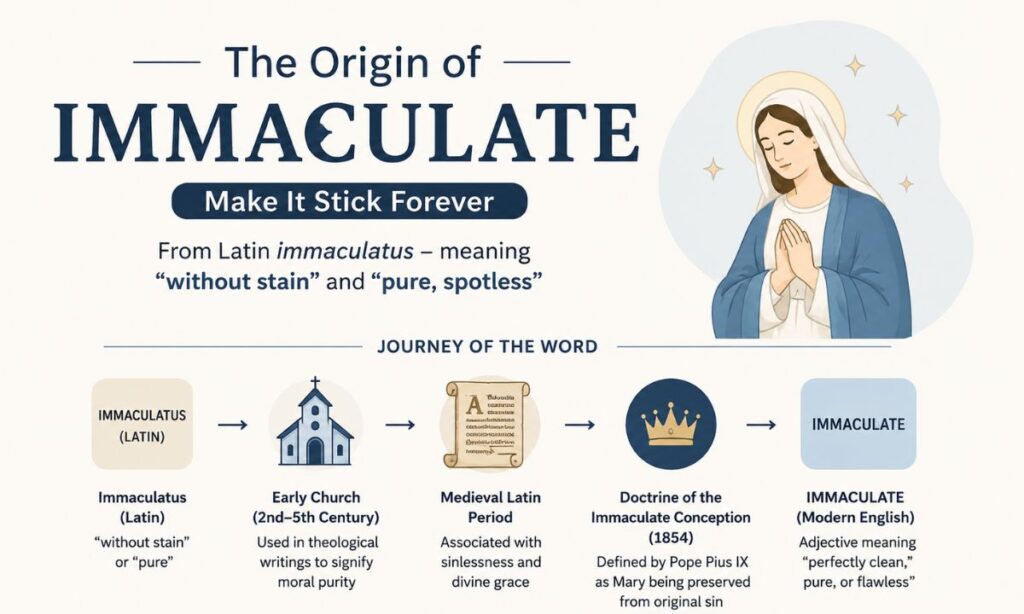
One of the best ways to remember the correct spelling of any word is to understand where it comes from. The etymology of “immaculate” is surprisingly simple and, once learned, makes the spelling feel completely obvious.
The word immaculate comes from Latin:
| Latin Component | Meaning |
| im | not, without |
| macula | spot, stain, blemish |
| atus | adjective-forming suffix |
So immaculatus in Latin literally means “without stain” or “unstained.” The word entered Middle English around the mid-1400s, first used in a moral or spiritual sense to describe purity of character. The literal meaning of “spotlessly clean” came into common English use around 1735.
Here is a fascinating connection: the Latin root macula is still alive in modern science. Doctors use “macula” to refer to spots on the skin or the sensitive area of the retina. You may have heard of macular degeneration, an eye disease that affects central vision. That word shares the exact same Latin root.
So when you write “immaculate,” you are using a word with over 600 years of history. The “im” at the beginning means “not,” and it is double “m” because the prefix “in” assimilates to “im” before the letter “m.” This is standard Latin phonology. That double “m” is the key detail that separates immaculate from the misspelled emaculate.
Memory Trick: Never Forget Again
You only need one trick to lock in the correct spelling of emaculate vs immaculate forever.
The Trick: Think “I Must Make A Clean Life After Time Every day”
The first letters spell: I M M A C U L A T E
Or try this simpler approach: whenever you are tempted to write “emaculate,” ask yourself this question:
“Does this mean NOT stained?”
If yes, use immaculate. The “im” at the front means “not.” It is always “im” not “em.”
Additional memory anchors:
- Immaculate Conception is a phrase millions of people know. That famous phrase uses “immaculate,” not “emaculate.” Tie the spelling to something you already know.
- Think: “I” start with immaculate, just like “I” want things clean.
- The word maculate actually means “spotted” or “stained.” Immaculate is simply its opposite. Once you know “maculate,” you know that “immaculate” is its antonym, and the spelling becomes logical.
Every time you see the question of emaculate vs immaculate from now on, remember: it starts with “I” and means “not stained.”
How To Properly Use The Words In A Sentence
How To Use Emaculate In A Sentence
Because emaculate is not a recognized standard English word, it should not be used in formal writing. In everyday English, there is no correct sentence that requires the word “emaculate.” If you find yourself reaching for it, substitute “immaculate” instead.
The only exception some informal sources have attempted is using “emaculate” as a near-synonym for “emaciated” (extremely thin), but even this usage is not accepted by any authoritative dictionary. Avoid it entirely.
Incorrect usage example:
Her apartment was completely emaculate after the spring cleaning.
This sentence should use “immaculate,” not “emaculate.”
How To Use Immaculate In A Sentence
The word immaculate works in a wide range of contexts. Here are the key rules for using it correctly:
Rule 1: Use it to describe something that is perfectly clean or tidy.
The hotel lobby was immaculate, with polished marble floors and fresh flowers on every table.
Rule 2: Use it to describe something free from errors or flaws.
The pianist delivered an immaculate performance, hitting every note without hesitation.
Rule 3: Use it in religious or spiritual contexts where purity is implied.
The doctrine of the Immaculate Conception is a central belief in the Catholic faith.
Rule 4: Use it to describe a person’s appearance or presentation.
He arrived at the job interview looking absolutely immaculate in a pressed suit and polished shoes.
More Examples Of Emaculate & Immaculate Used In Sentences
Examples Of Using Emaculate In A Sentence
Since “emaculate” is not a standard English word, the examples below show common mistakes people make, followed by the corrected version:
| Incorrect (Emaculate) | Correct (Immaculate) |
| The chef kept an emaculate kitchen. | The chef kept an immaculate kitchen. |
| Her record was emaculate. | Her record was immaculate. |
| The garden looked perfectly emaculate. | The garden looked perfectly immaculate. |
| He had an emaculate driving record. | He had an immaculate driving record. |
| The house was emaculate from top to bottom. | The house was immaculate from top to bottom. |
Noticing the pattern in emaculate vs immaculate errors helps you self-correct faster in your own writing.
Examples Of Using Immaculate In A Sentence
Here are ten natural, well-crafted sentences using immaculate correctly:
- The surgeon’s gloves were immaculate before she made the first incision.
- After hours of cleaning, the apartment finally looked immaculate.
- His essay was immaculate, with no grammar errors and a perfectly structured argument.
- The bride walked down the aisle in an immaculate white gown.
- The restaurant earned a perfect hygiene score because the kitchen was immaculate.
- She had an immaculate reputation in the legal community.
- The museum’s collection was stored in immaculate condition.
- After the deep clean, the windows were immaculate and streak-free.
- The coach praised the team for their immaculate execution during the final quarter.
- The ancient manuscript was surprisingly immaculate despite its age.
Each of these sentences shows how versatile and useful immaculate is across different subject areas.
Immaculate vs Similar Words: What’s the Difference?
The word immaculate is sometimes confused not just with “emaculate” but also with other similar-sounding or similar-meaning words. Here is a clear breakdown:
| Word | Meaning | Similarity to Immaculate |
| Immaculate | Perfectly clean, flawless, pure | The correct word |
| Emaculate | Not a real word | Misspelling of immaculate |
| Emaciated | Extremely thin and weak | Sounds similar, completely different meaning |
| Spotless | Free from spots or dirt | Near-synonym of immaculate |
| Pristine | In original, unspoiled condition | Similar but implies originality |
| Flawless | Without any imperfection | Similar but focuses on perfection |
| Impeccable | Without fault; beyond criticism | Close synonym, more formal tone |
Understanding these distinctions helps you choose the precise word for every situation, not just default to immaculate when another word might serve you better.
Common Mistakes To Avoid
Using “Emaculate” Instead Of “Immaculate”
This is the single most common mistake. Writers type “emaculate” when they mean “immaculate,” and the result is a word that does not exist in the English language. The confusion usually happens because:
- The word is heard more often than it is read
- Fast speech can blur the “im” opening into something that sounds like “em”
- The brain substitutes familiar letter patterns without checking
Fix: Every time you write “emaculate,” treat it as a red flag. Replace it with “immaculate” immediately. Your spell-checker will flag it, but do not rely on auto-correct alone. Build the habit of checking.
Assuming “Immaculate” Means “Perfect”
Many writers use “immaculate” to mean “absolutely perfect” in every sense of the word. That is a stretch. The primary meaning of immaculate is “free from stain, blemish, or fault,” not a blanket synonym for “flawless” or “the best possible.”
For example:
Saying “his plan was immaculate” implies it had no errors or weaknesses. It does not mean the plan was the greatest plan ever conceived.
Offering Tips On How To Avoid Making These Mistakes In The Future
Here are practical steps to stop making mistakes with emaculate vs immaculate:
- Read the word slowly before you type it. Sound it out: im-mac-u-late.
- Use a dictionary app when in doubt. If you type “emaculate” and get no results, that is your answer.
- Write it out by hand five times. The physical act of writing reinforces memory more than typing.
- Use the etymology trick. Remember: “im” means “not” + “macula” means “stain.” “Immaculate” = not stained.
- Set up a grammar tool like Grammarly that flags non-words in real time.
Synonyms and Antonyms of “Immaculate”
Synonyms (words with similar meaning):
- Spotless — free from any dirt or marks
- Pristine — in perfect, original condition
- Flawless — without any imperfection
- Impeccable — without fault, beyond criticism
- Stainless — free from stains or discoloration
- Pure — free from contamination or corruption
- Unsullied — not spoiled or made impure
- Unblemished — without marks, flaws, or faults
- Unsoiled — not dirty or tainted
- Squeaky clean — informally clean and beyond reproach
Antonyms (opposite meaning):
- Dirty — covered in dirt or filth
- Stained — marked with a stain
- Maculate — spotted or blemished (the direct Latin opposite)
- Tainted — corrupted or contaminated
- Flawed — containing defects or weaknesses
- Soiled — made dirty by use or contact
- Impure — mixed with unwanted substances
- Sullied — damaged or tarnished
- Blemished — marked by an imperfection
Context Matters
The meaning of immaculate shifts slightly depending on how and where it is used. Understanding context helps you avoid misuse and write with greater precision.
Emaculate
Since emaculate is not a real word, context does not apply to it in standard English writing. Any context in which you feel tempted to use “emaculate” should prompt you to use “immaculate” instead.
Immaculate
Immaculate carries different weight in different settings:
- In everyday speech, it usually means perfectly clean or very neat.
- In professional writing, it often describes flawless performance or presentation.
- In religious contexts, it carries a deep sense of spiritual purity and freedom from sin.
- In academic writing, it can describe research or logic that is free from error.
Examples
The context examples below show how the same word takes on different dimensions:
“The lab was immaculate.” (Physical cleanliness context)
“Her reputation was immaculate.” (Moral/professional context)
“The Immaculate Conception is celebrated on December 8.” (Religious context)
“The athlete posted an immaculate scorecard.” (Performance context)
Exceptions To The Rules
Emaculate Exceptions
There are no widely accepted exceptions for “emaculate” in standard English. The word does not appear in reputable dictionaries and should be avoided across all writing contexts, formal or informal. Even in creative writing, using “emaculate” is likely to confuse your reader rather than impress them.
Immaculate Exceptions
While “immaculate” is almost always used as a positive descriptor, there are a few edge cases to be aware of:
- Hyperbole: “Even her mistakes looked immaculate” is technically incorrect as a literal statement, but may be used as creative exaggeration.
- Irony: Writers sometimes use “immaculate” sarcastically to describe something that is decidedly not clean or pure.
- Proper nouns: “Immaculate” appears in place names, school names, and brand names (e.g., Immaculate Heart College), where the rules of standard usage do not apply.
Practice Exercises
Test yourself on everything you have learned about emaculate vs immaculate with these exercises.
Exercise 1: Fill In The Blank
Choose the correct word (emaculate or immaculate) to complete each sentence:
- The hospital ward was kept __________ at all times.
- She had an __________ academic record throughout college.
- His white shirt was __________ despite the long workday.
- The inspector praised the kitchen for being completely __________.
- The dancer’s technique was absolutely __________ during the final performance.
Answers: All five blanks should be filled with immaculate.
Exercise 2: Sentence Completion
Write a full sentence for each situation below using the word “immaculate”:
- Describe a well-kept garden.
- Describe a person’s professional reputation.
- Describe a clean car interior.
- Describe a flawless speech.
- Describe a tidy office desk.
Sample answers:
- The garden was immaculate, with every hedge trimmed and every flower in full bloom.
- After 20 years in the industry, her professional reputation remained immaculate.
- The car’s interior was immaculate, as if it had never been used.
- The candidate delivered an immaculate speech that impressed every voter in the room.
- His desk was immaculate, with not a single paper out of place.
Read This: Dysregulated vs Disregulated: How Are These Words Connected?
Conclusion
The debate around emaculate vs immaculate ends here. Immaculate is the correct, recognized English word. It means perfectly clean, free from blemish, or spiritually pure, and it carries more than 600 years of history behind it. Emaculate, on the other hand, is a misspelling with no place in standard written English.
The mix-up happens for understandable reasons. The two combinations sound similar, especially in casual speech. But once you understand the Latin roots, the double “m” rule, and the memory trick, the right spelling becomes instinctive.
Good writing is built on small, accurate choices. Knowing the difference between emaculate vs immaculate is one of those small choices that signals to any reader that you are a careful, precise communicator.
Key Takeaways
- Immaculate is the only correct spelling between emaculate vs immaculate
- It comes from the Latin word “immaculatus,” meaning “without stain”
- “Emaculate” is a misspelling and is not recognized in English dictionaries
- Use immaculate to describe cleanliness, flawlessness, or spiritual purity
- The “im” prefix means “not,” and “macula” means “stain” — so immaculate literally means “not stained”
- Common synonyms include spotless, pristine, flawless, and impeccable
- When in doubt, check a dictionary and trust the red underline from your spell-checker
FAQs
What is the correct spelling: emaculate or immaculate?
Immaculate is the correct spelling. Emaculate is a misspelling that does not exist in any standard English dictionary.
Can emaculate be used to describe cleanliness?
No. Emaculate is not a real English word and should never be used to describe cleanliness. Use immaculate instead.
What is the main difference between emaculate and immaculate?
The main difference is simple: immaculate is a real, recognized English word meaning spotlessly clean or free from faults, while emaculate is an incorrect spelling with no accepted meaning.
Is immaculate only used for physical objects?
No. Immaculate can describe physical objects, a person’s appearance, someone’s reputation, moral character, and even religious concepts such as the Immaculate Conception.
What does immaculate mean in a religious context?
In religious contexts, especially in Catholicism, immaculate refers to being free from sin or spiritual impurity. The most famous example is the doctrine of the Immaculate Conception.
What is the Latin origin of immaculate?
The word comes from the Latin immaculatus, which combines im (not) and macula (stain or blemish), literally meaning “without stain.”
What are good synonyms for immaculate?
Strong synonyms include spotless, pristine, flawless, impeccable, unsullied, stainless, and unblemished.
How do I remember when to use immaculate vs emaculate?
Remember that immaculate starts with “im” which means “not” in Latin. Think: “im” + “maculate” (stained) = not stained. There is no situation where “emaculate” is the right choice.
Is immaculate formal or informal?
Immaculate works in both formal and informal contexts. It is common in professional, academic, religious, and everyday conversational writing.
Can emaculate ever be used correctly in English?
No. There is no context in standard English where “emaculate” is the correct word to use. It is always a spelling error.
Post navigation
Previous Post: Preform or Perform: What’s the Real Difference? Next Post: Manuel Vs. Manual: When To Use Each One In Writing?