
Have you ever been in the middle of writing a sentence and suddenly stopped, unsure whether to type “ally” or “Allie”? You are definitely not alone. The ally vs allie confusion is one of the most common spelling mix-ups in the English language, and it happens to students, writers, and even native speakers every single day. The reason is simple: both words sound completely identical when spoken out loud. Yet on paper, that one-letter difference changes everything about what you are trying to say.
In this article, you will get a complete breakdown of ally vs allie, including their definitions, correct usage, real sentence examples, common mistakes to avoid, and practical tips that will help you choose the right word every single time. Whether you are writing a school essay, a professional email, or a social media post, understanding the distinction between ally vs allie is a skill that will make your writing cleaner, sharper, and more credible.
Define Ally
The word “ally” is a legitimate, well-established English vocabulary word that appears in dictionaries across the world. It functions both as a noun and as a verb, making it highly versatile in everyday writing and speech.
As a noun, an ally refers to a person, group, organization, or country that cooperates with, supports, or stands beside another for a shared goal or common purpose. The relationship implied by the word ally is one of trust, mutual benefit, and solidarity. When two countries sign a defense agreement to protect each other, they are allies. When a colleague stands up for you during a difficult meeting, that person becomes your ally.
As a verb, to ally means to form a partnership, join forces with, or cooperate with someone else. You might say a company decided to ally with another firm to expand its reach. This verbal usage is less common in casual conversation but is entirely grammatically correct.
The word traces its roots back to the Old French word “alier,” which meant “to combine” or “join together.” Over centuries, it evolved into the modern English word ally, carrying that same sense of union and mutual support.
Key characteristics of “ally” as a word:
- It is a common noun and can be used in singular or plural form (allies)
- It appears in formal, academic, professional, and casual writing
- It is used in political, military, social justice, business, and personal contexts
- It does not require capitalization unless it begins a sentence
- It is recognized in both American English and British English dictionaries
Define Allie
Unlike ally, the word “Allie” is not a standard dictionary word with a defined grammatical meaning. Instead, Allie is a proper noun, most commonly used as a personal name or nickname. It is a widely recognized female given name in English-speaking countries and is frequently used as a shortened, affectionate form of longer names such as Allison, Alexandra, Alyssa, or Alice.
Because Allie is a proper noun, it always begins with a capital letter. This is not optional. Whether Allie appears at the beginning of a sentence, in the middle, or at the end, the capital “A” must always be there.
The name Allie gained significant cultural visibility through popular fiction. One of the most well-known examples is the character Allie Hamilton from the beloved novel and film “The Notebook,” where the name carries a warm, relatable quality that helped cement its popularity. The name is also associated with friendliness, approachability, and charm, which explains why so many parents continue to choose it for their children.
Key characteristics of “Allie” as a name:
- It is a proper noun and must always be capitalized
- It functions exclusively as a personal name or nickname in standard English usage
- It is not found in standard English dictionaries as a common word
- It has no plural form in the traditional grammatical sense
- It does not function as a verb under any standard circumstances
Read This: What Do You Call Someone Who Loves Music? 10+ Simple Terms
Ally vs Allie Meaning
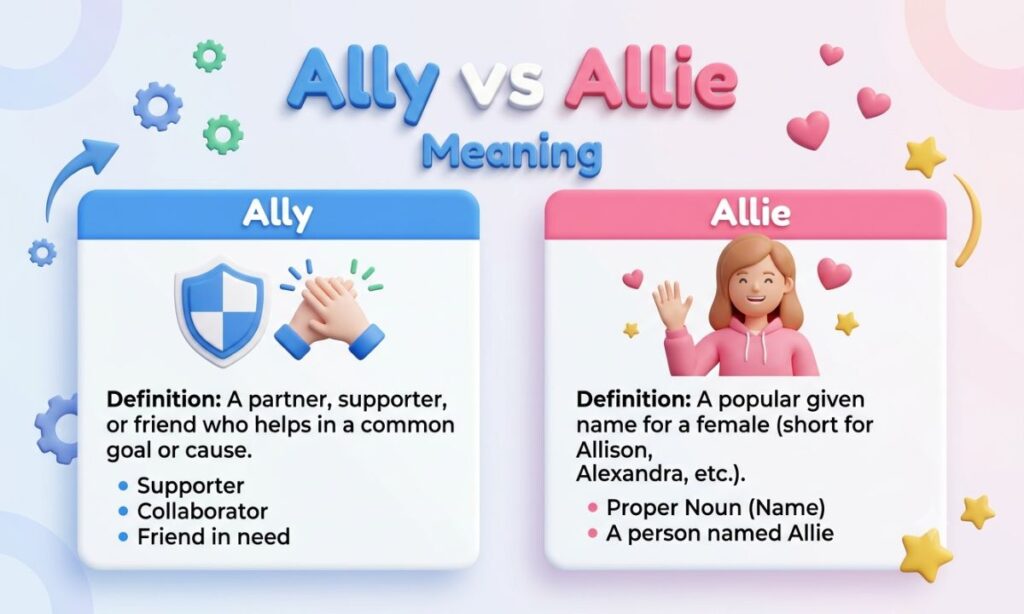
Now that both words have been defined separately, it is time to look at them side by side. The core of the ally vs allie debate comes down to this: one is a word, and the other is a name. That single distinction eliminates almost all confusion.
Here is a quick comparison table to make the ally vs allie difference crystal clear:
| Feature | Ally | Allie |
| Part of Speech | Noun and Verb | Proper Noun (Name) |
| Meaning | Supporter, partner, helper | A personal name or nickname |
| Capitalization | Not required (unless at start of sentence) | Always capitalized |
| Dictionary Status | Found in standard dictionaries | Not a standard dictionary word |
| Plural Form | Allies | No standard plural |
| Usage Context | Political, social, business, personal relationships | Refers to a specific person |
| Language | Common English vocabulary word | Proper English name |
When you see ally vs allie placed next to each other this clearly, the rule becomes effortless. If you are describing someone who supports a cause, backs up a friend, or stands with a partner organization, the word you need is ally. If you are referring to a specific person whose name happens to be Allie, then you use Allie with a capital A.
The ally vs allie mix-up is especially common in social and political writing. For instance, someone might want to say they support the LGBTQ+ community and write “I am an allie of the community.” This is incorrect. The correct term is “I am an ally of the community,” because the word here refers to the role of a supporter, not a person’s name.
How To Properly Use Ally and Allie in Sentences
Understanding the definitions of ally vs allie is important, but knowing how to apply them in real sentences is what truly builds confidence. The following sections break down practical usage for each word.
How To Use “Ally” in a Sentence
When you use “ally” in a sentence, you are describing a supportive relationship, a partnership, or cooperative action. The word fits naturally into sentences that involve teamwork, solidarity, advocacy, or mutual assistance.
Consider the following guidelines before using “ally”:
- Ask yourself whether the sentence is describing support, partnership, or cooperation.
- Check whether the word can be replaced by synonyms like “supporter,” “partner,” or “collaborator” without changing the meaning.
- Confirm that you are not referring to someone whose actual name is Allie.
If all three conditions point to support or cooperation, then “ally” is your word.
Quick sentence formula: Subject + verb + ally + context of support or partnership.
How To Use “Allie” in a Sentence
When you use “Allie” in a sentence, you are referring to a specific person by name. Think of it exactly the same way you would use any other proper name like “Sarah,” “David,” or “Jordan.” The name Allie carries no implied meaning of support or partnership on its own. It is simply someone’s identity.
Quick sentence formula: Allie + verb + action (treating the name exactly like any other person’s name in the sentence).
More Examples of Ally and Allie Used in Sentences
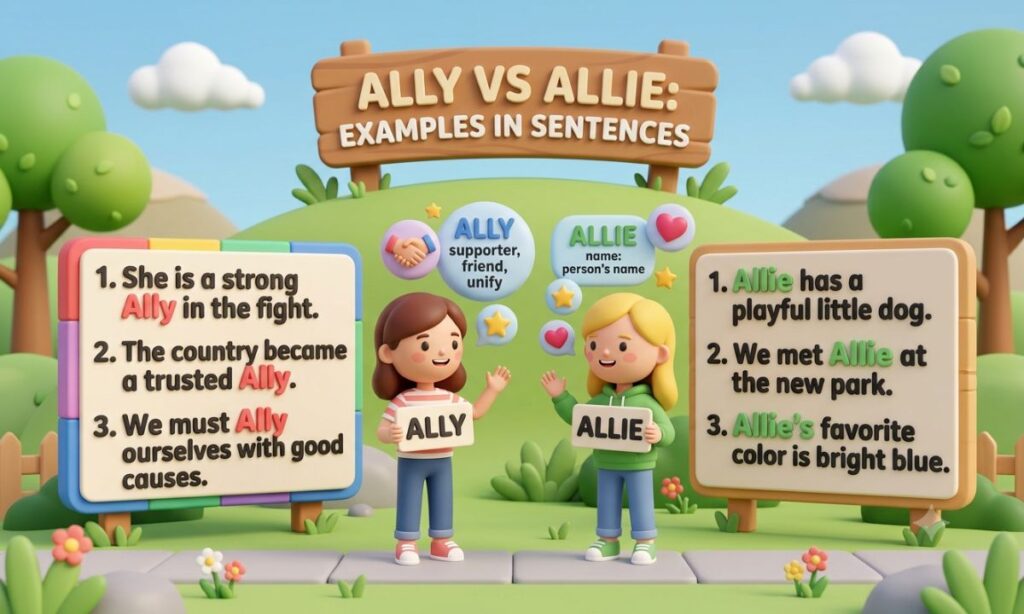
Nothing reinforces learning like exposure to real-world examples. The following collections of sentences demonstrate how ally vs allie functions across a variety of everyday situations.
Examples of Using “Ally” in a Sentence
These examples show the word “ally” being used correctly as both a noun and a verb across different contexts:
- During the crisis, the country turned to its closest ally for military support.
- She proved to be a reliable ally throughout the entire legal battle.
- The nonprofit decided to ally with several community organizations to fund the project.
- Without a strong ally in the boardroom, the proposal would never have passed.
- He became a vocal ally of the environmental movement after witnessing coastal flooding firsthand.
- The two rival companies agreed to ally temporarily to compete against a larger corporation.
- Finding an ally within the organization made the workplace far more manageable.
- The union acted as a powerful ally for workers seeking better wages.
- In times of international conflict, a trusted ally is worth more than any resource.
- She chose to ally herself with local activists to push for educational reform.
Examples of Using “Allie” in a Sentence
These examples show the proper noun “Allie” used correctly in everyday sentences:
- Allie arrived at the office earlier than anyone else this morning.
- I have known Allie since we were both in elementary school.
- Allie’s presentation on climate change was the most impressive one at the conference.
- The birthday cake was decorated with Allie’s favorite flowers.
- Everyone in the group looked to Allie for creative direction on the project.
- Allie called me last night to share some exciting news about her promotion.
- My cousin Allie lives just three blocks from the city center.
- Allie adopted a rescue dog and named him Captain.
- The teacher asked Allie to read the first paragraph aloud to the class.
- Allie enjoys hiking on weekends and often invites the whole team along.
Common Mistakes to Avoid
Now that the rules around ally vs allie are clear, it is time to address the errors that trip people up most often. Knowing what not to do is just as valuable as knowing the correct approach.
1. Using “Ally” When You Mean “Allie”
This mistake happens when someone writes the word “ally” in a sentence but actually intends to refer to a person named Allie. The result is a sentence that strips a real person of their identity and replaces it with a role.
Incorrect: I spoke to my ally at the party last weekend. (If “ally” here refers to a person named Allie, then the spelling is wrong.)
Correct: I spoke to Allie at the party last weekend.
This error often appears in casual writing and text messages where people type quickly without checking capitalization or spelling. The fix is simple: if you are talking about a person whose name is Allie, always use the capitalized proper noun form.
2. Using “Allie” When You Mean “Ally”
This is the reverse of the previous error and is arguably more damaging to your credibility in formal writing. When you use “Allie” in place of “ally,” the sentence suddenly implies you are talking about a specific person rather than describing a supportive role or relationship.
Incorrect: She has been an incredible Allie throughout this entire campaign. (Unless “Allie” is this person’s name, this is a spelling and grammar error.)
Correct: She has been an incredible ally throughout this entire campaign.
This mistake is especially common in social justice and advocacy writing, where terms like “being an ally” carry significant cultural weight. Writing “being an Allie” turns a meaningful social statement into a reference to a person’s name.
3. Forgetting Capitalization for Names
One of the most frequent writing errors across the board is failing to capitalize proper nouns. Since Allie is a proper noun, it must always appear with a capital “A,” no exceptions.
Incorrect: I asked allie to review the document before submission.
Correct: I asked Allie to review the document before submission.
Grammar tools and spell-checkers sometimes miss this error because the lowercase “allie” may not trigger a red flag in automated systems. This is why human proofreading remains essential, especially in professional documents.
Tips to Avoid Mistakes
Knowing the rules is one thing. Remembering them under pressure is another. Here are practical, easy-to-apply tips that will help you consistently choose the correct word between ally vs allie.
Context Matters
The most reliable way to avoid confusing ally vs allie is to pay close attention to the context of your sentence. Ask yourself one clear question before you type either word: Am I describing a role or a person?
If you are describing a role (supporter, partner, helper), the word you need is ally. If you are referring to a specific individual whose name is Allie, the word you need is Allie.
This single question eliminates the vast majority of ally vs allie errors before they even happen.
Examples of Different Contexts
Context is the most powerful tool in the ally vs allie discussion. The same sentence structure can require completely different spellings depending on the surrounding meaning.
1. Personal Relationships
In personal friendships and family dynamics, the word “ally” typically refers to someone who supports you emotionally, socially, or practically. It communicates trust and solidarity.
Examples:
- My older brother has always been my most steadfast ally during difficult times.
- Having a genuine ally at school makes a huge difference for students who feel isolated.
- She became my ally after realizing we were both working toward the same goal.
In contrast, “Allie” in personal relationships is simply someone’s name:
- Allie and I have been best friends since middle school.
2. Business Relationships
In the professional world, “ally” carries significant weight. It refers to a business partner, a collaborative organization, or a trusted colleague who supports your objectives.
Examples:
- The startup found a valuable ally in its venture capital firm.
- Our marketing department became an unexpected ally in the push for remote work policies.
- She described her mentor as both an advisor and a trusted ally in the competitive industry.
In a business context, “Allie” would only appear if someone named Allie is part of the conversation:
- Allie from the finance team will be presenting the quarterly budget this afternoon.
3. Military or International Context
This is one of the most common settings where the word “ally” appears in everyday news, history books, and political discussions. Countries that support each other through treaties or defense agreements are allies.
Examples:
- France has been a long-standing ally of the United States since the American Revolution.
- The coalition of allies agreed on a shared strategy to address the regional conflict.
- NATO members function as mutual allies bound by a collective defense agreement.
Here, “Allie” would make no sense unless a fictional story involved a character with that name playing a role in the narrative.
Exceptions to the Rules
Every grammar rule has its exceptions, and ally vs allie is no different. Understanding these edge cases will prepare you for situations where the standard rules bend slightly.
1. Proper Nouns
Some people choose to spell their name “Ally” rather than “Allie.” Both spellings are used as personal names in real life. Characters like Ally McBeal (from the popular television series) demonstrate that the spelling “Ally” can function as a name too.
In these cases, the spelling is dictated by the individual’s personal preference or the context of a fictional character. As a writer, you must respect the spelling that the person actually uses for their own name.
Practical tip: When writing about a real person or a named character, always use the spelling that they themselves have adopted, regardless of the standard grammatical rules.
2. Regional Variations
While there is no official spelling difference between American English and British English when it comes to ally vs allie, regional naming preferences do exist. In some parts of the United Kingdom, “Allie” appears more frequently as an informal spelling of the name, while in the United States, both “Ally” and “Allie” are popular as personal names.
The good news is that these regional variations affect only the use of the name, not the common noun “ally,” which is spelled identically in all English-speaking regions around the world.
3. Slang and Informal Usage
In casual texting, social media posts, and informal online communication, people sometimes take liberties with spelling. You might occasionally see “allie” used informally in ways that do not follow standard grammar rules, such as playful nicknames or creative username formatting.
While these informal uses exist, they do not represent correct English. If you are writing anything professional, academic, or public-facing, always follow the standard rules for ally vs allie. Informal shortcuts belong in private chats, not in formal documents.
Read This: Manuel Vs Manual: When To Use Each One In Writing?
Frequently Asked Questions About Ally vs Allie
What is the main difference between ally and Allie?
Ally is a common English word meaning a supporter or partner, while Allie is a proper noun used as a personal name or nickname.
Can “Allie” be used instead of “ally” in a sentence?
No, Allie cannot replace ally when referring to support or partnership. Allie is only used when referring to a person’s name.
Is “Allie” a real word in the dictionary?
No, Allie is not a standard dictionary word. It is a proper noun used as a personal name, often a nickname for Allison, Alexandra, or Alice.
Do ally and Allie sound the same when spoken?
Yes, both words are pronounced identically, which is the primary reason so many people confuse them in written form.
Should “Allie” always be capitalized?
Yes, because Allie is a proper noun (a person’s name), it must always be written with a capital A.
Can “ally” be used as a verb?
Yes, ally can function as a verb meaning to form a partnership or alliance. Example: “The two organizations allied to fight climate change.”
What is the plural of ally?
The plural of ally is allies. Example: “The allied countries formed a united front during the negotiations.”
Is there a British vs American spelling difference for ally?
No, ally is spelled identically in both American English and British English.
Can someone’s name be spelled “Ally” instead of “Allie”?
Yes, both Ally and Allie are acceptable spellings for a personal name. The correct spelling depends on individual preference.
Why do people mix up ally vs allie so often?
People mix them up because the two words sound exactly the same when spoken, and the visual difference of just one letter is easy to overlook when writing quickly.
Conclusion
The ally vs allie question has a wonderfully simple answer once you understand the core principle: one is a word, and the other is a name. Ally is a powerful, versatile English word that describes support, partnership, solidarity, and cooperation across personal, professional, political, and military contexts. Allie, on the other hand, is a warm and widely beloved personal name that carries no dictionary definition beyond being someone’s identity.
Throughout this article, you have seen that ally vs allie errors typically come down to one of three issues: using the wrong word for the wrong context, forgetting that Allie requires a capital letter, or confusing a person’s name with a descriptive role. Now that you understand all three, avoiding these mistakes becomes effortless.
The golden rule of ally vs allie is this: if you mean a supporter, write ally. If you mean a person named Allie, write Allie with a capital A. Keep that distinction in mind, apply it consistently, and your writing will always communicate exactly what you intend. Strong writing starts with getting the small things right, and mastering ally vs allie is one of those small things that makes a genuinely big difference.