
If you have ever paused mid sentence wondering whether to write “less then” or “less than,” you are not alone. This is one of the most common mixups in English writing, and it trips up students, professionals, and even experienced writers. The confusion mostly comes down to how similar the two words sound when spoken out loud, even though they serve completely different jobs on paper.
In this guide, we will settle the debate around Less Then or Less Than once and for all. You will learn the correct usage, see plenty of real examples, understand the role of the less than symbol, and find out which version is actually used the most in everyday English. By the end of this article, you will never second guess this phrase again, whether you are writing an email, a school assignment, or a line of code.
This kind of mixup is more common than most people realize. English is full of word pairs that sound alike but mean very different things, and then versus than sits right at the top of that list. Once you understand the simple logic behind it, the Less Then or Less Than question becomes one of the easiest grammar rules to apply correctly every single time.
Less Then or Less Than – Which Is Correct?
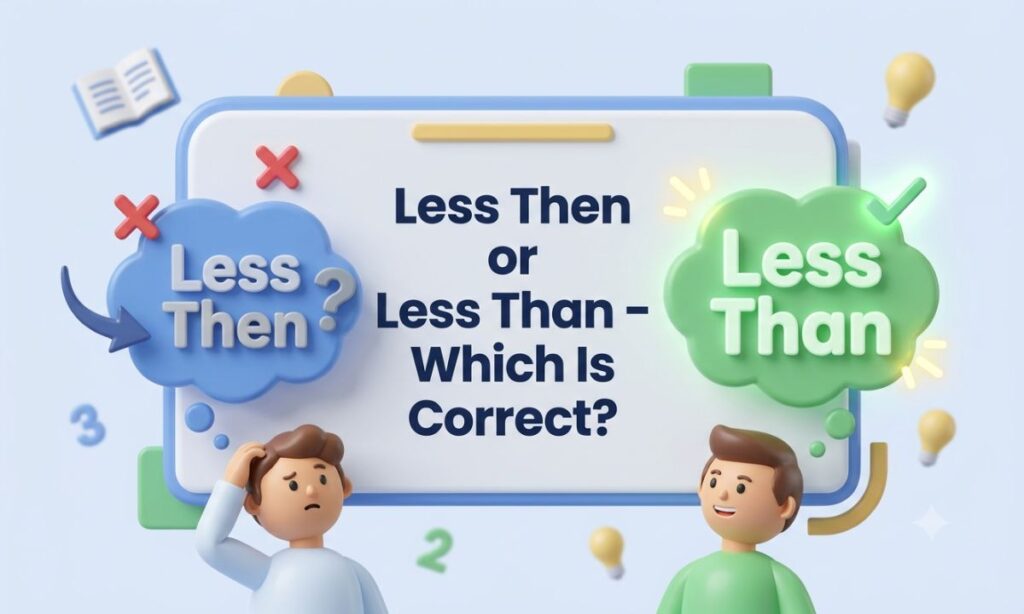
The short answer is simple. “Less Than” is the correct phrase, and “Less Then” is incorrect. Whenever you are comparing numbers, amounts, sizes, ages, prices, or quantities, the only grammatically acceptable choice is less than.
The Less Then or Less Than debate exists purely because of a spelling mixup between two short, similar sounding words. “Then” and “than” sound almost identical when spoken quickly, especially in casual conversation. But on paper, they serve completely different grammatical roles, and swapping one for the other changes the meaning of a sentence, or in many cases, simply breaks it.
Here is a quick snapshot to settle the Less Then or Less Than question at a glance.
| Phrase | Correct or Incorrect | Function |
| Less than | Correct | Used for comparisons of amount, number, or degree |
| Less then | Incorrect | “Then” refers to time or sequence, not comparison |
To understand why one form works and the other does not, it helps to look at then and than separately before applying that knowledge to the full phrase. Once you see how each word behaves on its own, the Less Then or Less Than rule becomes second nature.
Why People Mix Up Less Then or Less Than
There are a few clear reasons this error keeps showing up across emails, essays, text messages, and social media posts.
- Both words have nearly identical pronunciation in fast, casual speech.
- They only differ by a single vowel, an “e” versus an “a.”
- Many people learn English by ear before they learn it by spelling, so the visual difference between the two words gets lost.
- Spell checkers and autocorrect tools do not always catch the mistake, because both “then” and “than” are valid words on their own and are not technically misspelled.
- Keyboards place the letters close together, which makes typing errors more likely, especially on mobile devices.
Once you understand the underlying grammar rule, the Less Then or Less Than confusion becomes much easier to avoid for good. It really comes down to memorizing one simple distinction and applying it consistently.
The Core Grammar Rule Behind Less Then or Less Than
English grammar gives each of these two words a very specific job.
- “Then” is an adverb. It deals with time, sequence, or consequence. It answers questions like “when did this happen” or “what happened next.”
- “Than” is a conjunction. It is used strictly for comparisons. It connects two things being measured against each other.
Since the word “less” is a comparative word by definition, it can only logically pair with another comparison word. That makes “than” the only grammatically valid partner. This single insight resolves almost every version of the Less Then or Less Than debate you are ever likely to encounter.
Read This: Indulgent vs Sober: Deciding Between Similar Terms
Less Then
“Less then” is grammatically wrong in every standard context of modern English. The word “then” is an adverb that refers to time, sequence, or a result of something happening. It answers questions like “when” or “what happened afterward.” It has nothing to do with comparing two things, which is exactly what the word “less” requires in a sentence.
Think about how “then” is properly used entirely on its own, without any comparison involved at all.
- First we finished dinner, then we watched a movie.
- If it rains, then we will stay indoors for the afternoon.
- She studied hard, then passed the exam with ease.
- We arrived at the airport, then waited two hours for our flight.
In every one of these examples, “then” marks a point in time, a sequence of events, or a logical outcome. It never expresses that one thing has a smaller amount compared to another. That is precisely why pairing it with “less” creates a broken phrase that native speakers immediately recognize as wrong.
Examples of Less Then Used Incorrectly
Here are several sentences where “less then” appears incorrectly, followed by the corrected version that uses “less than” instead.
| Incorrect Sentence | Corrected Sentence |
| She has less then five dollars in her wallet. | She has less than five dollars in her wallet. |
| The package weighs less then two kilograms. | The package weighs less than two kilograms. |
| He finished the race in less then ten minutes. | He finished the race in less than ten minutes. |
| There are less then twenty students in the class. | There are less than twenty students in the class. |
| This project will cost less then expected. | This project will cost less than expected. |
| My brother is less then patient with noisy crowds. | My brother is less than patient with noisy crowds. |
| The hotel room was less then comfortable. | The hotel room was less than comfortable. |
Notice how every incorrect sentence above is making a comparison. The amount of money, the weight, the time, the number of students, the cost, the patience level, and the comfort are all being measured against another value or expectation. Comparisons always call for than, never then. This single rule resolves most of the confusion in the Less Then or Less Than debate almost instantly.
If you ever catch yourself typing less then, pause for a second and ask whether you are comparing two amounts, qualities, or quantities. If the answer is yes, swap it for less than right away, and your sentence will read correctly every time.
A Simple Trick to Avoid Less Then
One helpful memory trick involves the letter A. Both than and comparison contain the letter A, while then and time also share a letter pattern that points to sequence. Whenever you are unsure during the Less Then or Less Than decision, remember that A stands for amount, and amount comparisons always require than.
Less Than
Now that the Less Then or Less Than question has a clear answer, it helps to look closer at why less than works so naturally in English. Less Than is the grammatically correct phrase used whenever you want to show that one amount, number, quantity, or quality is smaller than another. The word than is a conjunction used specifically for comparisons, which makes it the natural partner for comparative words like less, more, better, worse, taller, smaller, and faster.
Whenever a sentence contains a comparative word, your brain should immediately expect than to follow shortly after. This pattern applies across nearly all comparative structures in English, not just with the word less.
Common Uses of Less Than
Once the Less Then or Less Than rule clicks, you start noticing less than everywhere in everyday writing and speech, across many different categories. Some typical examples include the following.
- Money: The shoes cost less than fifty dollars.
- Time: We finished the meeting in less than an hour.
- Distance: The store is less than a mile from here.
- Weight or measurement: The suitcase weighs less than the airline limit.
- General comparison: Her score was less than his on the final test.
- Age: My cousin is less than two years older than me.
- Temperature: It feels like less than ten degrees outside today.
These examples show how flexible and common the phrase truly is. Whether you are discussing budgets, schedules, travel plans, weather, or simple comparisons between people and objects, less than almost always fits naturally into the sentence.
Less Than Versus Fewer Than
A related point of confusion involves less than and fewer than. While both compare quantities, they are not always interchangeable, and understanding the difference adds an extra layer of precision once you have already mastered the basic Less Then or Less Than rule.
| Term | Used For | Example |
| Less than | Uncountable nouns or amounts treated as a single quantity | Less than a gallon of milk |
| Fewer than | Countable nouns | Fewer than ten apples |
| Less than | Time, money, distance, and weight, even though these can technically be counted | Less than thirty minutes, less than twenty dollars |
Notice that money, time, and distance almost always pair with less than, even though strict traditional grammar guides would technically expect fewer than for countable items. This is one of those widely accepted exceptions that native speakers use naturally in daily conversation, and most major dictionaries now recognize it as standard usage.
Sentence Examples Using Less Than
Here are several additional examples that show correct usage of less than across different real life situations.
- The recipe needs less than a cup of sugar.
- Their flight took less than three hours.
- He spent less than he had planned on vacation.
- The room temperature dropped to less than freezing overnight.
- She completed the marathon in less than four hours.
- The company hired less than expected this quarter.
- Our new apartment costs less than our old one.
- The puppy weighs less than three kilograms.
Each sentence makes a clear comparison, and than connects the comparative word less to the value being compared. This consistent pattern is the easiest way to remember the correct choice whenever the Less Then or Less Than question comes up again in your own writing.
Less then or less than symbol
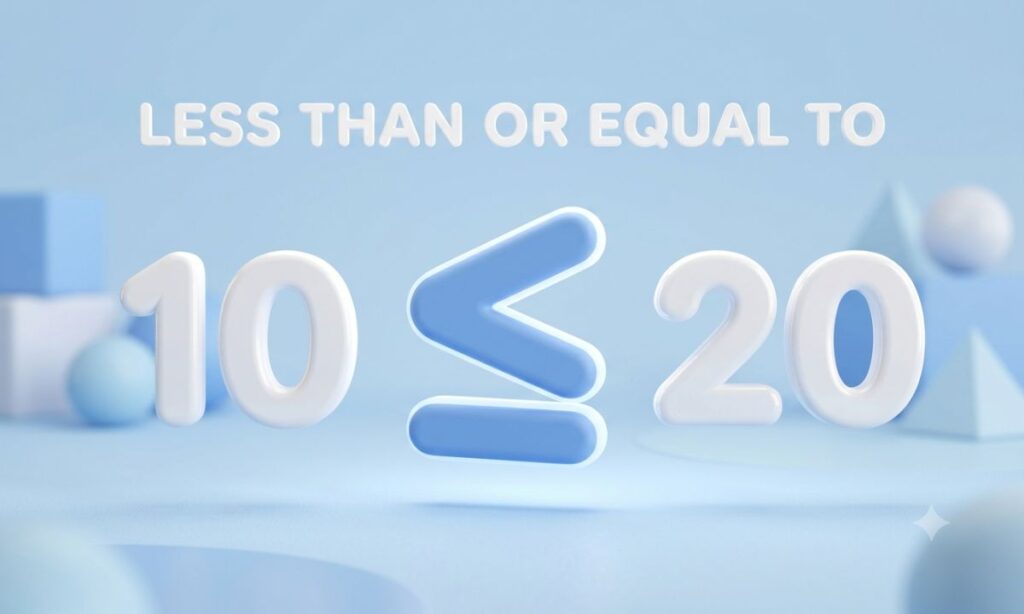
Outside of grammar, this phrase often comes up in mathematics, coding, and data work, where a symbol replaces the written words entirely. The less than symbol looks like this, an open angle bracket pointing left: <
In math, the less than symbol is used to show that one value is smaller than another. For example, 4 < 9 means four is less than nine. The open side of the symbol always faces the larger number, while the pointed side faces the smaller one. Many students remember this using the alligator trick, imagining the symbol as a hungry mouth that always opens wide toward the bigger number.
| Symbol | Meaning | Example |
| < | Less than | 5 < 8 |
| > | Greater than | 8 > 5 |
| ≤ | Less than or equal to | x ≤ 10 |
| ≥ | Greater than or equal to | x ≥ 10 |
| ≠ | Not equal to | x ≠ y |
There is no symbol for less then, because the word then has no place in mathematical comparison at all. Only than belongs in this context, which reinforces the same rule we have applied throughout this entire Less Then or Less Than guide. Math, by its very nature, only deals with comparisons, never with sequence or time, so the symbol naturally aligns with than rather than then.
In programming languages such as Python, JavaScript, and C, the less than symbol also controls conditional logic, loops, and sorting operations, making it one of the most frequently used symbols in computer science as well as basic arithmetic. A simple loop condition like i < 10 tells the computer to keep running as long as a value remains smaller than ten. Spreadsheet formulas, database queries, and statistical software all rely on this same small symbol to filter and sort information by size.
Understanding both the written phrase and the symbol version gives you a complete picture of how comparison works across language, mathematics, and modern technology, all built on the same underlying logic.
Which Is Used the Most?
If you compare the search volume and everyday usage of both phrases, less than wins by a massive margin. Less than is a standard, widely accepted phrase used in academic writing, business communication, casual conversation, journalism, legal documents, and technical fields like mathematics and programming.
Less then, on the other hand, only appears because of typing mistakes, autocorrect failures, or a simple lack of awareness about the difference between then and than. It has no legitimate grammatical use and does not appear in dictionaries, style guides, or any professional writing standard.
Here is a simple breakdown of where each phrase typically shows up in real world writing.
| Context | Less Than | Less Then |
| Academic writing | Always used | Never correct |
| Business emails | Always used | Common typo |
| Casual texting | Mostly correct | Frequent error |
| News and journalism | Standard usage | Treated as an error |
| Math and coding | Standard symbol < | Not applicable |
| Published books | Standard usage | Almost never appears |
This comparison makes it clear that within the Less Then or Less Than discussion, only one form holds any real linguistic weight. The other exists purely as a spelling slip that should always be caught and corrected during proofreading.
If you want to avoid this mistake permanently, try this simple trick. Remember that both than and comparison contain the letter A. Since than is used for comparisons, the matching vowel can help your memory lock in the correct spelling every single time you write a sentence involving less than.
Quick Checklist Before You Hit Publish
Use this short checklist whenever you are proofreading your own writing for the Less Then or Less Than mistake.
- Does the sentence compare two amounts, sizes, or values? If yes, use than.
- Does the sentence talk about time, sequence, or what happens next? If yes, use then.
- Read the sentence aloud slowly. If you naturally pause before the comparison, than almost always belongs there.
- Search your document for the word then and check each instance for a nearby comparative word like less, more, better, or worse.
Following this short routine takes only a minute or two, yet it can eliminate one of the most common small errors in everyday writing.
Less Then or Less Than in Professional and Academic Writing
Professional editors, teachers, and publishers treat the Less Then or Less Than question as a basic proofreading check, similar to catching a missing comma or a misplaced apostrophe. In resumes, cover letters, research papers, and client emails, using less then instead of less than can quietly damage how careful and polished your writing appears, even if the rest of the message is strong.
Many style guides used in journalism, academic publishing, and corporate communication do not even list less then as an alternative spelling, because it simply is not recognized as valid. This is one more reason why settling the Less Then or Less Than question matters beyond casual texting. Strong writing habits in this small area tend to reflect strong habits overall, which is exactly why hiring managers, professors, and editors notice it quickly.
Building the habit of double checking less than during proofreading, alongside other common comparison words like more than and rather than, can meaningfully raise the overall quality of your writing over time.
Read This: Dought vs Doubt: Which Should You Use In Writing?
Frequently Asked Questions
Is it correct to say less then or less than?
Less than is the only correct phrase. Less then is a common misspelling, and this Less Then or Less Than guide exists to help readers avoid it in formal and casual writing alike.
What does less than mean in a sentence?
It means one amount, number, or quantity is smaller than another, such as in the sentence she earns less than her manager.
Why do people confuse then and than?
The two words sound nearly identical in fast speech, and they differ by only one letter, which makes the mistake easy to make even for careful writers.
Is less than used for countable or uncountable nouns?
It is mainly used for uncountable nouns, time, money, and distance, while fewer than is generally reserved for clearly countable nouns.
What is the symbol for less than?
The less than symbol is the less than sign, written as <, and it is used across math and programming to show that one value is smaller than another.
Can less then ever be correct?
No. Then relates to time or sequence, so it cannot be paired with a comparative word like less in any standard grammatical context.
Does British English follow the same Less Then or Less Than rule?
Yes. Both British and American English treat less than as correct and less then as incorrect, with no regional variation on this particular rule.
Is it less than or fewer than for people?
Fewer than is technically preferred for countable groups of people, such as fewer than ten guests, although less than is sometimes heard in casual speech.
Final Thoughts
The Less Then or Less Than confusion is one of the easiest grammar mistakes to fix once you understand the underlying rule. Then belongs with time and sequence, while than belongs with comparison. Since less is always a comparative word, less than is the only correct choice across formal writing, casual conversation, mathematics, and programming alike.
Whether you are writing a school essay, a business report, a text message, or a line of code, remembering this simple distinction will keep your writing accurate and professional. The next time the Less Then or Less Than question pops into your head while you are typing, you will already know the answer without having to stop and think twice.
Choose than whenever you are comparing, choose then whenever you are talking about time, and your sentences involving less will always read correctly. Keep this guide handy, share it with anyone who still mixes up the two, and let the Less Then or Less Than mistake become a thing of the past in your own writing.