
Have you ever typed a word and then second-guessed yourself halfway through? That is exactly what happens with convertor vs converter. Both spellings exist. Both appear across the internet, in technical manuals, and even in some dictionaries. Yet writers, students, engineers, and bloggers keep wondering: which one is actually right?
The short answer is that converter is the standard, widely accepted spelling in modern English. But the longer answer is far more interesting because convertor vs converter is not simply a case of right versus wrong. It is a nuanced spelling debate shaped by history, technical usage, regional preferences, and industry conventions.
This article breaks down everything you need to know about convertor vs converter, including definitions, origins, real-world usage examples, a comparison table, and clear guidance on when each spelling applies. By the time you finish reading, you will feel completely confident choosing the correct form every single time.
The Same, Only Different
At the most basic level, convertor and converter mean the same thing. Both words describe a person, device, or tool that converts something from one form into another. Whether you are talking about a currency converter, a file converter, an analog to digital signal convertor, or a power convertor, the core meaning never changes.
The confusion around convertor vs converter is not new. English has a long history of accepting spelling variants, especially for nouns derived from verbs. Words like advisor and adviser, realtor and realter, and similar pairs show how English tolerates variation. The convertor vs converter debate fits neatly into that tradition.
Both words trace their roots to the Latin word “convertere,” which combines “con” meaning together or altogether and “vertere” meaning to turn. From Latin, the word passed into Old French as “convertir” and then entered Middle English as “convert.” The noun forms followed naturally, giving us both spelling variants that persist to this day.
So why do people still argue about convertor vs converter? Because one form is clearly dominant in everyday writing while the other holds a specific, narrower place in technical and engineering contexts. Understanding that distinction is the key to using both correctly.
The Word “Converter”
Converter is the standard spelling. It is the form recognized by Merriam-Webster, Oxford English Dictionary, Cambridge Dictionary, and virtually every other major reference work in the English language. When you look up the word in any mainstream dictionary, “converter” is the primary entry.
The spelling follows a straightforward English word formation rule. When English creates an agent noun from a verb, meaning a noun describing something that performs the action of that verb, it typically adds the suffix “er.” Think of teacher, player, builder, worker, runner, and heater. These all follow the same pattern. Converter fits perfectly into this family of words.
In everyday usage, convertor vs converter is not much of a contest. Converter wins in almost every general context. Here are the most common areas where the word “converter” appears:
Digital and Online Tools Online converter tools are everywhere in modern life. People use currency converters to check exchange rates before traveling abroad. Video converters help users change file formats from MP4 to AVI or MOV. Audio converters transform files between MP3, WAV, and FLAC formats. Unit converters calculate distances, weights, and temperatures instantly. PDF converters turn documents from one file type to another.
Automotive Applications The catalytic converter is one of the most widely recognized uses of the word. This device sits inside a vehicle’s exhaust system and converts harmful gases like carbon monoxide and nitrogen oxides into less harmful emissions. Every modern gasoline and diesel vehicle contains one. No automotive manual or engineering standard spells it “catalytic convertor.”
Currency and Finance Currency converter tools are built into search engines, travel apps, and banking platforms. When someone needs to know how many Pakistani rupees equal one US dollar, they reach for a currency converter. The financial world overwhelmingly prefers this spelling.
Broadcast and Media Analog to digital converters, also called ADCs, are essential in broadcasting, audio recording, and telecommunications. A signal converter translates between different transmission standards. These fields use “converter” consistently in professional documentation and technical standards.
The dominance of “converter” in these areas is not accidental. It reflects how modern English has standardized around the “er” suffix for most agent nouns derived from verbs ending in a consonant plus “t.”
Read This: Wheaten vs Wheat: When To Use Each One? What To Consider
The Convertor Technicality
Now here is where the convertor vs converter story gets genuinely interesting. Convertor is not simply a misspelling that somehow went viral. It has a real historical presence, a legitimate foothold in certain technical domains, and a place in some dictionaries as an accepted alternative form.
The Oxford English Dictionary, one of the most authoritative references in the English language, lists “convertor” as an alternative spelling for “converter.” It does not call it wrong. It acknowledges its existence and notes that both forms have been used historically.
Several specific contexts show a clear preference for the convertor spelling:
Electrical Engineering The term “convertor” appears frequently in older electrical engineering texts and manuals. A Bessemer convertor, for example, is a historical term from metallurgy describing the vessel used to convert iron into steel through the Bessemer process. British engineering publications from the 19th and early 20th centuries used this spelling extensively.
European and British Technical Usage While British English does not universally prefer “convertor,” some European technical and manufacturing traditions incorporated this spelling into their documentation. Certain European product catalogs, engineering standards, and technical manuals still use “convertor” when referring to specific electrical or mechanical devices.
Older Technical Literature If you read technical texts from the early and mid 20th century, you will encounter “convertor” with some regularity. These texts were written during a period when spelling conventions were less rigidly standardized than they are today.
Specific Device Names In some niche technical areas, “convertor” has stuck as part of a proper name or established term. Signal convertor, rotary convertor, and synchronous convertor are examples where the “or” spelling appears in older technical literature.
The key insight in the convertor vs converter debate is this: convertor is not wrong in an absolute sense. It is simply less common, less standardized, and potentially confusing when used outside specialized technical contexts. Modern style guides, search engine conventions, and general writing standards all point firmly toward “converter.”
Convertor or Converter Table
One of the clearest ways to understand the convertor vs converter distinction is to see both forms compared side by side. The table below summarizes the most important differences between the two spellings.
| Feature | Converter | Convertor |
| Standard Spelling | Yes | No (alternative) |
| Dictionary Entry | Primary form in all major dictionaries | Listed as alternative in some dictionaries |
| General Usage | Everyday writing, digital content, media | Rare, niche technical contexts |
| Technical Usage | Modern engineering, electronics, software | Older engineering texts, some European manuals |
| Regional Preference | American English, British English, global | Some older British and European technical writing |
| SEO and Digital | Dominant in web content | Very limited online presence |
| Examples | Currency converter, file converter, catalytic converter | Bessemer convertor, rotary convertor (historical) |
| Recommended for Writing | Yes, always | Only when quoting historical or technical sources |
| Considered a Misspelling | No | Sometimes, depending on context |
| Dictionary Status | Merriam-Webster primary entry | Oxford notes as alternative spelling |
This table makes the core convertor vs converter answer very clear. For any modern writing purpose, whether you are composing a blog post, a technical report, a school essay, or professional content, “converter” is the correct choice. “Convertor” belongs in historical quotes, older technical references, or very specific engineering contexts where the term has been established by tradition.
Here We Use “Converter”, And There We Use “Convertor”
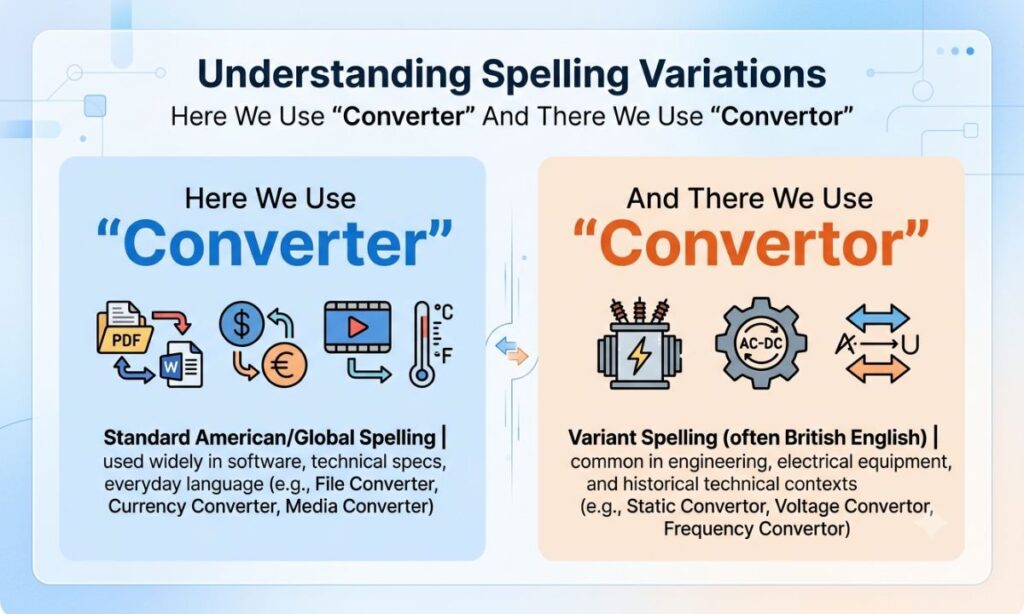
Context is everything in the convertor vs converter conversation. The two spellings do not compete on equal ground across all situations. Instead, each one has its natural territory. Knowing which territory applies to your writing situation makes the decision effortless.
Use “Converter” in these situations:
When you write about online tools, “converter” is the clear choice. An online currency converter, a video converter app, a unit converter website, or a PDF converter tool all use this spelling without exception.
When writing about automotive parts, “converter” is standard. The catalytic converter installed in every modern vehicle is always spelled this way in service manuals, regulatory documents, and automotive journalism.
When discussing modern electronics and software, “converter” dominates. Analog to digital converters, digital to analog converters, power converters, and voltage converters in consumer electronics all follow this spelling convention in contemporary technical writing.
When writing for a general audience anywhere in the world, “converter” communicates clearly and professionally. It will not raise eyebrows, create confusion, or look like a spelling error.
When optimizing content for search engines, “converter” is the practical choice. The vast majority of internet searches use this spelling, meaning your content will rank better and reach more readers when it consistently uses “converter.”
Use “Convertor” only in these specific situations:
When directly quoting a historical source, engineering manual, or technical document that uses the “convertor” spelling, you should preserve the original spelling in the quotation. Changing it would alter the quoted text.
When discussing specific historical devices or processes by their established names, such as the Bessemer convertor or the rotary convertor, some writers preserve the original spelling to maintain historical accuracy.
When writing for a specific engineering audience that has established conventions using “convertor” within their field or organization, following those conventions may be appropriate.
Outside these narrow situations, the convertor vs converter decision really is not a decision at all. You use “converter.”
Convertor or Converter Calculator
One of the most practical and popular applications of the converter concept today is the online calculator. These tools have made the word “converter” familiar to billions of internet users who rely on them every single day.
What does an online converter or convertor tool actually do?
An online converter takes an input value in one format, unit, or currency and transforms it into the equivalent value in a different format, unit, or currency. The underlying mathematics can be simple or complex, but the user experience is always the same: enter a value, get an instant result.
Here are the most widely used types of online converters:
Currency Converter A currency converter uses live exchange rates to calculate how much one currency is worth in another. Travelers, international businesses, online shoppers, and financial analysts use these tools constantly. Major search engines have built currency converters directly into their results pages.
Unit Converter A unit converter handles measurements across dozens of categories. You can convert miles to kilometers, pounds to kilograms, Fahrenheit to Celsius, gallons to liters, acres to square meters, and thousands of other unit pairs. Scientists, students, engineers, and everyday users all rely on these tools.
File Converter File converters transform digital files from one format to another. A PDF to Word converter, an MP4 to MP3 converter, a JPG to PNG converter, and a DOCX to PDF converter are examples of this category. Creative professionals and office workers use file converters daily.
Time Zone Converter A time zone converter helps people coordinate across different global time zones. Remote teams, international travelers, and anyone scheduling a meeting with someone in another country needs this tool.
Voltage and Power Converter Travelers use voltage converters when visiting countries with different electrical standards. A device that works on 110 volts in the United States may need a power converter to operate safely in a country that uses 220 volts.
All of these tools are universally labeled and searched for using the spelling “converter.” If you tried to search for a “currency convertor” or a “file convertor,” you would still find results, but you would find far fewer of them. The internet has overwhelmingly standardized around the “er” spelling.
This real-world digital evidence reinforces the core conclusion of the convertor vs converter debate: converter is the word the modern world uses.
So, Show Me How To Use Them
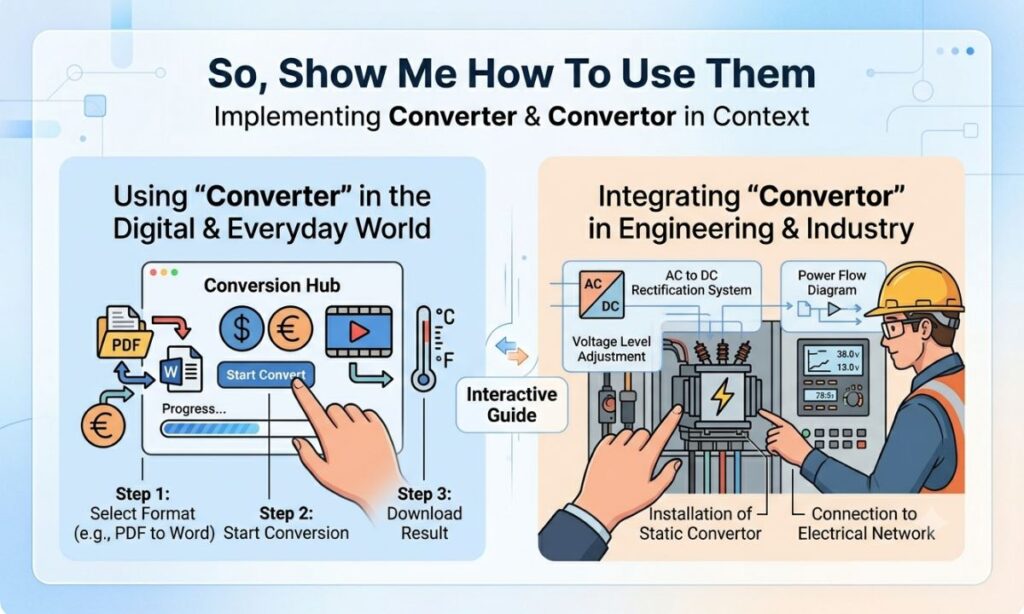
Understanding the theory behind convertor vs converter is valuable, but seeing both words used correctly in actual sentences makes the guidance concrete and memorable. Here are detailed usage examples for each spelling.
Converter
The word “converter” works in virtually any context where you need to describe something that transforms one form into another. These examples show the natural range of the word:
“The currency converter on her phone showed that her travel budget would go much further in Southeast Asia than she had originally estimated.”
“After downloading a reliable video converter, she was able to change all of her old AVI files into a modern MP4 format that her new tablet could play without any issues.”
“Engineers installed a new analog to digital converter in the radio broadcasting system, which dramatically improved signal quality for listeners across the entire region.”
“The automotive technician warned that a failing catalytic converter would not only increase harmful emissions but could also trigger the engine warning light.”
“His laptop charger is technically a type of AC to DC converter, transforming the alternating current from the wall outlet into the direct current that powers the device’s battery and circuits.”
“Using an online unit converter, she quickly calculated that the marathon distance of 26.2 miles was equivalent to approximately 42.2 kilometers.”
“The solar power installation included a high efficiency power converter that maximized the amount of usable electricity generated from the panels each day.”
“She used a PDF to Word converter to edit the contract before sending it back with her suggested revisions.”
Convertor
The word “convertor” belongs in more specific and historically grounded contexts. When you use it, your reader should understand you are either quoting a historical source, working within a specialized technical tradition, or deliberately following a regional or industry convention.
“The original 1856 patent drawings showed the Bessemer convertor as a large pear-shaped vessel that could be tilted to pour out molten steel.”
“According to the 1947 engineering manual, the rotary convertor must be inspected for brush wear before every operational cycle.”
“The European industrial equipment catalog listed the signal convertor specifications on page 47 of the technical appendix.”
“The research paper cited an early 20th century textbook that consistently used the term electromechanical convertor throughout its discussion of power systems.”
Notice the clear pattern. When “convertor” appears, it is always in a historical, archival, or specialized technical context. When “converter” appears, it works naturally in any modern sentence about any type of conversion task.
Frequently Asked Questions About Convertor vs Converter
Is convertor a real word? Yes, convertor is a real word. The Oxford English Dictionary lists it as an alternative spelling for converter, though converter is the standard and preferred form in modern English.
Which spelling do Merriam-Webster and Oxford prefer? Both dictionaries list “converter” as the primary entry. Oxford notes “convertor” as an alternative spelling, but neither dictionary recommends it for general use.
Is convertor British English? Not exactly. While some older British engineering texts used “convertor,” both American and British English today prefer “converter” as the standard form.
Can convertor and converter be used interchangeably? In casual writing, yes. In professional, technical, or SEO-focused writing, always use “converter” to avoid confusion and maintain credibility.
Why does “convertor” still appear online? It appears in older technical documents, some European product catalogs, historical engineering texts, and occasionally in content written by non-native English speakers who learned the word from outdated sources.
Which spelling should I use for SEO purposes? Always use “converter.” Search engines process the more common spelling in the vast majority of queries, and your content will perform better with the standard spelling.
Is there a difference between convertor and converter in American vs British English? No meaningful difference exists today. Both regions use “converter” as the standard spelling in contemporary writing.
What does a converter do in electronics? An electronic converter changes electrical energy from one form to another, such as alternating current to direct current, or one voltage level to another, making it compatible with connected devices.
Read This: Rug Vs Rag, How Are These Different? When To Use Them?
Conclusion
The convertor vs converter debate has a clear winner in modern English: converter. It is the spelling recognized by major dictionaries, preferred by search engines, used across industries from automotive to finance to digital media, and understood instantly by readers everywhere in the world.
Convertor is not wrong in an absolute sense. It has historical roots, dictionary acknowledgment, and a narrow place in certain technical traditions. But for any writing you do today, whether it is a website article, a school assignment, a technical report, a social media post, or a professional email, converter is the correct and professional choice.
Think of it this way: both words share the same meaning, the same origin, and the same purpose. The only real difference is that one form has stood the test of time and modern standardization. Converter is that form.
The next time you pause over the convertor vs converter question, remember this simple rule: if you are writing for a modern audience in any general or digital context, go with “converter” every single time. If you are quoting a historical document or working within a very specific technical tradition that uses “convertor,” you may preserve that spelling. In every other case, converter is your word.
Now you have a thorough understanding of convertor vs converter, its origins, its usage patterns, its industry applications, and its place in modern English. Use that knowledge confidently and write with clarity.