
If you have ever typed the word “sponser or sponsor” and paused to wonder which one is right, you are in very good company. This is one of the most frequently searched spelling questions on the internet, and the confusion is completely understandable. The two versions look nearly identical, and when spoken aloud, they sound exactly the same. But here is the truth: only one of them is a real English word.
This article will clear up the confusion around sponser or sponsor once and for all. You will learn the correct spelling, understand where the word comes from, see how to use it properly in a sentence, and discover the most common mistakes writers make. Whether you are putting together a business proposal, writing a blog post, or simply texting a friend, this guide will make sure you never mix up these two versions again.
Quick Answer: Sponsor or Sponser?
The correct spelling is sponsor. The word “sponser” does not exist in any English dictionary, in any dialect, in any part of the world. It is simply a misspelling of sponsor, and it should always be corrected. There are no exceptions to this rule.
Define Sponsor
The word sponsor functions both as a noun and as a verb in the English language. According to the Merriam-Webster Dictionary, a sponsor is defined as “a person or organization that pays for or plans and carries out a project or activity.” The Cambridge Dictionary further describes it as an entity that provides money for an event, sports activity, television program, or person in exchange for advertising or recognition.
As a noun, a sponsor refers to the person or company providing the support. As a verb, it describes the act of providing that support. For example, a corporation can be a sponsor (noun) at a music festival, or it can sponsor (verb) a local sports team.
The word has a rich history. According to etymology records, sponsor entered the English language in the 1650s in a religious context, originally referring to a godparent at a baptism. It comes directly from the Latin word sponsor, meaning a guarantor or one who makes a solemn promise, derived from the Latin verb spondere, meaning “to pledge solemnly.” By the 1930s, the word expanded into broadcasting, where companies would pay to sponsor radio programs.
Today, the sponsor or sponser debate comes up constantly in professional writing, marketing materials, event planning, and academic papers. The correct form, sponsor, is used across all industries and contexts worldwide.
Define Sponser
“Sponser” is not a word. It has no definition in any recognized dictionary, including Merriam-Webster, Oxford, Cambridge, or Collins. It is a misspelling that results from confusing the Latin-derived suffix “or” with the common English suffix “er.”
In English, words like teacher, writer, and runner use the “er” ending to describe a person who performs an action. This pattern is deeply familiar to English speakers, which is why many people instinctively write “sponser” when they mean “sponsor.” However, the word sponsor did not come from an English root verb. It was borrowed directly from Latin, where it already existed as a complete word with the “or” ending. That is why the “er” suffix simply does not apply here.
There is no context, dialect, or usage scenario where “sponser” becomes acceptable. If you see it written somewhere, it is always a spelling error.
Read This: Emaculate vs Immaculate: Which One Is The Correct One? Updated 2026
How To Properly Use The Words In A Sentence
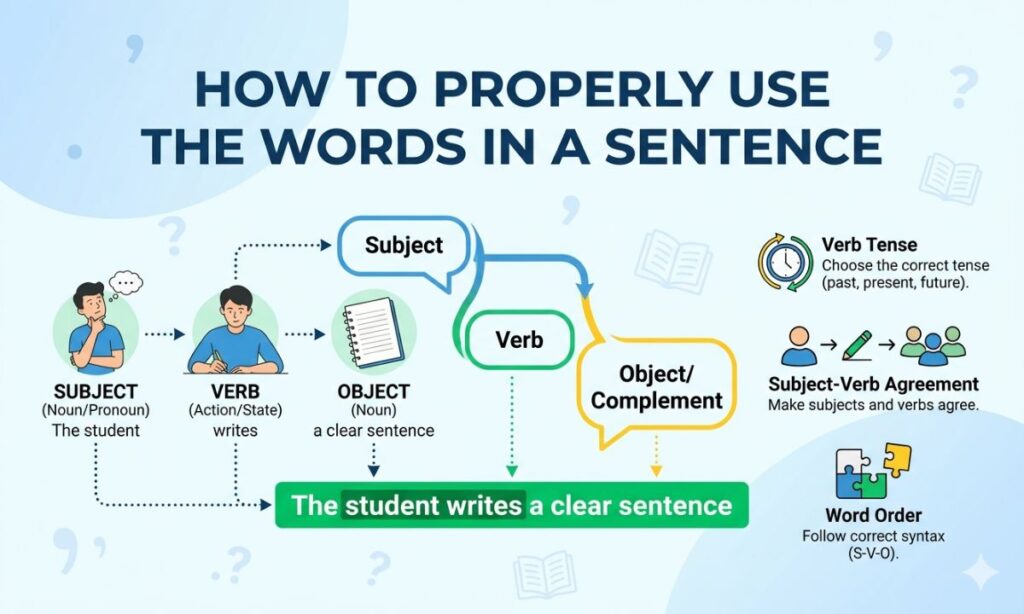
Understanding the difference between sponser or sponsor is only the first step. The next step is knowing how to use the correct word naturally and confidently in different types of sentences.
How To Use “Sponsor” In A Sentence
Since sponsor works as both a noun and a verb, the way you use it in a sentence will depend on what you are trying to say. Here are the two main patterns:
As a noun (referring to a person or organization): The sentence structure typically places “sponsor” after a determiner such as “a,” “the,” or “our.”
- The company agreed to be the official sponsor of the annual charity run.
- We are still searching for a sponsor to help fund the documentary project.
- Each sponsor received a thank-you mention at the beginning of the broadcast.
As a verb (describing the act of providing support): Here, “sponsor” follows a subject and acts as the main action word in the sentence.
- The energy drink brand has decided to sponsor three athletes this season.
- Our school board agreed to sponsor the science fair for the third year in a row.
- She asked the local bakery to sponsor the community fundraiser.
Notice that “sponsor” is flexible. It slots naturally into professional, academic, casual, and creative writing without sounding out of place.
How To Use “Sponser” In A Sentence
This section has a straightforward answer: you do not use “sponser” in a sentence, ever. It is not a word. Any sentence that contains “sponser” contains a spelling mistake. The only correct approach is to replace every instance of “sponser” with “sponsor.”
For example:
- Incorrect: “We are looking for a sponser to support our podcast.”
- Correct: “We are looking for a sponsor to support our podcast.”
No matter how many times you have seen “sponser” written online, in text messages, or even in printed materials, it remains a misspelling. The question of sponser or sponsor is always resolved in favor of sponsor.
More Examples Of Sponsor & Sponser Used In Sentences
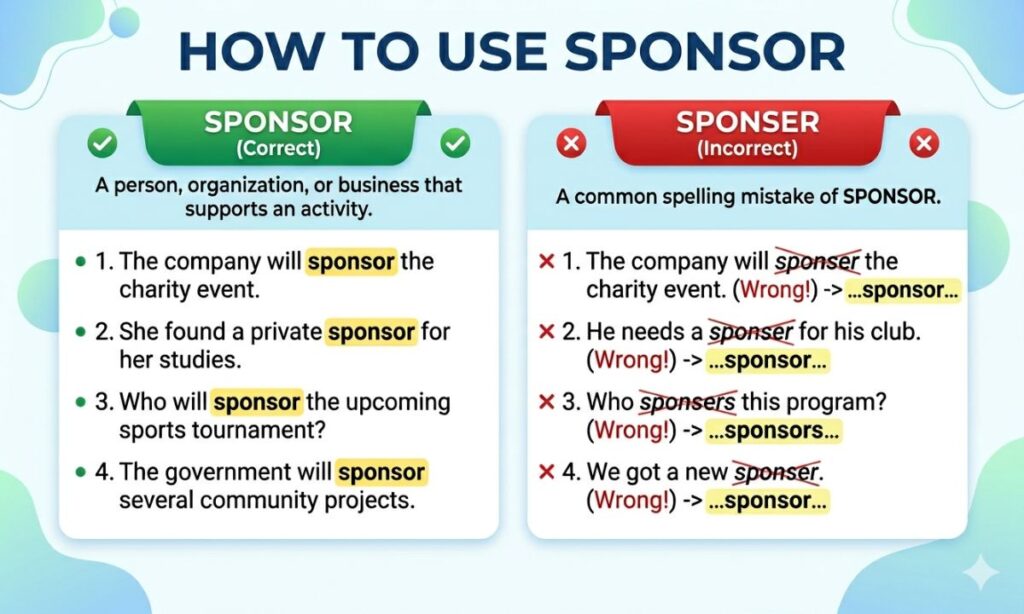
Seeing a word used in multiple contexts helps build a stronger memory of the correct form. The more examples you review, the easier it becomes to write “sponsor” automatically without second-guessing yourself.
Examples Of Using Sponsor In A Sentence
Here is a wide range of correct example sentences using sponsor:
- The tech giant announced it would sponsor the upcoming robotics competition for high school students.
- Without a reliable sponsor, the festival would not have been able to cover its production costs.
- Local businesses often act as sponsor partners for neighborhood sports leagues.
- She was proud to serve as a sponsor for her colleague’s visa application.
- The television network required each show to find at least one corporate sponsor before production began.
- Finding the right sponsor can transform a small startup into a nationally recognized brand.
- As a sponsor, the pharmaceutical company provided free medical kits to community clinics.
- The bill’s sponsor in the Senate pushed hard for a vote before the end of the legislative session.
- He asked his mentor to act as his sponsor during the professional certification process.
- The marathon’s lead sponsor had its logo displayed prominently on every participant’s running bib.
Examples Of Using Sponser In A Sentence
Since “sponser” is a misspelling, the examples below show what incorrect usage looks like, followed by the corrected version. This helps reinforce the right habit.
| Incorrect (Sponser) | Correct (Sponsor) |
| We need a sponser for the event. | We need a sponsor for the event. |
| Can your company sponser our team? | Can your company sponsor our team? |
| She found a sponser for her visa. | She found a sponsor for her visa. |
| The sponser logo appeared on stage. | The sponsor logo appeared on stage. |
| He signed the sponser agreement. | He signed the sponsor agreement. |
As the table above makes clear, every instance of “sponser” is simply a version of “sponsor” with a typo. The fix is always the same: replace the “er” ending with “or.”
Common Mistakes To Avoid
Even experienced writers make spelling errors. Here are the most important mistakes to watch for when working with sponser or sponsor.
Using “Sponser” Instead Of “Sponsor”
This is by far the most common error. Writers type “sponser” because the “er” suffix feels natural in English. Hundreds of English words use “er” to describe someone who does something: driver, manager, teacher, runner, baker. Because sponsor describes a person or company that does something (provides support), the brain automatically reaches for the “er” ending.
The fix is to remember that sponsor is a Latin-origin word, not an English-constructed one. Its “or” ending is baked into the word from the beginning. Think of other Latin-origin role words that also end in “or”: actor, director, senator, governor, professor. These all describe people in roles, just like sponsor does, and none of them use the “er” ending.
Using “Sponsor” When “Sponsee” Is Intended
A sponsee is the person or entity that receives support from a sponsor. This is the opposite of a sponsor. Confusing the two leads to awkward or inaccurate sentences.
- Incorrect: “The athlete who received the funding was listed as the sponsor.”
- Correct: “The athlete who received the funding was listed as the sponsee.”
In any professional agreement, the sponsor provides; the sponsee receives. Keeping this distinction clear is especially important in legal documents, contracts, and event planning materials.
Using “Sponsor” When “Sponsorship” Is Intended
Sponsorship is a noun that refers to the arrangement, deal, or program itself, not the individual or company involved. Mixing up sponsor and sponsorship can lead to grammatically incorrect or confusing sentences.
- Incorrect: “The company offered their sponsor of the event.”
- Correct: “The company offered their sponsorship of the event.”
Use “sponsor” when referring to the person or company. Use “sponsorship” when referring to the relationship, agreement, or financial arrangement between two parties.
Tips To Avoid These Mistakes
Here are practical strategies to help you always write sponser or sponsor correctly:
- Remember the “or” rule. Think of words like actor, director, and senator. Sponsor belongs to the same family.
- Look for the word “spons” at the beginning. The core of the word is Latin and does not change.
- Use spell-check as a backup. Most word processors will flag “sponser” as an error instantly. But do not rely on it alone; always proofread manually.
- Associate sponsor with “support.” Both words have the letter “o” prominently featured, which can help reinforce the correct spelling.
- Practice writing it. Write the word “sponsor” five times every time you catch yourself second-guessing it. Repetition builds muscle memory.
Context Matters
The word sponsor is used in a wide variety of industries and situations. Understanding the context in which it appears helps you use it more accurately and confidently.
Examples Of Different Contexts
Business and Corporate: In the business world, a sponsor is typically a company or investor that provides financial backing for an event, team, or project. The relationship is usually commercial, with the sponsor receiving advertising exposure or brand visibility in return.
Sports: Athletic teams, competitions, and individual athletes regularly rely on a sponsor for funding. The sponsor’s logo often appears on uniforms, banners, and promotional materials.
Television and Broadcasting: Programs are supported by a commercial sponsor that pays for advertising slots during the broadcast. This is one of the oldest and most recognized uses of the word.
Legal and Immigration: A sponsor in legal contexts is a person who takes on formal responsibility for another individual. This is especially common in immigration cases, where a sponsor vouches for the applicant and may accept financial responsibility.
Religious: Historically, a sponsor referred to a godparent at a baptism, the person who vouches for the moral and religious upbringing of a child.
Recovery Programs: In support programs such as Alcoholics Anonymous, a sponsor is an experienced member who guides and supports a newer member through the recovery process.
No matter the context, the spelling is always the same. Whether you are writing about sponser or sponsor in sports, business, law, or broadcasting, the answer is always sponsor.
Exceptions To The Rules
English is a language full of exceptions, but when it comes to sponser or sponsor, the rules are unusually clear.
Exceptions For Sponsor
There are no spelling exceptions for “sponsor.” It is spelled the same way in American English, British English, Australian English, and every other variety of the language. Unlike words such as “colour” versus “color” or “organise” versus “organize,” sponsor does not have regional spelling variants. The word is stable and consistent across all English-speaking countries and all style guides.
In terms of usage, sponsor remains the correct form whether it is a noun or a verb, in formal or informal writing, in professional or casual contexts.
Exceptions For Sponser
There are no exceptions that make “sponser” correct. It is not an alternative spelling. It is not a dialect variation. It is not an older historical form of the word. It has never been an accepted spelling in any published dictionary in any era of the English language. No usage context, no matter how informal, makes “sponser” appropriate.
The only thing “sponser” ever is, is a mistake.
Read This: Symptomatology vs Symptomology: Meaning And Differences
Practice Exercises
Now that you understand the difference, it is time to test yourself. These exercises will help cement the correct spelling in your memory.
Exercise 1
Read the sentences below and choose the correct word, either sponsor or sponser, to fill in the blank.
- The bank agreed to _______ the local arts festival this summer.
- Finding a reliable _______ can make or break a nonprofit fundraising event.
- Her company became the official _______ of the university’s engineering program.
- We are reaching out to potential _______ s for our upcoming podcast series.
- The senator was the lead _______ of the new environmental legislation.
Answers: All five blanks should be filled with sponsor. If you wrote “sponser” in any blank, go back and review the section on common mistakes.
Exercise 2
Identify the error in each sentence below and rewrite it correctly.
- “The event committee found a sponser who would donate equipment for the tournament.”
- “She introduced herself as the sponser of the scholarship fund.”
- “Without a major sponser, the documentary could not secure distribution.”
- “He listed the company as his primary sponser on the application form.”
- “The team wore the sponser’s logo on their jerseys throughout the season.”
Corrected sentences:
- The event committee found a sponsor who would donate equipment for the tournament.
- She introduced herself as the sponsor of the scholarship fund.
- Without a major sponsor, the documentary could not secure distribution.
- He listed the company as his primary sponsor on the application form.
- The team wore the sponsor’s logo on their jerseys throughout the season.
Conclusion
The debate around sponser or sponsor is settled clearly and permanently: sponsor is the only correct spelling. “Sponser” is a misspelling that has no place in written English, no dictionary definition, and no usage context in which it is acceptable.
The word sponsor comes from the Latin spondere, meaning to pledge or promise, and it entered English in the 1650s as a religious term before expanding into law, commerce, broadcasting, and everyday use. Today it functions as both a noun and a verb, describing the person or organization that provides support as well as the act of providing that support.
Every time you write the word, remember: it ends in “or,” not “er.” Think of actor, director, senator, and governor. Sponsor belongs in that family.
Getting this word right matters more than it might seem. In professional communication, a spelling error can undermine your credibility. In formal documents, it can create confusion. And in the world of digital content, correct spelling is one of the factors that contributes to the quality and trustworthiness of your writing.
Now that you know the correct answer to sponser or sponsor, you will never have to pause and wonder again.
FAQs
Is “sponser” ever correct in any situation? No. “Sponser” is always a misspelling. The only correct form is “sponsor,” regardless of context, dialect, or formality level.
What is the difference between sponsor and sponsorship? A sponsor is the person or company providing support, while sponsorship refers to the financial arrangement or relationship itself.
Can sponsor be used as both a noun and a verb? Yes. “Sponsor” is both a noun (the company is a sponsor) and a verb (the company will sponsor the event).
What is the difference between a sponsor and a sponsee? A sponsor provides funding or support; a sponsee is the person or entity that receives that support.
How can I remember the correct spelling of sponsor? Think of “actor,” “director,” and “senator.” Like sponsor, all of these Latin-origin words end in “or,” not “er.”
Post Navigation
Ready to sharpen your grammar and spelling skills further? Explore related articles on common English spelling confusion below.
Similar Posts
Hampster vs Hamster: Which Spelling Is Actually Correct?
Like sponser vs sponsor, only one spelling of this word is correct. Discover which one it is and why so many people get it wrong.
Dysregulated vs Disregulated: How Are These Words Connected?
Two prefixes, one correct choice. This article breaks down the grammar rules behind “dis” and “dys” and when each prefix applies.
Seing Vs Seeing: What’s The Correct Spelling To Use?
“Seing” is another common spelling mistake that crops up in casual writing. Find out the correct form and the grammatical rule behind it.
Striping vs Stripping: Master Meaning, Usage, and Grammar Differences
These two words look similar but mean entirely different things. Learn the meaning difference and how to use each one without confusion.
Realist Vs. Realest: How Are These Different? When To Use
One is a standard adjective; the other is a noun. This guide explains the grammatical difference and when each word applies.
Inexcusable Vs Unexcusable: What’s The Correct Word To Use?
Both sound plausible, but only one is accepted in standard English. Find out which prefix to use and why it matters.