
If you have ever paused halfway through typing a sentence and wondered whether it should be Bussiness or Business, you are not alone. This is one of the most searched spelling questions in English, and it trips up students, professionals, and even native speakers who are typing too fast to think. The good news is that the answer is short and permanent. There is only one correct spelling, and once you understand why the mistake happens, you will never make it again.
In this guide, we will settle the Bussiness or Business debate for good. You will learn the correct spelling, where the word came from, how it is used in British and American English, the most common mistakes people make, and simple memory tricks that make the correct spelling stick. We will also look at real world examples from emails, news articles, social media, and school writing, along with a comparison table and a quick practice section so you can test what you have learned.
Bussiness or Business: Quick Answer
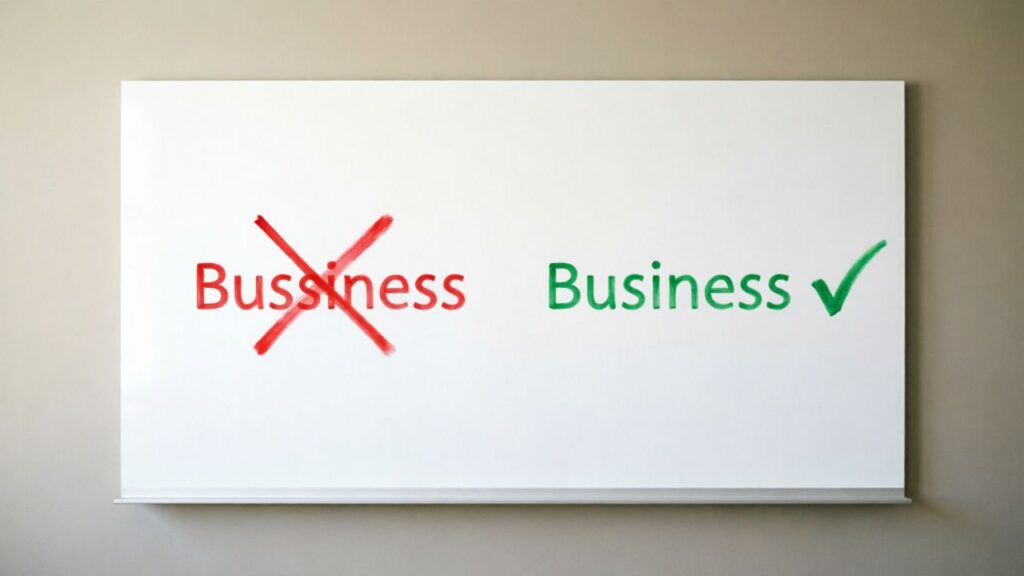
The correct spelling is business. Bussiness, with a double s in the middle, is not a recognized word in any English dictionary. It is simply a common typing error.
Here is the short version of the Bussiness or Business answer:
- Business is correct in every context, formal or casual.
- Bussiness is always incorrect, no matter how it is used.
- The spelling does not change between British and American English.
- The mistake usually comes from typing speed, autocorrect, or pronunciation confusion.
So whenever you catch yourself asking Bussiness or Business, remember that business, spelled with one s in the middle, is the only accepted form.
Read This: Tapping vs Taping: When To Use Each One? What To Consider
The Origin of Bussiness or Business
To fully understand the Bussiness or Business question, it helps to look at where the word actually came from. Business has roots in Old English, tracing back to a word close to bisignis, which carried the meaning of care, occupation, or the state of being busy. Over the centuries, English spelling went through major shifts, and the word slowly settled into the modern form we use today, business.
Interestingly, business shares its root with the word busy. The suffix ness was added to busy to describe a state or condition, similar to how happiness comes from happy. That connection is actually one of the best tools for solving the Bussiness or Business confusion, because if you can spell busy correctly, you already have most of the answer.
As English trade and commerce grew, the meaning of business expanded from simply describing a state of being occupied to describing:
- A person’s job, trade, or profession
- A company or commercial organization
- Buying and selling goods or services
- Matters or affairs that need attention
None of these meanings ever changed the spelling. Every dictionary, style guide, and grammar authority in the English speaking world agrees on one form, and that puts an end to the Bussiness or Business debate at the historical level.
British English vs American English Spelling
Many English words change slightly between British and American spelling. Think of colour versus color, or centre versus center. Naturally, people assume the Bussiness or Business question might have a regional answer too.
It does not.
Both British English and American English use the exact same spelling, business, with a single s after the bu and another single s before the final ness. There is no transatlantic variation here, unlike words such as organise or organize.
This makes the Bussiness or Business question easier to resolve than many other English spelling debates, because you do not need to think about which country you are writing for. Whether you are writing a business email in London, a business report in New York, or a business plan in Sydney, the spelling stays exactly the same.
Which Spelling Should You Use?
By now the answer to Bussiness or Business should be clear, but let us make it official. Always use business. There is no situation, formal or informal, academic or casual, where bussiness is the right choice.
Use business when you are:
- Writing a resume, cover letter, or job application
- Sending professional emails to clients or colleagues
- Publishing content on a website or blog
- Completing school assignments or academic papers
- Posting on social media platforms
- Filling out legal, tax, or government documents
There is genuinely no exception to this rule. Anyone still debating Bussiness or Business in their own writing can settle it permanently by remembering that only one version, business, appears in dictionaries, spell checkers, and grammar tools.
Common Mistakes with Bussiness or Business
Even though the correct spelling is simple, the Bussiness or Business mistake remains one of the most frequently searched spelling errors online. Understanding why it happens can help you avoid it for good.
Why the Mistake Happens
There are a few clear reasons people slip up on Bussiness or Business:
- Pronunciation confusion. The word business is often pronounced quickly, almost like biz nis, and the sound can make it feel like there should be a double s in the middle.
- Fast typing. When typing quickly, it is easy to hit an extra key and accidentally create bussiness instead of business.
- Autocorrect errors. Some keyboard autocorrect tools fail to catch the mistake, especially on mobile devices.
- Similarity to other words. Words like passion or possession use double letters in similar positions, which can create a false pattern in the writer’s mind.
- Non native English speakers. Learners sometimes assume English words follow a phonetic spelling pattern, which leads to guesses like bussiness.
All of these reasons explain why the Bussiness or Business search remains so popular, even among experienced writers.
Memory Trick
The simplest way to lock in the correct spelling is to remember that the word busy hides inside business. Just add the suffix ness, and you get business.
Another helpful trick for solving Bussiness or Business once and for all is to break the word into three parts:
- Bus
- I
- Ness
Say it slowly as bus, i, ness, and the correct order of letters becomes much easier to remember. There is no reason to double the middle s once you see the word broken down this way.
Read This: Sponser or Sponsor: Which Spelling Is Actually Correct?
Bussiness or Business in Everyday Examples

Seeing the word used correctly in real contexts is one of the best ways to permanently solve the Bussiness or Business confusion. Below are examples from different types of writing.
Emails
Professional emails are one of the most common places where this mistake shows up, often because people type quickly under time pressure.
- Correct: I would like to discuss a business opportunity with your team.
- Incorrect: I would like to discuss a bussiness opportunity with your team.
News
News articles rely heavily on the word business, especially in finance, economy, and trade sections.
- Correct: The business sector reported strong growth this quarter.
- Incorrect: The bussiness sector reported strong growth this quarter.
Social Media
Social media captions and posts are often typed on phones, which increases the chance of a Bussiness or Business typo.
- Correct: Check out my new business page for updates and offers.
- Incorrect: Check out my new bussiness page for updates and offers.
Formal Writing
Formal documents, reports, and academic papers require careful attention to spelling, since errors reduce credibility.
- Correct: This report analyzes current business performance across three markets.
- Incorrect: This report analyzes current bussiness performance across three markets.
School and Education
Students frequently search Bussiness or Business while writing essays, assignments, or business studies coursework.
- Correct: She is studying business management at university.
- Incorrect: She is studying bussiness management at university.
Bussiness or Business: Google Trends & Usage Data
Search data consistently shows that people around the world type Bussiness or Business into search engines every single day. The correct spelling, business, dominates global search volume by a wide margin, since it is used constantly in professional, academic, and everyday writing.
At the same time, misspellings like bussiness, buisness, and busines still generate a noticeable amount of search traffic. This pattern appears strongly in countries where English is a second language, including regions across Asia, Europe, and South America, as learners try to confirm the correct spelling before submitting an assignment or sending a message.
A few patterns stand out when looking at how people search for Bussiness or Business:
- The correct spelling, business, is searched far more often overall, since it appears in everyday professional use.
- The misspelling bussiness spikes around back to school periods and the start of new academic terms.
- Mobile searches for Bussiness or Business tend to be higher than desktop searches, which lines up with typing errors on smaller keyboards.
This data confirms that Bussiness or Business remains a widespread point of confusion, even though the correct answer has never changed.
Comparison Table: Bussiness vs Business
The table below breaks down the key differences between the correct and incorrect spellings.
| Feature | Business (Correct) | Bussiness (Incorrect) |
| Dictionary recognition | Recognized in all major English dictionaries | Not recognized anywhere |
| British English | Standard spelling | Never used |
| American English | Standard spelling | Never used |
| Spell checker result | Accepted | Flagged as an error |
| Origin | From Old English, related to busy | No historical basis |
| Common use | Emails, news, school, social media, formal writing | Only appears as a typo |
| Professional impact | Builds credibility | Reduces credibility |
This table makes the Bussiness or Business comparison easy to reference whenever you need a quick reminder.
Why Correct Spelling Matters
Spelling might seem like a small detail, but in professional and academic settings it carries real weight. Getting Bussiness or Business wrong in an email, resume, or website can quietly damage how readers perceive your writing.
Here are a few reasons correct spelling matters so much:
- First impressions. A misspelled word in the opening lines of an email or resume can make a reader question your attention to detail.
- Trust and credibility. Businesses, teachers, and clients often equate accurate spelling with reliability and professionalism.
- Search engine visibility. Content published online with spelling errors can perform worse in search rankings and reader engagement.
- Clear communication. A wrong spelling can momentarily confuse the reader, slowing down comprehension.
Solving the Bussiness or Business question once, and remembering it permanently, protects your writing across every platform you use.
Business in Different Contexts
The word business is flexible and appears in many different situations. Understanding these contexts makes it even easier to use the word confidently and correctly every time.
Business as a Company
In this sense, business refers to a specific organization that sells goods or provides services.
Example: She opened a small business selling handmade candles.
Business as Work
Here, business refers to a person’s job, task, or professional matter.
Example: He has business to finish before the meeting starts.
Business as Commerce
This meaning covers the broader activity of buying, selling, and trading goods or services.
Example: International business continues to expand across new markets.
Business in Education
In academic settings, business often refers to a field of study, such as business administration or business management.
Example: She is completing a degree in business studies this year.
No matter which context applies, the spelling never changes. Every version of Bussiness or Business, in every context listed above, has the same single correct answer, business.
Quick Practice: Bussiness or Business
Test what you have learned. Choose the correct spelling to complete each sentence.
- She owns a successful clothing _____.
- He studies _____ management at college.
- Their online _____ is growing quickly.
- The company expanded its _____ operations overseas.
- I have _____ to finish before tomorrow.
Answer key: All five blanks should be filled with business. If you wrote bussiness for any of them, review the memory trick above and try again.
Common Word Combinations with Business
Learning the common phrases that pair with business can help you use the word naturally and correctly in daily writing. Here are some frequent combinations:
- Small business
- Business owner
- Business plan
- Business meeting
- Business partner
- Business trip
- Business email
- Online business
- Business management
- Business administration
- Business opportunity
- Business hours
- Family business
- Business model
- Business strategy
Each of these phrases uses the same single correct spelling, business, no matter the context or industry.
Read This: Manuel Vs Manual: When To Use Each One In Writing?
Frequently Asked Questions
Is bussiness ever a correct spelling?
No. Bussiness is always a spelling mistake and has no meaning in English.
Do British and American English spell it differently?
No. Both use the same spelling, business, with no regional variation.
Why do people write bussiness by mistake?
It usually happens due to fast typing, pronunciation confusion, or autocorrect errors.
What is an easy way to remember the correct spelling?
Remember that the word busy sits inside business, then add the suffix ness.
Does spelling business incorrectly affect professionalism?
Yes. Incorrect spelling in emails, resumes, or reports can reduce credibility and trust.
Is the plural form spelled businesses?
Yes. Simply add es to form the plural, businesses.
Conclusion
The debate over Bussiness or Business really comes down to one simple rule. Business is correct, and bussiness is not, in any dialect, context, or type of writing. The confusion is common because of pronunciation habits, fast typing, and autocorrect slips, but the fix is just as simple as the mistake itself.
Remember the word busy hidden inside business, add the suffix ness, and you will never second guess the spelling again. Whether you are writing a professional email, a school assignment, a social media caption, or a formal report, business is the only spelling you need. The next time someone asks you Bussiness or Business, you will be able to answer with total confidence.