
If you have ever typed a sentence and suddenly stopped mid-thought, wondering whether to write “tapping” or “taping,” you are not alone. These two words look almost identical on the page, and they sound remarkably similar when spoken aloud. Yet their meanings are completely different, and using one in place of the other can change the entire meaning of what you are trying to say.
The confusion between tapping vs taping is one of the most common spelling mix-ups in everyday English writing. One tiny letter, an extra “p,” separates them. But that single letter changes the word from an action involving adhesive tape or recording to an action involving a light, rhythmic touch or strike. Whether you are writing a text message, a professional report, a medical note, or a sports commentary, choosing the correct word matters.
This article covers everything you need to know about tapping vs taping: clear definitions, proper sentence usage, real-world examples, common mistakes people make, context-specific guidance, and practice exercises so you can test your understanding. By the time you finish reading, choosing between the two will feel completely natural.
Define Tapping
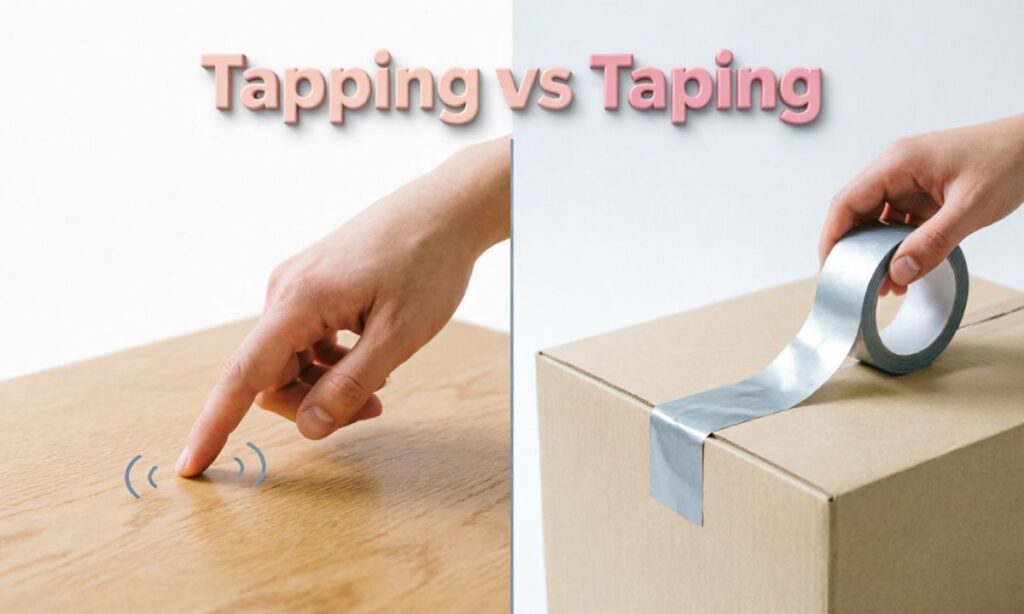
Tapping is the present participle of the verb “tap.” It describes the act of lightly striking, touching, or hitting something, usually repeatedly and often in a rhythmic pattern. The action is quick, gentle, and deliberate. It produces a small sound or a brief physical contact with a surface or object.
The word “tapping” shows up in several very different contexts, all connected by the idea of a light, repeated contact or access:
- Physical tapping: Striking a surface with your fingers, knuckles, foot, or a tool. Think of someone tapping their fingers on a desk while waiting, or a carpenter tapping nails gently into wood.
- Digital tapping: On touchscreen devices, tapping means lightly pressing the screen to open an app, select a link, or trigger an action. This usage has become extremely common with the rise of smartphones.
- Musical and dance tapping: In music, tapping refers to a guitar technique where a player strikes the fretboard with their fingers to create notes. In dance, tap dancing involves rhythmic foot movements that produce percussive sounds.
- Resource tapping: In business and everyday language, “tapping into” something means accessing or drawing from a source. For example, a company might tap into a new market or a speaker might tap into the audience’s emotions.
- Medical tapping: In healthcare, a procedure called a spinal tap involves drawing fluid from the spinal canal. Percussion tapping is also used by doctors and therapists to assess a patient’s body by listening to the sounds produced.
- EFT tapping: Emotional Freedom Technique (EFT) is a therapeutic practice in which a person taps specific acupressure points on their body while focusing on a stressful thought or feeling, helping to reduce anxiety and emotional distress.
In every one of these cases, tapping involves motion, rhythm, contact, or access. It is never about adhesive material or recording.
Define Taping
Taping is the present participle of the verb “tape.” It refers to the act of applying adhesive tape to something for the purposes of securing, attaching, protecting, supporting, or repairing it. It can also refer to the act of recording audio or video, a meaning that developed during the era of magnetic tape technology.
Here are the main ways taping is used:
- Everyday taping: Sealing a cardboard box for shipping, fixing a torn page, hanging a poster on a wall, or wrapping a gift. This is the most familiar use of the word for most people.
- Sports and athletic taping: Athletes and trainers frequently use adhesive tape to support muscles and joints, prevent injuries, and provide compression. There are several types used in this context, including rigid athletic tape, kinesiology tape, and elastic tape. Ankle taping and knee taping are two of the most widely practiced techniques in sports medicine.
- Medical taping: Healthcare professionals use specialized adhesive tape to secure bandages, stabilize wounds, support soft tissue, and protect skin during recovery. Kinesiology taping has become a popular tool in physical therapy and rehabilitation.
- Electrical taping: Electricians use insulating tape to cover wire connections, protect against short circuits, and organize cables in home and industrial electrical work.
- Recording taping: Even though physical magnetic tapes are rarely used today, people still say “we are taping the show” or “the interview was taped.” This usage persists in broadcasting, entertainment, and everyday conversation to describe recording audio or video.
Taping always involves either a physical piece of tape being applied to something, or the act of capturing media for later playback. It is never about movement or rhythm on its own.
Read This: Placque Vs. Plaque: Meaning, And Correct Way To Use Each One
How To Properly Use Tapping And Taping In A Sentence
Understanding the difference between tapping vs taping in theory is one thing. Applying that knowledge correctly in a sentence is another. Both words are verbs in their present participle form, which means they follow the same grammatical patterns. The difference lies entirely in the action being described.
Before writing either word, ask yourself: Is the action about lightly striking or accessing something? That is tapping. Is the action about applying tape or recording something? That is taping.
How To Use “Tapping” In A Sentence
Use “tapping” when describing a light, repeated, rhythmic motion or when describing the act of accessing or drawing from a source. The subject should be performing a striking, touching, or reaching action.
| Sentence | Context |
| She was tapping her fingers on the table nervously. | Physical motion |
| He kept tapping his foot to the beat of the song. | Rhythmic movement |
| The child was tapping on the window to get attention. | Knocking |
| The developer was tapping the app icon to test the interface. | Touchscreen use |
| The company is tapping into a new customer base this year. | Resource access |
| The guitarist was tapping the fretboard during the solo. | Musical technique |
| The therapist used EFT by tapping on her pressure points. | Therapeutic use |
How To Use “Taping” In A Sentence
Use “taping” when describing the application of adhesive tape to something, or when describing the act of recording a session, show, or event.
| Sentence | Context |
| She was taping the gift box closed before wrapping it. | Packaging |
| The trainer spent time taping the athlete’s injured ankle. | Sports medicine |
| The electrician was taping the wire connections carefully. | Electrical work |
| The nurse was taping a bandage over the wound. | Medical application |
| They are taping the live performance for broadcast later. | Recording |
| The painter was taping the edges before applying paint. | DIY/home work |
| He was taping the posters to the wall for the event. | Securing items |
More Examples Of Tapping & Taping Used In Sentences
Seeing more real-world examples makes the tapping vs taping distinction even clearer. Below are extended example sets for each word across different situations and writing styles.
Examples of Using “Tapping” in a Sentence
- She was tapping her pen rhythmically against the notebook while waiting for the meeting to start.
- He found himself tapping the glass softly to check its thickness.
- The toddler kept tapping on the fish tank, trying to get the fish to swim toward him.
- The musician spent hours tapping the guitar strings in different positions to find the right sound.
- After tapping on the notification, she realized she had a message from her manager.
- The doctor examined the patient by tapping along the abdomen to check for fluid.
- By tapping into solar energy, the building reduced its electricity costs significantly.
- The instructor was tapping her students on the shoulder to get their attention one by one.
- He could hear someone tapping at the door just after midnight.
- The session involved tapping on specific acupressure meridian points while repeating affirmations.
Examples of Using “Taping” in a Sentence
- The moving crew was taping boxes shut throughout the afternoon.
- Before the marathon, the physiotherapist spent fifteen minutes taping his knee for support.
- The production crew was taping the documentary across four different cities over two months.
- She was carefully taping the torn edges of the old photograph back together.
- The electrician was taping the exposed wires before closing the panel.
- After taping the bandage in place, the nurse instructed the patient to keep it dry.
- The coach was taping the wrist of every player before the wrestling competition.
- He spent the morning taping insulation along the edges of the windows to reduce drafts.
- The student was taping notes to the wall to organize her research for the project.
- The broadcast team confirmed they were taping the entire ceremony for the national archive.
Tapping vs Taping Meaning

At the core of the tapping vs taping debate is a simple but important distinction in meaning. Both words come from different base verbs: “tap” and “tape.” These base words have completely unrelated meanings, and the confusion arises only because of how similar the two present participles look and sound when spoken quickly.
Here is a quick reference comparison:
| Feature | Tapping | Taping |
| Base verb | Tap | Tape |
| Core meaning | Lightly striking or touching something | Applying adhesive tape or recording |
| Physical action | Motion, rhythm, contact | Binding, securing, attaching |
| Common settings | Music, sports, technology, therapy | Sports medicine, electrical, packing, recording |
| Metaphorical use | Yes (tapping into resources) | Rarely |
| Medical use | Spinal tap, percussion, EFT | Bandaging, joint support, kinesiology |
When reading through the tapping vs taping comparison, the pattern becomes clear. One word is about what your fingers or hands do in motion. The other is about what tape does as a material. Keeping that mental model in mind will prevent almost every mix-up.
Common Mistakes To Avoid When Using Tapping & Taping
Even careful writers and speakers make errors with tapping vs taping. Knowing the most frequent mistakes in advance helps you stay aware and avoid them in your own writing.
1. Using Tapping and Taping Interchangeably
This is the most common error. Many people assume that because the two words sound so similar, they must mean roughly the same thing or be acceptable substitutes for each other. They are not. Saying someone was “tapping the box shut” is incorrect if you mean they sealed it with tape. Similarly, saying someone was “taping the screen” makes no sense if you mean they touched it with their finger. Each word has a distinct, non-negotiable meaning that depends on the action described.
2. Assuming They Have the Same Purpose
In medical and sports contexts especially, people sometimes use “tapping” when they mean “taping” and vice versa. In sports medicine, “taping” refers to the physical application of adhesive tape to a joint. “Tapping” in that same setting refers to a therapeutic technique involving fingertip pressure on acupressure points. Confusing these in a healthcare or athletic context can cause real miscommunication between patients, athletes, and professionals.
3. Incorrect Technique
Even when writers know the difference in meaning, they sometimes write the wrong word simply due to fast typing and autocorrect. Because both words are real English words, spellcheck will not flag either one as incorrect. This makes careful proofreading even more essential. The only way to catch this mistake is to read your sentence with attention to what is actually happening in the action described.
Tips to Avoid Mistakes
- Pause and visualize: Before writing either word, picture the action. Is there tape involved? Is someone pressing a surface repeatedly? Let the image guide your word choice.
- Ask the action question: “Is this about motion or material?” Motion leads to tapping. Material leads to taping.
- Check the vowel: “Tape” has a long vowel sound and a single “p.” “Tap” has a short vowel sound and doubles the “p” in its participle form, giving you “tapping.”
- Proofread carefully: Always reread sentences containing either word before publishing or sending.
Context Matters: When to Use Tapping vs Taping
The setting in which a word appears plays a huge role in determining which of the two is correct. Understanding the most common real-world contexts where tapping vs taping decisions arise will sharpen your writing accuracy significantly.
1. Industrial Applications
In manufacturing and engineering environments, both words appear but serve completely different functions. Tapping in this context refers to a machining process where internal threads are cut into a hole so that a bolt or screw can be fastened. Industrial tapping tools are specifically designed for metal, plastic, and other materials that need threaded connections. This is a precision process requiring specialized equipment.
Taping in industrial settings usually means applying protective or insulating tape to surfaces, wrapping components, or labeling equipment. In environments with vibrations or heavy mechanical stress, tapping is often preferred over taping for structural connections because threaded fastenings offer greater durability than adhesive tape.
2. Medical Applications
Healthcare is one of the most important contexts for understanding tapping vs taping correctly, because the two techniques are both used but for very different clinical purposes.
Medical tapping refers to procedures like percussive assessment (where a clinician taps the body to assess internal conditions through sound), lumbar puncture (spinal tapping), or Emotional Freedom Technique tapping used in psychological care. These are diagnostic or therapeutic actions that involve no adhesive material whatsoever.
Medical taping refers to the application of various types of adhesive tape for physical support, wound care, or injury management. This includes kinesiology taping, compression taping, and wound dressing securement. Using the wrong word in a clinical note or patient instruction can create significant confusion.
3. Electrical Applications
Electricians and DIY enthusiasts both encounter tapping vs taping in their work. Electrical taping means applying insulating tape around wire connections and exposed conductors to prevent short circuits, protect against moisture, and organize cables. Electrical tape is one of the most essential materials in any electrical toolkit.
Tapping in electrical work can refer to making a physical connection to an existing wire or circuit to draw power, sometimes called a “tap” connection. These two actions serve completely different functions, so getting the word right in electrical documentation and instruction is critical for safety.
4. DIY Projects
In home improvement and DIY work, both words appear frequently. A painter might spend time taping off edges before applying color, while a carpenter might be found tapping nails into place. A person assembling furniture might be taping parts together temporarily, while someone fixing a leaky pipe might be tapping the seal to check its firmness. Knowing the tapping vs taping difference in this space helps create clear instructions that others can follow without confusion.
Exceptions To The Rules: When Tapping and Taping Differ
Most of the time, the tapping vs taping distinction follows the rules clearly. But there are a few exceptional cases worth knowing where the standard definitions stretch or where the context makes choosing the right word especially important.
1. Medical Conditions
In medicine, some specialized uses of these words blur the line for non-professionals. A “tap” procedure (such as a thoracentesis or lumbar puncture) is a procedure where fluid is drawn from a body cavity. It sounds like “tapping,” and indeed the verb form “tapping” is used when describing the ongoing action of the procedure. But “taping” is used when applying supportive or therapeutic dressings. Medical professionals make this distinction clearly, but patients and general writers sometimes confuse the two when reading or describing medical procedures.
2. Athletic Performance
In sports, both tapping and taping are used regularly and sometimes in the same sentence. An athlete might be described as “tapping their feet on the starting line” (rhythmic motion) while simultaneously having their ankles supported by “taping done before the race” (athletic tape application). The tapping vs taping split in sports content is especially important for coaches, physiotherapists, and sports writers to get right because both techniques directly impact athlete performance and safety.
3. Personal Preferences
In therapeutic and wellness settings, some individuals choose between EFT tapping and kinesiology taping as complementary tools for managing discomfort, stress, or pain. EFT tapping involves no materials and focuses entirely on acupressure stimulation combined with mindfulness. Kinesiology taping involves applying specialized elastic tape to support muscles and improve movement. These two approaches are sometimes discussed together, making the tapping vs taping clarity even more essential in wellness writing and coaching content.
Practice Exercises: Test Your Understanding of Tapping vs Taping
Now that you have a thorough understanding of tapping vs taping, it is time to put that knowledge to work. The exercises below will help you confirm your grasp of the material and identify any gaps.
Exercise 1: Fill in the Blank
Choose either “tapping” or “taping” to complete each sentence correctly.
- She was __________ her foot to the rhythm of the background music.
- The athlete was __________ his ankle before the big game.
- I am __________ this conversation so I can listen to it again later.
- The plumber was __________ the wall to locate the hollow section behind it.
- He was __________ the edges of the frame to protect the wall from paint.
- The child was __________ on the glass to get the bird’s attention outside.
- The physiotherapist spent time __________ the patient’s shoulder with kinesiology tape.
- She was __________ her phone screen quickly to scroll through the photo gallery.
Answers: 1. tapping, 2. taping, 3. taping, 4. tapping, 5. taping, 6. tapping, 7. taping, 8. tapping
Exercise 2: Multiple Choice
Choose the correct word for each scenario.
1. He was __________ his fingers on the guitar to maintain rhythm.
- a) tapping
- b) taping
Correct Answer: a) tapping Reason: This describes a rhythmic, physical motion involving finger contact on the guitar strings or body. No adhesive material is involved.
2. The doctor was __________ the patient’s knee with a bandage for post-surgery support.
- a) tapping
- b) taping
Correct Answer: b) taping Reason: This describes the application of adhesive material to support and protect the knee joint during recovery.
3. She was __________ the gift wrap to the box neatly.
- a) tapping
- b) taping
Correct Answer: b) taping Reason: The action involves adhering wrapping paper to a gift box using tape, which is a taping action.
4. The documentary crew was __________ their final episode across three locations.
- a) tapping
- b) taping
Correct Answer: b) taping Reason: This describes the act of recording video footage, which falls under the recording meaning of taping.
5. He kept __________ on the neighbor’s door to check if anyone was home.
- a) tapping
- b) taping
Correct Answer: a) tapping Reason: Knocking on a door lightly and repeatedly is a classic example of the physical tapping action.
Read This: Grately vs Greatly: When To Use Each One In Writing
Conclusion
The debate over tapping vs taping comes down to one simple but powerful question: are you describing a motion or a material? When the action involves a light, repeated strike, a rhythmic contact, a touchscreen gesture, or access to a resource, “tapping” is your word. When the action involves adhesive tape being applied to a surface, a joint being supported, wires being insulated, or a session being recorded, “taping” is the correct choice.
These two words are separated by just one letter, but that single letter carries a completely different meaning. In professional writing, healthcare documentation, sports commentary, electrical manuals, and everyday communication, choosing the right word builds clarity and credibility. Getting it wrong can cause real confusion for readers, especially in technical or clinical contexts.
The good news is that once you internalize the core distinction, you will rarely second-guess yourself again. Motion and rhythm belong to tapping vs taping on the tapping side. Adhesive and recording belong on the taping side. With the examples, tables, context guides, and practice exercises in this article, you now have all the tools you need to use both words with complete confidence.
Frequently Asked Questions
What is the main difference between tapping and taping?
Tapping means lightly striking or touching something repeatedly, while taping means applying adhesive tape or recording something.
Is tapping the same as taping in sports?
No. Tapping involves rhythmic foot or finger movement, while taping means applying athletic or kinesiology tape to joints for support.
Can taping mean recording?
Yes. Taping is still widely used to describe recording audio or video, even though physical magnetic tapes are largely obsolete.
Which word do I use for touchscreen interaction?
Always use tapping. You tap a phone screen; you do not tape it.
What is EFT tapping?
EFT tapping is a therapeutic technique where a person taps acupressure points on the body to reduce stress and emotional distress. It involves no tape at all.
Can both words appear in the same sentence?
Yes. For example: “The trainer was taping the athlete’s ankle while he kept tapping his foot anxiously before the race.”
Why do people confuse tapping and taping so often?
The words differ by only one letter, sound nearly identical in fast speech, and both describe hands-on physical actions, making it easy to mix them up without careful attention.