
Have you ever typed a word, paused, and wondered if you spelled it right? That exact moment happens thousands of times each day when writers face the comprable vs comparable debate. People across the globe, from students crafting essays to business professionals writing reports, stumble on this specific word. The confusion is real, it is widespread, and it matters more than most people realize.
Here is the short answer before we go any deeper: comprable vs comparable has only one winner. The word “comparable” is correct English. The word “comprable” is a misspelling. But understanding WHY this confusion happens, and HOW to avoid it every time, is what makes the difference between a good writer and a great one.
This guide covers everything you need to know: definitions, proper sentence usage, pronunciation, grammar rules, common mistakes, and even practice exercises. By the time you reach the end, the comprable vs comparable question will never trip you up again.
Define Comprable
“Comprable” is not a real word in the English language. It does not appear in any major dictionary, including Merriam-Webster, Oxford, or Cambridge. No grammar guide or style manual recognizes it as a valid spelling.
So where does it come from? It comes purely from a phonetic spelling mistake. When people say the word “comparable” quickly in speech, the middle syllable often sounds swallowed or reduced. The brain then processes that sound and reconstructs the spelling without the crucial letter “a” that follows the letter “p.” The result is “comprable,” a common typo that has spread widely online.
In the comprable vs comparable conversation, “comprable” plays a very specific role: it is the example of what NOT to write. Treat it as a red flag whenever you see it in your own writing or in content you are editing.
| Term | Status | Dictionary Entry |
| Comprable | Incorrect spelling | Not found in any dictionary |
| Comparable | Correct spelling | Found in all major dictionaries |
Define Comparable
“Comparable” is a legitimate English adjective with a well-documented history. It traces back to the Latin root “comparabilis,” which means “able to be compared.” The word entered English through Old French and has remained standard in formal and informal writing ever since.
When we use the word “comparable,” we mean that two or more things share enough qualities, values, or characteristics to be placed side by side and meaningfully evaluated. The word signals similarity in quality, quantity, size, or nature.
Key attributes of “comparable”:
- It is an adjective
- It modifies nouns by showing likeness or equivalence
- It is commonly paired with the prepositions “to” or “with”
- It is accepted in American English, British English, and all global varieties of the language
- It is widely used in academic, legal, financial, and everyday writing
In the comprable vs comparable discussion, “comparable” is always the word you want on the page.
Read This: Manuel Vs Manual: When To Use Each One In Writing?
How To Properly Use The Words In A Sentence
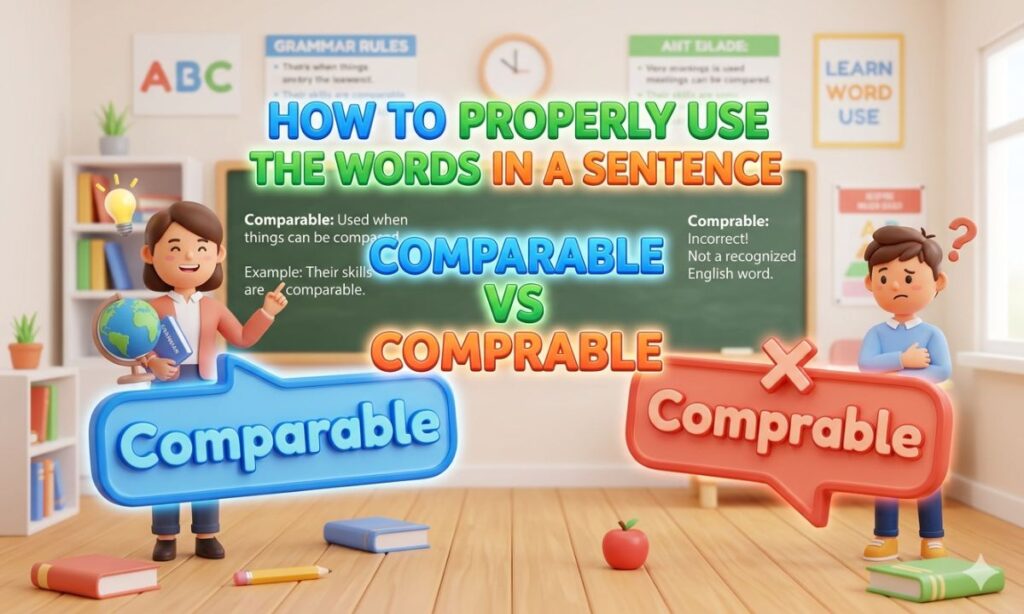
Getting comfortable with comprable vs comparable in real sentences makes the distinction stick. Because “comprable” is not a valid word, this section focuses on showing you which form belongs in a sentence and which one you must always remove.
How To Use “Comprable” In A Sentence
This is the critical part of understanding comprable vs comparable: you do NOT use “comprable” in a sentence. Any sentence that contains “comprable” contains a spelling error. Here are examples of incorrect usage so you can recognize and fix the mistake when it appears:
Incorrect examples (to avoid):
- The two laptops are comprable in terms of processing speed.
- She found a comprable apartment on the other side of the city.
- The research team used comprable data sets from three different studies.
In each of the sentences above, “comprable” should be replaced with “comparable.” There is no context, no regional dialect, and no style guide that permits “comprable” as acceptable writing.
How To Use “Comparable” In A Sentence
Now that you know which form to avoid in the comprable vs comparable pairing, here is how to use “comparable” correctly:
Correct examples:
- The two laptops are comparable in terms of processing speed.
- She found a comparable apartment on the other side of the city.
- The research team used comparable data sets from three different studies.
- His salary is comparable to what senior engineers earn in that industry.
- The two smartphone brands offer comparable camera quality at similar price points.
Notice that “comparable” often pairs naturally with “to” or “with.” Both prepositions work, though “comparable to” is slightly more common in everyday usage. When you feel unsure in the comprable vs comparable moment, just remember: only one version has that key letter “a” right after the letter “p.”
Comprable vs Comparable Pronunciation
One of the biggest reasons the comprable vs comparable mix-up keeps happening is pronunciation. People hear the word spoken at normal conversational speed, and they miss an entire syllable. Let us break this down properly.
Correct pronunciation of “comparable”:
The word has four syllables: COM-par-a-ble
- COM: stressed, rhymes with “mom”
- par: like the word “par” in golf
- a: a soft, unstressed vowel sound
- ble: like the ending in “able” or “table”
The third syllable, that soft “a,” is the one people drop in casual speech. When someone says “COM-pra-ble” at speed, it SOUNDS correct to the ear even though the letter “a” has disappeared. This is why so many people search for comprable vs comparable online: the misspelling feels right because of how the word sounds.
Key pronunciation tips:
- Slow down when you say the word and feel all four syllables
- Say it as “com-PAIR-a-ble” to emphasize the middle syllables
- Remember: if you wrote only three syllables, you likely wrote “comprable”
The pronunciation difference between “comparable” and “comprable” in speech is almost undetectable. The spelling difference, however, is very clear on paper. In the comprable vs comparable challenge, your ear might mislead you, but your dictionary never will.
Comprable vs Comparable Grammar
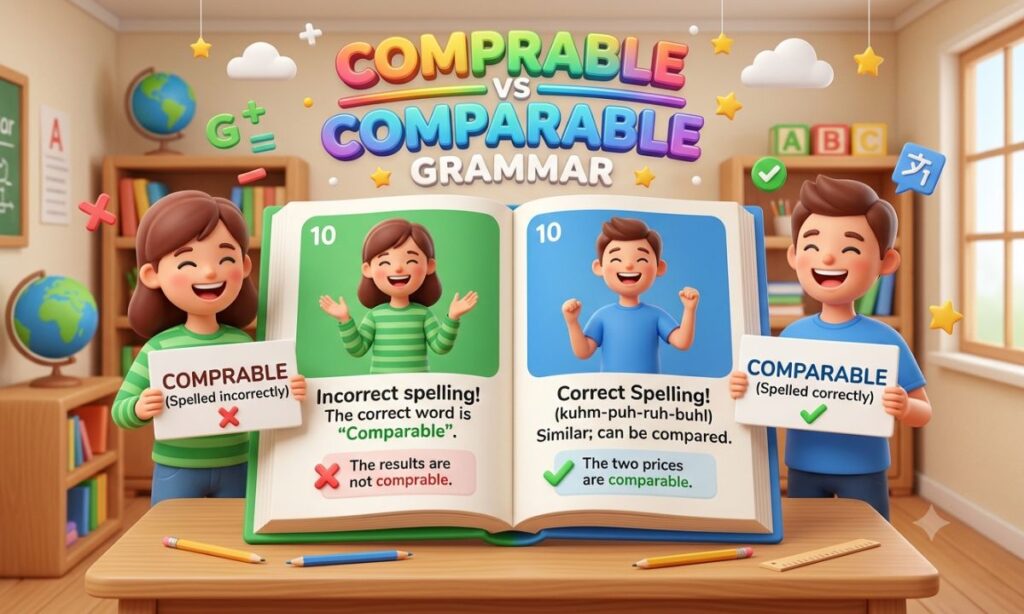
From a grammar standpoint, the comprable vs comparable question has a clean, simple answer. “Comparable” functions as an adjective in every sentence where it appears. “Comprable” has no grammatical function at all because it is not a recognized word.
Grammatical role of “comparable”:
“Comparable” describes or modifies nouns. It answers the question: “In what way are these things alike?”
| Grammatical Use | Example Sentence |
| Predicate adjective | The two offers are comparable in value. |
| Attributive adjective | They presented comparable evidence in court. |
| With preposition “to” | Her experience is comparable to his. |
| With preposition “with” | The results are comparable with earlier findings. |
Common grammatical mistakes related to comprable vs comparable:
- Using “more comparable” when “comparable” already implies a relative degree
- Writing “comparable than” instead of “comparable to” or “comparable with”
- Confusing “comparable” with “comparative,” which is a different word entirely
Correct grammar structures:
- “Comparable to” (most common)
- “Comparable with” (formal, especially in British English)
- “Not comparable” (to show lack of similarity)
Whenever the comprable vs comparable question comes up in a grammar check, remember that only “comparable” has a defined grammatical role. Treating “comprable” as a grammatical option simply does not work in standard English.
More Examples Of Comprable and Comparable Used In Sentences
Real-world examples are the fastest way to internalize correct usage. The more you see comprable vs comparable demonstrated in context, the quicker the correct form becomes automatic.
Examples Of Using “Comprable” In A Sentence
These examples show the INCORRECT form. They are included so you can spot and fix this error in your own writing:
- ❌ The athlete’s performance was comprable to a professional’s.
- ❌ We reviewed comprable models before making our final decision.
- ❌ The two cities offer comprable quality of life.
- ❌ Our company provides comprable services at a lower rate.
- ❌ The new medication showed comprable results in clinical trials.
In every single case above, “comprable” must be replaced with “comparable” to make the sentence grammatically correct and professionally acceptable.
Examples Of Using “Comparable” In A Sentence
These examples show the CORRECT form in a wide range of real-world situations:
Everyday use:
- The two neighborhoods offer comparable access to schools and parks.
- Her cooking is comparable to what you would find in a top restaurant.
Business and finance:
- The analyst found comparable sales data across three competing firms.
- Both job offers were comparable in terms of salary and growth potential.
Academic and scientific writing:
- The researchers selected comparable sample sizes for both groups.
- Laboratory conditions were kept comparable across all three experiments.
Legal contexts:
- The attorney referenced comparable cases from the previous decade.
- Damages were assessed based on comparable property values in the region.
Technology and product reviews:
- The budget laptop delivers comparable performance to mid-range models.
- Both phones offer comparable battery life despite the price difference.
Seeing “comparable” across these different contexts reinforces why it matters so much to get the comprable vs comparable distinction right. The word shows up in high-stakes environments where errors reduce credibility.
Common Mistakes To Avoid
Using “Comprable” Instead Of “Comparable”
This is the most fundamental error in the comprable vs comparable debate. Writers drop the letter “a” because they spell phonetically, type too fast, or simply never learned the correct form. Autocorrect sometimes catches it, but not always. The fix is simple: slow down, spell out all four syllables, and always verify with a spell checker before publishing.
Using “Comparable” When “Similar” Or “Related” Would Be More Appropriate
“Comparable” is a strong, specific word. It implies that a meaningful, measurable comparison can be made. Sometimes a simpler word fits better:
| Situation | Better Word Choice |
| General likeness | Similar |
| Loose connection | Related |
| Exact match | Identical or Equal |
| Measurable closeness | Comparable |
If you are describing two ideas that share a loose theme, “related” is more accurate. If you are describing something that is roughly the same in quantity or quality, “comparable” is the right pick. Misusing it dilutes its meaning.
Not Understanding The Difference Between “Comparable” And “Complementary”
“Comparable” and “complementary” are entirely different in meaning, yet writers sometimes confuse them.
- Comparable = similar in quality, quantity, or nature
- Complementary = things that complete or enhance each other
Example of confusion:
- ❌ The two flavors are comparable and make a great pairing.
- ✅ The two flavors are complementary and make a great pairing.
If two things work TOGETHER to form a whole, use “complementary.” If two things can be MEASURED SIDE BY SIDE, use “comparable.”
Using “Comparable” Too Frequently
Even the correct word becomes a problem when overused. Repeating “comparable” in every sentence makes writing sound repetitive and rigid. Consider these alternatives when appropriate:
- Similar
- Analogous
- Equivalent
- Proportionate
- On par with
- Matching
- Parallel
Rotating vocabulary keeps your writing fresh while preserving the meaning you intend. The comprable vs comparable issue is about correct spelling, but good writing goes beyond just avoiding the wrong form.
Tips To Avoid These Mistakes
- Proofread every piece of writing before sending or publishing
- Run a spell check, but do not rely on it alone
- Say the word out loud slowly: COM-par-a-ble has four syllables
- Search your document for “comprable” and replace it every time you find it
- Keep a personal cheat sheet of words you frequently misspell
- Read widely to internalize correct spelling patterns naturally
Context Matters
The comprable vs comparable situation teaches us something broader about language: context shapes word choice. Knowing that “comparable” is correct is just the beginning. Understanding WHEN and WHERE to use it makes your writing truly sharp.
Comparing Products Or Services
In product reviews, marketing copy, and consumer guides, “comparable” helps readers make informed decisions. When a reviewer says a budget product offers comparable quality to a premium brand, that single word does a lot of work. It tells the reader that a meaningful, trustworthy comparison has been made.
Example: “The store-brand headphones offer comparable sound quality to well-known premium models at half the price.”
Legal Or Financial Contexts
In legal and financial writing, word precision is essential. “Comparable” carries specific weight in areas like property valuation, contract law, and investment analysis. Legal professionals use “comparable sales” or “comparable transactions” to establish fair market value. Financial analysts rely on “comparable companies” as a benchmark method in business valuation.
In these settings, any spelling error, including the comprable vs comparable mix-up, can undermine the perceived credibility of an entire document.
Scientific Comparisons
Research papers and scientific reports depend on “comparable” to signal methodological integrity. When scientists state that two groups had comparable baseline characteristics, they are telling readers the experiment was designed fairly. Accuracy in this language is not just stylistic; it is part of how scientific trust is built.
Example: “The two patient groups showed comparable age distribution and health histories at the start of the trial.”
Exceptions To The Rules
Even clear-cut grammar topics have nuances. The comprable vs comparable distinction is mostly black and white, but a few edge cases are worth knowing.
1. Adjective-Noun Combinations
In some technical fields, “comparable” gets combined with nouns in set phrases. For example, “comparable worth” is a recognized term in labor law referring to the principle of equal pay for work of equal value. In these compound terms, the word remains spelled correctly as “comparable.” No exception exists for “comprable” in any specialized vocabulary.
2. Regional Differences
Some learners wonder if “comprable” is a British English spelling or an American English variant. The answer is no. Unlike words such as “colour” and “color,” or “organise” and “organize,” the word “comparable” does not have regional spelling variants. It is spelled the same in every country where English is spoken. The comprable vs comparable debate is not a regional one; it is purely about correct versus incorrect spelling.
3. Typos And Misspellings
In informal digital communication, typos pass more easily. But even in a text message or social media caption, “comprable” is still a spelling error, not an accepted shorthand. Some misspellings gain traction over time and eventually make it into dictionaries as informal variants. That has not happened with “comprable,” and grammar authorities show no indication that it will.
Practice Exercises
Now that you have a thorough understanding of comprable vs comparable, it is time to test yourself. These exercises reinforce correct usage and help you internalize the spelling pattern.
Exercise 1: Fill In The Blank
Fill each blank with the correct word. All answers will be “comparable” because “comprable” is never correct.
- The two universities offer ____________ academic programs and financial aid packages.
- Her level of dedication is ____________ to that of an Olympic athlete in training.
- The real estate agent showed us three ____________ properties before we made an offer.
- Both marketing campaigns generated ____________ levels of customer engagement.
- The new drug produced results ____________ to the existing standard treatment.
- Researchers noted that the two ecosystems were ____________ in biodiversity.
- The salaries offered by both companies were ____________ when benefits were included.
- A ____________ analysis of competing products helped the team finalize the design.
Answer key: All eight blanks should be filled with “comparable.”
Exercise 2: Multiple Choice
Choose the correct sentence in each pair:
Question 1:
- A) The two apartments are comprable in rent and amenities.
- B) The two apartments are comparable in rent and amenities.
Answer: B
Question 2:
- A) Scientists reviewed comparable data from five separate studies.
- B) Scientists reviewed comprable data from five separate studies.
Answer: A
Question 3:
- A) The athlete’s recovery time was comprable to the team average.
- B) The athlete’s recovery time was comparable to the team average.
Answer: B
Question 4:
- A) These two business models are comprable in their approach to revenue.
- B) These two business models are comparable in their approach to revenue.
Answer: B
Question 5:
- A) The job offer included a salary comparable with industry standards.
- B) The job offer included a salary comprable with industry standards.
Answer: A
Read This: Well Deserved or Well-Deserved? Which is Correct?
Conclusion
The comprable vs comparable question is one of those small but meaningful details that separates polished writing from careless writing. The conclusion is simple: “comparable” is the only correct form. “Comprable” is a spelling error caused by fast speech, fast typing, or an honest misunderstanding of how the word is constructed.
Throughout this article, you learned that “comprable” has no dictionary entry, no grammatical function, and no accepted use in any variety of English. You also learned that “comparable” is a powerful, precise adjective that belongs in your everyday writing vocabulary, whether you are comparing products, analyzing data, drafting legal documents, or publishing academic research.
The comprable vs comparable mix-up is easy to make, but it is just as easy to fix once you understand it. Say the word slowly (COM-par-a-ble), feel all four syllables, and you will always remember where that crucial letter “a” belongs. Practice the exercises, use the tips provided, and make “comparable” a word you use with complete confidence.
Good writing starts with correct spelling. And now, the comprable vs comparable question has one final, definitive answer for you: it is always, without exception, “comparable.”
Frequently Asked Questions
Is “comprable” a real word?
No. “Comprable” is a misspelling of “comparable” and does not appear in any recognized English dictionary.
What does “comparable” mean?
“Comparable” means similar in quality, quantity, or nature, used when two things can be meaningfully placed side by side.
Is “comprable” used in British English?
No. “Comparable” is spelled the same in British English, American English, and all other global varieties.
What is the correct pronunciation of “comparable”?
It is pronounced COM-par-a-ble, with four syllables. The third syllable “a” is often dropped in fast speech, which leads to the misspelling.
When should I use “comparable” vs “similar”?
Use “comparable” when a measurable or meaningful comparison is being made. Use “similar” for general likeness.
Can “comparable” be used with both “to” and “with”?
Yes. “Comparable to” and “comparable with” are both grammatically correct, though “comparable to” is more commonly used in everyday writing.
Does “comparable” have a synonym?
Yes. Synonyms include “equivalent,” “analogous,” “parallel,” “proportionate,” and “on par with.”
Why do so many people search for comprable vs comparable?
Because the word sounds like “comprable” when spoken quickly, many people assume both spellings exist. The search volume reflects widespread but honest confusion about this single missing letter.