
You are drafting an important email to your manager requesting time off. You type the phrase and then pause. Should it be “half day” or “half-day”? That tiny hyphen suddenly feels enormous. You stare at the screen, second-guessing yourself, wondering if one option makes you look unprofessional. You are absolutely not alone in this moment.
This guide answers the question of half day or half-day once and for all. Mastering half day or half-day is simpler than you think. By the end of this article, you will know exactly which form to use, when to use it, and why the rule is actually simple once you see it explained clearly. Whether you are writing a work email, a school notice, a blog post, or a formal business document, this complete guide has you covered.
Half Day or Half-Day? Which is Correct?
Both half day or half-day are grammatically correct in English. Neither version is wrong. However, they are not interchangeable. The form you choose depends entirely on how the phrase is functioning inside your sentence.
Here is the short answer you can save right now:
| Form | Grammar Role | Example |
| half day | Noun | I am taking a half day off work. |
| half-day | Adjective (compound modifier) | We attended a half-day seminar. |
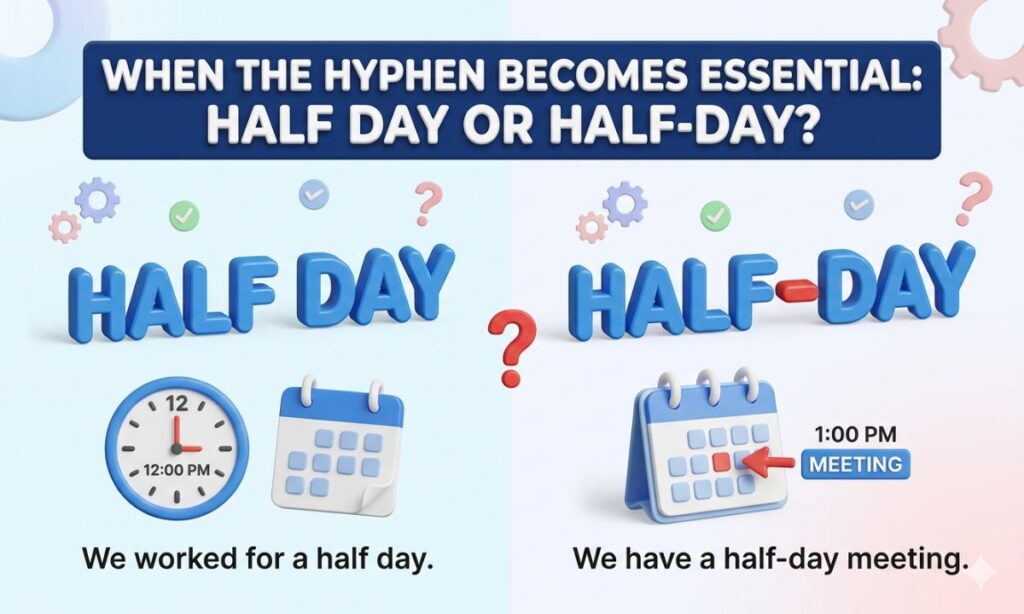
The confusion around half day or half-day comes from the hyphen. English uses hyphens in compound modifiers, which are two or more words that team up to describe a noun. When “half” and “day” combine to describe another noun, they need a hyphen. When they stand alone as the subject or object of a sentence, they do not need one.
This is the complete rule. Everything else in this guide builds on it and gives you the context, examples, and memory tricks to make it automatic.
Understanding the Key Difference
The difference between half day or half-day is a matter of grammatical function, not meaning. Both phrases refer to the same concept: a period of time roughly equal to half of a standard working or school day, usually around four hours. The concept stays the same. Only the role in the sentence changes.
Think of it this way. Words in English can wear different hats depending on where they sit in a sentence. The word “run” can be a verb (“I run every morning”) or a noun (“I went for a run”). The same logic applies to half day or half-day.
When “half day” wears the noun hat
When the phrase acts as a noun, it is the thing being discussed. It is the direct object of a verb, the subject of the sentence, or the object of a preposition. In these cases, no hyphen is needed.
When “half-day” wears the adjective hat
When the phrase acts as a describing word and sits directly before another noun, it becomes a compound adjective. The hyphen is the signal that tells the reader these two words are working together as a single unit of description.
Understanding this distinction is what makes the half day or half-day question permanently easy to answer.
Read This: 10 Better Ways To Say “Glad To Hear That”
Half Day or Half Day Meaning
Before going deeper into grammar, it helps to understand what the phrase means in practical terms.
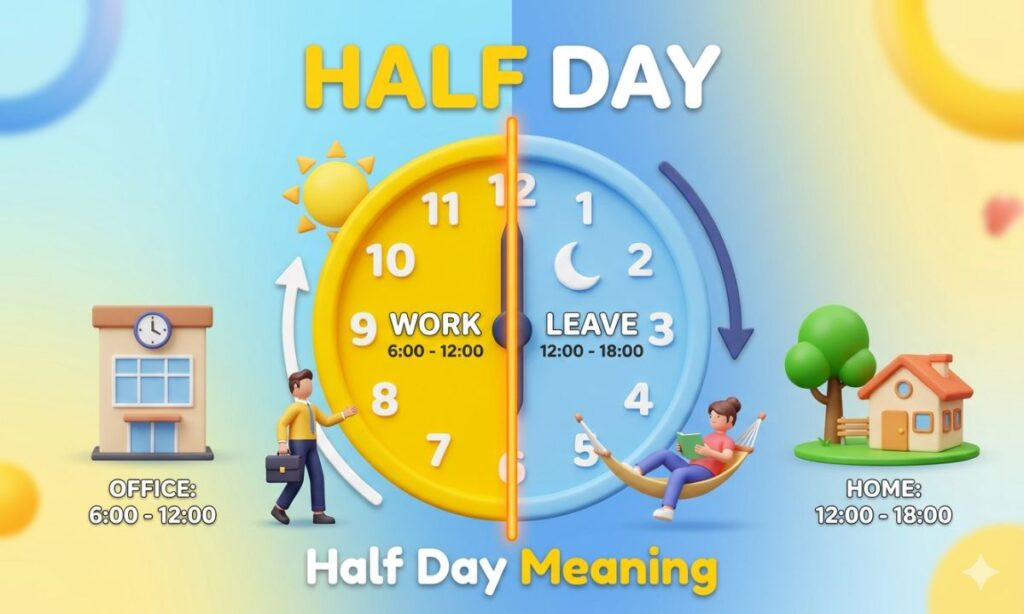
A half day refers to a period that covers roughly half of a full standard day. In most workplace contexts, a full working day is eight hours. A half day therefore covers approximately four hours, either in the morning or the afternoon. In school settings, a half day typically means students attend for only part of the usual schedule, often leaving at noon.
The phrase is widely used in these contexts:
- Workplace scheduling: Employees request a half day for doctor appointments, personal errands, or family events.
- School calendars: Schools announce a half day before holidays or for teacher development days.
- Business events: Companies organize half-day workshops, training sessions, or conferences.
- Retail and service industries: Businesses operate on a half-day schedule during public holidays.
- Event planning: Organizers book venues for a half-day event or a half-day retreat.
The Oxford Dictionary and the Cambridge Dictionary both recognize the phrase as a noun. Both dictionaries also acknowledge the hyphenated compound adjective form. This dual recognition confirms that half day or half-day is a legitimate grammatical question with two valid answers depending on context.
Half Day: Meaning and Usage as a Noun
When “half day” functions as a noun, it stands on its own as a thing. It is not describing anything else in the sentence. It is the period of time itself that you are talking about.
As a noun, “half day” refers to a block of time that equals half of a regular working or school day. You use it when you talk about taking time off, planning schedules, or describing how long something lasts without attaching it directly to another noun.
Key characteristics of the noun form
- No hyphen is used
- The phrase can stand alone after verbs like “take,” “work,” or “have”
- It can be pluralized: “half days”
- It can follow prepositions like “for,” “on,” or “during”
- It functions as the direct object or subject of a sentence
Plural form
The plural of the noun form is “half days.” You would write: “She has been working half days since her surgery.” The plural form follows standard English rules and does not require a hyphen.
Noun form in professional contexts
In workplace communication, the noun form appears constantly. An employee sends a leave request and writes, “I would like to request a half day on Friday.” A manager sends a team update and writes, “The office will close at noon, so everyone gets a half day today.” In both cases, “half day” is the thing being talked about, not a word describing something else.
Half-Day: Meaning and Usage as an Adjective
When “half-day” functions as an adjective, it describes a noun that comes directly after it. The hyphen is essential in this role. It signals to the reader that both words are working as a single descriptive unit.
The hyphenated form “half-day” is what grammarians call a compound modifier or compound adjective. This is a standard feature of English grammar. Other common examples include “well-known author,” “full-time employee,” and “high-quality product.” In each case, two words join forces to describe a single noun.
Key characteristics of the adjective form
- A hyphen connects the two words
- The phrase appears directly before a noun it is describing
- It answers the question “what kind of?” before the noun
- It cannot stand alone as the only content of a sentence
- It tells you the duration or nature of the noun following it
When the adjective form is used after a verb
There is an important nuance here. When “half-day” appears after a linking verb like “is” or “was,” the hyphen sometimes becomes optional in informal writing. For example, “The meeting was half day” can work in casual contexts. However, most professional style guides recommend keeping the hyphen for consistency and clarity, even in this position.
The adjective form in formal writing
AP Style and the Chicago Manual of Style both support hyphenating compound adjectives when they appear before nouns. Following these guidelines ensures your writing meets professional and academic standards.
When the Hyphen Becomes Essential
There are specific situations where skipping the hyphen in half day or half-day creates genuine confusion. Understanding these cases helps you see why the rule exists in the first place.
Preventing misreading
Consider the phrase “half day workshop.” Without a hyphen, a reader might briefly parse this as “half” followed by “day workshop,” as if “day workshop” were a type of workshop, and “half” is modifying it. The hyphenated form “half-day workshop” eliminates this pause instantly. The reader knows immediately that the workshop is described by “half-day” as a single unit.
Maintaining professional credibility
In formal communication, small grammar details send signals about your attention to quality. Using the correct form of half day or half-day shows that you understand compound modifier rules, which reflects well on your professional communication skills.
Consistency across a document
If you use “half-day training” in one paragraph and “half day training” in the next, readers may wonder if you intended two different things. Consistent correct usage of half day or half-day throughout a document maintains clarity and professionalism.
Examples of Using “Half Day” in A Sentence
These examples demonstrate the correct use of “half day” as a noun. Notice that in each sentence, the phrase stands alone without directly modifying another noun.
- I am planning to take a half day tomorrow for a dental appointment.
- The company gave everyone a half day to celebrate the product launch.
- She worked a half day on Christmas Eve before leaving to visit family.
- Can I have a half day on Friday to attend my child’s school play?
- He clocked out early after working only a half day.
- The team finished early, so the manager called it a half day.
- Students will have a half day on the last Friday before summer break.
- We managed to finish the project by working a half day on Saturday.
- The receptionist asked if I wanted to schedule a morning half day or an afternoon one.
- After working three back-to-back weekends, they rewarded staff with a half day.
- She had not taken a half day in over six months.
- The school district announced two half days in the upcoming academic calendar.
- Taking a half day occasionally helps prevent employee burnout.
- The office policy allows up to four half days per quarter.
- He used a half day of annual leave to handle a personal matter.
Examples of Using “Half-Day” in A Sentence
These examples demonstrate the correct use of “half-day” as a compound adjective. In each sentence, “half-day” directly modifies a noun that follows it.
- We attended a half-day workshop on digital marketing strategies.
- The company organized a half-day training session for new hires.
- She submitted a half-day leave request for the following Tuesday.
- The school announced a half-day schedule for parent-teacher conference week.
- We booked a half-day boat tour along the coastline.
- The HR department set up a half-day orientation program.
- He signed up for a half-day coding boot camp offered by the tech firm.
- The team organized a half-day offsite retreat to brainstorm for the new quarter.
- She enjoyed a relaxing half-day spa package at the resort.
- The clinic operates on a half-day schedule every Wednesday.
- They planned a half-day seminar on workplace mental health.
- The local museum offers a guided half-day tour of all its galleries.
- The contract specifies a half-day event with setup and breakdown time included.
- Managers attended a half-day leadership development program.
- A half-day excursion into the mountains is included in the vacation package.
Grammar Rules Behind the Hyphen
Understanding the grammar behind half day or half-day helps you apply the rule confidently across many similar situations in English.
The compound modifier rule
In English grammar, when two or more words join together to modify a noun, they typically need a hyphen when placed before that noun. This rule applies to countless phrases beyond half day or half-day.
| Compound Adjective | Example Sentence |
| full-time | She is a full-time employee. |
| part-time | He has a part-time schedule. |
| long-term | This is a long-term strategy. |
| well-known | She is a well-known author. |
| high-quality | They offer high-quality service. |
| half-day | We attended a half-day session. |
Why adverbs ending in “ly” are different
One important exception to the compound modifier rule involves adverbs that end in “ly.” These do not take a hyphen even when they appear before a noun alongside another word. For example, “highly skilled worker” does not need a hyphen because “highly” is an adverb, and readers instantly recognize it as modifying “skilled” rather than “worker.” The “ly” suffix serves the same clarifying function that the hyphen provides in other compound modifiers.
The post-noun position
When a compound modifier appears after the noun it describes rather than before it, the hyphen is often dropped. This is because the structure of the sentence already makes the relationship clear. Compare these two sentences:
- “It was a half-day event.” (before the noun: hyphen needed)
- “The event was half day.” (after the noun: hyphen optional in informal writing)
Most professional style guides still recommend keeping the hyphen for consistency, but you will encounter both versions in post-noun positions.
Style guide guidance
Both AP Style and the Chicago Manual of Style support hyphenating compound adjectives before nouns. These are the two most widely followed style guides in professional English writing. Following their guidance on half day or half-day ensures your writing meets accepted editorial standards.
Common Mistakes to Avoid
Even native English speakers make errors with half day or half-day. Here are the most frequent mistakes and how to correct them.
Mistake 1: Writing “halfday” as one word
“Halfday” as a single word without a hyphen is not recognized as correct by any major dictionary or style guide. Avoid this form entirely in professional and formal writing.
Wrong: I am requesting a halfday leave. Right: I am requesting a half-day leave.
Mistake 2: Using a hyphen when the noun form is needed
Adding a hyphen when the phrase is functioning as a noun is one of the most common errors related to half day or half-day.
Wrong: I will take a half-day tomorrow. Right: I will take a half day tomorrow.
Mistake 3: Missing the hyphen before a noun
Leaving out the hyphen when “half-day” is modifying a noun is equally common and equally incorrect.
Wrong: We attended a half day training session. Right: We attended a half-day training session.
Mistake 4: Inconsistent usage in the same document
Mixing both forms randomly throughout a document without following the noun or adjective rule creates confusion and looks unprofessional. Always check whether the phrase is functioning as a noun or as a modifier.
Mistake 5: Capitalizing incorrectly
“Half day” and “half-day” are not proper nouns and should not be capitalized unless they appear at the start of a sentence or in a title. In titles, capitalize both words: “Half-Day Workshop.”
Quick Reference Guide and Memory Tricks
Here is your fast reference for half day or half-day in any situation, plus simple tricks to get it right every time without hesitation.
Quick Reference Table
| Situation | Which Form | Example |
| Talking about time off | half day (noun) | “I’m taking a half day.” |
| Describing a meeting | half-day (adjective) | “A half-day meeting.” |
| Referring to a workshop | half-day (adjective) | “A half-day workshop.” |
| Saying you worked less | half day (noun) | “I worked a half day.” |
| Modifying a schedule | half-day (adjective) | “A half-day schedule.” |
| Plural form | half days (noun) | “Working half days now.” |
| Leave application | half-day (adjective) | “Half-day leave request.” |
Memory Trick 1: The “What Kind Of?” Test
Ask yourself “what kind of ____?” before the word that follows. If “half-day” answers that question, you need the hyphen.
What kind of training? A half-day training. (hyphen needed) What kind of leave? A half-day leave. (hyphen needed)
If there is no noun following the phrase, skip the hyphen.
Memory Trick 2: The Substitution Test
Try substituting “four-hour” in place of “half-day” or “half day.” If it works as an adjective (“four-hour training”), use the hyphenated form. If it works as a noun (“I worked four hours”), use the unhyphenated form.
Memory Trick 3: The “Can It Stand Alone?” Check
Ask whether the phrase can stand on its own as the main point of a short sentence. “I took a half day” works perfectly on its own. “I took a half-day” sounds incomplete because it is waiting for a noun. If it feels incomplete, add the noun and use the hyphen.
Memory Trick 4: Think of Similar Phrases
Recall other hyphenated compound adjectives you already know: “full-time job,” “long-term goal,” “part-time worker.” Notice how the hyphen always appears when two words describe a noun before them. Apply the same logic to half day or half-day.
Read This: Inhouse or In-House or In House? Which is Correct?
Frequently Asked Questions
Is “half-day leave” or “half day leave” correct?
“Half-day leave” is correct because “half-day” is acting as an adjective that describes the type of leave.
Can I use “half day” and “half-day” in the same sentence?
Yes. “I took a half day to attend a half-day training” is grammatically correct because the first is a noun and the second is an adjective.
What is the plural of “half day”?
The plural is “half days” without a hyphen when used as a noun.
Is “halfday” one word correct?
No. “Halfday” as a single word is not accepted in standard English writing or recognized by major dictionaries.
Does the rule change between American and British English?
No. The noun and adjective rules for half day or half-day apply the same way in both American and British English.
Which is more common, “half day” or “half-day”?
According to Google Ngram Viewer data, “half-day” is slightly more common overall because it appears frequently as a compound adjective in professional and academic writing.
Do I capitalize “Half-Day” in a title?
Yes. In titles where each major word is capitalized, you would write “Half-Day Workshop” or “Half-Day Training Program.”
What does AP Style say about half-day?
AP Style supports hyphenating compound adjectives before nouns, which means “half-day” is the correct form when it precedes a noun.
Is “half-day” used differently in education vs. business?
The same grammar rule applies in both contexts. Schools use “half day” as a noun (“We have a half day today”) and “half-day” as an adjective (“half-day schedule”).
Can “half-day” appear after the noun it describes?
In that position, the hyphen becomes optional in informal writing, but keeping it is recommended in professional documents for consistency.
Conclusion
The question of half day or half-day is one of those grammar puzzles that seems complicated at first but becomes completely clear once you understand the rule. Both forms are correct. The choice simply depends on whether the phrase is acting as a noun or as a compound adjective.
Use half day without a hyphen when you are talking about the time period itself. Use half-day with a hyphen when the phrase is sitting directly before another noun and describing it.
Apply the “what kind of?” test whenever you are unsure. If the phrase answers that question before a noun, the hyphen belongs there. If the phrase stands alone as the thing you are discussing, leave the hyphen out.
Now that you understand the complete picture of half day or half-day, you can write with total confidence in every professional email, leave request, school notice, business report, or blog post. That small hyphen no longer needs to slow you down. You know exactly when it belongs and when it does not, and that knowledge makes your writing sharper, clearer, and more credible every single time.
Bonus: Half Day or Half-Day? in Different Writing Contexts
One thing that trips people up is that half day or half-day behaves slightly differently depending on the writing environment. Here is a breakdown of how the rule applies across the most common types of writing.
In Email Communication
Email is probably where most people encounter the half day or half-day question most often. The stakes feel high because a professional email reflects directly on you. Here, the noun vs. adjective rule applies just as it does anywhere else.
When you are writing to request time off, you will almost always use the noun form: “I would like to request a half day on Thursday.” When you are describing the type of event or meeting in the email body, you will use the adjective form: “Please join us for a half-day planning session next Monday.”
In Leave Application Forms
Leave applications and HR documents commonly feature both forms. An employee might write “half-day leave request” in the subject line (adjective form, describing the type of request) and then write “I am requesting a half day” in the body (noun form, referring to the time off itself). Both uses in that single document are correct.
In Academic and Formal Writing
Academic writing tends to be strict about compound modifier rules. Professors, editors, and academic publications consistently expect the hyphenated form when the phrase precedes a noun. When writing a research paper, proposal, or thesis that mentions scheduling, always use “half-day” before any noun. The question of half day or half-day in academic contexts almost always resolves in favor of the hyphenated form when a noun follows.
In Blog and Online Content Writing
Online writing sometimes follows more relaxed rules, particularly in conversational blog posts. However, even in digital content, using the correct form of half day or half-day demonstrates professionalism and care. SEO-focused content especially benefits from consistent, correct usage because it signals quality to both readers and search engines.
In Titles and Headings
When writing titles, the capitalization changes but the hyphen rule stays the same. A workshop title would be written as “Half-Day Leadership Workshop” because “Half-Day” is still modifying “Workshop.” A heading about taking time off might read “How to Request a Half Day” because the noun form is being used.
Understanding the distinction of half day or half-day across these different contexts means you are equipped to write correctly no matter what format or platform you are working in.