
If you have ever paused mid-sentence and wondered whether to say is there any or are there any, you are not alone. This is one of the most common grammar questions among English learners and even native speakers. The confusion is understandable because both phrases look almost identical, yet they follow very different grammar rules.
Knowing the difference between is there any vs are there any can transform the way you write and speak English. It makes your sentences cleaner, your communication sharper, and your writing more professional. Whether you are composing an email, writing an essay, or having a casual conversation, getting this right matters.
In this updated 2026 guide, you will find clear explanations, real-world examples, comparison tables, and simple rules that make choosing between is there any vs are there any effortless. By the end, you will never second-guess yourself again.
“Is There Any” vs “Are There Any”: Differences and Usage
The core difference between is there any vs are there any comes down to one fundamental grammar concept: the type of noun you are talking about.
Is there any is used when the noun is singular or uncountable. Are there any is used when the noun is plural and countable. This is the golden rule, and everything else flows from it.
Here is a quick overview table to help you see the difference at a glance:
| Phrase | Noun Type | Example |
| Is there any | Uncountable noun | Is there any water left? |
| Is there any | Singular countable noun | Is there any chance of rain? |
| Are there any | Plural countable noun | Are there any seats available? |
The verb “is” is the singular form of “to be,” while “are” is the plural form. Because uncountable nouns are always treated as singular in English grammar, they pair with “is.” Plural nouns, naturally, pair with “are.” Understanding this connection is the foundation for using is there any vs are there any correctly every single time.
Is There Any vs Are There Any Grammar
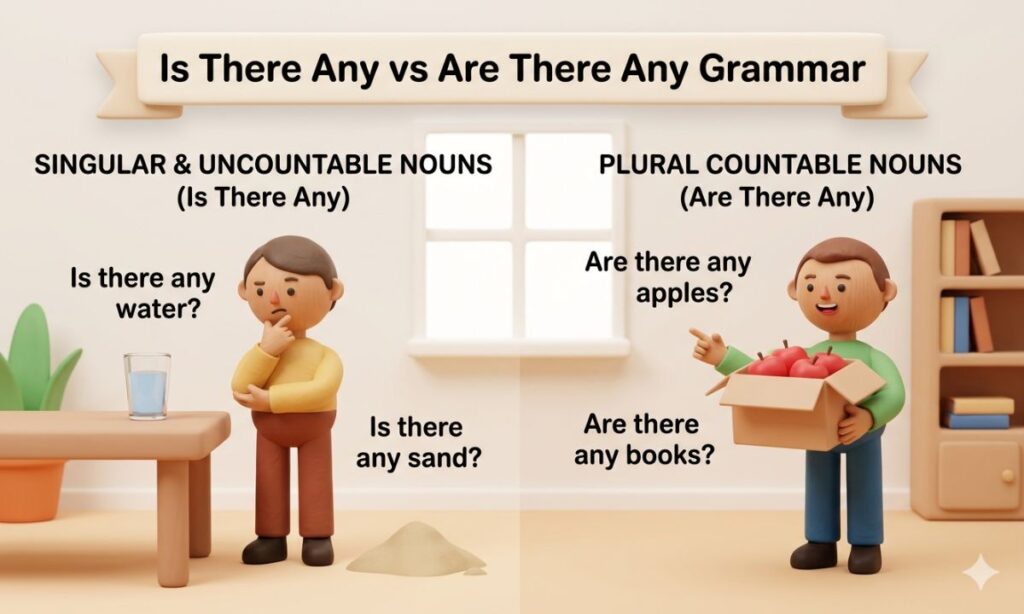
Grammar is the backbone of both these phrases. The structure “there is” and “there are” follows English subject-verb agreement rules, and when you convert these into question form, the same rules apply.
In a statement:
- There is some milk in the fridge. (singular / uncountable)
- There are some apples on the table. (plural)
When you form a question using “any”:
- Is there any milk in the fridge?
- Are there any apples on the table?
The word “any” in both cases signals that you are asking about an unspecified or unknown quantity. It does not change which verb form you use. The noun still decides everything. So when you think about is there any vs are there any, always look at your noun first.
Is There Any: Explained
“Is there any” is a question structure you use when you want to find out whether something exists or is available, and that something is either an uncountable noun or a singular noun. The phrase is made up of three parts: the verb “is,” the placeholder word “there,” and the determiner “any.”
You use this construction to ask about things that cannot be easily divided into individual countable units, or about single items when you want to know if at least one exists.
Usage with Uncountable Nouns
Uncountable nouns are things that cannot be counted with standard numbers. You cannot say “one water, two waters” or “one advice, two advices.” These nouns exist as a mass or a substance. Because they are always treated as singular in English, the verb “is” is the correct choice.
Common uncountable nouns include: water, milk, rice, sugar, air, bread, butter, information, advice, furniture, money, traffic, knowledge, music, and happiness.
When you combine “is there any” with these nouns, you are asking whether any amount of that thing is present. The question does not specify how much. It simply asks about existence.
Examples with uncountable nouns:
- Is there any water in the bottle?
- Is there any milk left in the fridge?
- Is there any sugar in the pantry?
- Is there any information available about the flight?
- Is there any traffic on the highway today?
- Is there any bread in the kitchen?
In every case, the noun cannot be counted individually, so “is there any” is the grammatically correct choice when comparing is there any vs are there any.
Singular Form
You can also use “is there any” with singular countable nouns in certain contexts, particularly when you are asking about the general existence of something rather than a specific number of items. In these cases, the noun represents one item or one instance.
Examples with singular countable nouns:
- Is there any chance we can reschedule?
- Is there any reason to worry?
- Is there any doubt about the results?
- Is there any problem with the plan?
In these sentences, the noun “chance,” “reason,” “doubt,” and “problem” are each used in their singular form. The question is asking whether even one instance of that thing exists. This is a perfectly natural and grammatically sound use of “is there any.”
Is There Any vs Are There Any Examples
Seeing both phrases side by side in examples is the fastest way to internalize the rule. Here is a comparison table with real-life sentences:
| Is There Any (correct) | Are There Any (correct) |
| Is there any juice in the carton? | Are there any juice boxes in the fridge? |
| Is there any homework tonight? | Are there any assignments due this week? |
| Is there any hope for a solution? | Are there any solutions we have not tried? |
| Is there any food left? | Are there any sandwiches left? |
| Is there any noise coming from upstairs? | Are there any loud guests at the party? |
| Is there any coffee in the pot? | Are there any coffee cups on the shelf? |
Notice how the left column always involves a substance, a mass, or an idea treated as a single whole. The right column always involves things you can count individually. This pattern is the key to mastering is there any vs are there any.
Are There Any: Explained
“Are there any” is a question structure you use when you are asking about multiple items that can be counted individually. The verb “are” signals plurality. When you use this phrase, you are expecting a response that might involve numbers or at least the acknowledgment that more than one of something may exist.
To form a correct question using “are there any,” follow these four steps:
- Start with “are” — the plural form of the verb “to be.”
- Add “there” — to introduce the existence of something in a particular place or situation.
- Follow with “any” — to express that you are asking about an unspecified quantity.
- End with a plural noun — such as books, chairs, students, or emails.
Plural countable nouns are things that exist as individual separate units. Examples include: apples, chairs, books, emails, students, tickets, cars, questions, movies, and problems.
Examples with plural countable nouns:
- Are there any tickets available for tonight’s show?
- Are there any students who need extra help?
- Are there any cars in the parking lot?
- Are there any emails from the manager?
- Are there any questions before we begin?
- Are there any books on that subject in the library?
- Are there any issues we need to address?
- Are there any seats left in the front row?
Each of these uses “are there any” correctly because the noun following it is a countable plural noun. When it comes to is there any vs are there any, these examples show that the plural form is always the right pick for countable, individually existing items.
“Is There Any” vs “Is There A”
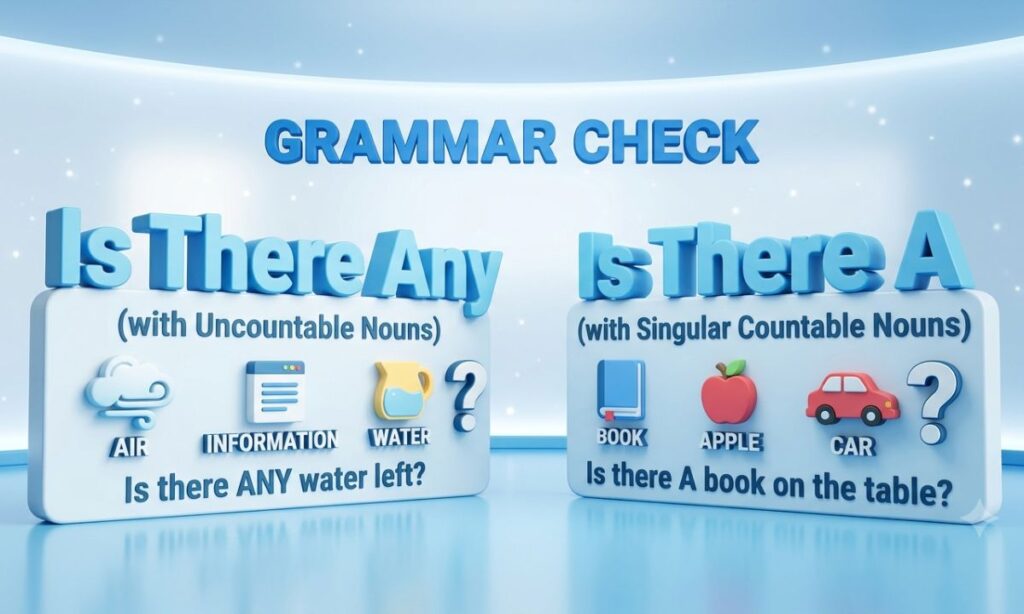
Many people confuse not only is there any vs are there any but also mix up “is there any” with “is there a.” These two phrases are related but serve different purposes.
“Is there a” is used with a singular countable noun when you are asking about one specific item. The article “a” means “one.” You are asking whether a single item exists.
“Is there any” is used with uncountable nouns to ask about an unspecified amount of something. There is no article “a” because uncountable nouns do not take “a/an.”
Here is a comparison table that makes this crystal clear:
| Phrase | Used With | Example | Meaning |
| Is there a | Singular countable noun | Is there a doctor available? | Asking about one doctor |
| Is there any | Uncountable noun | Is there any medicine left? | Asking about some amount |
| Is there a | Singular countable noun | Is there a pen I can borrow? | Asking about one pen |
| Is there any | Uncountable noun | Is there any ink in this pen? | Asking about the substance |
More comparison examples:
- Is there a bakery near here? (one specific bakery)
- Is there any bread at the bakery? (some amount of bread)
- Is there a taxi outside? (one specific taxi)
- Is there any traffic on the road? (traffic as a mass)
- Is there a solution to this problem? (one specific solution)
- Is there any hope left? (hope as an abstract uncountable idea)
The key takeaway: “is there a” asks about one countable item. “Is there any” asks about an uncountable amount or substance. When you master both distinctions, including is there any vs are there any, your English grammar becomes significantly more accurate.
Examples of Using ‘Is There Any’ in a Sentence
Now that you understand the rule, here are extensive real-world examples of is there any used correctly in sentences. These cover uncountable nouns, abstract concepts, and singular forms across a variety of everyday situations.
Food and Drink:
- Is there any orange juice in the refrigerator?
- Is there any sugar I can add to my coffee?
- Is there any butter left for the toast?
- Is there any rice in the bowl?
- Is there any soup simmering on the stove?
- Is there any salt in the kitchen cabinet?
Information and Communication:
- Is there any news about the missing flight?
- Is there any information available about the new policy?
- Is there any update from the research team?
- Is there any feedback on my report?
- Is there any evidence to support this theory?
Abstract and Emotional Concepts:
- Is there any hope that things will improve?
- Is there any doubt in your mind about this decision?
- Is there any chance we can fix this before the deadline?
- Is there any reason to believe the project will fail?
- Is there any truth in what she said?
- Is there any love left between them?
Practical Everyday Use:
- Is there any traffic on the main road right now?
- Is there any fuel in the car?
- Is there any room for negotiation?
- Is there any space in the overhead compartment?
- Is there any money left in the account?
- Is there any electricity in this part of the building?
- Is there any work remaining for today?
Each of these sentences correctly uses “is there any” because the noun is either uncountable or singular. Notice how naturally these questions flow. That naturalness comes from applying the grammar rule correctly. The more you practice is there any vs are there any, the more instinctive the choice becomes.
Examples of Using ‘Are There Any’ in a Sentence
Here are comprehensive real-world examples of are there any used correctly. These sentences all involve plural countable nouns across a wide range of contexts.
Shopping and Daily Life:
- Are there any apples left in the fruit bowl?
- Are there any seats available on the next train?
- Are there any stores open near the hotel?
- Are there any discounts available for students?
- Are there any items on sale today?
- Are there any sizes left in this jacket?
Work and Office Settings:
- Are there any emails from the client this morning?
- Are there any meetings scheduled for this afternoon?
- Are there any tasks left on the to-do list?
- Are there any employees available to help with the move?
- Are there any reports due by the end of the week?
Travel and Events:
- Are there any flights to London tonight?
- Are there any tickets remaining for the concert?
- Are there any hotels near the beach?
- Are there any buses going downtown at this hour?
- Are there any museums open on Sundays in this city?
Education and Learning:
- Are there any students who have not submitted the assignment?
- Are there any questions before the exam begins?
- Are there any books on this topic in the library?
- Are there any classes available for beginners?
- Are there any scholarships I can apply for?
Health and Safety:
- Are there any doctors available at this clinic?
- Are there any side effects I should know about?
- Are there any hospitals nearby?
- Are there any medications that could cause allergic reactions?
Each of these correctly uses “are there any” because the noun is plural and countable. When you compare these with the “is there any” examples above, the pattern becomes unmistakable. This is the practical heart of understanding is there any vs are there any.
Quick Reference: Is There Any vs Are There Any
| Feature | Is There Any | Are There Any |
| Verb form | Singular (is) | Plural (are) |
| Used with | Uncountable nouns, singular nouns | Plural countable nouns |
| Examples of nouns | Water, milk, rice, hope, money | Books, chairs, tickets, emails |
| Asks about | An unspecified amount | Multiple individual items |
| Common mistake | Saying “is there any books” | Saying “are there any milk” |
Common Mistakes to Avoid
Understanding is there any vs are there any also means knowing what NOT to do. Here are the most frequent errors and their corrections:
Mistake 1: Is there any books in the library? Correct: Are there any books in the library? (books is plural and countable)
Mistake 2: Are there any water in the glass? Correct: Is there any water in the glass? (water is uncountable)
Mistake 3: Are there any milk left? Correct: Is there any milk left? (milk is uncountable)
Mistake 4: Is there any chairs in the room? Correct: Are there any chairs in the room? (chairs is plural and countable)
Mistake 5: Are there any traffic on this route? Correct: Is there any traffic on this route? (traffic is uncountable)
Tips to Remember the Rule
Remembering is there any vs are there any is easier with a few simple mental tricks:
- Ask yourself: can I count it? If you can say “one, two, three” before the noun (three books, five apples), use “are there any.” If you cannot attach a number to it (you cannot say “three milks”), use “is there any.”
- Check for a plural form. If the noun has a common plural form that changes the word (book becomes books, chair becomes chairs), it is countable. Use “are there any.”
- Think about the verb in the answer. If the answer uses “there is,” the question should use “is there any.” If the answer uses “there are,” the question should use “are there any.”
- Watch for these tricky uncountable nouns: advice, information, furniture, news, equipment, luggage, traffic, research, knowledge, and progress. These are always uncountable in English, even though they feel like they could be countable.
Frequently Asked Questions
Is “is there any questions” correct?
No. “Questions” is plural and countable, so the correct form is “are there any questions.”
Can “is there any” be used with countable nouns?
Yes, when the countable noun is in its singular form, such as “is there any chance” or “is there any problem.”
What is the difference between “is there any” and “are there any”?
“Is there any” is for uncountable or singular nouns; “are there any” is for plural countable nouns.
Is “are there any milk” correct?
No. Milk is uncountable, so “is there any milk” is the correct form.
Can I use “any” with both countable and uncountable nouns?
Yes. “Any” works with both, but the verb (is or are) changes depending on the noun type.
What does “is there any” mean?
It asks whether any amount or instance of something exists, usually about uncountable or singular items.
What does “are there any” mean?
It asks whether one or more instances of something exist, used with plural countable items.
Is “is there any updates” correct?
No. “Updates” is plural, so the correct form is “are there any updates.”
When should I use “is there a” instead of “is there any”?
Use “is there a” when asking about one specific countable item; use “is there any” when asking about an uncountable amount.
How do I know if a noun is uncountable?
If you cannot place a number directly before it (you would not say “three rices” or “two advices”), it is uncountable. Use “is there any” with these nouns.
Read This: Courtesy vs Curtesy: When to Opt for One Term Over Another
Conclusion
Mastering is there any vs are there any is not complicated once you understand the relationship between verbs and noun types. The rule is consistent and reliable: use “is there any” with uncountable nouns and singular forms, and use “are there any” with plural countable nouns.
The moment you train yourself to look at the noun first, the right choice becomes automatic. Ask whether the noun can be counted. If yes and it is in plural form, go with “are there any.” If no, or if it is singular, use “is there any.”
This single grammar distinction improves the clarity and professionalism of your English writing and speaking more than you might expect. Apply these rules in your daily communication, and you will notice the difference immediately. The examples in this guide give you a strong foundation to practice from.
Keep the comparison tables handy, revisit the common mistakes section whenever you are unsure, and use the quick tips to build a strong instinct for choosing between is there any vs are there any every time without hesitation.