
Have you ever typed the word “copy” and then paused, wondering whether the plural is copys or copies? You are not alone. This is one of those deceptively simple questions that trips up students, professionals, and even experienced writers every single day. Whether you are preparing a business report, writing an email, or working on an academic paper, using the wrong plural form can make your writing look careless and unprofessional.
The good news is that the answer is completely straightforward once you understand the grammar rule behind it. This guide will explain exactly why copys or copies is such a common point of confusion, which one is correct, how to use it in real sentences, and how to remember the rule forever. By the end of this article, you will never second-guess yourself on copys or copies again.
Why Copies is the Correct Spelling?
The correct answer in the copys or copies debate is always copies. There is no exception to this rule in standard English. The word “copys” does not exist in any recognized dictionary and is considered a spelling error in all formal and informal writing contexts.
But why is copies correct and not copys? The answer lies in one of the most consistent and reliable rules in English grammar: the pluralization rule for nouns ending in a consonant followed by the letter “y.”
Here is how the rule works:
When a noun ends in a consonant plus the letter “y,” you must drop the “y” and add “ies” to form the plural.
The word “copy” ends with the letter “p” followed by “y.” Since “p” is a consonant, the rule applies directly. You drop the “y” and add “ies,” which gives you copies.
This same rule applies to dozens of other common English words:
| Singular | Plural |
| baby | babies |
| city | cities |
| story | stories |
| country | countries |
| lady | ladies |
| party | parties |
| duty | duties |
| family | families |
| copy | copies |
Notice that every word in the list ends with a consonant before the letter “y,” and every plural form ends in “ies.” This pattern is extremely consistent, which is what makes the copys or copies rule so reliable once you learn it.
The only time you simply add “s” to a word ending in “y” is when the letter before the “y” is a vowel. For example:
- boy becomes boys
- key becomes keys
- day becomes days
- toy becomes toys
Since “copy” ends in “p” (a consonant) plus “y,” it follows the “ies” rule, and copies is always correct.
Read This: Half Day or Half-Day? The Complete Guide to Getting It Right Every Time
Copys or Copies Meaning
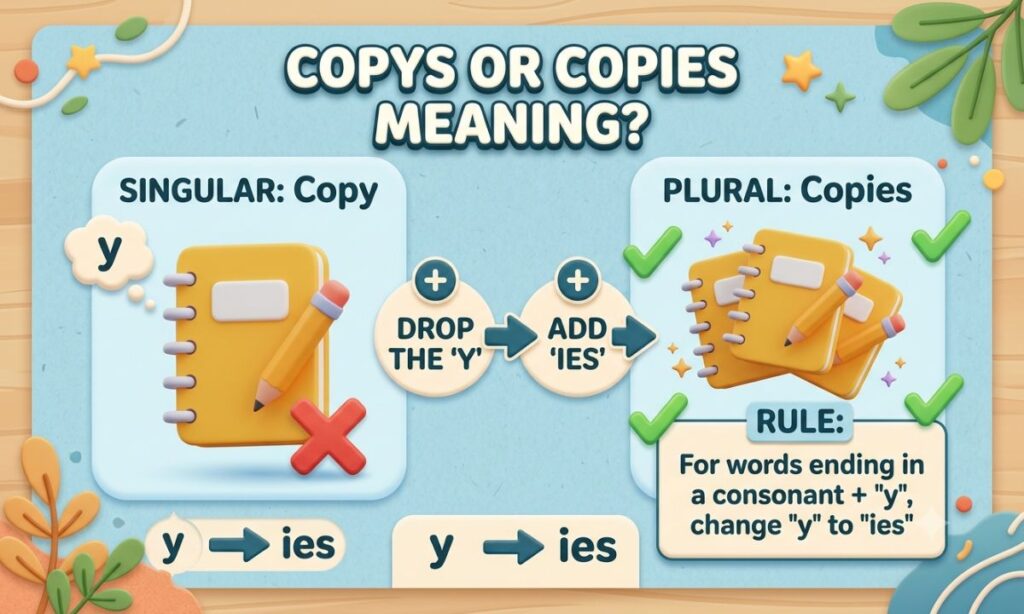
Understanding copys or copies also means understanding what the word “copy” actually means, because it can be used in several different ways in everyday English.
As a noun, “copy” refers to a reproduction or duplicate of something. It can describe a physical duplicate, such as a printed document, a photograph, or a book. It can also refer to a digital file that has been duplicated. In advertising and marketing, “copy” refers to the written text used in advertisements, emails, websites, and promotional materials.
As a verb, “copy” means the act of reproducing or duplicating something. You copy a file, copy a document, or copy someone else’s behavior.
Here is a clear breakdown of the meanings:
Copy as a Noun:
- A printed or digital duplicate of a document
- One instance of a published book or magazine
- Written text in advertising or marketing materials
- A reproduction of an original piece of art or photograph
Copy as a Verb:
- To reproduce or duplicate something
- To imitate someone else’s actions or words
- To transfer data from one location to another
When we talk about copys or copies, we are specifically dealing with the plural form of the noun. When someone needs more than one document, more than one book, or more than one advertisement text, they use the word copies. The debate around copys or copies only applies to noun usage.
Copys or Copies Grammar Examples
Seeing the correct form in real sentences is one of the best ways to internalize the copys or copies rule. Here are grammar examples across different contexts to show you how copies works in practice:
In Office and Business Writing:
- The manager requested ten copies of the quarterly report before the board meeting.
- Please prepare five copies of the contract for all parties to sign.
- The receptionist made copies of every important document before filing them.
In Academic and School Settings:
- The teacher distributed copies of the assignment to every student in class.
- She submitted three copies of her thesis to the graduate office.
- Students must bring two copies of the permission slip signed by a parent.
In Publishing and Media:
- The first edition sold over one million copies within a week of release.
- They printed 500 copies of the limited edition poster for the exhibition.
- The advertising team reviewed all the copies before the campaign launched.
In Digital and Technology Contexts:
- Always keep backup copies of your important files on an external drive.
- The system automatically creates copies of every document saved to the cloud.
- He shared digital copies of the presentation with all team members.
Incorrect Examples (What NOT to Write):
- ~~Please send me three copys of the invoice.~~
- ~~We have extra copys of the brochure available.~~
- ~~Make ten copys before the meeting starts.~~
As you can see, “copys” never fits naturally into a sentence the way copies does. If you ever see “copys” written somewhere, it is always a spelling mistake.
Copys or Copies: Which is Correct?
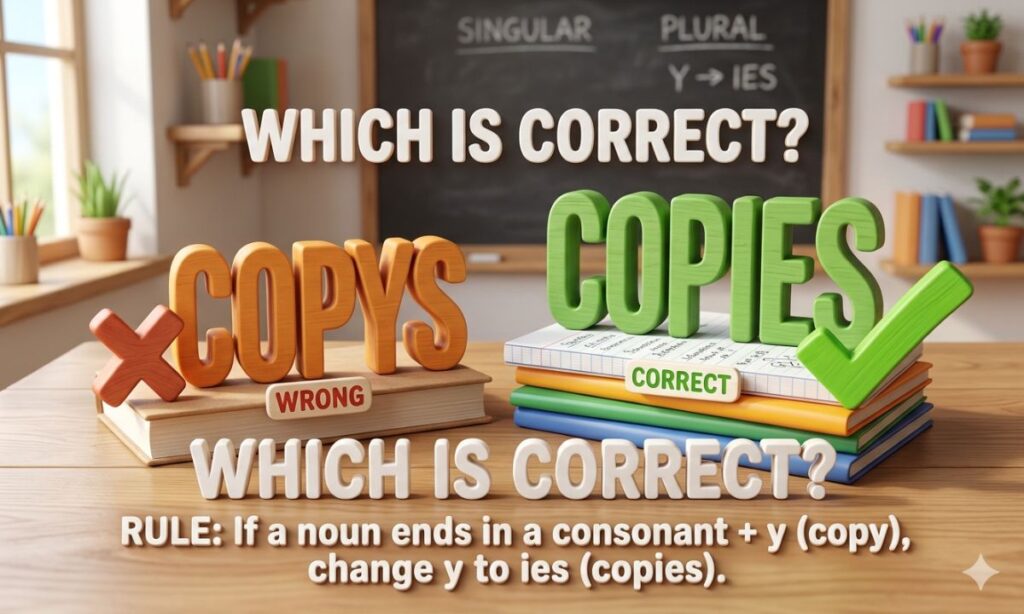
Let us settle this question once and for all. Between copys or copies, only copies is correct. The form “copys” is not a valid English word and should never appear in your writing under any circumstances.
This section breaks down both the noun and verb forms of “copy” so you understand exactly how pluralization works in each case.
Pluralization of Copy as a Noun
When “copy” is used as a noun, it must follow the consonant plus “y” pluralization rule. Because the letter before the “y” in “copy” is the consonant “p,” you replace the “y” with “ies” to get copies.
This applies to every context in which “copy” functions as a noun:
- One document becomes multiple copies
- One book becomes multiple copies
- One ad copy becomes multiple copies (in marketing)
- One photograph becomes multiple copies
The formula is simple:
copy (noun) → drop “y” → add “ies” → copies
There is no situation in standard English grammar where you add a plain “s” to “copy” to make it plural as a noun. The form “copys” simply does not follow any recognized grammatical pattern in the English language.
Here is a quick visual comparison to make this absolutely clear:
| Form | Correct? | Reason |
| copies | Yes | Follows consonant + y → ies rule |
| copys | No | Does not follow any standard English plural rule |
Pluralization of Copy as a Verb
When “copy” is used as a verb, the situation is different and actually much simpler. Verbs in English do not become plural the same way nouns do. Instead, verb forms change based on the subject of the sentence.
Look at these examples:
- I copy the files every morning.
- You copy the documents before submitting them.
- He copies the files every morning. (third person singular present tense)
- They copy the files every morning.
Notice that when the subject is a third person singular pronoun (he, she, it), the verb “copy” does become “copies.” However, this is not pluralization. This is subject-verb agreement, which is a completely different grammatical concept.
The key takeaway is:
- Copies as a noun = more than one duplicate
- Copies as a verb = what he/she/it does in the present tense
In neither case is “copys” ever correct. Whether you are dealing with a noun or a verb, the form “copys” does not belong in the English language.
Copys or Copies Worksheet
Practice is the best way to make the copys or copies rule stick in your memory. Work through this quick worksheet to test your understanding and reinforce what you have learned.
Part A: Fill in the Blank
Choose the correct form (copys or copies) to complete each sentence:
- The librarian made several ________ of the reading list for new students.
- Please bring three ________ of your resume to the interview.
- She signed ten ________ of the memoir at the book launch event.
- Are there any ________ of the floor plan available for review?
- He printed multiple ________ of the report before the presentation.
Answers: 1. copies, 2. copies, 3. copies, 4. copies, 5. copies
Part B: Correct the Error
Identify the mistake in each sentence and rewrite it correctly:
- The office keeps copys of every signed agreement on file. → The office keeps copies of every signed agreement on file.
- She handed out copys of the agenda to each participant. → She handed out copies of the agenda to each participant.
- We ordered extra copys of the textbook for the semester. → We ordered extra copies of the textbook for the semester.
Part C: True or False
- “Copys” is an acceptable plural form in formal writing. → False
- “Copies” follows the consonant plus y equals ies rule. → True
- You can use either “copys or copies” in professional emails. → False
- The word “copy” ends in a consonant before the y. → True
Part D: Write Your Own Sentences
Write three original sentences using the word copies correctly:
- Use copies in an office context.
- Use copies in a school or academic context.
- Use copies in a digital or technology context.
This type of practice exercise is widely used in classrooms and ESL programs because it helps learners move from knowing the rule to actually applying it without thinking. Once you complete this kind of worksheet a few times, the correct form in the copys or copies question will feel completely natural.
2 Copy or 2 Copies
Another common question related to copys or copies is this: should you say “2 copy” or “2 copies”?
The answer is clear: you should always say 2 copies, not “2 copy.”
In English, whenever a number greater than one is used before a noun, the noun must be in its plural form. This is a fundamental grammar rule that applies across the language:
- 2 books (not 2 book)
- 3 chairs (not 3 chair)
- 5 reports (not 5 report)
- 2 copies (not 2 copy)
So if someone asks for two duplicates of a document, you say “please make 2 copies.” Saying “2 copy” is grammatically incorrect in standard English.
Here are more examples with numbers to show this rule in practice:
| Number | Correct Form | Incorrect Form |
| 1 | 1 copy | N/A |
| 2 | 2 copies | 2 copy / 2 copys |
| 5 | 5 copies | 5 copy / 5 copys |
| 10 | 10 copies | 10 copy / 10 copys |
| 100 | 100 copies | 100 copy / 100 copys |
The singular “copy” is only used when the number is exactly one. For every other quantity, copies is the only correct form. This aligns perfectly with what we have already established in the copys or copies discussion: copies is the valid plural, and “copys” is never correct.
One practical tip: if you are unsure about singular vs. plural after a number, just ask yourself: “Is it more than one?” If yes, use the plural form. For “copy,” the plural form is always copies.
Examples of Using “Copies” in a Sentence
To help you use copies confidently across different situations, here is a comprehensive set of example sentences organized by category. These examples reflect real-world usage in professional, academic, creative, and everyday contexts.
Professional and Business Contexts:
- The legal team prepared five copies of the agreement before the signing ceremony.
- Please email digital copies of all the invoices to the accounting department.
- The printer ran out of paper halfway through making copies of the employee handbook.
- She organized the copies of each application by submission date.
- Every department received copies of the updated company policy document.
Educational and Academic Contexts: 6. The professor distributed printed copies of the syllabus on the first day of class. 7. Students must submit two copies of their research paper: one digital and one physical. 8. The school library keeps copies of all required reading materials on reserve. 9. He made copies of his notes to share with classmates before the exam. 10. The publisher donated 200 copies of the textbook to the university.
Creative and Marketing Contexts: 11. The copywriter submitted three copies of the advertisement for client review. 12. They printed 1,000 copies of the promotional flyer for the product launch. 13. The graphic designer prepared multiple copies of the logo in different file formats. 14. Marketing teams often test several copies of email subject lines before sending a campaign. 15. The director requested copies of all scripts before the table read.
Digital and Technology Contexts: 16. Always save backup copies of your work to an external hard drive or cloud storage. 17. The software automatically creates copies of files before applying any updates. 18. She shared digital copies of the presentation with all participants before the webinar. 19. The system stores encrypted copies of every user transaction for security purposes. 20. He lost all his data and wished he had kept multiple copies in different locations.
Everyday and Informal Contexts: 21. Can you make a few copies of this recipe for me to share with friends? 22. The photographer sent over digital copies of all the wedding photos. 23. We picked up copies of the local newspaper from the stand outside the cafe. 24. She signed copies of her novel for fans who came to the bookstore event. 25. He left copies of the instructions with every member of the household.
Each of these sentences demonstrates natural, grammatically correct usage of copies in context. You will notice that “copys” could never replace copies in any of these sentences without making the sentence sound wrong and unprofessional.
Read This: Manuel Vs Manual: When To Use Each One In Writing?
Frequently Asked Questions About Copys or Copies
Is “copys” ever correct in English?
No. “Copys” is not a recognized word in standard English and is always considered a spelling error.
What is the correct plural of “copy”?
The correct plural of “copy” is copies, formed by replacing the “y” with “ies.”
Why does “copy” become “copies” and not “copys”?
Because “copy” ends in a consonant (“p”) followed by “y,” English grammar requires replacing the “y” with “ies” to form the plural.
Does the copys or copies rule apply to other words?
Yes. Words like baby, city, story, country, and lady all follow the same rule and become babies, cities, stories, countries, and ladies.
Should I write “2 copy” or “2 copies”?
Always write “2 copies.” When a number greater than one precedes a noun, the noun must be plural.
Is “copies” used in advertising and marketing?
Yes. In marketing, the word “copy” refers to written text for ads. Multiple versions are called copies or “ad copies.”
Can grammar checking tools catch “copys”?
Yes. Tools like Grammarly will flag “copys” as a spelling error and suggest “copies” as the correct replacement.
Is the rule for copys or copies the same in British and American English?
Yes. Both British and American English use “copies” as the correct plural form of “copy.”
Conclusion
The debate around copys or copies has a clear and definitive answer: copies is always correct, and “copys” is always wrong. This rule is not arbitrary. It is based on one of the most consistent patterns in the English language: when a noun ends in a consonant followed by “y,” you replace the “y” with “ies” to form the plural.
Understanding copys or copies is about more than just spelling one word correctly. It is about learning a pattern that applies to dozens of common English words and improves the overall quality of your writing. Whether you are producing business documents, academic papers, marketing materials, or casual emails, using copies instead of “copys” makes your communication look polished and professional.
Remember the core rule: copy ends in “p” (consonant) plus “y,” so the plural is always copies. The same logic gives you babies from baby, cities from city, stories from story, and so on. Learn the rule once, and you solve dozens of similar spelling questions at the same time.
The next time someone wonders about copys or copies, you will know the answer immediately and be able to explain exactly why copies is the only correct choice in standard English writing.