

Have you ever typed “curtesy” when you meant “courtesy” or wondered if they are actually the same word? You are not alone. The debate around courtesy vs curtesy confuses thousands of writers, students, and professionals every single day. At first glance, these two words look strikingly similar. Say them out loud and they sound nearly identical. Yet put them in writing and pick the wrong one, and your entire message changes completely.
This comprehensive guide breaks down everything you need to know about courtesy vs curtesy: what each word means, where it comes from, how to use it correctly in a sentence, and why choosing the wrong one could cost you credibility. Whether you are drafting a professional email, writing a legal document, or simply trying to improve your English vocabulary, understanding the distinction between courtesy vs curtesy is a skill worth having.
By the end of this article, you will never second-guess yourself on courtesy vs curtesy again.
Define Courtesy
The word courtesy is a noun that refers to polite, considerate, and respectful behavior toward other people. It is one of the most commonly used words in the English language when it comes to social etiquette, professional communication, and everyday interaction.
Courtesy originates from Old French “courtoisie,” which described the refined manners associated with life at a royal court. Over centuries, the word evolved beyond its courtly roots and entered everyday speech as a general term for any act of kindness, politeness, or good manners.
In modern English, courtesy carries several related meanings:
- Politeness and good manners: Treating others with consideration and respect.
- A gracious gesture or favor: Doing something kind for someone without being required to.
- An adjective meaning complimentary or free: As in a “courtesy copy” or a “courtesy shuttle.”
The pronunciation of courtesy is “KUR-tuh-see,” with the stress placed on the first syllable.
Here is a quick overview of how courtesy functions grammatically:
| Feature | Detail |
| Part of Speech | Noun (also used as an adjective) |
| Origin | Old French “courtoisie” |
| Pronunciation | KUR-tuh-see |
| Plural Form | Courtesies |
| Common Context | Everyday speech, professional writing, social settings |
Understanding courtesy as a word rooted in human social behavior helps you recognize when and why it fits so naturally into daily communication. Whenever you are writing or speaking about polite conduct, respectful gestures, or considerate treatment of others, courtesy is the word you want.
Define Curtesy
Now here is where things get interesting in the courtesy vs curtesy conversation. Curtesy (spelled with a “u” replacing the second “o”) is a completely different word with a completely different meaning. It is a legal term rooted in historical common law, and it has nothing whatsoever to do with politeness or social behavior.
Curtesy refers to a husband’s legal right to inherit a life estate in his deceased wife’s real property, provided that the couple had a child born alive who was capable of inheriting that property. This right originated in feudal England as part of the common law system and was designed to protect surviving husbands from being left destitute after their wife’s death.
To put it simply, curtesy is a property law concept, not a manners concept. Here is a breakdown of its key features:
| Feature | Detail |
| Part of Speech | Noun |
| Legal System | English Common Law |
| Subject | Husband’s inheritance rights |
| Condition | Required a child born alive |
| Modern Status | Largely abolished; replaced by statutory laws |
| Context | Legal documents, historical texts, property law |
The legal framework behind curtesy involved four specific conditions that had to be met before a husband could claim this right. First, a valid legal marriage between the couple had to exist. Second, the wife had to have owned inheritable real property during the marriage. Third, a child capable of inheriting that property had to have been born alive during the marriage. Fourth, the wife had to have died before the husband.
When all four conditions were satisfied, the husband gained what was known as “curtesy initiate” after the birth of a child, which then became “curtesy consummate” upon the wife’s death. This gave him the right to occupy and benefit from the property for the rest of his life, though he could not sell it or pass it on through his own will.
It is worth noting that curtesy had a female equivalent called “dower,” which granted a widow a one-third life estate in her deceased husband’s real property.
Today, curtesy rights have been abolished in most states across the United States and in most modern legal systems worldwide. They have been replaced by elective share statutes and other equitable distribution laws. However, you will still encounter the term curtesy in historical legal texts, property law scholarship, and certain state statutes.
So when you see the word curtesy, think history, think inheritance law, think feudal England. It has no place in a polite conversation or a professional email about good manners.
Read This: Manuel Vs Manual: When To Use Each One In Writing?
How To Properly Use The Words In A Sentence
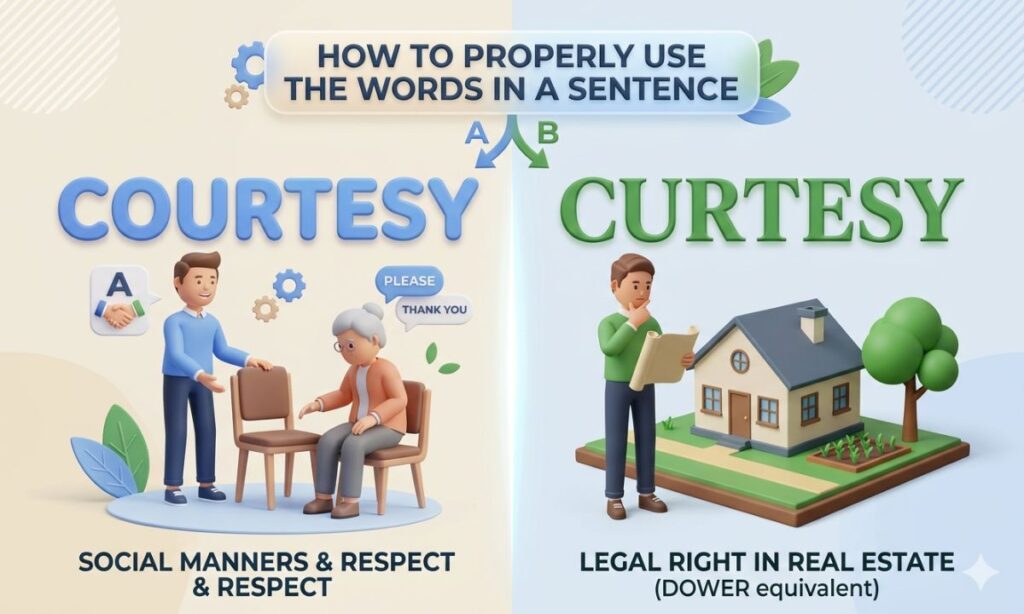
Now that you understand what each word means, let us look at how to use them correctly in actual writing and speech. The confusion in courtesy vs curtesy is understandable, but the proper usage of each is very clear once you know the context.
How To Use “Courtesy” In A Sentence
Courtesy belongs in everyday language. You use it whenever you are describing polite behavior, kind gestures, professional etiquette, or complimentary services. It fits seamlessly into both formal and informal writing. Here is how to use it:
As a noun referring to polite behavior:
“She answered every question with patience and courtesy.”
As a noun referring to a kind gesture:
“As a courtesy, the manager offered a full refund without being asked.”
As an adjective meaning complimentary or provided as a favor:
“The hotel provided a courtesy van for airport transfers.”
As part of a common phrase:
“Out of courtesy, he called ahead before dropping by.”
In professional communication:
“This is a courtesy reminder that your appointment is tomorrow at 10 a.m.”
Notice that in every example above, courtesy connects directly to human behavior, respectful interaction, or a gesture of goodwill. This is the heartland of the word.
How To Use “Curtesy” In A Sentence
Curtesy belongs in legal writing, historical analysis, or property law discussions. You will rarely encounter it outside of these contexts, and you should never use it in place of courtesy. Here is how the word appears when used correctly:
In a legal document or text:
“Under the doctrine of curtesy, the widower was entitled to a life estate in his wife’s farmland.”
In a historical analysis:
“The common law concept of curtesy required that a child be born alive before the husband could claim his interest.”
In a property law discussion:
“Many states have abolished curtesy rights and replaced them with elective share provisions.”
In a historical case study:
“Because the couple had no children, the husband could not claim curtesy over his late wife’s estate.”
As you can see, curtesy only appears in contexts involving inheritance, property rights, and legal history. If your sentence has nothing to do with those topics, curtesy is the wrong word and courtesy is almost certainly what you need.
Courtesy vs Curtesy Meaning
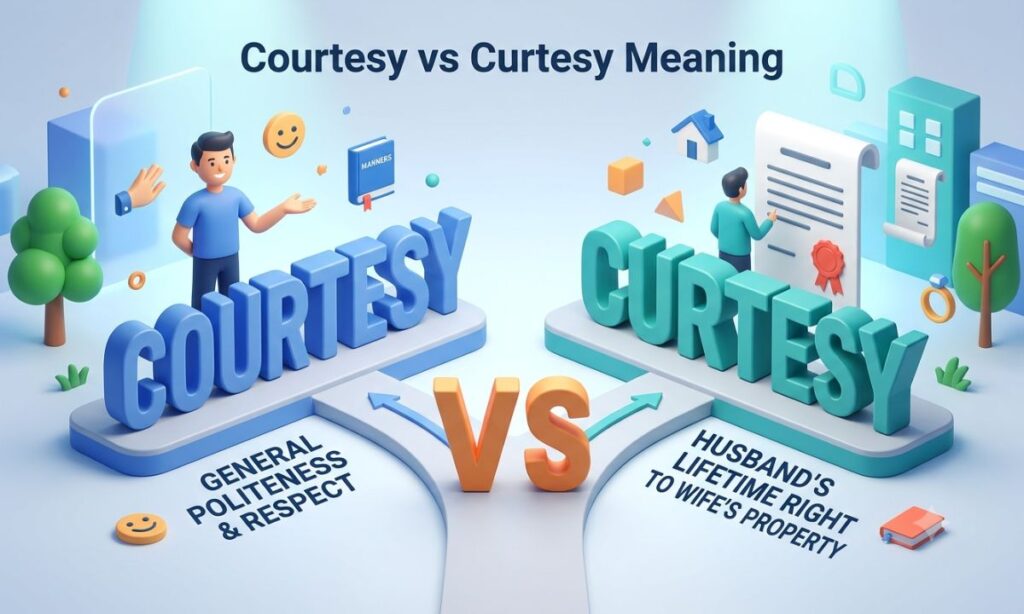
Let us bring the meaning comparison together in one place, because understanding the core differences between courtesy vs curtesy is what will help you remember which one to use.
| Aspect | Courtesy | Curtesy |
| Core Meaning | Polite, considerate behavior | Husband’s legal right to wife’s estate |
| Part of Speech | Noun and adjective | Noun (legal term only) |
| Language Origin | Old French “courtoisie” | Common law English |
| Usage Frequency | Extremely common in everyday use | Rare; mostly historical and legal |
| Contexts | Social, professional, academic | Legal documents, property law |
| Modern Relevance | Very high | Very low (largely abolished) |
| Example | “Thank you for your courtesy.” | “He claimed curtesy over her estate.” |
The simplest way to remember the difference in courtesy vs curtesy is this: if you are talking about how people treat each other, use courtesy. If you are reading a centuries-old property deed or a legal history textbook, you might encounter curtesy.
In practical terms, courtesy is the word you will use in 99.9% of your writing. The courtesy vs curtesy distinction matters most as a spelling and meaning check to ensure you do not accidentally write a legal term when you intend to compliment someone’s good manners.
More Examples Of Courtesy & Curtesy Used In Sentences
Seeing a word in action across multiple contexts is one of the best ways to internalize its meaning. Here is a broader set of examples for both words in the courtesy vs curtesy comparison.
Examples of Using Courtesy in a Sentence
- “The airline extended the courtesy of a free upgrade to passengers who had waited over an hour.”
- “Professional courtesy requires that you acknowledge a colleague’s email within 24 hours.”
- “He greeted every customer with a smile and remarkable courtesy.”
- “Out of basic courtesy, please lower your voice in the library.”
- “The company sent a courtesy copy of the invoice to keep the client informed.”
- “She showed great courtesy by listening without interrupting during the entire presentation.”
- “Diplomatic courtesy is essential when representatives from different nations meet.”
- “The receptionist handled every complaint with patience and unwavering courtesy.”
- “As a professional courtesy, attorneys sometimes waive fees for fellow members of the bar.”
- “A simple thank-you note is one of the most underrated acts of courtesy in the modern workplace.”
Examples of Using Curtesy in a Sentence
- “The concept of curtesy granted the widower a life estate in all of his wife’s inheritable land.”
- “Under classical common law, curtesy required that the couple had produced a living child.”
- “The judge reviewed the husband’s claim of curtesy over the disputed property.”
- “Dower and curtesy were companion doctrines that protected widows and widowers respectively under English law.”
- “Because curtesy has been abolished in most jurisdictions, modern estates are now governed by statutory share laws.”
- “The law student studied the historical development of curtesy as part of her property law coursework.”
- “The 19th-century deed referenced curtesy rights as the basis for the widower’s continued tenancy.”
- “Curtesy initiate arose at the birth of the couple’s first child, even before the wife’s death.”
Reading through these examples side by side reinforces just how different courtesy vs curtesy truly are in practice. One lives in the world of human relationships and polite society. The other belongs to dusty law books and historical land records.
Curtesy or Courtesy Call
One question that comes up frequently in the courtesy vs curtesy discussion is about the phrase “courtesy call.” Some writers wonder if it should be spelled “curtesy call” instead. The answer is clear: it is always spelled courtesy call, never “curtesy call.”
A courtesy call is a visit or phone call made as a gesture of goodwill, respect, or professional protocol rather than for urgent business. The term is widely used in both personal and professional settings.
In diplomacy, a courtesy call is a formal visit in which a diplomat, representative, or dignitary meets with a head of state or senior official. The meeting is typically symbolic in nature and serves to demonstrate respect and goodwill between parties.
In business, a courtesy call serves several purposes:
- Following up with a customer after a purchase to check on their satisfaction.
- Reaching out to a new client to welcome them and establish rapport.
- Informing a colleague of an important development before making a formal announcement.
- Checking in with a longtime contact simply to maintain the relationship.
In personal life, a courtesy call might involve calling a friend after a difficult event, reaching out to a neighbor after moving in, or phoning a relative simply to show you are thinking of them.
The key characteristic of a courtesy call is that it is motivated by respect and consideration rather than immediate necessity. It reflects the broader meaning of courtesy as a word tied to thoughtful, considerate human behavior.
There is no such thing as a “curtesy call.” If you ever see that phrase, it is simply a misspelling. The word curtesy belongs to legal history and has no connection to phone calls, visits, or social gestures of any kind.
Common Mistakes To Avoid
Understanding courtesy vs curtesy also means knowing the pitfalls that trip writers up the most. Here are the most common errors and how to steer clear of them.
1. Using “Curtesy” Instead of “Courtesy”
This is by far the most frequent mistake in the courtesy vs curtesy debate. Writers who are unsure of the correct spelling sometimes default to “curtesy” thinking it looks more sophisticated or formal. In reality, writing “curtesy” when you mean polite behavior is an error that can undermine your credibility.
Wrong: “Thank you for your curtesy during the meeting.” Right: “Thank you for your courtesy during the meeting.”
Wrong: “Please extend the curtesy of a timely response.” Right: “Please extend the courtesy of a timely response.”
The word curtesy should only appear in your writing if you are specifically discussing legal property rights in a historical or legal context.
2. Using “Courtesy” as a Verb
Courtesy is a noun and an adjective. It is not a verb. A common error is to use it as though it describes an action in the verbal sense.
Wrong: “I will courtesy him with a phone call.” Right: “I will show him the courtesy of a phone call.”
If you need a verb form, use words like “show,” “extend,” “offer,” or “demonstrate” alongside the noun courtesy.
3. Confusing Courtesy With Respect
While courtesy and respect are closely related concepts, they are not identical. Respect is a broader attitude or feeling of admiration and regard. Courtesy is more specifically about the outward expression of that respect through polite words and considerate actions. You can feel respect internally; courtesy is how you demonstrate it externally.
Tips To Avoid These Mistakes
- Whenever you write the word, ask yourself: am I talking about polite behavior? If yes, use “courtesy.”
- Remember: the “u” after the “o” in “courtesy” connects to “you” and how you treat people around you.
- Run a quick context check. If the word is not in a legal document or historical text, “curtesy” is almost certainly wrong.
- Read your sentence aloud. “Thank you for your curtesy” will sound correct to the ear but look wrong to an educated reader.
- Use spellcheck and grammar tools, but do not rely on them entirely, as both words are technically real words and spellcheck may not flag the error.
Context Matters
One of the most important lessons in the courtesy vs curtesy discussion is that context is everything. The same two letters can point to completely different worlds: one of social grace and one of medieval property law.
In everyday conversation, social media, professional emails, academic essays, and business writing, courtesy is almost always the correct choice. It describes how people interact with each other, how businesses treat their customers, and how professionals carry themselves in their work.
In legal briefs, historical scholarship, property law textbooks, and archival documents, curtesy is the term that may appear. But even legal professionals today rarely encounter curtesy in active use, since it has been abolished in most jurisdictions and replaced by modern statutory protections for surviving spouses.
Context also matters when courtesy functions as an adjective. Phrases like “courtesy car,” “courtesy copy,” “courtesy reminder,” and “courtesy discount” are all standard expressions in professional and commercial English. In each case, the word signals that something is being provided as a gesture of goodwill or professional consideration.
There is no equivalent adjectival use for curtesy. The word exists strictly as a legal noun and has no adjective form in common or modern use.
When you are unsure which word to use, simply ask yourself one question: am I writing about legal property rights in a historical context? If the answer is no, use courtesy.
Exceptions To The Rules
While the rules of courtesy vs curtesy are fairly clear-cut, there are a few exceptional contexts where the lines can get slightly blurry or where additional nuance applies.
1. Legal Terminology
In strict legal writing, curtesy remains the accurate and preferred term for discussing the historical common law right of a surviving husband. Even though this doctrine has been abolished in most places, legal historians, property law professors, and estate attorneys still use the term correctly when referencing its historical application.
It is also worth noting that some older legal texts and court opinions used “courtesy” and “curtesy” somewhat interchangeably, treating them as variant spellings of the same legal concept. This historical inconsistency is one reason why the two words cause confusion today. Modern legal writing, however, standardizes on curtesy for the property law meaning.
2. Heraldry
In the field of heraldry, the word courtesy appears in a specialized context: the practice of granting a coat of arms or a title to the descendants of a noble family even when they are not strictly entitled to it by birth. This is known as a “courtesy title” or a “courtesy peerage.” In this context, courtesy is being used in its adjective form to describe something granted as a gracious favor rather than as a legal right.
This heraldic use of courtesy is legitimate but specialized. Most everyday writers will never need to use the word in this way, but it is a good example of how courtesy can stretch into formal and historical domains while still retaining its core meaning of gracious, generous conduct.
3. Everyday Communication
In everyday communication, the word curtesy essentially has no place. Even if someone intends to use it as a creative or archaic-sounding alternative to courtesy, doing so will almost always be read as a spelling mistake. Modern readers, editors, and employers will not recognize “curtesy” as an intentional stylistic choice in a non-legal context. They will simply see an error.
The exception here would be if you are writing historical fiction set in a period when curtesy was an active legal concept, or if you are writing educational content specifically about property law history. Outside of those scenarios, stick with courtesy in all everyday communication.
Read This: Atleast or At Least? Which One is Correct?
Practice Exercises
The best way to lock in your understanding of courtesy vs curtesy is to put the knowledge into practice. These exercises will help you apply what you have learned and build confidence in choosing the right word.
Exercise 1: Fill in the Blank
Choose the correct word, either “courtesy” or “curtesy,” to complete each sentence. Answers are provided below.
- “As a professional _______, the doctor offered a free second opinion.”
- “The widower claimed _______ rights over his late wife’s inherited estate.”
- “Please show basic _______ by arriving on time for the meeting.”
- “Under English common law, _______ required the couple to have had a living child.”
- “The airline offered a _______ meal to all passengers whose flights were delayed.”
- “The attorney studied the history of dower and _______ in her property law class.”
- “Her _______ and professionalism made her stand out among the candidates.”
- “The concept of _______ has been largely replaced by elective share laws in most U.S. states.”
Answers:
- courtesy
- curtesy
- courtesy
- curtesy
- courtesy
- curtesy
- courtesy
- curtesy
Exercise 2: Sentence Completion
Complete each sentence using the correct word and your own words. There is no single right answer, but the word choice must be appropriate.
- “The hotel provided a _______ shuttle because…”
- “Under the old common law doctrine of _______, a husband could…”
- “Out of basic _______, she always remembered to…”
- “Legal scholars studying _______ often look at cases from…”
- “He was known throughout the office for his _______ and…”
Sample Answers:
- “The hotel provided a courtesy shuttle because they wanted guests to feel welcome from the moment they arrived.”
- “Under the old common law doctrine of curtesy, a husband could claim a life estate in his wife’s property after her death, provided they had a child born alive.”
- “Out of basic courtesy, she always remembered to respond to emails within the same working day.”
- “Legal scholars studying curtesy often look at cases from 18th and 19th century England to understand how property rights evolved.”
- “He was known throughout the office for his courtesy and willingness to help colleagues without being asked.”
Frequently Asked Questions About Courtesy vs Curtesy
Is “curtesy” just a misspelling of “courtesy”?
No. “Curtesy” is a real legal term with a distinct meaning related to a husband’s inheritance rights, though it is rarely used today.
Which word should I use in everyday writing?
Almost always “courtesy.” It refers to polite, respectful behavior and is appropriate in nearly all everyday contexts.
Are “courtesy” and “curtesy” pronounced the same?
Yes, both words share the same pronunciation: “KUR-tuh-see,” which is one reason they are so commonly confused.
Can “courtesy” be used as an adjective?
Yes. Phrases like “courtesy call,” “courtesy car,” and “courtesy copy” are all common and correct uses of “courtesy” as an adjective.
Is curtesy still a legal right today?
In most places, no. Curtesy rights have been abolished in the majority of U.S. states and modern legal systems, replaced by elective share statutes.
What is the difference between courtesy and respect?
Courtesy is the outward expression of respect through polite words and considerate actions. Respect is the broader internal attitude.
What is a courtesy title in heraldry?
A courtesy title is one granted to a noble family’s descendants as a gracious gesture rather than as a strict legal entitlement.
Can I use “curtesy” in a business email?
No. Using “curtesy” in a business email would be read as a spelling error. Always use “courtesy” in professional communication.
Conclusion
The courtesy vs curtesy debate is one of those fascinating corners of the English language where spelling, history, law, and everyday communication all intersect. Two words that look nearly identical and sound exactly the same turn out to inhabit completely different worlds.
Courtesy is alive and thriving in our everyday vocabulary. It shows up in professional emails, customer service interactions, diplomatic relations, and personal conversations. It describes the small but meaningful gestures that make human life more pleasant and respectful. Whether you are offering a courtesy call, extending professional courtesy, or simply showing basic courtesy to a stranger, this word captures the essence of considerate behavior.
Curtesy, on the other hand, is a word that belongs to history. It played an important role in shaping property and inheritance law for centuries under the English common law system, but it has been largely replaced by modern statutory protections. Today, it lives primarily in legal textbooks, historical scholarship, and specialized legal contexts.
The most important takeaway from this courtesy vs curtesy guide is simple: in virtually every situation you will ever encounter in writing or speech, courtesy is the word you want. Reserve curtesy for historical or legal writing only.
Mastering the distinction between courtesy vs curtesy is a small but meaningful step toward becoming a more precise and credible writer. And if you ever feel uncertain, just remember: if it has anything to do with good manners, politeness, or respectful behavior, the answer in the courtesy vs curtesy question is always courtesy.