
If you have ever typed a sentence and paused to wonder whether you should write “Manuel” or “manual,” you are not alone. The confusion around Manuel Vs. Manual is more common than most people realize. These two words look almost identical on paper, separated by only a single letter, yet their meanings, grammar rules, and correct usage are entirely different. Mixing them up in professional writing, academic work, or even a casual email can make your text look sloppy or unclear.
This complete guide breaks down the Manuel Vs. Manual debate once and for all. You will learn their definitions, the right contexts to use each word, helpful memory tricks, real sentence examples, and answers to the most frequently asked questions writers have about these terms. By the end of this article, you will feel confident every single time you choose between Manuel Vs. Manual in your writing.
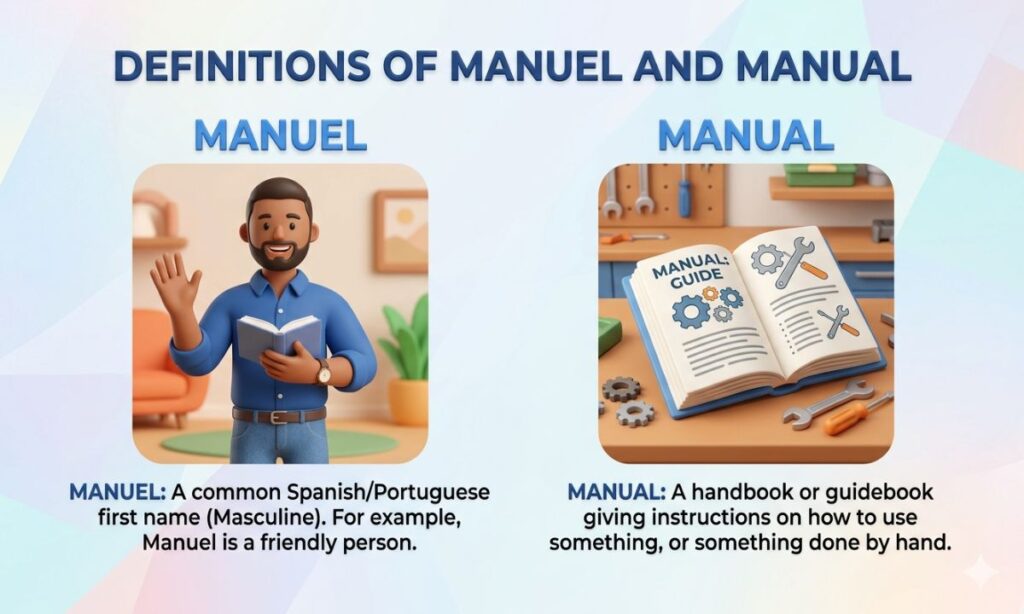
Definitions Of Manuel And Manual
Before diving into usage tips, it is important to understand what each word actually means. Knowing the definition is the foundation for using any word correctly. The confusion between Manuel Vs. Manual almost always starts because people do not fully understand what each term represents.
Read This: Atleast or At Least? Which One is Correct?
Definition Of Manuel
Manuel is a proper noun. It is a personal name of Spanish and Portuguese origin, most commonly given to boys and men. The name traces back to the Hebrew name “Emmanuel,” which carries the meaning “God is with us.” Over centuries, as the name traveled through Spanish and Portuguese speaking cultures, it became shortened and adapted into the form we recognize today as Manuel.
Because Manuel is a proper noun, it always begins with a capital letter, regardless of where it appears in a sentence. You will find this name commonly used across Spain, Portugal, Latin America, and other regions influenced by Iberian culture. Popular nicknames for Manuel include Manny and Manolo.
Beyond being a personal name, Manuel is also the name of a municipality located in the Valencia province of Spain. So in geography, Manuel functions as a proper place name as well. In both cases, whether referring to a person or a place, Manuel is always capitalized and always functions as a proper noun.
Key facts about Manuel:
- It is a proper noun (a name)
- It always starts with a capital letter
- It originates from Spanish and Portuguese
- It cannot be used as an adjective or a common noun
- It refers to a person or a specific place
Definition Of Manual
Manual is a common English word with several distinct meanings depending on the context in which it is used. It can function as a noun or as an adjective, making it a more grammatically flexible word than Manuel.
As a noun, “manual” refers to a book or document that provides instructions, directions, or guidelines on how to use something or how to perform a task. Think of the instruction booklet that comes with a new appliance, a car, or a software program. That booklet is commonly called a manual.
As an adjective, “manual” describes something that is done by hand or operated by a person rather than a machine or automated system. For example, manual labor refers to work performed physically by a person, and a manual process is one that requires human operation rather than automation.
In the context of music, “manual” can also refer to the keyboard of an organ that is played by the hands, as opposed to the foot pedals.
In automotive contexts, “manual” is used as a shortened form of “manual transmission,” referring to a gearbox that requires the driver to shift gears by hand using a clutch pedal.
Key facts about manual:
- It is a common noun or adjective in English
- It is written in lowercase unless it begins a sentence
- It can refer to an instruction book, a hand-operated process, or a vehicle transmission type
- It can describe tasks done by human effort rather than machines
- It has several valid meanings depending on context
Manuel Or Manual
The question of whether to write “manuel or manual” comes up frequently, especially among people who are learning English or who work in multilingual environments. The answer depends entirely on what you are trying to say.
If you are referring to a person’s name, the correct choice is always Manuel with a capital “M.” There is no situation in which you would write a person’s name as “manuel” with a lowercase “m” unless it appears in a headline where all letters are lowercase by style choice.
If you are referring to an instruction guide, a hand-operated task, or a type of vehicle transmission, the correct word is always manual in lowercase.
A simple way to remember the difference between “manuel or manual” is this memory trick: Manuel ends in “el” like “he” because it refers to a person. Manual ends in “al” like “all” the instructions you would find in a guidebook.
Here is a quick reference table:
| Word | Type | Capitalized? | Meaning |
| Manuel | Proper noun | Always (Yes) | A person’s name or a place in Spain |
| manual | Common noun / Adjective | Only at sentence start | Instruction book, hand-operated task, gear transmission |
Manual Vs Manuel
The manual vs manuel comparison comes down to one core rule: context determines everything. Writers, students, and professionals regularly confuse these two words because they look so similar in appearance and sound almost identical when spoken aloud depending on the speaker’s accent.
Here is what makes manual vs manuel confusing:
- Both words have the same number of letters (six)
- Both words begin with “manu”
- In fast speech, the vowel sounds in the final syllables can blur together
- Spell-check tools do not always flag “manuel” as an error if the program assumes it might be a name
However, the distinction in manual vs manuel is actually quite clear once you understand the grammar. One word is a proper noun (a name). The other is a common noun or adjective used in everyday English sentences. They are never interchangeable in formal or professional writing.
Common mistakes writers make:
- Writing “Please read the manuel” when they mean “Please read the manual”
- Writing “Ask manuel for help” when they mean “Ask Manuel for help” (missing the capital M)
- Confusing the two in autocorrect situations where one word replaces the other
How To Properly Use Manuel And Manual In A Sentence
Understanding the grammar rules behind Manuel Vs. Manual is the key to using both words correctly every single time. Let us walk through the rules for each one in detail.
Rules for using Manuel in a sentence:
- Always capitalize the first letter
- Use it as a subject, object, direct object, or indirect object in a sentence
- Never use it as an adjective to describe a noun
- It refers only to a person or a place, never to a thing or an action
Rules for using manual in a sentence:
- Keep it lowercase unless it opens a sentence
- Use it as a noun to refer to an instruction book or guide
- Use it as an adjective to describe hand-operated tasks, tools, or processes
- Use it in automotive contexts to describe a stick-shift or standard gearbox
- Use it in music to describe the keyboard played by hand on an organ
Understanding these rules makes navigating Manuel Vs. Manual much simpler in real writing situations.
Manuel Vs Manual Meme
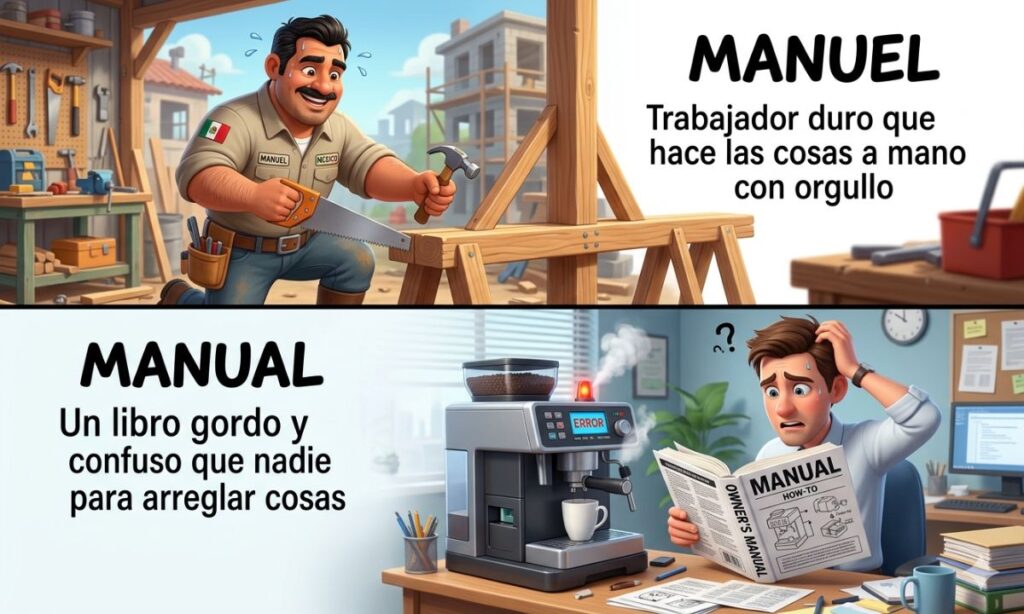
The Manuel vs manual meme culture online has given this grammar mix-up a humorous life of its own. Across social media platforms, writers and grammar enthusiasts have shared jokes about receiving an “instruction manual” only to discover it was written by “a guy named Manuel.” The humor comes from the idea that a person and a guidebook have been swapped by accident.
One of the most popular joke formats goes something like: “I asked for the manual. They sent me Manuel. Now Manuel is trying to explain how to reset my router.”
These memes highlight something important: the Manuel vs manual mistake is relatable because it is genuinely easy to make, especially when typing quickly or relying on autocorrect. The meme culture around Manuel Vs. Manual has actually helped more people remember the correct usage because laughter makes things memorable.
While the memes are funny, the real-world consequences of mixing up Manuel Vs. Manual in a professional document, a business email, or an academic paper can be embarrassing. Taking a few seconds to double-check which word you need is always worth the effort.
Manuel Or Manual Transmission
When people search for “Manuel or manual transmission,” they are almost always asking about vehicle gearboxes, not a person named Manuel. In automotive writing and conversation, the correct term is always manual transmission.
A manual transmission (also called a stick shift, standard transmission, or gearbox) is a type of vehicle drivetrain system that requires the driver to manually select and engage gears using a gear lever and a clutch pedal. This is in contrast to an automatic transmission, which shifts gears on behalf of the driver.
Saying “Manuel transmission” is grammatically incorrect in automotive contexts. That phrase would imply that a person named Manuel invented or owns the transmission, which is almost certainly not what the writer intends. The correct phrase is always manual transmission.
Key facts about a manual transmission:
- Requires the driver to operate a clutch pedal and gear shift
- Generally offers better fuel efficiency than older automatic transmissions
- Provides more driver control and engagement
- Is sometimes called a “stick shift” or “standard” in informal speech
- Has become less common in modern vehicles as automatic technology improves
So in the Manuel Vs. Manual debate within an automotive context, the answer is clear: always use manual when talking about transmissions.
Manuel Or Manual Book
Another common search is “Manuel or manual book,” and again the answer here is straightforward. A manual book (or simply “a manual”) refers to a printed or digital document that contains instructions, operating procedures, or reference information for a product, system, or process.
You would never correctly refer to a guidebook as a “Manuel book” unless you were making a joke or referring to a book that literally belongs to someone named Manuel.
Common types of manuals include:
- User manual: A guide that helps end users understand how to use a product
- Owner’s manual: A booklet included with vehicles or appliances explaining operation and maintenance
- Training manual: A document used to instruct employees or students on procedures
- Technical manual: A detailed reference guide used by engineers or technicians
- Policy manual: A document outlining organizational rules and procedures
In every one of these cases, the correct word is manual, not “Manuel.” The Manuel Vs. Manual rule remains consistent: if you are talking about a document or a book of instructions, you must use manual.
Manuel Vs Manual Reddit
The Manuel vs manual reddit discussions are a goldmine of real-world examples showing how everyday people encounter and struggle with this word pair. On forums like Reddit’s grammar communities, r/grammar, r/writing, and r/learnEnglish, users frequently post questions about common confusable words, and Manuel Vs. Manual appears regularly.
Some of the most upvoted responses on Reddit about this topic include advice such as:
- “If it has a capital M, it is a name. If it is lowercase, it is a word describing something done by hand or an instruction book.”
- “Think about what you are describing. Is it a person? Then Manuel. Is it a book or a process? Then manual.”
- “A great trick: replace the word with another person’s name like Carlos. If that still makes sense, you want Manuel. If not, you want manual.”
Reddit discussions about Manuel Vs. Manual also highlight that non-native English speakers are especially prone to this confusion, particularly speakers whose native languages include Spanish or Portuguese, where “Manuel” is a very common given name. Seeing “manual” in English text and reading it as a familiar name is a natural mental shortcut that leads to the mix-up.
The community-driven nature of Reddit grammar discussions makes them a valuable resource for understanding how real writers experience Manuel Vs. Manual confusion in everyday life.
How And When To Use Manuel
Use Manuel whenever you are referring to:
- A person who carries this name (e.g., a friend, a colleague, a historical figure)
- A place called Manuel (specifically the municipality in Valencia, Spain)
- Any proper noun context where Manuel serves as a subject, object, or identifier in a sentence
Grammar tips for using Manuel correctly:
- Always capitalize: it is a proper noun
- Never use it before a common noun as a descriptor (you would not say “a Manuel car”)
- It can appear anywhere in a sentence: beginning, middle, or end
- When addressing someone directly (direct address), set it off with a comma: “Can you help me, Manuel?”
How And When To Use Manual
Use manual whenever you are referring to:
- An instruction book or user guide for a product or system
- A task or process performed by hand rather than by machine
- A type of vehicle transmission requiring hand and foot coordination
- The hand-operated keyboard on a pipe organ
Grammar tips for using manual correctly:
- Keep it lowercase in all regular contexts
- As an adjective, place it before the noun it modifies (e.g., “manual process,” “manual labor”)
- As a noun, it can stand alone or be modified by other adjectives (e.g., “the instruction manual,” “a detailed manual”)
- In automotive contexts, you can say “I drive a manual” as a shortened informal phrase
Examples Of Manuel And Manual Use In Sentences
Seeing words used in context is one of the best ways to lock in their correct usage. Here are detailed examples for both words to help you master Manuel Vs. Manual in real writing.
Example Sentences of Manuel
- Manuel arrived at the office early every morning without fail.
- The project was led by Manuel, whose expertise in data analysis proved invaluable.
- Have you met Manuel? He just transferred from the Barcelona branch.
- The award was presented to Manuel during the annual ceremony last Thursday.
- Manuel grew up in a small coastal town before moving to the city for university.
- The team asked Manuel to review the financial report before the board meeting.
- Manuel is also the name of a charming municipality in the Valencia province of Spain.
- According to Manuel, the new software update solves the connectivity issue.
- My grandfather was named Manuel after his great-uncle who lived in Seville.
- The history book mentioned Manuel I of Portugal as a pivotal figure in the Age of Exploration.
Example Sentences of Manual
- Please read the instruction manual before attempting to assemble the furniture.
- The factory still uses manual labor for some of its more delicate assembly steps.
- She prefers driving a manual because it gives her more control on mountain roads.
- The technician referred to the service manual before replacing the engine component.
- Manual data entry takes significantly longer than using the automated system.
- The new employee was given a training manual on her first day at the company.
- The organ has three manuals and a set of foot pedals for the bass notes.
- Learning to operate a manual transmission requires patience and coordination.
- The IT team prepared a manual outlining the steps to reset each employee’s login credentials.
- The company decided to switch from manual processing to a fully automated workflow.
Conclusion
The Manuel Vs. Manual distinction is one of those small but meaningful details that separates careful writers from careless ones. At its core, the rule is refreshingly simple: Manuel is a proper noun and a name, while manual is a common word describing instruction books, hand-operated processes, or vehicle transmissions.
Throughout this article on Manuel Vs. Manual, you have seen that the two words differ in their part of speech, their capitalization rules, their origins, and their appropriate contexts. Whether you are writing a professional document, crafting a story, discussing car transmissions, or simply sending an email, knowing the correct word to use reflects your attention to detail and your command of the English language.
Remember the core memory trick: Manuel ends in “el” because he is a person. Manual ends in “al” because it covers all the instructions in a book. Keep that in mind, and you will never mix up Manuel Vs. Manual again.
The next time you are unsure whether to reach for Manuel Vs. Manual, ask yourself one simple question: am I talking about a person or about a process, guide, or transmission? Your answer will point you directly to the right word every single time.