
If you have ever typed a quick message and wondered whether to write atleast or at least, you are not alone. This tiny spelling question trips up thousands of writers every single day, from students and bloggers to professional content creators. The good news is that the answer is completely straightforward, and once you know it, you will never second-guess yourself again.
This article will walk you through everything you need to know about atleast or at least: the correct form, its grammatical role, its mathematical symbol, real sentence examples, how it is used across UK and US English, and the best synonyms you can use in its place. By the time you finish reading, you will feel fully confident using this phrase in any type of writing.
Atleast or At Least: Which is Correct?
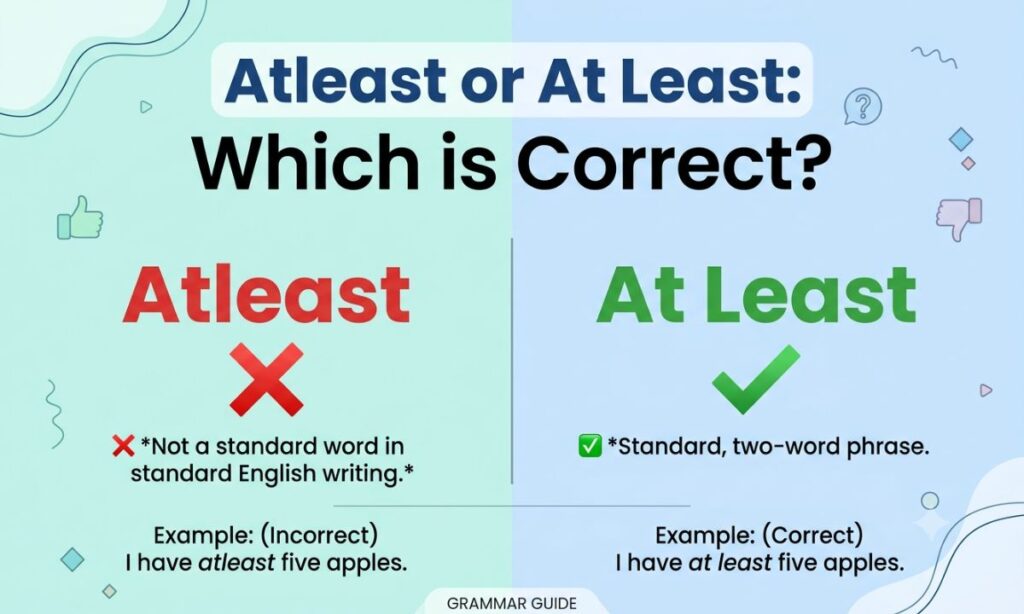
The answer is simple: at least is correct. Atleast is not a real word in the English language.
No major English dictionary, whether Oxford, Cambridge, Merriam-Webster, or Collins, recognizes “atleast” as a valid entry. It does not appear in any standard grammar guide, academic writing manual, or style handbook. Writing “atleast” in a formal email, essay, report, or any professional document is a spelling error, plain and simple.
Here is a quick comparison to make this crystal clear:
| Form | Correct? | Notes |
| at least | Yes | Standard two-word phrase accepted in all contexts |
| atleast | No | Spelling error; not found in any dictionary |
The confusion between atleast or at least is understandable. When we speak quickly in everyday conversation, the two words blend together and sound almost like a single word. That acoustic illusion leads many writers, especially those who learned English as a second language, to write it as one word. But no matter how natural it sounds in speech, the written rule is firm: two words, always.
Quick Rule: You need at least one space between “at” and “least.” Remove that space, and you remove the correct spelling entirely.
Understanding ‘At Least’ as a Phrase
To truly understand why atleast or at least matters, it helps to look at how the phrase is constructed grammatically.
The phrase “at least” is made up of two separate words:
- “At” is a preposition. It is used to indicate a particular point, position, or condition.
- “Least” comes from the Old English word læsest, which means “lowest or smallest in power or position.” In modern English, it functions as an adjective, adverb, or noun depending on context.
Together, these two words form an adverbial phrase, a unit that modifies verbs, adjectives, or entire sentences to convey the idea of a minimum. Because “at” is a preposition that must remain separate from the word it governs, merging them into “atleast” breaks a fundamental grammar rule. The preposition needs its own space.
This is similar to how we would never write “atonce” instead of “at once,” or “atlast” instead of “at last.” The preposition “at” always stands on its own.
‘At Least’ is an Adverb
From a grammatical standpoint, at least functions primarily as an adverb phrase. That means it modifies or adds detail to a verb, an adjective, or a whole clause rather than standing as a noun or subject in a sentence.
According to Cambridge Dictionary, we use at least (and with stronger emphasis, at the very least) to talk about a minimum number or amount, conveying the meaning of “no less than.” In this role, it acts exactly the way an adverb does: it tells us something about the degree, quantity, or extent of an action or quality.
Consider this example:
- “She practices piano at least two hours a day.”
Here, at least modifies the time expression “two hours” by setting a lower boundary on the amount of practice. The phrase tells us the minimum, and leaves open the possibility that she may practice even more. That is the job of an adverb: to qualify and quantify.
The phrase can also be used to soften or qualify a statement:
- “The meeting was long, but at least it was productive.”
In this case, at least functions more like a discourse marker, shifting our focus to a positive angle within an otherwise neutral or negative situation.
Usage in Sentences
The phrase at least can appear in several positions within a sentence:
Before a number or quantity: Showing the minimum acceptable figure: “You need at least eight hours of sleep.”
In the middle of a sentence: Offering contrast or reassurance: “He forgot the gift, but he at least remembered to call.”
At the beginning of a sentence: Introducing a concession: “At least we arrived before the rain started.”
After a clause: Softening or qualifying: “She passed the test, at least that is what she told me.”
In every position, the phrase at least serves to establish a lower limit or introduce a silver-lining perspective. This versatility is exactly why it appears so often in both spoken and written English.
Atleast or At Least Meaning Grammar
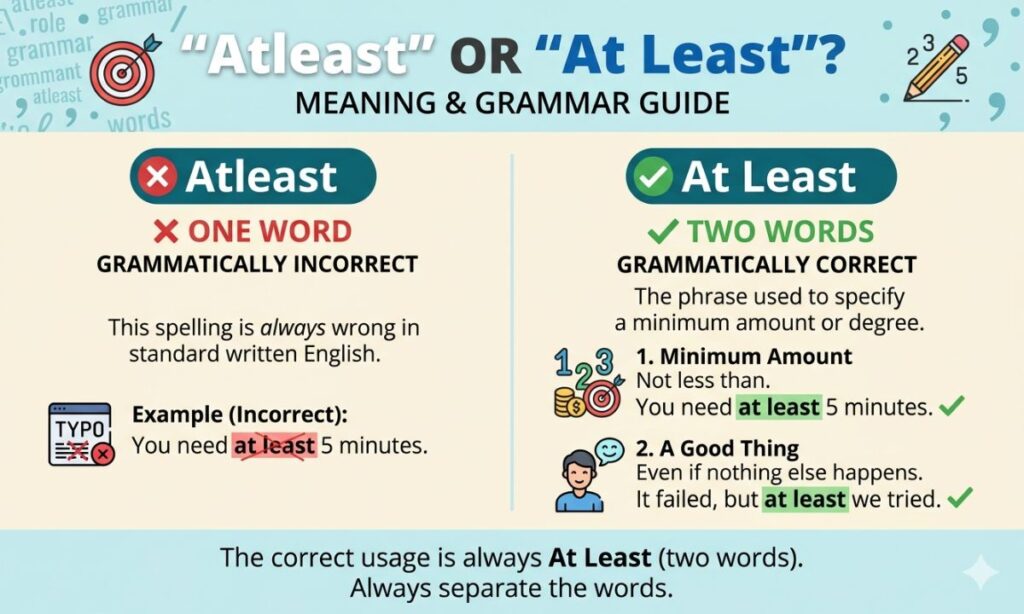
Since the debate of atleast or at least often comes down to meaning and grammar, let us look at the phrase more closely from both angles.
Meaning: The phrase at least carries two primary meanings in English:
- Minimum amount or number: It signals the lowest acceptable quantity, degree, or extent of something. Example: “You must attend at least three sessions to qualify.”
- Consolation or silver lining: It highlights a positive point within a difficult or disappointing situation. Example: “The flight was delayed, but at least our luggage arrived safely.”
Collins English Dictionary notes that the extended forms “at the least” and “at the very least” are also accepted and used to add further emphasis to a minimum condition.
Grammar: The word “atleast” has zero grammatical standing. It is not a preposition, an adverb, an adjective, or any recognized part of speech. Editors, teachers, and grammar authorities uniformly treat it as a misspelling. If you use “atleast” in a professional context, such as a resume, a business proposal, or an academic paper, it will signal careless writing and reduce your credibility instantly.
Here is a breakdown of the grammatical structure:
| Word | Part of Speech | Role in Phrase |
| at | Preposition | Marks position or condition |
| least | Adjective/Adverb/Noun | Signals the minimum |
| at least (together) | Adverbial phrase | Modifies verbs, adjectives, or clauses |
The takeaway from this atleast or at least grammar analysis is clear: two words, one meaning, zero exceptions.
Atleast or At Least Symbol
Many students and professionals encounter the atleast or at least question not just in language arts but also in mathematics and logic. In these fields, “at least” has a precise symbolic representation.
In mathematics, at least means “greater than or equal to.” It is represented by the symbol ≥.
So when a math problem says “x is at least 5,” it translates into the inequality:
x ≥ 5
This means x can be equal to 5, or it can be any value larger than 5. The symbol ≥ captures both possibilities, which is exactly what “at least” means in plain language.
Here is a helpful reference table for inequality symbols and their everyday English equivalents:
| English Phrase | Math Symbol | Meaning |
| At least | ≥ | Greater than or equal to |
| At most | ≤ | Less than or equal to |
| More than | > | Strictly greater than |
| Less than | < | Strictly less than |
| Exactly | = | Equal to |
Understanding this symbol connection is particularly useful in algebra, probability, and data analysis. For example, in probability, “the probability of at least one success” refers to one or more successes occurring, which mathematically means P(X ≥ 1).
So whether you are writing an essay or solving an equation, at least (never atleast) is the correct and universally recognized form.
Examples of Using “At Least” in a Sentence
The best way to master atleast or at least is to see the correct form used naturally across a variety of contexts. The following examples cover everyday conversation, academic writing, professional communication, and more.
Everyday Conversation:
- “You should drink at least eight glasses of water every day.”
- “Call me at least once a week so I know you are okay.”
- “The drive will take at least two hours with traffic.”
- “She has visited that café at least a dozen times.”
Expressing a Silver Lining:
- “We lost the match, but at least everyone played their best.”
- “The restaurant was fully booked, but at least we found a great spot nearby.”
- “He missed the train, but at least he finished his report while waiting.”
Academic and Professional Writing:
- “Participants must complete at least three out of five modules to receive certification.”
- “The study required at least 100 respondents to be statistically valid.”
- “Candidates should have at least five years of relevant industry experience.”
Setting Conditions or Requirements:
- “You need to score at least 70 percent to pass the exam.”
- “The package weighs at least five kilograms.”
- “Please arrive at least 15 minutes before the meeting starts.”
Softening or Qualifying a Statement:
- “I am not sure he is right, but at least his argument is well-structured.”
- “The weather was terrible, at least for the first few days.”
- “At least we tried our best, and that is all we can ask for.”
Notice how in every sentence above, the phrase at least appears as two separate words. There is no version of these sentences where “atleast” would be acceptable. The answer to atleast or at least is always the same: two words, every time.
Atleast vs. At Least in UK and US English
One common follow-up question in the atleast or at least debate is whether the answer differs between British and American English. The short answer is no. Both UK and US English agree completely on this point.
In British English, as confirmed by Oxford and Cambridge, “at least” is the only recognized spelling. British grammar authorities treat “atleast” as a straightforward spelling error with no dialectal exceptions.
In American English, as confirmed by Merriam-Webster and the AP Stylebook, the same rule applies. “At least” is correct; “atleast” is a mistake. There is no regional American dialect or informal register that legitimizes the single-word spelling.
Here is a comparison table to put this clearly:
| Variety of English | Correct Form | Incorrect Form |
| British English (UK) | at least | atleast |
| American English (US) | at least | atleast |
| Australian English | at least | atleast |
| Canadian English | at least | atleast |
| International English | at least | atleast |
Some learners wonder if “atleast” might be accepted in informal writing, social media, or texting. While social media is more forgiving of unconventional spellings, using “atleast” still marks a gap in grammar knowledge. If you are writing anything beyond a casual personal text, always go with at least.
The bottom line: atleast or at least is not a regional debate. It is a matter of correct versus incorrect, and the correct answer is identical in every English-speaking country around the world.
Other Correct Ways of Saying: “At Least”
If you want to add variety to your writing and avoid repeating atleast or at least too frequently, English gives you several strong alternatives. Each synonym carries a slightly different shade of meaning, so choosing the right one depends on the context of your sentence.
Synonymous Terms
Here are the most commonly used alternatives to “at least,” along with their tones and uses:
| Synonym | Tone | Best Used For |
| At the minimum | Formal | Professional and academic writing |
| No less than | Formal | Stating requirements or standards |
| At the very least | Emphatic | Expressing the bare minimum with force |
| Not less than | Neutral/Legal | Contracts, legal documents, formal writing |
| Minimum of | Neutral | Quantitative contexts, numbers |
| If nothing else | Conversational | Highlighting one positive in a negative situation |
| In any case | Casual/Concessive | Pivoting from a negative to a positive point |
| Leastways / Leastwise | Informal/Colloquial | Casual spoken English (more common in British dialects) |
Example Sentences
Below are example sentences showing how each synonym works as a natural replacement for at least:
At the minimum: “You should exercise at the minimum three times a week for noticeable health benefits.”
No less than: “The contract requires a notice period of no less than 30 days before termination.”
At the very least: “You could at the very least send a thank-you message after someone does you a favor.”
Not less than: “The report must contain not less than 2,000 words to meet submission requirements.”
Minimum of: “Applicants must have a minimum of two years of teaching experience.”
If nothing else: “If nothing else, the project taught us how to manage our time more effectively.”
In any case: “The event might be cancelled, but in any case, we should stay prepared.”
Leastways / Leastwise: “I think it worked out fine, leastways that is how it seemed from where I was standing.”
Each of these alternatives can help you avoid repetition and keep your writing fresh. However, remember that none of them replace “at least” in every context. Always choose the synonym that best fits the tone and purpose of your sentence.
Frequently Asked Questions (FAQs)
Q1: Is “atleast” ever correct in English?
No. “Atleast” is never correct in any variety of English. The only accepted form is “at least,” written as two separate words.
Q2: Why do so many people write “atleast” instead of “at least”?
Because in fast, natural speech, the two words blend together and sound like one. This phonetic habit carries over into writing, creating one of the most common spelling errors in English.
Q3: What does “at least” mean in grammar?
It is an adverbial phrase that expresses a minimum amount, number, or condition, or introduces a positive observation in a negative situation.
Q4: What is the mathematical symbol for “at least”?
The symbol is ≥ (greater than or equal to). For example, “x is at least 5” is written as x ≥ 5.
Q5: Can “at least” be used in formal writing?
Yes, absolutely. “At least” is appropriate and standard in both formal and informal writing, academic papers, business emails, and everyday conversation.
Q6: What is the opposite of “at least”?
The opposite is “at most,” which means “no more than” and is represented by the symbol ≤ in mathematics.
Q7: Is “at the least” the same as “at least”?
Yes. “At the least” and “at the very least” are extended forms of the same phrase and carry the same meaning, often with added emphasis.
Q8: Can I use “if nothing else” instead of “at least”?
Yes, in conversational contexts. “If nothing else” works well when you want to highlight one positive element in a difficult situation.
Q9: Does “at least” always come before a number?
No. While it often precedes a number or quantity, it can also appear in other positions to qualify or soften a statement, as in “at least we tried.”
Q10: Is “atleast” accepted on social media or in texting?
Informally, readers may understand it, but it still signals a spelling error. Developing the habit of writing “at least” correctly benefits your communication in all settings.
Conclusion
The debate between atleast or at least has one definitive winner: at least, always written as two words. This conclusion holds true in every English dialect, every style guide, every grammar rulebook, and every dictionary on the planet.
“Atleast” is simply a misspelling that arises from how naturally the phrase flows in spoken English. But the written language demands precision, and precision here means keeping “at” and “least” as two separate words, every single time.
Remember: “at least” functions as an adverbial phrase that establishes a lower limit, expresses a minimum requirement, or introduces a silver lining. In mathematics, it corresponds to the ≥ symbol. In everyday writing, it is one of the most versatile and useful phrases in the English language.
The next time you catch yourself wondering about atleast or at least, think of the simple rule: two beats, two words. “At” needs its own space, just like any preposition does. Give it that space, and your writing will always be correct, professional, and clear.
Now that you know the answer to the atleast or at least question, you can write with full confidence. No hesitation, no second-guessing, just clean and accurate English every time.