
Have you ever typed a word and then stared at it wondering, “Wait, is that even right?” That exact moment happens to thousands of people every day with the words catagory vs category. At first glance, both versions may look like they could work. But the truth is surprisingly straightforward: only one of them is a real English word, and this article will make sure you never mix them up again.
Whether you are a student working on an assignment, a professional drafting a report, or a content writer optimizing a page, knowing the correct spelling of this word matters more than you might think. A single spelling error can undermine your credibility, get flagged by spellcheck tools, and confuse your readers. So, if you have been searching to resolve the catagory vs category debate once and for all, you are in exactly the right place.
This guide covers the correct spelling, the full meaning, the grammatical structure, the etymology, the difference between categorical and category, the difference between categorised and categorized, synonyms, antonyms, and real example sentences. By the end, catagory vs category will never be a question in your mind again.
Catagory Vs Category, Which One Should You Use In Writing?
The answer is short and definitive. You should always use category in your writing. The spelling “catagory” is a misspelling and does not appear in any standard English dictionary, whether British, American, or Australian.
Here is a quick reference table to settle the catagory vs category debate at a glance:
| Term | Correct? | Notes |
| Category | Yes | The only accepted spelling in English |
| Catagory | No | A common misspelling, not a real word |
| Categories | Yes | Correct plural form |
| Catagories | No | Incorrect plural based on the misspelling |
The confusion between catagory vs category arises because of the way the word sounds when spoken aloud. The second syllable is not strongly stressed, so it sounds almost like “uh” rather than a clean “e” sound. This phonetic ambiguity leads many writers to replace the letter “e” with the letter “a,” producing the incorrect “catagory.” The problem is entirely pronunciation-based, not logic-based.
Think of other commonly confused spellings that follow the same pattern. People write “Febuary” instead of “February” or “libary” instead of “library” for exactly the same reason: the spoken version blurs a letter that the written version requires. The catagory vs category confusion fits squarely into this category of pronunciation-driven spelling errors.
The simple fix? Whenever you write this word, remember that the correct version contains the letters C-A-T-E-G-O-R-Y. No repeated vowels. The vowels appear in this order: A, E, O, Y. If you see two A’s, you know you have made the mistake.
Read This: Implicit vs Complicit: Clear Differences Explained With Practical Examples
Which is Correct, Catagory or Category?
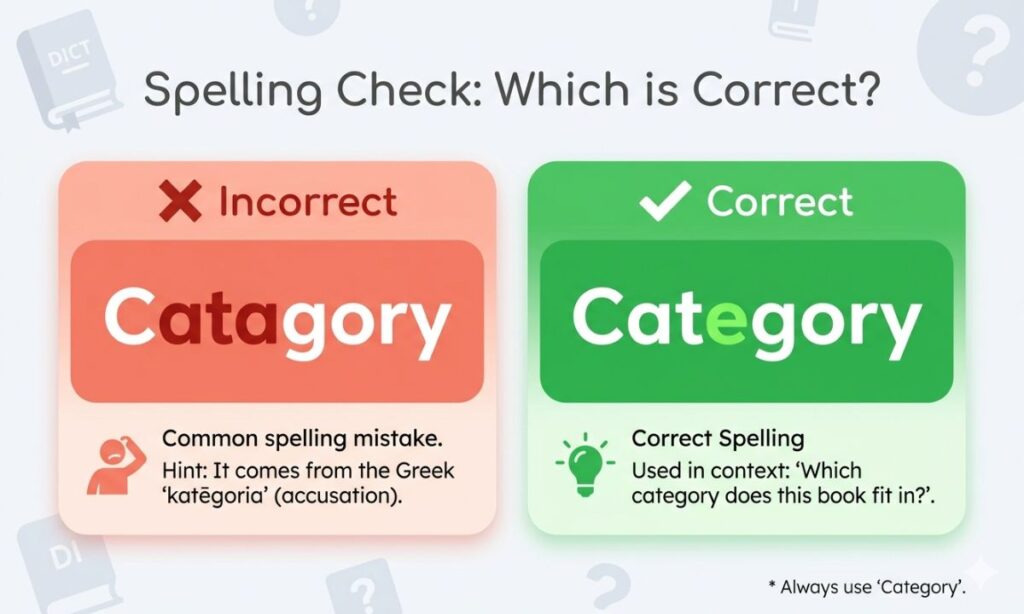
Category is correct. Catagory is not.
This is not a British English vs American English distinction. It is not a formal vs informal usage question. It is simply a right vs wrong spelling situation. In every English-speaking region of the world, from the United Kingdom and the United States to Canada, Australia, New Zealand, and South Africa, the correct and accepted spelling is category.
When you type “catagory” in any modern word processor, grammar tool, or search engine, it will be flagged or auto-corrected immediately. That is because spell checkers recognize it as an error rather than an alternate regional form. The catagory vs category question has only one correct answer, and it is always category.
A memory trick that actually works:
Inside the word “category” you can find the name “Cate.” Think of a person named Cate who loves to organize and group things together. Cate puts everything in its proper category. If you can picture Cate doing the grouping, you will always remember that the correct spelling starts with C-A-T-E, not C-A-T-A.
Another trick: check whether any vowel repeats. The word category has four vowels: A, E, O, and Y. None of them repeats. If you have written two A’s, you have written the wrong word.
What is the Difference Between Categorical and Category?
Many writers also get confused between “categorical” and “category.” While these two words share the same root, they serve completely different grammatical functions and carry different meanings in use.
| Term | Part of Speech | Meaning |
| Category | Noun | A group or class of things sharing common features |
| Categorical | Adjective | Absolute, unconditional, or relating to a category |
Category is a noun. It names a group or classification. You place things into a category.
Categorical is an adjective. It describes something that is unconditional or absolute. A categorical statement leaves no room for doubt. A categorical denial means an outright rejection with no qualifications attached.
Here is the key insight: when something is “categorical,” it does not merely mean “relating to one category.” Rather, it means “asserting absolutely” or “without any conditions.” This usage traces back to the word’s philosophical origins in ancient Greek logic, where a categorical proposition was one that made a direct, unqualified claim.
Examples:
- The school placed the students into a new category based on reading levels. (noun)
- The spokesperson issued a categorical denial of all allegations. (adjective, meaning absolute)
- This product belongs to the category of organic skincare. (noun)
- The board gave a categorical refusal to the proposed merger. (adjective, meaning unconditional)
So when you are choosing between these two words, ask yourself: am I naming a group or classification (use “category”) or am I describing something as absolute and unqualified (use “categorical”)?
Meaning
The word category refers to a class, division, or group of things that share common characteristics, features, or qualities. It is used to organize information, objects, ideas, or people into structured groups so that they can be more easily understood, discussed, or compared.
In everyday language, a category helps us make sense of the world by grouping similar things together. When you browse an online store, you see product categories like “Electronics,” “Clothing,” and “Books.” When a teacher grades student performance, they may use categories like “Excellent,” “Satisfactory,” and “Needs Improvement.” These groupings exist to bring order and clarity to complex sets of information.
In philosophy, the word carries a deeper and more technical meaning. Aristotle used it to describe the highest-level classes under which all things could be organized. In this sense, a category was not just a practical grouping but a fundamental way of understanding reality itself.
In modern usage, the definition of category covers several contexts:
- General use: A class or group based on shared features
- Philosophical use: A fundamental mode of classification in logic
- Mathematical use: A structure consisting of objects and their relationships
- Grammatical use: A class of linguistic units sharing similar properties
No matter the context, the word category always carries the core idea of classification and grouping. And as always, when writing this word, remember the catagory vs category rule: only category is correct.
Grammatical Structure
Understanding how “category” works grammatically will help you use it correctly in any sentence. Here is a detailed breakdown:
| Feature | Detail |
| Word Type | Noun |
| Noun Type | Common noun |
| Singular Form | Category |
| Plural Form | Categories |
| Related Adjective | Categorical |
| Related Verb | Categorize (American) / Categorise (British) |
| Related Noun (action) | Categorization / Categorisation |
| Capitalization | Not capitalized unless starting a sentence or in a title |
Category is a common noun, meaning it refers to a general concept rather than a specific named thing. Because it is a common noun, it follows standard noun rules:
- It takes articles: “a category,” “the category”
- It has a plural form: “categories” (formed by changing the Y to I and adding ES)
- It can be modified by adjectives: “a broad category,” “a specific category,” “a new category”
- It can function as the subject or object of a sentence
One important grammatical note: category cannot function as a verb on its own. If you want to describe the action of placing something into a group, you must use the verb form “categorize” (American English) or “categorise” (British English).
The catagory vs category confusion never appears in the plural form either, since “catagories” is just as wrong as “catagory.” The only correct plural is categories.
What is the Difference Between Categorised and Categorized?
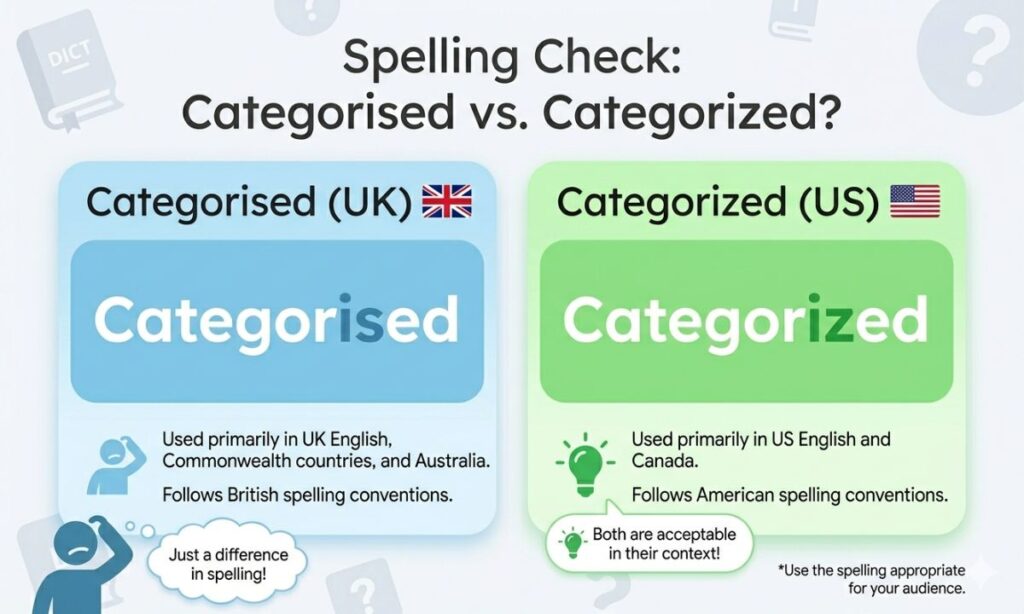
This is a valid question that trips up many writers, especially those who write for international audiences. Here is the straightforward answer:
Categorised and categorized mean exactly the same thing. Both words are the past tense of the verb meaning “to place something into a category or group.” The only difference between them is regional spelling preference.
| Spelling | Region | Status |
| Categorized | American English | Preferred in the USA |
| Categorised | British English | Preferred in UK, Australia, NZ |
| Categorized | International | Gaining global acceptance |
The “ize” vs “ise” distinction is a well-known difference between American and British English. American English almost always uses “ize” endings (categorize, organize, recognize), while British English uses “ise” endings (categorise, organise, recognise). Neither is more correct than the other in an absolute sense. The correct choice depends entirely on which variety of English your audience expects.
This distinction is completely different from the catagory vs category debate. With catagory vs category, only one spelling is correct for everyone. With categorised vs categorized, both spellings are correct, just in different regions.
Practical guidance:
- Writing for an American audience? Use categorized
- Writing for a British, Australian, or New Zealand audience? Use categorised
- Writing for a global audience? Either is acceptable, but stay consistent throughout your piece
Etymology
The history of the word category is fascinating and traces back over two thousand years to ancient Greek philosophy.
The word comes from the Greek kategoria, which originally meant “accusation” or “a charge made against someone.” The root combines kata (meaning “against” or “down”) and agoreuein (meaning “to speak in the assembly” or “to declare publicly”), which itself derives from agora, the public marketplace in ancient Greek cities where citizens gathered to discuss matters of public concern.
Over time, the great philosopher Aristotle adapted kategoria to mean a predicate in a logical statement. He used it to classify the different types of things that could be said about a subject. Through his influential work “Categories,” Aristotle identified ten fundamental categories of being: substance, quantity, quality, relation, place, time, position, state, action, and passion.
The word moved from Greek into Late Latin as categoria, and from there into Old French as categorie, before arriving in English around the late 15th and early 16th century. By the 1660s, the modern general meaning of “any broad and distinctive class of things” had become established in common usage.
The journey from “public accusation” to “organized group or classification” reflects how language evolves over centuries of philosophical and practical use. The letter K of the Greek original was replaced by C in Latin, and that is the form that survived into modern English.
Understanding this etymology also makes the catagory vs category issue clearer. The second syllable of the word comes from the Greek root “kate” or “cate,” not “cata.” So when you write “catagory,” you are not just making a spelling mistake; you are also distorting the word’s historical root. The correct spelling, category, honors the original Greek and Latin forms.
Synonyms
Words that carry a similar meaning to category include:
- Class
- Group
- Division
- Classification
- Section
- Type
- Kind
- Bracket
- Genus
- Cluster
- Tier
- Heading
- Compartment
- Subdivision
- Rank
Each of these synonyms can substitute for category in different contexts, though “category” remains the most neutral and widely applicable term for general classification.
Antonyms
Words that convey the opposite concept of category (in the sense of organized grouping) include:
- Mixture
- Miscellany
- Disorder
- Jumble
- Chaos
- Hodgepodge
- Randomness
- Ambiguity
- Vagueness
- Disorganization
These antonyms reflect the idea of things that lack clear classification or grouping, the opposite of what a category provides.
Similar Words
Words that are closely related to category and often appear in the same context include:
| Word | Relationship to Category |
| Categorical | Adjective form: relating to or absolute |
| Categorize | American English verb: to assign to a group |
| Categorise | British English verb: to assign to a group |
| Categorization | Noun: the process of assigning to categories |
| Subcategory | A smaller division within a broader category |
| Recategorize | To reassign to a different group |
| Uncategorized | Not yet assigned to any group |
Understanding these related words will expand your vocabulary and help you use category and its forms with greater precision and confidence.
Usage
The word category is remarkably versatile. It fits naturally into academic writing, professional communication, casual conversation, and digital content. Below are the most common contexts where you will encounter it:
Academic writing: Researchers use categories to organize data, classify study participants, and group findings under thematic headings.
Business and marketing: Companies organize products and services into categories to help customers find what they need. Think of the product categories on an e-commerce platform.
Technology: Software developers use categories and subcategories to organize databases, content management systems, and app navigation menus.
Education: Teachers group students by skill level, subjects are organized into academic categories, and exam questions fall into knowledge categories.
Everyday conversation: People refer to categories when discussing types of food, music genres, personality types, and more.
No matter the context, the spelling rule from the catagory vs category comparison always applies: use category, never “catagory.”
Sentences With Category
Here are clear, natural example sentences that show how to use category correctly across a range of contexts:
- The library organizes every book into a specific category so visitors can find titles easily.
- This product falls into the category of luxury skincare items.
- The government has created a new category for renewable energy subsidies.
- She finished first in her age category at the regional marathon.
- The research paper analyzed data from three broad category types.
- His response to the question did not fit neatly into any single category.
- The online store added a new category for sustainable clothing brands.
- Teachers can place assignments into any category they choose within the grading software.
- That film belongs to the category of psychological thrillers, not horror.
- The committee debated which category best described the new policy proposal.
- Understanding the catagory vs category spelling rule will make you a more confident writer.
- Each product in the catalog has been assigned to exactly one category for clarity.
- A hurricane can be assigned to a category based on its wind speed.
- The budget was split across five category headings.
- No item should be listed without being placed into the correct category.
Notice how naturally “category” integrates into all these sentences. The word “catagory” would never fit because it simply does not exist.
People Also Ask
Is “catagory” ever correct? No. Catagory is always a misspelling. The correct word is category in all contexts and regions.
What is the plural of category? The plural of category is categories, formed by changing the Y to I and adding ES.
Can category be used as a verb? No. Category is a noun only. To describe the action of classifying, use the verb “categorize” (American) or “categorise” (British).
Is the catagory vs category issue a British vs American English difference? No. Unlike categorised vs categorized, the catagory vs category issue is not regional. Catagory is simply wrong in all forms of English.
What is a categorical statement? A categorical statement is one that is absolute and unconditional, leaving no room for exceptions or conditions.
Why do people spell category as catagory? The confusion arises because when “category” is spoken quickly, the second syllable sounds like “uh,” making it easy to assume the letter is “a” rather than “e.”
Is catagory in any dictionary? No. Catagory does not appear in any recognized English dictionary, including Merriam-Webster, Oxford, Collins, or Cambridge.
What is the difference between a category and a subcategory? A category is the main group or classification, while a subcategory is a smaller, more specific division within that larger group.
What part of speech is categorical? Categorical is an adjective. It means absolute, unconditional, or relating to a category.
How do I remember the correct spelling of category? Remember: C-A-T-E-G-O-R-Y. Find the name “Cate” at the beginning. No vowel repeats. The vowels go A, E, O, Y in order.
Read This: Dysregulated vs Disregulated: How Are These Words Connected?
Final Thoughts
The catagory vs category question is one of those spelling debates that has a perfectly clear answer: category is always correct, and “catagory” is always wrong. There is no gray area, no regional exception, and no context where the misspelling becomes acceptable.
This article has taken you through every dimension of this word. You now know that catagory vs category is not a matter of British vs American English, but a straightforward case of correct vs incorrect spelling. You have explored the full meaning of category, its grammatical structure, its deep etymological roots in ancient Greek philosophy, its relationship to words like “categorical,” and the legitimate regional difference between “categorised” and “categorized.”
The catagory vs category rule is simple to remember once you know the tricks: find the name “Cate” in the word, check that no vowel repeats, and recall that the second syllable is spelled with an E, not an A. These memory anchors will keep you on the right side of this debate for life.
Every time you write this word from now on, the answer is category, not catagory. Keep that truth in mind, share it with other writers who struggle with the same confusion, and use the word with the confidence that comes from knowing you have it exactly right.