
Have you ever been in the middle of writing something important and paused to ask yourself: should I say implicit or complicit here? You are not alone. These two words trip up even experienced writers because they sound just similar enough to be confusing. But make no mistake, implicit vs complicit are not interchangeable. They refer to completely different things, and mixing them up can dramatically change your intended meaning.
Whether you are writing a legal document, a research paper, an ethical argument, or simply trying to express yourself clearly in everyday conversation, knowing the difference between implicit vs complicit matters. This guide gives you clear definitions, practical sentence examples, common mistakes to avoid, and a comparison table that makes the distinction stick for good.
By the end of this article, you will feel completely confident choosing between implicit vs complicit in any context.
Understanding Implicit vs Complicit: Key Differences
Before going deeper into each word individually, here is the fastest way to understand the implicit vs complicit distinction at a glance.
Implicit is about communication and meaning. It describes something that is suggested, hinted at, or understood without being directly stated. It lives in the world of language, tone, and subtext.
Complicit is about behavior and responsibility. It describes someone who knowingly participates in or allows a wrongdoing to happen. It lives in the world of ethics, law, and moral accountability.
One word is about what is communicated indirectly. The other is about who shares guilt in a harmful act. That is the core of the implicit vs complicit comparison.
Here is a simple breakdown before we go further:
| Feature | Implicit | Complicit |
| Part of Speech | Adjective | Adjective |
| Core Meaning | Implied or indirectly expressed | Involved in wrongdoing |
| Related to | Communication, meaning, subtext | Ethics, law, responsibility |
| Intent Required | No | Yes |
| Moral Weight | Neutral or situational | Always negative |
| Common Synonyms | Implied, inferred, suggested | Culpable, involved, accessory |
When you are thinking about implicit vs complicit, always ask yourself: am I talking about how something is communicated, or am I talking about someone’s role in a wrongdoing? That single question usually settles it immediately.
Define Implicit
The word implicit is an adjective that means something is implied, suggested, or understood without being directly or openly expressed.
According to Merriam-Webster, implicit means “capable of being understood from something else though not clearly or directly stated.” It also carries a secondary meaning of absolute or unquestioning, as in “implicit trust.”
The word traces back to the Latin verb implicare, which means “to fold in” or “to entangle.” That etymology is telling. When something is implicit, it is folded into the message rather than laid out plainly on top of it.
Think of implicit communication as the subtext beneath the words. When someone says “nice haircut” with a flat tone and raised eyebrows, the implicit meaning might be exactly the opposite of what the words say. No one states the sarcasm outright, but everyone understands it. That is implicit meaning in everyday life.
Implicit operates across several contexts:
- In communication: an implicit message is one the listener must interpret from tone, body language, or context rather than from direct words.
- In bias: implicit bias refers to unconscious attitudes or stereotypes that influence judgment without the person being fully aware of them.
- In trust: implicit trust means complete, unconditional trust that does not need to be proven or stated.
- In agreements: an implicit agreement is one both parties understand without ever spelling it out.
The key feature of implicit is that the understanding does not require a direct statement. It is inferred from context, behavior, or surrounding information. When you master the implicit vs complicit distinction, you start to see how frequently implicit appears in nuanced, thoughtful writing.
Synonyms for implicit: implied, inferred, understood, tacit, suggested, unspoken, inherent, latent, indirect.
Antonyms for implicit: explicit, stated, direct, expressed, clear, overt.
Define Complicit
The word complicit is an adjective that means being involved in or associated with a wrongful, illegal, or unethical act, especially alongside others.
Dictionary.com defines complicit as “choosing to be involved in an illegal or questionable act, especially with others; having complicity.” Merriam-Webster puts it plainly as “helping to commit a crime or do wrong in some way.”
The word arrived in English in the mid-1800s as a back-formation from the noun complicity, which came from the French complicité. Both words trace back to the Latin complicare, meaning “to fold together.” The image here is of people whose fates and actions become intertwined through shared involvement in something wrong.
Being complicit does not necessarily mean you committed the act directly. It means you knew about the wrongdoing and either participated, enabled, covered it up, or simply failed to stop it when you had the power and responsibility to do so. The moral weight of complicit always points toward guilt, accountability, and shared responsibility for harm.
Complicit shows up frequently in:
- Legal contexts: courts determine whether a person was complicit in a crime by evaluating their level of awareness and involvement.
- Ethical debates: organizations, governments, or individuals can be labeled complicit when they benefit from or enable injustice.
- Corporate accountability: companies found complicit in labor violations or environmental damage face legal and reputational consequences.
- Social and political discussions: silence in the face of known abuse or injustice is often described as being complicit.
The critical element that separates complicit from related words is knowledge combined with inaction or participation. Ignorance is typically a defense against being called complicit. If you genuinely did not know something wrong was happening, you are not complicit. But if you knew and said nothing, did nothing, or actively helped? That is complicity.
Synonyms for complicit: culpable, involved, accessory, guilty, accountable, implicated, party to.
Antonyms for complicit: innocent, uninvolved, ignorant, blameless, clean.
Understanding the full weight of each word makes the implicit vs complicit comparison much more meaningful.
Read This: Ingage vs Engage: Stop Confusing These Two Words Today
How to Properly Use the Words in a Sentence
Getting implicit vs complicit right in a sentence comes down to two things: what meaning you are trying to convey, and what role the word plays in your sentence. Both words function as adjectives, so they modify nouns. But the nouns they modify, and the situations they describe, are very different.
How to Use “Implicit” in a Sentence
When you use implicit in a sentence, you are describing something that is communicated, understood, or present without being openly stated. The word typically modifies nouns like message, meaning, trust, understanding, assumption, bias, warning, threat, agreement, or promise.
Ask yourself: is something being left unsaid but still understood? Is a meaning being conveyed through context rather than words? If yes, implicit is your word.
Here are clear usage patterns:
- Use implicit before a noun to describe something unspoken but understood: “There was an implicit agreement between the two teams.”
- Use implicit to describe a quality that is complete or unconditional: “She placed implicit trust in her mentor.”
- Use implicit to describe biases or attitudes that are unconscious: “The study revealed implicit racial bias in hiring decisions.”
- Use implicitly as the adverb form: “He implicitly agreed by staying silent when asked for objections.”
How to Use “Complicit” in a Sentence
When you use complicit in a sentence, you are making a statement about someone’s moral or legal involvement in wrongdoing. The word typically modifies a person, organization, government, institution, or group. It almost always appears with the preposition “in.”
Ask yourself: did someone know about a wrongful act and participate in it, enable it, or fail to stop it? If yes, complicit is your word.
Here are clear usage patterns:
- Use complicit to describe knowing participation in wrongdoing: “The manager was complicit in the accounting fraud.”
- Use complicit to describe enabling behavior: “By looking the other way, the committee became complicit in the abuse.”
- Use complicit in social and political contexts: “Critics argued the media was complicit in spreading misinformation.”
- Use complicit when silence or inaction contributes to harm: “Her refusal to report what she witnessed made her complicit in the cover-up.”
The implicit vs complicit distinction in sentence construction is actually quite clean once you see the pattern. Implicit belongs to the world of meaning and communication. Complicit belongs to the world of action, knowledge, and responsibility.
More Examples of Implicit and Complicit Used in Sentences
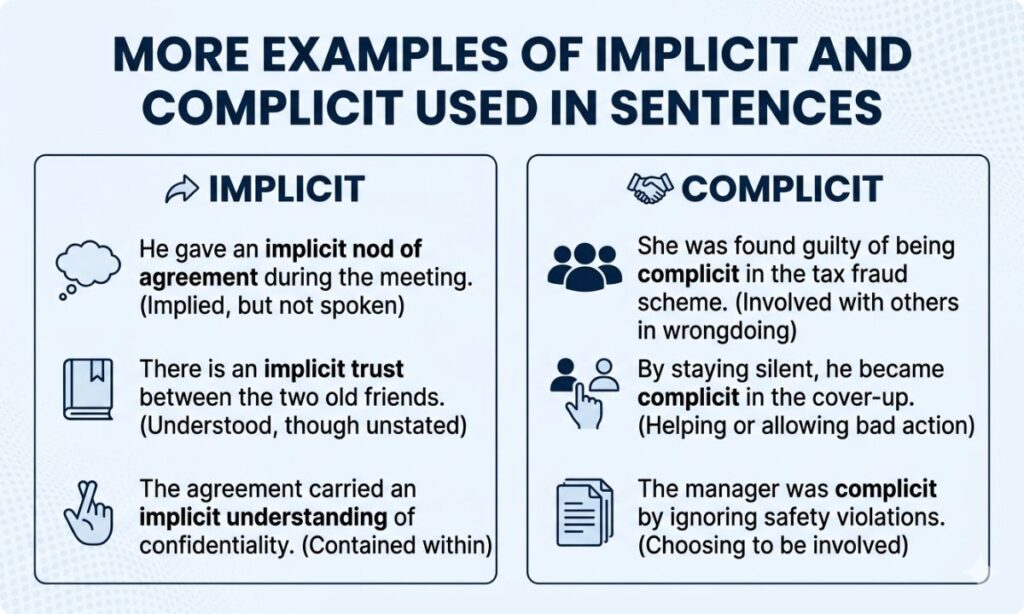
Reading multiple examples is one of the most effective ways to make implicit vs complicit feel natural and automatic. The following examples cover a range of real-world contexts.
Examples of Using Implicit in a Sentence
- The job listing had an implicit requirement for weekend availability, even though it was never written in the posting.
- There was an implicit understanding between the two neighbors that the fence line would never be moved.
- Her body language sent an implicit message of disagreement even while she nodded politely.
- The organization placed implicit pressure on its members to attend every fundraising event.
- He had implicit faith in the medical team handling his recovery.
- The researcher found evidence of implicit stereotyping in how resumes were evaluated.
- The movie’s ending carried an implicit critique of modern materialism.
- Her silence on the subject was itself an implicit form of disapproval.
- A good teacher often uses implicit cues to guide students toward the right answer rather than just giving it.
- There is an implicit social contract between citizens and the government that forms the foundation of civil society.
Examples of Using Complicit in a Sentence
- The board members who knew about the financial irregularities and said nothing were complicit in the fraud.
- Journalists argued that the platform was complicit in the spread of dangerous health misinformation.
- She felt deeply complicit in the situation after realizing she had ignored the warning signs for months.
- The factory’s supply chain partners were found complicit in violating labor rights laws.
- A getaway driver may not have entered the bank, but the law still considers them complicit in the robbery.
- Historians noted that ordinary citizens who remained silent were complicit in allowing the regime to grow stronger.
- The government was accused of being complicit in the environmental violations by refusing to enforce existing regulations.
- He became complicit the moment he agreed to delete the evidence.
- Several senior officials were revealed to be complicit in the disinformation campaign.
- The audit showed that multiple departments had been complicit in misreporting the company’s financial performance.
These examples make the implicit vs complicit divide crystal clear. Implicit connects to communication, tone, and unspoken understanding. Complicit connects to moral responsibility, awareness of wrongdoing, and shared guilt.
Common Mistakes to Avoid
Even skilled writers make errors with implicit vs complicit. Understanding the most common mistakes helps you avoid them entirely.
Using Implicit When Referring to Complicit
This is the most frequent error in the implicit vs complicit pairing. Writers sometimes say “implicit in the crime” when they mean “complicit in the crime.” These two phrases mean completely different things.
“Implicit in the crime” would suggest that something about the crime is implied or understood without being stated, which makes little sense in most contexts.
“Complicit in the crime” correctly says that a person knowingly participated in or enabled it.
The confusion often arises because both words begin with similar sounds. But their meanings are miles apart. Before you use either word, ask: am I talking about implied meaning, or am I talking about someone’s involvement in wrongdoing? The answer will immediately tell you which word belongs in the sentence.
Failing to Recognize the Ethical Implications
When someone calls another person complicit, they are making a serious moral accusation. Complicit is never a neutral term. It always carries weight, judgment, and consequence. Using it carelessly, or applying it to situations that involve no wrongdoing whatsoever, dilutes its power and can also be genuinely unfair to the person being described.
Implicit, on the other hand, is often perfectly neutral. An implicit understanding between friends, an implicit message in a novel, or implicit trust in a colleague carries no negative moral charge unless the context makes it so. Do not assume implicit has the same ethical gravity as complicit. It does not, unless context makes it so.
Overgeneralizing the Concept of Implicit
Some writers treat implicit as a catch-all for anything that is not completely spelled out. That is an overgeneralization. Implicit specifically means that something is communicated or understood indirectly through context, behavior, tone, or surrounding information.
Not every unstated thing qualifies as implicit. If something is simply unknown or absent, it is not implicit. Implicit requires that the understanding actually exists, even without direct expression. There must be enough context for the implied meaning to be genuinely received or recognized. That distinction matters when you are writing carefully about implicit vs complicit or using these terms in professional or academic work.
Context Matters
Both implicit and complicit shift in meaning and weight depending on the context in which they are used. Understanding context is essential to using implicit vs complicit accurately and responsibly.
Legal Proceedings
In legal contexts, implicit vs complicit carries enormous practical weight. Courts regularly examine whether a person was complicit in a crime, meaning whether they knowingly participated in, enabled, or failed to prevent a wrongful act when they were required by law to do so. Being found complicit can result in criminal charges, civil liability, or professional sanctions.
Implicit, in legal settings, appears in phrases like “implicit authority” (authority that is not directly stated but is understood to exist from the nature of a role) or “implicit consent” (agreement that is inferred from behavior rather than stated verbally). Courts analyze implied contracts and implicit understandings all the time. The precise meaning of each word can determine the outcome of a case.
Ethical Dilemmas
In ethical discussions, both words play important roles but in very different ways. A person wrestling with an ethical dilemma might recognize that their continued participation in a flawed system makes them complicit in harm, even if they did not initiate it. This is a common theme in discussions about corporate responsibility, institutional racism, and systemic injustice.
Implicit bias, on the other hand, is a widely studied psychological phenomenon describing unconscious attitudes that affect behavior and judgment without the person’s awareness. The ethical challenge with implicit bias is that it operates below the level of conscious intent, making it harder to identify and address than deliberate discrimination. Implicit vs complicit in ethics often comes down to the role of intention and awareness.
Personal Relationships
In personal relationships, implicit communication does a great deal of heavy lifting. Partners often develop systems of implicit understanding, where a particular look, a silence, or a small gesture carries a clear and agreed-upon meaning that outsiders would never recognize. Implicit expectations in relationships, however, can also cause friction when one person assumes the other understands something that was never stated.
Complicit shows up in relationships when one person enables or looks the other way on harmful behavior. A friend who covers for someone engaging in self-destructive or harmful behavior becomes complicit in that harm over time. Recognizing the implicit vs complicit dynamics within close relationships often requires honest self-reflection.
Societal Issues
At the societal level, the conversation around implicit vs complicit is perhaps most charged. Implicit bias research has shown that deeply embedded social stereotypes can influence institutional decisions around hiring, policing, healthcare, and education without anyone making a consciously discriminatory choice.
Complicit, in societal terms, is used to describe individuals, institutions, and governments that knowingly perpetuate injustice through their silence, inaction, or active participation. Social movements often invoke the concept of complicity to argue that neutrality in the face of documented harm is itself a form of involvement. The implicit vs complicit debate in social justice contexts is nuanced, powerful, and ongoing.
Exceptions to the Rules of Complicit vs Implicit
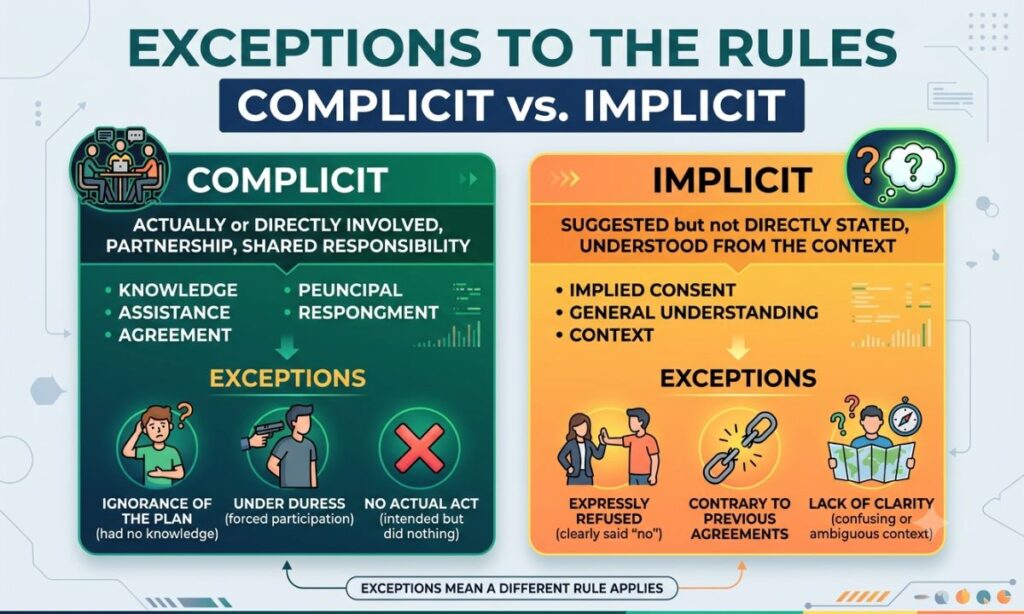
Language rarely operates without exceptions. Here are situations where the usual rules around implicit vs complicit require a bit more flexibility and careful thought.
Cultural Differences
Different cultures have vastly different norms around implicit and explicit communication. High-context cultures, such as many East Asian and Middle Eastern cultures, rely heavily on implicit communication, where meaning is embedded in context, relationships, and indirect suggestion rather than direct speech. What reads as an implicit message in one culture may be entirely explicit in another.
This means that when assessing whether something was implicit in a cross-cultural exchange, you must consider the communicative norms of both parties. What seems like an obvious implicit signal to a Japanese speaker may be completely invisible to someone from a low-context culture like Germany or the United States. Implicit vs complicit analysis must account for this cultural layer.
Legal and Ethical Frameworks
Different legal systems define complicity differently. Common law systems, civil law systems, and religious legal frameworks each have their own thresholds for what constitutes complicit involvement in a wrongful act. In some frameworks, mere knowledge of a crime without reporting it can constitute complicity. In others, active assistance is required before the label applies.
Similarly, ethical frameworks differ on when someone becomes complicit in harm. Utilitarian ethics, deontological ethics, and virtue ethics would each evaluate complicity differently. Always consider which framework is being applied when implicit vs complicit terms arise in formal or professional discussions.
Contextual Ambiguity
Sometimes a situation is genuinely ambiguous, and reasonable people disagree about whether something qualifies as implicit or complicit. For example, was a corporation’s implicit endorsement of a harmful practice enough to make it complicit? The answer may depend on intent, knowledge, and the specific legal and ethical standards in play.
In ambiguous cases, defining your terms carefully and explaining your reasoning is more important than simply choosing one label over the other. Precise writing around implicit vs complicit requires acknowledging complexity when it exists.
Individual Communication Styles
Some people communicate almost entirely through implicit channels, rarely stating anything directly. For them, implicit messages are the norm, not the exception. Others communicate in a highly explicit style and may miss or misread implicit signals entirely. Recognizing this variation helps writers and communicators avoid the assumption that a message was understood just because it was implicit.
This has practical consequences for questions of complicity too. Someone who missed an implicit signal that wrongdoing was occurring may argue, sometimes legitimately, that they could not be complicit in something they genuinely did not detect.
Evolving Language Usage
Language changes over time, and both implicit and complicit have seen their usage evolve. Complicit, in particular, saw a massive surge in popular usage during the mid-2010s as it became a common term in political and social justice discourse. As words become more widely used, their precise definitions sometimes stretch or blur in everyday speech.
Being aware of this drift helps you use implicit vs complicit with precision, especially in professional or academic writing where exact meaning matters.
Quick Comparison Table of Implicit vs Complicit
The table below puts the most important distinctions side by side for fast, easy reference.
| Category | Implicit | Complicit |
| Definition | Implied or understood without being directly expressed | Involved in or participating in a wrongful act |
| Part of Speech | Adjective | Adjective |
| Ethical Weight | Neutral (context-dependent) | Always negative |
| Requires Intent | No | Yes |
| Key Context | Communication, language, meaning | Law, ethics, accountability |
| Typical Preposition | Implicit in (something), implicit trust | Complicit in (wrongdoing) |
| Common Collocations | Implicit bias, implicit trust, implicit agreement, implicit understanding | Complicit in fraud, complicit in a cover-up, complicit in silence |
| Adverb Form | Implicitly | Complicitly (rare) |
| Noun Form | Implicitness | Complicity |
| Opposite | Explicit | Innocent / uninvolved |
| Can Describe Objects/Ideas? | Yes | Rarely (usually people or institutions) |
| Legal Significance | Moderate (implied contracts, consent) | High (criminal liability, civil suits) |
Frequently Asked Questions
What is the simplest difference between implicit and complicit? Implicit means something is suggested or understood without being stated. Complicit means someone knowingly participated in or enabled a wrongdoing.
Can a person be both implicit and complicit in something? Not in the same sense. A person can communicate implicit messages while also being complicit in wrongdoing, but the two words describe separate things.
Is implicit always neutral? Mostly yes, but context can give it a negative tone, such as “implicit threat” or “implicit bias.”
Is being complicit the same as being guilty? Not exactly. Complicit indicates shared responsibility or involvement in wrongdoing, but legal guilt depends on jurisdiction and specific circumstances.
What is an implicit bias? An unconscious attitude or stereotype that influences judgment and behavior without the person’s full awareness.
Can silence make someone complicit? Yes. If a person with knowledge and responsibility fails to act on known wrongdoing, many ethical and legal frameworks consider them complicit.
Are implicit and explicit opposites? Yes. Explicit means directly stated; implicit means indirectly expressed.
Can organizations be complicit? Absolutely. Companies, governments, and institutions are regularly described as complicit when they knowingly enable or benefit from harmful practices.
Read This: Studder or Stutter: The Correct Spelling Everyone Gets Wrong
Conclusion
The implicit vs complicit comparison comes down to one fundamental distinction: communication versus conduct. Implicit lives in the realm of language, tone, and unspoken understanding. Complicit lives in the realm of moral responsibility, knowledge, and shared guilt in wrongdoing.
Getting implicit vs complicit right in your writing shows precision, care, and genuine command of the English language. Whether you are navigating a legal document, an ethical argument, a piece of journalism, or a personal conversation, choosing the correct word signals that you understand not just what each word means, but why the distinction matters.
The next time you reach for implicit vs complicit, pause for a second and ask: am I describing something that is communicated indirectly, or am I describing someone’s knowing involvement in a wrongful act? That question, asked honestly, will lead you to the right word every single time.
Master implicit vs complicit today and your writing will be sharper, clearer, and far more credible in any context.