
If you have ever paused while typing an email and wondered whether you should write “filling” or “filing,” you are not alone. These two words look almost identical, sound nearly the same when spoken quickly, and yet they mean completely different things. Mixing them up can change the entire meaning of a sentence, confuse your reader, and even make professional documents look careless.
This guide breaks down the Filling vs Filing debate in plain, simple language. By the end, you will know exactly when to use each word, why people confuse them so often, and how to avoid embarrassing mistakes in emails, forms, and official paperwork.
Two Words That Sound Similar but Mean Very Different Things

English is full of word pairs that trip people up, and Filling vs Filing is one of the most common. Both words come from a similar sounding root, both can act as verbs or nouns, and both show up constantly in daily life, whether at the office, at the dentist, or in the kitchen.
But here is the key point: filling is about making something full or adding material inside something, while filing is about organizing, storing, or officially submitting documents. One word relates to substance and space. The other relates to paperwork and order.
Understanding Filling vs Filing properly will help you write with more confidence, avoid awkward errors in professional communication, and sound more polished in everyday conversation too.
Quick Answer: Filling vs Filing Explained Simply
Here is the short version if you are in a hurry.
Filling means putting something inside something else, or making something full. Think of a sandwich filling, a dental filling, or filling out a form.
Filing means arranging, storing, or submitting documents in an organized way. Think of filing taxes, filing a complaint, or filing paperwork in a cabinet.
So when someone asks about Filling vs Filing, the simplest rule is this: if it involves food, dental work, or completing forms, use filling. If it involves documents, records, taxes, or official submissions, use filing.
Read This: Immerse vs Emerse: Stop Confusing These Words Today
Filling vs Filing at a Glance
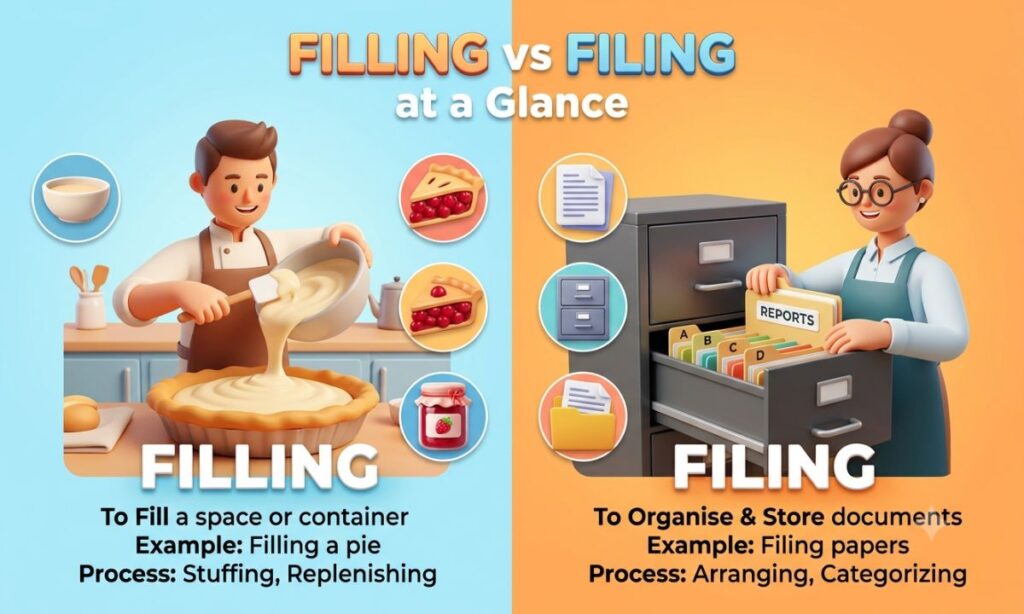
Before diving deeper, it helps to see both words side by side. This quick overview gives you an instant snapshot of how Filling vs Filing differ in meaning, usage, and common examples.
Comparison Table for Instant Clarity
| Feature | Filling | Filing |
| Root word | Fill | File |
| Core meaning | Making something full or adding material inside | Organizing, storing, or submitting documents |
| Word type | Noun, verb (present participle), adjective | Noun, verb (present participle) |
| Common context | Food, dentistry, forms, containers | Offices, taxes, legal records, digital storage |
| Example sentence | She is filling the jar with cookies. | She is filing the report in the cabinet. |
| Related to | Fullness, completion | Files, folders, archives, records |
| Typical setting | Kitchen, dentist office, casual writing | Business, legal, government, administration |
This table makes the Filling vs Filing comparison easy to scan, especially if you are searching for a quick answer before sending an important message.
What Does “Filling” Mean?
The word filling comes from the verb “fill,” which means to make something full or to occupy an empty space. Filling can be used as a noun, a verb, or even an adjective depending on the sentence. It almost always relates to the idea of adding something into a space until that space is no longer empty.
Let’s break down the most common ways filling is used.
Filling as Putting Something Inside Something Else
At its core, filling describes the action of adding material into an empty or open space. This could be liquid going into a container, fabric stuffing going into a cushion, or sand going into a bag.
Examples include:
- He is filling the water bottle before the hike.
- The workers spent the morning filling sandbags.
- She filled the box with old books.
In each case, something is being placed inside another object until it reaches capacity. This is the most literal and widely understood meaning when comparing Filling vs Filing.
Filling in Food and Cooking Contexts
In the kitchen, filling refers to the ingredients placed inside another food item, such as a pie, sandwich, cake, or dumpling. This is one of the most common everyday uses of the word.
Examples include:
- The pie filling was made with apples and cinnamon.
- This sandwich has a chicken and avocado filling.
- The bakery is known for its rich chocolate filling.
Notice that in food contexts, filling is almost always used as a noun describing the contents inside another dish.
Dental Filling Meaning
Another extremely common use of the word appears at the dentist’s office. A dental filling is the material used to repair a tooth after a cavity has been removed. This is one of the clearest examples of filling as a noun referring to a physical substance placed inside a space, in this case, a tooth.
Examples include:
- I need to get a filling replaced next week.
- The dentist used a tooth colored filling for a natural look.
- My filling fell out while eating something hard.
This dental meaning is searched frequently online, and it remains firmly on the “filling” side of the Filling vs Filing comparison, never the “filing” side.
Filling in Forms and Everyday Language
This is where a lot of confusion begins. When you complete the blanks on a document, you are filling in the form. This describes the action of writing information into empty spaces.
Examples include:
- Please start filling in your details on page two.
- She spent twenty minutes filling out the application form.
- I am filling in the survey right now.
Filling in a form refers to the act of writing or entering information. It does not refer to submitting that form officially. That distinction becomes important once we look at filing.
What Does “Filing” Mean?
The word filing comes from the verb “file,” which traces back to the idea of arranging papers on a thread or string in a particular order. Over time, this evolved into the modern meaning of organizing, storing, or officially submitting documents and records.
Filing almost always relates to paperwork, records, official processes, or systems of organization, whether physical or digital.
Filing Documents and Records
The most basic meaning of filing involves placing documents into a system where they can be easily found later. This might be a physical filing cabinet, a folder, or a digital storage system.
Examples include:
- The assistant spent the afternoon filing client records.
- All invoices are filed alphabetically by company name.
- She is filing old contracts into the archive room.
This sense of filing is central to office work and administrative tasks everywhere.
Filing Taxes and Legal Usage
One of the most searched uses of this word relates to taxes and legal matters. When you file taxes, you officially submit your tax return to the relevant government authority. This is a formal action with legal weight, not simply writing information on a form.
Examples include:
- We need to file our taxes before the April deadline.
- He filed a complaint with the regulatory authority.
- The company filed for bankruptcy last year.
- Millions of people file their tax returns online every season.
In legal contexts, filing always refers to the official act of submission, recording, or registering something with an authority such as a court, government office, or regulatory body.
Filing in Workplace and Administrative Communication
In offices, filing is often part of someone’s daily job description. Administrative staff are frequently responsible for organizing paperwork, maintaining records, and ensuring documents are easy to retrieve.
Examples include:
- Her main responsibilities include filing, scheduling, and answering phones.
- The new intern is learning the filing system this week.
- Proper filing reduces the risk of losing important documents.
This usage appears constantly in job postings, training manuals, and workplace communication, making it one of the most practical examples in the Filling vs Filing discussion.
Digital Filing and Modern Document Management
Filing is no longer limited to paper and cabinets. In modern workplaces, filing often means organizing digital files into folders, naming them consistently, and storing them on cloud platforms or internal servers.
Examples include:
- The company switched to a digital filing system last year.
- All reports are filed automatically into shared drives.
- Digital filing has made document retrieval much faster.
Even though the tools have changed, the core idea remains the same: filing is about order, structure, and easy access to information later on.
Why People Confuse Filling and Filing
Given how different these meanings are, it might seem strange that anyone confuses Filling vs Filing at all. Yet this mix up happens constantly, even among native English speakers. Here is why.
Pronunciation Similarities
When spoken quickly or casually, “filling” and “filing” can sound almost identical, especially in accents where vowel sounds blend together. The difference between the short “i” sound in filling and the longer “i” sound in filing is subtle, and easy to miss in fast conversation.
English Spelling Patterns
English spelling rules can be inconsistent. Doubling a consonant before adding “ing” is common with short vowel sounds, as in “fill” becoming “filling.” Meanwhile, words ending in a single consonant after a long vowel, like “file,” simply drop the silent “e” and add “ing” to become “filing.” Without knowing this rule, it is easy to guess the wrong spelling.
Common Learner Mistakes
For English language learners, the Filling vs Filing pair is a classic trap. Many learners memorize “filing” for paperwork but accidentally write “filling” because it feels more familiar or because their first language does not distinguish between these sounds as clearly.
Sound vs Meaning Confusion
Ultimately, the confusion comes down to this: the ear hears similar sounds, but the brain needs to apply completely different meanings. Spellcheck tools often do not catch this error either, since both words are spelled correctly on their own, just used in the wrong context.
Filing vs Filling: Key Differences Side by Side
To make the Filling vs Filing distinction even clearer, here is a focused breakdown of how each word behaves in real sentences.
| Aspect | Filling | Filing |
| Relates to | Substance, space, completion | Documents, records, submission |
| Common verbs used with it | Fill, filled, filling | File, filed, filing |
| Typical objects | Cushions, containers, forms, teeth | Cabinets, folders, tax returns, complaints |
| Formality level | Casual to neutral | Often formal or official |
| Legal weight | None | Often legally significant |
Whenever you are unsure which word fits, ask yourself one simple question: am I talking about something becoming full, or something being organized and submitted? That single question solves most Filling vs Filing confusion instantly.
Correct Usage in Real Life Situations
Understanding definitions is helpful, but seeing these words in real contexts makes the difference stick. Let’s look at how Filling vs Filing plays out across different settings.
Office and Business Communication
In professional environments, both words appear often, but in very different tasks.
- The HR department is filing employee records for the new quarter.
- Please continue filling in the spreadsheet with updated figures.
- The manager asked for help filing last month’s invoices.
- She is filling the vacant position with an internal candidate.
Notice how filling here relates to completing a task or occupying a role, while filing relates strictly to documents and records.
Academic Writing and Emails
In academic and formal email writing, precision matters. Using the wrong word can make a message seem unclear or unprofessional.
- I am filing this report under the correct department code.
- Please find the attached form. Kindly begin filling it out today.
- The university requires filing all scholarship applications by Friday.
Here, filing refers to the act of submission or storage, while filling refers to completing the form itself.
Everyday Conversations
In casual speech, filling is far more common simply because it relates to food, containers, and daily tasks.
- This soup is really filling.
- Can you help me fill the tank before we leave?
- I need to fill in for my coworker tomorrow.
Filing rarely comes up in casual conversation unless someone is specifically talking about paperwork, taxes, or legal matters.
Online and Social Media Writing
Online, both words appear frequently, but errors are common because people type quickly without proofreading.
- Just finished filing my taxes, what a relief.
- This burger has the best filling I have ever tasted.
- Filling out job applications all day today.
- Filing a noise complaint with the building manager tonight.
Even in informal online writing, choosing the correct word in the Filling vs Filing pair helps your message read clearly and avoid confusion.
Filling vs Filing in Common Phrases
Certain phrases almost always pair with one word and not the other. Knowing these set expressions makes correct usage almost automatic.
Common phrases with filling:
- Filling in for someone
- Filling out a form
- Filling a position
- Filling a cavity
- Filling a gap
Common phrases with filing:
- Filing a complaint
- Filing taxes
- Filing a lawsuit
- Filing system
- Filing cabinet
If you memorize these common pairings, the Filling vs Filing decision becomes almost instinctive in most everyday writing situations.
Grammar and Usage Rules You Should Know
Beyond meaning, there are a few grammar patterns that help clarify when to use each word correctly.
Verb vs Noun Usage
Both filling and filing can function as the present participle of their root verbs, fill and file. They can also act as nouns describing a result or an activity.
- As a verb: She is filling the cup. He is filing the documents.
- As a noun: The filling tasted sweet. The filing took two hours.
Recognizing whether you need a verb or a noun in your sentence often points you toward the correct word.
Context-Driven Meaning
Since both words can technically appear in similar sentence structures, context is the real deciding factor. The surrounding words usually reveal the intended meaning instantly.
- “She is filling the form” suggests she is writing information into it.
- “She is filing the form” suggests she is submitting or storing it officially.
This is why understanding the full sentence matters more than memorizing isolated words when working through Filling vs Filing.
Sentence Positioning Tips
Filling often appears with prepositions like “in,” “out,” or “up,” especially when referring to forms or containers. Filing more often pairs with prepositions like “with” or “under,” especially in legal and administrative contexts.
- Filling in the blanks
- Filling out a survey
- Filing with the court
- Filing under a specific category
Paying attention to these small prepositions can help confirm whether filling or filing is the correct choice in your sentence.
Memory Tricks to Never Mix Them Up Again
If you struggle with Filling vs Filing, try these simple memory tricks.
- Filling has two L’s, just like the word “full.” Both relate to fullness or completion.
- Filing has one L, just like the word “file.” Both relate to files, folders, and records.
- Think of a sandwich filling versus a filing cabinet. One is something you eat, the other is something you organize.
- Remember the phrase “fill it, file it.” First you fill out the form, then you file it officially.
- If your sentence involves a court, government office, or tax authority, it almost always needs filing, not filling.
Using these tricks consistently will help the Filling vs Filing distinction become second nature over time.
Common Writing Mistakes Related to Filing and Filling
Even experienced writers occasionally slip up. Here are some of the most frequent mistakes people make.
- Writing “I am filling my taxes” instead of the correct “I am filing my taxes.”
- Writing “The documents are filling in the cabinet” instead of “The documents are filed in the cabinet.”
- Writing “Please complete the tax filling” instead of “Please complete the tax filing.”
- Using “filing” when describing food, such as “cake filing” instead of “cake filling.”
- Confusing “filed” and “filled” in past tense sentences, such as “She filled a complaint” instead of “She filed a complaint.”
Spellcheck tools rarely catch these errors because both words exist correctly in the dictionary. The only fix is understanding the meaning behind each word, which is exactly why the Filling vs Filing distinction matters so much in professional writing.
American vs British English Usage
A common question is whether Filling vs Filing usage changes between American and British English. The good news is that the core meanings remain the same across both varieties of English.
In both American and British English, filling refers to substances placed inside something, completing forms, or dental work. Filing refers to organizing or submitting documents and records.
The only minor differences that sometimes appear relate to spelling conventions in related words, such as British English occasionally using slightly different terminology for certain office equipment or tax processes. However, the fundamental Filling vs Filing distinction itself does not change based on regional English variations.
Usage Trends and Search Behavior
Online search data shows that people frequently search for terms like “filling vs filing,” “filing or filling taxes,” and “filling out vs filing a form.” This reflects genuine everyday confusion rather than rare or unusual usage.
Tax season tends to see a spike in searches related to filing, as people want to confirm whether they are filing or filling their tax returns. Meanwhile, searches related to filling tend to remain steady year round, driven largely by food, dental, and form related questions.
This pattern highlights why clear explanations matter. People are not just curious about grammar for its own sake. They want to use the correct word in real situations, often during important tasks like submitting taxes, completing job applications, or writing professional emails.
Filling vs Filing in Professional Writing
In professional and business writing, accuracy matters more than in casual conversation. A single wrong word can make a document look unpolished or even create confusion about what action has actually been taken.
For example, telling a colleague “I have filled the report” suggests something was made full or completed in a different sense, while “I have filed the report” clearly communicates that the report has been submitted or stored in the proper system.
Similarly, instructions like “please fill in the attached form and file it with HR by Friday” use both words correctly within a single sentence, showing exactly how Filling vs Filing can work together when each word is used in its proper place.
Professional writers, HR teams, legal staff, and administrative employees should pay close attention to this distinction, since incorrect usage in official communication can lead to misunderstandings about whether a task has truly been completed or only partially addressed.
Reference Cambridge Dictionary Definitions
According to the Cambridge Dictionary, filling is defined as any material used to fill something, as well as the layer of food inside a sandwich or cake. It also refers to the substance placed in a tooth where decay has been removed.
The Cambridge Dictionary defines filing as the activity of putting documents or electronic information into files, as well as the act of officially recording something, such as accounts or tax returns, with an authority.
These definitions align closely with everything covered in this guide and confirm the clear separation between the two meanings. Filling relates to substance, fullness, and completion, while filing relates to organization, records, and official submission.
Read This: Outting or Outing (2026): Which Spelling Is Correct?
Conclusion
The Filling vs Filing comparison may seem like a small detail, but it plays a real role in clear communication. Filling relates to making something full, adding content inside a space, completing forms, or describing food and dental materials. Filing relates to organizing, storing, and officially submitting documents, especially in legal, tax, and administrative contexts.
Once you understand the root words behind each term, fill for filling and file for filing, the distinction becomes much easier to remember. Pay attention to context, watch for common phrases, and use the memory tricks shared in this guide whenever you feel unsure.
Whether you are writing a casual message, completing a form, or submitting an official document, choosing correctly between Filling vs Filing will help your writing stay clear, accurate, and professional every single time.
Frequently Asked Questions
Is it filing taxes or filling taxes?
It is filing taxes. You file your tax return with the tax authority.
What does filling in a form mean?
It means writing information into the blank spaces on a document.
What is a filing in dentistry?
There is no such thing. The correct dental term is a filling, not a filing.
Can filling be used as a noun?
Yes, filling can describe food contents, dental material, or anything used to fill a space.
Is filing only used for paperwork?
Mostly yes, though it can also describe storing digital files or submitting legal documents.
Do British and American English differ in this usage?
No, the meanings of filling and filing remain consistent across both varieties of English.
Why do people confuse filling and filing?
Because the words sound similar in speech, even though their meanings are completely different.
What is the correct phrase, filling out or filing out a form?
The correct phrase is filling out a form.