
If you have ever paused mid sentence wondering whether to write “immerse” or “emerse,” you are not alone. These two words look almost identical, sound similar when spoken quickly, and both trace back to the same Latin root. Yet they mean completely different things, and mixing them up can confuse your readers or make your writing look careless.
This guide breaks down Immerse vs Emerse in plain, simple language. You will learn what each word means, when to use them, why one is common and the other is rare, and how to remember the difference forever. By the end, the Immerse vs Emerse debate will feel like an easy win instead of a grammar trap.
Quick Answer: Immerse vs Emerse in One Glance
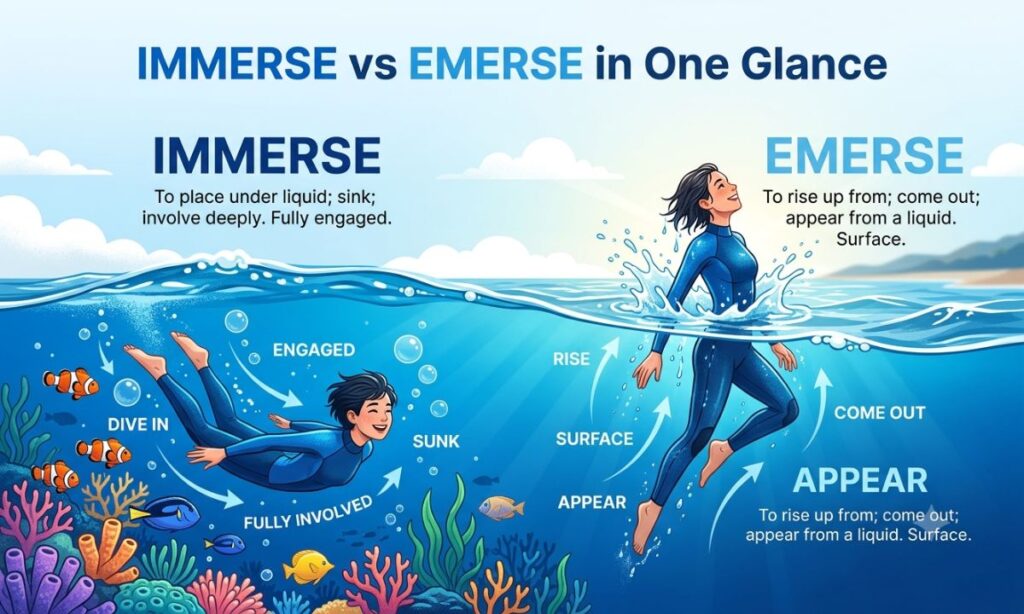
Here is the short version of Immerse vs Emerse before we go deeper.
- Immerse means to plunge fully into something, either physically (like water) or figuratively (like an activity, culture, or idea).
- Emerse means to rise above or stick out from the surface of water, usually used in botany and science.
In everyday writing, immerse is the word you want almost every time. Emerse is rare, technical, and easy to misuse. If you remember nothing else from this Immerse vs Emerse breakdown, remember this: when in doubt, choose immerse.
Read This: Outting or Outing (2026): Which Spelling Is Correct? + Examples
Side-by-Side Comparison: Immerse vs Emerse Meaning
Before exploring each word individually, it helps to see the Immerse vs Emerse comparison laid out clearly.
| Feature | Immerse | Emerse |
| Core meaning | To go into or be deeply involved | To rise above or stick out from water |
| Word type | Verb (very common) | Verb/adjective (rare) |
| Direction | Inward | Outward |
| Common usage | Everyday English, education, entertainment | Botany, biology, scientific writing |
| Frequency | Extremely high | Very low |
| Latin root | Immersus (plunged into) | Emersus (risen up) |
| Typical opposite | Emerge / surface | Submerge |
This table sums up most of what people need to know about Immerse vs Emerse, but the details behind each word matter just as much, especially if you want to use them with confidence.
What Does “Immerse” Mean?
The word “immerse” is a verb that means to submerge something completely in a liquid, or to involve someone deeply in an activity, environment, or idea. Think about dropping a sponge into a bowl of water. It sinks down and absorbs the liquid completely. That image captures the essence of immerse.
The word comes from the Latin “immersus,” where “im” means “into” and “mersus” means “dipped or plunged.” So at its root, immerse literally means to dip into something fully.
The Two Main Meanings of Immerse
When discussing Immerse vs Emerse, it helps to understand that immerse actually carries two related meanings depending on context.
Physical Meaning
The original and most literal meaning of immerse involves liquid. To immerse something means to put it completely under water or another fluid.
Examples include:
- Immerse the pasta in boiling water before cooking.
- The diver immersed her equipment in the lake to test it.
- She immersed the dirty cloth in soapy water.
In each case, the object goes fully under the surface. Nothing is left exposed.
Figurative Meaning (Most Common)
By the 1700s, English speakers began using immerse in a non physical sense, describing total mental or emotional involvement in something. This figurative meaning is now the most widely used version of the word.
Examples include:
- He immersed himself in his studies before the exam.
- She immersed herself in the local culture while traveling abroad.
- The students were immersed in a hands on science project.
In these sentences, nothing is literally wet. Instead, the person is fully focused, surrounded, or absorbed in an experience.
Why “Immerse” Is So Widely Used
Part of the reason the Immerse vs Emerse question even exists is because immerse shows up everywhere. It appears in education, technology, marketing, travel writing, and casual conversation. People talk about immersive learning, immersive games, and immersive experiences almost daily.
Immerse works so well because it paints a vivid picture. It suggests depth, focus, and full engagement, all in one short word. That versatility is exactly why immerse dominates modern English while its counterpart in the Immerse vs Emerse pairing remains largely unknown.
What Does “Emerse” Mean?
Now let’s flip the picture. The word “emerse” describes something that rises above, or sits partly above, the surface of water. It is essentially the opposite direction of immerse.
The Core Meaning
To emerse, or to be “emersed,” means to be positioned above the surface of a liquid, typically water, rather than being submerged beneath it. Where immerse pulls something down and in, emerse pushes something up and out.
This is one of the clearest ways to understand Immerse vs Emerse at a glance. Immerse goes down. Emerse comes up.
The word comes from the Latin “emersus,” meaning “risen up” or “come forth,” which itself comes from “emergere,” the same root that gives us “emerge.”
Scientific Context of “Emerse”
Unlike immerse, which is used everywhere, emerse mostly survives in scientific and botanical writing. In botany, plants growing in or near water are often described based on how much of them sits above the surface.
For example:
- A water lily with leaves floating above the pond is described as having emerse leaves.
- As water levels drop in a wetland, certain plant stems may become emerse, sticking out above the new surface line.
- Biologists studying aquatic ecosystems may note which species are emerse versus submerged.
In these technical contexts, emerse is precise and useful. It tells scientists exactly how a plant relates to the waterline without needing extra description.
Why Most Writers Rarely Use “Emerse”
If emerse is a real word with a clear meaning, why does almost nobody use it? The answer lies in habit and familiarity.
Most English speakers reach for “emerge” instead of “emerse” because emerge feels more natural and is far more common. “The submarine emerged from the water” sounds normal. “The submarine emersed from the water” sounds odd to most ears, even though both could technically work in certain contexts.
This is the heart of the Immerse vs Emerse confusion. People know immerse well, vaguely recognize emerse exists, but default to emerge because it is the word their brain reaches for first.
Immerse vs Emerse vs Emerge: The Real Source of Confusion
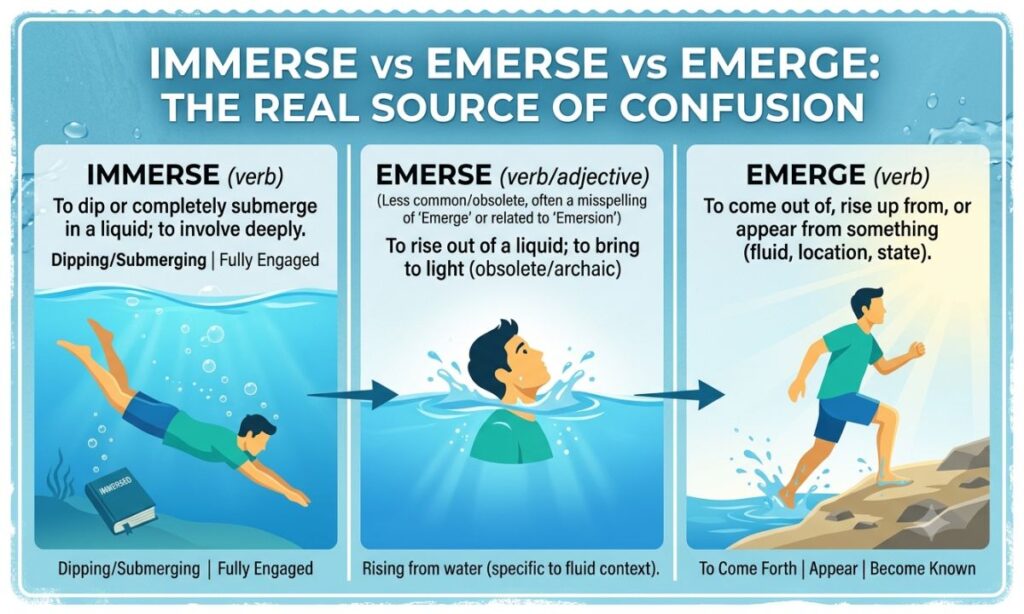
To fully solve the Immerse vs Emerse puzzle, we need to bring a third word into the picture: emerge. This word is the real troublemaker because it sounds close to both immerse and emerse, and it is the word most people actually mean to use.
Key Differences Explained Simply
Here is the simplest way to separate all three words:
- Immerse: to go fully into something (water, an activity, an idea).
- Emerse: to be positioned above or rise above a water surface (mostly scientific).
- Emerge: to come out, appear, or become visible (general, everyday word).
Notice that emerse and emerge share meaning territory, both involve coming out or becoming visible, but emerge is the common, everyday choice, while emerse is the rare, technical cousin.
Quick Comparison Table
| Word | Meaning | Direction | Common Context |
| Immerse | Go fully into | Inward/downward | Everyday, figurative, physical |
| Emerse | Rise above water surface | Outward/upward | Botany, biology |
| Emerge | Come out, appear | Outward | Everyday, general |
Why This Confusion Happens
The Immerse vs Emerse vs Emerge mix up happens for a few clear reasons:
- All three words share the Latin root “mergere,” meaning to dip or plunge, so they look and sound related.
- Immerse and emerse differ by only two letters, making typos easy.
- Emerse and emerge differ by only one letter at the end, making them easy to swap.
- Emerse is rarely seen in daily reading, so most people have no strong mental image of it, unlike immerse and emerge, which appear constantly.
Once you separate these three words mentally, the entire Immerse vs Emerse question becomes far less intimidating.
When to Use “Immerse” in Writing
Now that the meanings are clear, let’s talk about practical usage. In almost every situation, immerse is the word you want.
Use “Immerse” When You Want to:
- Describe full physical submersion in a liquid.
- Describe deep mental, emotional, or sensory involvement in an activity.
- Add depth and vividness to descriptions of learning, travel, work, or entertainment.
- Create an engaging, immersive tone in marketing or storytelling.
Common Real-Life Use Cases
Learning & Education
Education writers love immerse because it captures the idea of total engagement.
- Students who are immersed in a foreign language environment often learn faster.
- The history class immersed students in primary source documents from the era.
- Immersive learning programs place students directly into real world scenarios.
Entertainment
Gaming, movies, and virtual reality content rely heavily on this word.
- The new game lets players immerse themselves in a richly detailed fantasy world.
- Viewers were completely immersed in the film’s storyline within minutes.
- Virtual reality headsets aim to immerse users in lifelike digital environments.
Work & Productivity
Professional writing also benefits from this versatile term.
- She immersed herself in the project, blocking out every distraction.
- New employees are immersed in company culture during onboarding week.
- He stayed immersed in his research for hours without checking his phone.
Why It Works So Well
Immerse works because it instantly communicates depth without extra explanation. Saying someone is “immersed” in something tells the reader they are not just participating, they are fully absorbed. That single word does a lot of heavy lifting, which is why writers across every industry rely on it so often.
When to Use “Emerse” in Writing
Emerse is the rarer half of the Immerse vs Emerse pair, and its use cases are far more limited.
Use “Emerse” Only When:
- You are writing in a scientific, botanical, or biological context.
- You need to describe a plant or organism that sits above the water line.
- Precision matters more than familiarity, such as in academic papers or technical reports.
Typical Use Cases
Emerse appears almost exclusively in:
- Botany textbooks and plant identification guides.
- Ecology and wetland research papers.
- Aquatic biology discussions about plant structure.
Example Sentences
- The emerse leaves of the water lily catch sunlight more efficiently than the submerged stems.
- As the pond dried out, several plants became emerse that were previously underwater.
- Researchers classified the species based on its emerse and submerged growth patterns.
Simple Rule
If your writing has nothing to do with plants, water levels, or scientific classification, you almost certainly do not need emerse. In the Immerse vs Emerse decision tree, emerse is the exception, not the rule.
Common Mistakes in “Immerse vs Emerse” Usage
Even careful writers stumble here. Let’s look at the most frequent errors people make in the Immerse vs Emerse debate.
Mistake: Using “Emerse” Instead of “Emerge”
This is by far the most common mistake. Someone wants to say a person or object came out or appeared, but they type “emerse” instead of “emerge.”
Incorrect: New trends emersed during the meeting. Correct: New trends emerged during the meeting.
Why This Happens
This mix up happens because emerse and emerge look so similar in spelling, differing by just one letter. Since most people rarely encounter emerse in reading, their brain autocorrects toward the more familiar emerge, but sometimes the wrong spelling slips through anyway, especially when typing quickly.
Mistake: Overusing Rare Vocabulary
Another mistake is using emerse in casual or general writing just because it sounds sophisticated. While it might seem impressive, using emerse outside scientific contexts can confuse readers or make writing feel unnatural.
Quick Fix Tips
To avoid Immerse vs Emerse mistakes:
- If you mean “go into” or “be deeply involved,” use immerse.
- If you mean “come out” or “appear” in general writing, use emerge.
- Only use emerse if you are specifically discussing plants, water levels, or scientific classification.
- When unsure, search your sentence for the word “water.” If water is not involved and you are not writing science content, avoid emerse entirely.
Pronunciation Guide: Immerse vs Emerse
Part of the Immerse vs Emerse confusion comes from how similar these words sound out loud.
- Immerse is pronounced “ih MURS,” with the stress on the second syllable.
- Emerse is pronounced “ee MURS,” also with stress on the second syllable.
The difference comes down to that first vowel sound, “ih” versus “ee.” When spoken quickly or in a noisy environment, these sounds can blur together, especially since both words end in the same “merse” sound.
Practical Tip
If you are unsure which word someone said in conversation, context almost always tells you the answer. If they are talking about water plants or science, emerse may be intended. If they are talking about focus, culture, learning, or submerging something physically, immerse is almost certainly correct.
Memory Tricks to Never Confuse Them Again
Memory tricks are one of the fastest ways to permanently solve the Immerse vs Emerse problem.
Easy Mental Associations
- Im sounds like “in.” Immerse means to go IN.
- E at the start can remind you of “exit” or “emerge.” Emerse means to come OUT or sit above.
- Immerse rhymes with “converse,” both involve being deeply engaged.
- Emerse relates to “emersion,” which sounds like “emerging,” meaning to rise or appear.
Simple Analogy
Picture a swimming pool. When you jump in and disappear completely under the water, you are immersed. When part of your body, like your head and shoulders, sticks out above the surface while the rest stays underwater, that part of you is emerse.
Another way to think about it: immerse pulls you deeper into something, while emerse describes what is left showing above the line. Once this image sticks, the Immerse vs Emerse choice becomes automatic.
Real-World Examples That Make It Click
Sometimes seeing the words used side by side in everyday situations helps the Immerse vs Emerse difference click into place.
Example 1: Learning a Language
When someone moves to a new country and only speaks the local language at home, work, and with friends, they are immersed in that language. Every conversation, sign, and menu pushes them deeper into fluency. Nothing about this situation calls for the word emerse, since there is no water or plant involved, only deep involvement.
2: Cooking or Chemistry
In the kitchen, you might immerse vegetables in boiling water to blanch them, or immerse a thermometer in a pot to check temperature. In a chemistry lab, a sample might be immersed in a solution for testing. These are classic physical uses of immerse, fully submerging an object in liquid.
3: Aquatic Plants
Now picture a pond filled with water lilies. The roots and stems stay below the surface, fully submerged, while the broad leaves and flowers float and stick out above the water. Botanists would describe those floating leaves as emerse, since they sit above the surface while the rest of the plant remains underwater. This is the textbook scenario where emerse genuinely belongs.
Comparing these three examples side by side shows exactly why Immerse vs Emerse rarely overlaps in real writing. One word covers nearly everything, while the other covers a narrow, specific scientific situation.
Case Study: Why Most Writers Should Avoid “Emerse”
Let’s walk through a realistic scenario that shows how the Immerse vs Emerse mix up can affect everyday writing.
Scenario
Imagine a content writer working on a blog post about a new product launch. They write a sentence describing how customer feedback “emersed” after the product hit the market, intending to say that feedback appeared or surfaced.
Problem
Readers familiar with proper usage might pause, wondering if this is a typo for “emerged,” or if the writer meant something entirely different involving water or plants. Either way, the sentence creates a small but real moment of confusion, which can quietly hurt readability and trust.
Fix
The writer simply changes “emersed” to “emerged.” The sentence now reads naturally: “Customer feedback emerged quickly after the product hit the market.” No confusion, no awkward pause, no question marks in the reader’s mind.
Result
By avoiding emerse outside of scientific writing, the content stays clear, professional, and easy to read. This small example highlights the bigger lesson behind Immerse vs Emerse: precision matters, but so does choosing words your audience will instantly understand.
Is “Emerse” a Real Word?
This question comes up constantly in the Immerse vs Emerse discussion, and the answer is more nuanced than a simple yes or no.
Dictionary-Level Insight
Emerse does have a documented history and meaning, particularly in botanical and biological contexts, where it describes plant parts that rise above water. It is recognized in specialized references and scientific literature, even if it does not appear in everyday dictionaries as prominently as immerse.
Important Note
While emerse is technically a real word with a legitimate origin, it is considered rare and largely limited to technical fields. For general writing, blogging, business communication, and everyday conversation, emerse is not the word you need. Immerse and emerge cover almost every situation a typical writer will encounter.
So when someone asks whether emerse is real, the honest answer is yes, but reaching for it outside botany or biology will likely confuse more readers than it impresses.
Read This: Stellar vs Steller: Which Spelling Is Correct? (2026 Guide)
Frequently Asked Questions
What is the main difference between immerse and emerse?
Immerse means to go fully into something, while emerse means to rise above or sit partly above a water surface.
Is emerse the opposite of immerse?
Yes, in scientific contexts emerse describes the opposite position of immerse, above the surface versus below it.
Can I use emerse in everyday writing?
It is not recommended, since emerse is rare and mostly limited to botany and biology.
What word should I use if I mean “appeared” or “came out”?
Use “emerge,” not “emerse,” for general writing about something appearing or coming out.
Why do people confuse immerse, emerse, and emerge?
All three share the same Latin root and similar spelling, which makes them easy to mix up, especially since emerse is rarely seen in everyday reading.
Is “immersed” more common than “emersed”?
Yes, by a huge margin. Immersed is used constantly in education, entertainment, and daily conversation, while emersed mainly appears in scientific writing.
Reference Cambridge Dictionary Definitions
For readers who want a more formal definition, the Cambridge Dictionary defines immerse primarily around the idea of putting something completely into a liquid or becoming completely involved in an activity. This aligns closely with the figurative and physical meanings discussed throughout this guide.
Emerse, by contrast, does not appear as a standard entry in most general dictionaries, including Cambridge, which reflects just how rare and specialized the word truly is. Its closest dictionary relative, “emersion,” appears mainly in scientific and astronomical contexts, describing the act of coming into view after being hidden or submerged.
This gap between the two words in mainstream dictionaries reinforces the core takeaway of this entire Immerse vs Emerse guide: immerse is the everyday workhorse, while emerse remains a niche term reserved for very specific scientific writing.
Conclusion
The Immerse vs Emerse debate looks intimidating at first glance, but the solution is simpler than it seems. Immerse means to go fully into something, whether that is water, a culture, a book, or a project, and it works in almost every writing situation you will ever face. Emerse, on the other hand, describes something rising above a water surface and belongs almost exclusively in botany and biology.
If you remember just one thing from this guide, remember this: immerse goes in, emerse stays above, and emerge is usually the word you actually meant when emerse comes to mind. With that simple framework, the Immerse vs Emerse confusion that trips up so many writers will never trouble you again.