
Every day, thousands of writers, students, marketers, and professionals type a word they think is correct, only to discover later that it quietly undermined their credibility. That word is “ingage.” The confusion around ingage vs engage is more widespread than most people realize. It pops up in blog posts, social media captions, business emails, and even academic papers. If you have ever paused mid-sentence and wondered which spelling is right, you are in exactly the right place.
Here is the quick answer: engage is the correct, modern, dictionary-accepted word. “Ingage” is not a recognized word in any major English dictionary used today. But that one-line answer does not give you the full picture. Understanding why the confusion exists, when “ingage” might legitimately appear, and how to use “engage” with total confidence will make you a sharper, more authoritative communicator.
By the end of this guide, you will never second-guess yourself on ingage vs engage again.
Ingage vs Engage: When To Use Each One? What To Consider
Before diving into definitions, here is a fast-reference comparison table that captures the core difference between ingage vs engage:
| Feature | Ingage | Engage |
| Standard Dictionary Word | No | Yes |
| Accepted in Formal Writing | No | Yes |
| Historical Usage | Rare, archaic spelling | Active since the 1500s |
| Modern Usage | Misspelling or brand name | Universal across all contexts |
| Part of Speech | N/A (not standard) | Verb (primarily) |
| Synonyms | N/A | Involve, connect, attract, interact |
Now let us go deeper into each term individually.
Define Ingage
The word “ingage” is not listed as a valid entry in Merriam-Webster, the Oxford English Dictionary as a current term, Cambridge Dictionary, or any other leading modern reference. In practical terms, that means it does not exist as a proper word in contemporary English.
However, “ingage” does have a documented history. According to research into Middle English texts, “ingage” was an older, archaic spelling of what we now write as “engage.” It appeared in writing as far back as the 17th century. John Milton’s Paradise Lost, published in 1667, contains the word “ingaging” in one of its passages, which confirms that the spelling was once in circulation. That said, the English language standardized around “engage” centuries ago, and the older form simply faded out.
Today, “ingage” surfaces in two situations. First, it appears as a plain spelling error made by writers who are sounding out the word phonetically. The hard “g” sound at the start leads some people to write “in” before “gage,” producing “ingage” instead of “engage.” Second, it appears as a proper noun in brand names. There are companies and software platforms that use “Ingage” as their business name, deliberately choosing a creative spelling to stand out. In those cases, “Ingage” is a trademark, not a word.
Outside of those two scenarios, there is no reason to write “ingage” in any modern context. If you see it in a text that is not referencing a brand, it is almost certainly a mistake.
Key point on ingage vs engage: “Ingage” is either an archaic relic, a misspelling, or a brand name. It is never the correct choice in standard writing.
Define Engage
“Engage” is a fully recognized, widely used English verb with a rich history and a broad range of meanings. It traces its roots to the Old French word engagier, which carried the meaning of “to pledge” or “to bind by promise.” That French root combined en (meaning “in” or “into”) with gage (meaning a pledge or deposit). English speakers adopted the word around the 1520s, and over the following five centuries, its meaning expanded enormously.
Today, according to Oxford Learner’s Dictionaries and Merriam-Webster, “engage” carries several distinct meanings depending on context:
- To attract and hold attention — “The documentary engaged viewers from the first minute.”
- To involve or participate in something — “She chose to engage in the community discussion.”
- To hire or employ someone — “They engaged a legal firm to handle the case.”
- To interlock mechanically — “Pull the lever to engage the gears.”
- To enter into conflict with — “The battalion moved forward to engage the opposing forces.”
- To commit to a promise (archaic/formal) — “He engaged himself to complete the work by Friday.”
The word “engage” ranks among the 2,000 most commonly used verbs in modern written English. That level of frequency reflects how deeply embedded it is across industries, disciplines, and everyday communication. From marketing to military strategy, from classroom education to mechanical engineering, “engage” does the work that few other single words can.
When you are weighing ingage vs engage in any sentence, “engage” is the correct choice every single time in standard English writing.
Read This: Studder or Stutter: The Correct Spelling Everyone Gets Wrong
How To Properly Use The Words In A Sentence
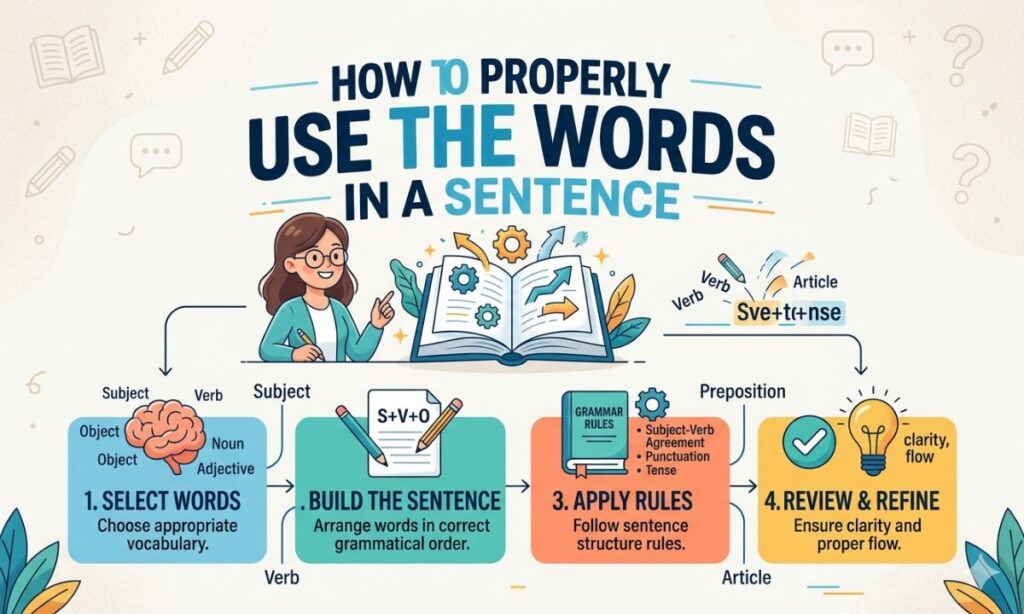
Understanding the theory behind ingage vs engage is helpful, but seeing the words in real sentences is where the learning truly sticks. Below are clear, practical examples of how each form appears in writing.
How To Use “Ingage” In A Sentence
Because “ingage” is not a standard word, your use of it should be minimal and purposeful. Here are the only situations where it might appear legitimately:
As a reference to an archaic text: “The 17th-century manuscript used the spelling ‘ingage’ rather than the modern form we recognize today.”
As a reference to a brand name: “The sales team is using the Ingage platform to create interactive presentations for clients.”
When discussing common spelling errors: “Many writers accidentally type ‘ingage’ when they intend to write ‘engage,’ especially when typing quickly.”
In every other scenario, “ingage” does not belong in a sentence. If your spell-checker underlines it in red, that is exactly the right response from the software.
How To Use “Engage” In A Sentence
“Engage” is versatile, and the way you use it will shift based on context. Here are clear examples across different uses:
Attract and hold attention: “The professor knew how to engage a room full of restless students.”
Participate or get involved: “Citizens are encouraged to engage with local government decisions.”
Hire or bring on board: “The startup decided to engage a marketing consultant for the product launch.”
Mechanical interlocking: “Press the button firmly until you hear the mechanism engage.”
Military context: “The commander gave orders to engage the approaching fleet at dawn.”
Business relationship: “Our brand needs to engage its audience more consistently on digital platforms.”
In each of these examples, “engage” carries a clear, purposeful meaning. That precision is what makes it one of the most valuable verbs in the English language, and why the ingage vs engage question always resolves in the same direction.
More Examples Of Ingage & Engage Used In Sentences
The more examples you see, the more natural the correct usage feels. Here is an extended collection to reinforce the difference in ingage vs engage once and for all.
Examples Of Using Ingage In A Sentence
These examples reflect the limited, legitimate contexts for “ingage”:
- “Historians studying Early Modern English often encounter the spelling ‘ingage’ in texts predating the 18th century.”
- “The company rebranded its platform as Ingage to signal a deeper approach to customer involvement.”
- “If you type ‘ingage’ in your word processor, most spell-checkers will flag it as incorrect immediately.”
- “The archive contained letters that used ‘ingage’ and other non-standard spellings common to that era.”
- “Do not confuse the software brand Ingage with the verb engage, which is an entirely different thing.”
Notice that in every sentence above, “ingage” is either being discussed as a word, quoted from an old source, or used as a brand name. It is never being used as a functioning verb in place of “engage.”
Examples Of Using Engage In A Sentence
Here are varied, real-world examples of “engage” used correctly across contexts:
- “The company launched a campaign to engage its online community through weekly live sessions.”
- “Effective teachers find creative ways to engage students who struggle with traditional learning.”
- “She decided to engage a nutritionist to help redesign her daily meals.”
- “The military unit received orders to engage the target only if fired upon first.”
- “Pressing the clutch pedal allows the driver to disengage and re-engage the transmission smoothly.”
- “The nonprofit works hard to engage volunteers from all age groups throughout the year.”
- “He was nervous about speaking publicly, but once he started, he found it easy to engage the crowd.”
- “Social media algorithms reward content that can engage audiences quickly within the first few seconds.”
Every one of these sentences uses “engage” naturally, accurately, and in a way that any reader would recognize. When the question is ingage vs engage, these are the patterns to follow.
Common Mistakes To Avoid: Engage vs Ingage
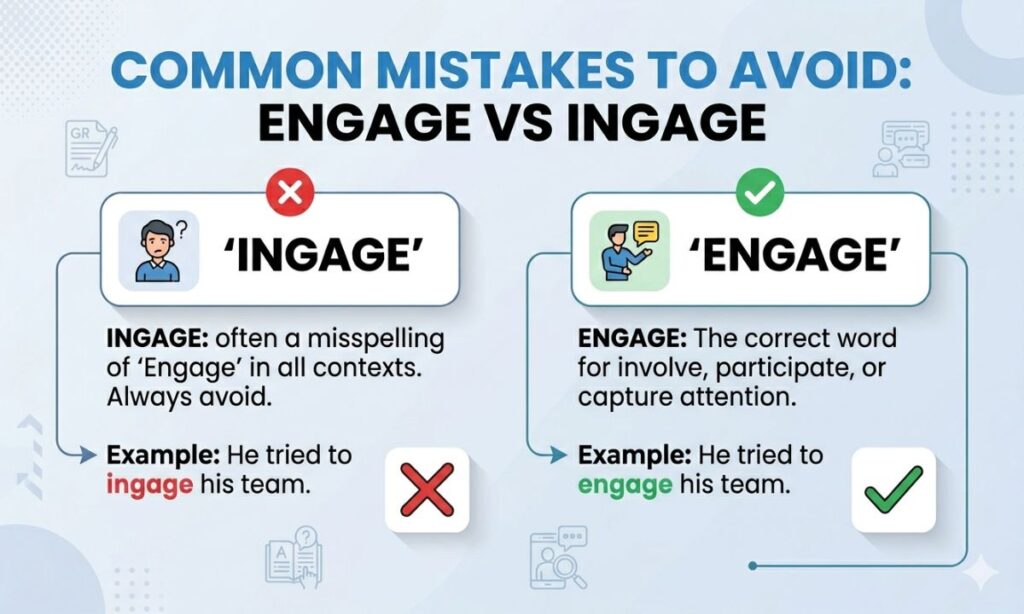
Knowing what to do is only half the battle. Knowing what not to do is equally important when it comes to ingage vs engage. Here are three common mistakes writers make and how to correct them.
Mistake #1: Using “Ingage” Instead Of “Engage”
This is the most frequent error in the ingage vs engage debate. Writers who type quickly or who rely on phonetic spelling sometimes produce “ingage” when they mean “engage.” The result is a word that does not exist in modern dictionaries, which makes the writer appear careless or poorly edited.
Wrong: “We need to ingage with our customers more effectively.” Right: “We need to engage with our customers more effectively.”
Wrong: “The teacher tried to ingage the class with a hands-on project.” Right: “The teacher tried to engage the class with a hands-on project.”
The fix is simple: slow down, proofread, and use a spell-checker. Whenever you see “ingage” in your own writing, treat it as a red flag and replace it with “engage” immediately.
Mistake #2: Using “Engage” In The Wrong Context
Even though “engage” is always the correct spelling, it can still be used awkwardly if placed in the wrong context. Because the word has multiple meanings, mismatching those meanings with the wrong situation creates confusing sentences.
Awkward: “She engaged the report thoroughly.” (This sounds mechanical and unnatural.) Better: “She engaged with the report thoroughly.” or “She studied the report thoroughly.”
Awkward: “The gears engaged the audience during the presentation.” (Confusing mechanical and social meanings.) Better: “The speaker engaged the audience during the presentation.”
Context awareness is just as important as spelling when it comes to ingage vs engage.
Mistake #3: Overusing “Engage”
“Engage” is such a flexible word that it is easy to lean on it too heavily. When it appears too often in a single piece of writing, the text starts to feel repetitive and dull. Thoughtful writers rotate between synonyms to keep their language fresh.
Overused: “We need to engage customers, engage employees, and engage partners through every channel we can to engage the wider community.”
Improved: “We need to connect with customers, motivate employees, and build relationships with partners to reach the broader community.”
Strong synonyms for “engage” include: involve, connect, attract, captivate, interact, participate, collaborate, recruit, and draw in. Cycling through these options keeps your writing energetic and your readers alert.
Context Matters
One of the most practical lessons in the ingage vs engage discussion is that context shapes how “engage” should be used, and what level of formality fits the situation. The word works differently depending on the setting, the audience, and the purpose of the communication.
Examples Of Different Contexts
Here is a breakdown of how “engage” operates across four major fields:
Marketing
In marketing, “engage” describes the relationship between a brand and its target audience. It covers everything from social media interaction to content strategy to customer retention.
When marketers talk about engagement, they typically mean measurable actions such as likes, comments, shares, email opens, or purchases. High engagement signals that an audience is connecting with a brand on a meaningful level.
Example: “The campaign was designed to engage first-time visitors and convert them into loyal buyers over a 90-day period.”
Some marketers have also borrowed the informal “ingage” spelling to describe a deeper, relationship-focused type of involvement, positioning it as going beyond surface-level engagement. However, this is niche industry jargon and not standard usage. In professional marketing copy, “engage” remains the correct and expected choice in any discussion of ingage vs engage.
Education
In education, “engage” is one of the most important words in the professional vocabulary. Effective teaching depends on a teacher’s ability to engage students, meaning to capture their attention, maintain their interest, and encourage active participation.
Research in educational psychology consistently shows that engaged students retain information better, perform higher on assessments, and develop stronger critical thinking skills.
Example: “The new curriculum was restructured specifically to engage students who had previously shown low levels of participation.”
Teachers, administrators, and curriculum designers all rely on “engage” as a core concept. If you work in education, you will use this word constantly, and you will never need to reach for “ingage.”
Business
In the business world, “engage” appears across human resources, client relations, project management, and leadership communication. Companies talk about employee engagement, client engagement strategies, and stakeholder engagement plans.
The idea is that engaged employees are more productive, engaged clients are more loyal, and engaged stakeholders are more supportive of organizational goals.
Example: “The HR team launched a new initiative to engage remote workers who had reported feeling disconnected since the shift to hybrid schedules.”
In all of these professional conversations about ingage vs engage, “engage” is the accepted standard without exception.
Exceptions To The Rules
While the general rule on ingage vs engage is clear and straightforward, there are a handful of situations where the picture gets slightly more nuanced. Understanding these exceptions will make you an even more informed communicator.
Technical Terminology
In mechanical and engineering contexts, “engage” takes on a very specific meaning related to the interlocking of parts. When gears engage, they mesh together and begin transferring motion. When a clutch engages, it connects the engine to the drivetrain.
This technical use is fully standard and recognized. There is no competing form or ambiguity here: “engage” is always the correct word in mechanical contexts.
Regional Differences
Unlike many English words that vary between American and British spelling (such as “color” vs “colour”), “engage” does not change based on region. Both American English and British English use the same spelling. There is no variant spelling that is accepted in one dialect but not another.
This means that no matter where in the world you are writing, “engage” is universally correct. “Ingage” is not a regional spelling. It is simply incorrect in all modern English dialects.
Creative Writing
Creative writing gives writers more freedom to experiment with language, including inventing words, using archaic forms, or deliberately misspelling for stylistic effect. A novelist writing a story set in the 1600s might choose to use “ingage” in dialogue to signal the historical period authentically.
Outside of historical fiction or deliberate stylistic choices, however, creative writers should still default to “engage.” Using “ingage” as a mistake in a published novel or story would undermine the author’s credibility with attentive readers.
Brand Names
As mentioned earlier, there are companies and software products that use “Ingage” as a registered trademark. In these cases, the capitalized form “Ingage” is a proper noun and must be spelled exactly as the brand uses it.
If you are writing content that references such a brand, use their official spelling. If you are writing about the concept of engaging an audience or connecting with customers, use “engage.” That distinction keeps the ingage vs engage question clean and unambiguous.
Practice Exercises
The best way to lock in your understanding of ingage vs engage is through practice. Complete these exercises to test and reinforce what you have learned.
Exercise 1: Fill In The Blank
Choose the correct word (ingage or engage) to complete each sentence. Answers follow at the bottom.
- “The new employee handbook was redesigned to ________ workers more effectively.”
- “I found an old letter that used the spelling ‘________’ rather than the modern version.”
- “Social media managers work daily to ________ their brand’s online community.”
- “Please do not ________ the safety mechanism unless there is an actual emergency.”
- “The company chose to name its software platform ‘________’ to reflect its focus on deep customer involvement.”
- “Good speakers know how to ________ an audience within the first 60 seconds.”
- “Our goal is to ________ at least 500 new subscribers this quarter through targeted content.”
Answers:
- engage
- ingage (referencing an archaic spelling)
- engage
- engage
- Ingage (brand name context)
- engage
- engage
Read This: Convertor vs Converter: Which Spelling Is Correct?
Exercise 2: Sentence Rewrites
Each sentence below contains an error related to ingage vs engage. Rewrite each sentence correctly and, where possible, improve the vocabulary.
Original: “We need to ingage with the community to build trust.” Rewritten: “We need to engage with the community to build trust.”
Original: “The brand tried to ingage younger demographics through short video content.” Rewritten: “The brand tried to engage younger demographics through short video content.”
Original: “She ingaged a lawyer to review the contract before signing.” Rewritten: “She engaged a lawyer to review the contract before signing.”
Original: “Engage, engage, engage. We must engage customers, engage staff, and engage stakeholders every single day.” Rewritten: “We must connect with customers, motivate our staff, and build meaningful relationships with stakeholders every day.”
Notice how the final rewrite not only fixes the spelling issue from ingage vs engage but also removes the repetitive overuse that weakens the writing.
Conclusion
The debate around ingage vs engage always reaches the same conclusion: “engage” is the word to use. It is dictionary-verified, universally recognized, and appropriate in every professional, academic, and creative context you will encounter. “Ingage” is not a valid word for modern writing. It is a historical relic, a phonetic misspelling, or in rare cases, a proper noun used by specific brands.
Understanding this distinction is not just about avoiding a typo. It is about communicating with precision and authority. When your writing is accurate, your reader trusts you more. That trust is the foundation of every effective blog post, business email, social media caption, and academic essay you will ever produce.
The rule is simple: whenever you pause and wonder about ingage vs engage, choose “engage.” It is correct, clear, and credible. Every time, without exception.